
Ted Wells Report: Future With Dolphins
Since the Ted Wells Report was released, the Richie Incognito–Jonathan Martin controversy has returned to the forefront of sports talk radio and hundreds of sports blogs and columns. In addition to those two, Dolphins guard John Jerry and their Pro Bowl center Mike Pouncey seem to be equally implicated as part of the bullying that allegedly went on. It seems that everybody has to weigh in on what this means to the modern NFL locker room, and has somehow been paired with the other big NFL story, the acceptance of Michael Sam into the NFL.
These stories are plenty important, but what they are replacing is the normal NFL offseason chatter about who is going where and what team is looking at which player. Until some semblance of a contract materializes for Incognito or Jerry, or a trade happens for Martin, these players are only important as it pertains to the Wells Report. However, all four have been seriously hurt in terms of their football stock.
Dolphins’ owner Stephen Ross has been open in that he believes it is unlikely that either Incognito or Martin will return to the team in 2014, though the club does own Martin’s rights. The second-round pick out of Stanford still may have some value, writes Darrin Gantt of Pro Football Talk, since he is still a cheap option at right tackle. James Walker of ESPN.com writes of Martin: “He’s young, cheap and can play left and right tackle. Those players do not grow on trees.” Walker also notes that because other teams know that the Dolphins will release him Martin they cannot trade him, that does significantly lower his trade value.
Former coach Jim Harbaugh was an avid defender of Martin, which may prompt speculation that San Francisco could be a destination. However, the 49ers are set at tackle, with Joe Staley and Anthony Davis on each side. The Colts also have that connection, with Pep Hamilton and a number of former Stanford players there. Of course, they also have a lot of money already invested in tackle play, with Anthony Castonzo and Gosder Cherilus.
Incognito and Jerry are both free agents, making them easy decisions for the Dolphins — both will most likely be let go. Incognito was probably set for a pretty large contract extension with the Dolphins, due to his high level of play and status as a “leader” in the team’s locker room. Now, his value is minimal. He didn’t make many friends with the Rams before he joined the Dolphins, so he does not have a lot of coaching staffs to fall back on. The Raiders’ offensive coordinator Greg Olsen could put a good word in for him, as the Raiders are in need of offensive line help.
Vinnie Iyer of SportingNews.com does note that in the landscape of the modern NFL, Incognito has a better chance of being accepted into another locker room than Martin. “Incognito doesn’t come out of the investigation looking like Mr. Nice Guy, but he hasn’t tried to. There’s a reason his mean streak is one of his biggest assets as a player,” Iyer writes. “For teams needy of interior line help, such as the Buffalo Bills, Indianapolis Colts or San Diego Chargers, he’s Mr. Nice Price.”
Jerry was also a candidate to be retained by the Dolphins before being implicated in the Wells Report, but his return is now unlikely, writes Charlie McCarthy of Fox Sports Florida. Jerry doesn’t have the history of performance that Incognito did. What he does have in his favor is a far less noticeable role in the bullying of Martin, but still he will find it difficult to sign a deal similar to one he could have had with the Dolphins had he not been implicated. Both Incognito and Jerry’s free agency could be further hurt if the league decides to suspend them for a few games during the 2014 season.
Finally, there is Pouncey, who despite his age, might be the most accomplished of the four, and definitely has the brightest future. Much like Jerry, he is able to downplay his role in the bullying, but unlike Jerry he is under contract for 2014. Also unlike Jerry, he has performed on the field as one of top lineman at his position over his short career thus far, reaching the Pro Bowl this past year. Still, a week ago James Walker of ESPN.com listed Pouncey as one of the players on the Dolphins who has outperformed his contract and is deserving of a raise. After his name became involved in the Wells Report, and with a looming suspension possible, that raise seems highly unlikely.
Free Agent Stock Watch: Hakeem Nicks
When looking at the landscape of free agent receivers, Eric Decker has separated himself in the eyes of general managers as the top pass catcher on the market. Our own Luke Adams wrote about Decker’s spot as the top free agent receiver earlier this month, noting that the only receivers on the market who can even come close to his production are Anquan Boldin and Julian Edelman. However, Decker was not always the clear cut big name receiver teams were looking. Last summer, Hakeem Nicks was thought to be the guy who would command the most free agent dollars this offseason.
Unlike Decker, Nicks is coming off his worst season as a pro in his contract year. He caught only 56 passes, totaling 896 yards, and very notably finished the season without a touchdown. He spent the season alternating between looking disinterested and expressing his discontent. The New York media started raking him over the coals due to his effort level about halfway through the Giants’ 0-6 start, declared him a malcontent and seemed to close the door on his tenure with the team by midseason. Trade rumors began to swirl, first with the Giants looking for a second-round pick in return. By the trade deadline, the media was wondering if the Giants could even expect a fourth-round pick in return. All in all, 2013 fell short of expectations for Nicks to say the least.
While Nicks cost himself a ton of money with a down 2013, teams interested in acquiring a number one caliber receiver for a cheap price could be enamored with the 26-year-old. Coming into last season the only knock on Nicks was his durability, as he had trouble staying on the field for Big Blue and often when he was on the field, he was playing at less than 100%. Shoulder, ankle, and knee injuries nagged him throughout the 2011 and 2012 seasons. When teammate Victor Cruz signed his extension last offseason, the sentiment was for Nicks to prove he can stay healthy and his deal would follow. Nicks was mostly healthy last year, but to no avail.
For teams interested in finding a talented receiver in free agency, long-term memory may have them leaning toward Nicks. It feels like forever ago, but in 2010, Nicks caught 79 balls, for 1,052 yards and a whopping 11 touchdowns in 12 starts. He followed that up with 76 catches for 1,192 yards and seven more touchdowns in 15 games in 2011. His most impressive stretch came during the Giants’ Super Bowl run, where he was the team’s most dominant offensive player, putting impressive numbers as he propelled the Giants to victory:
- Wild Card Round vs. Falcons – six catches, 115 yards, two touchdowns
- Divisional Round at Packers – seven catches, 165 yards, two touchdowns
- NFC Championship at 49ers – five catches, 55 yards (left with shoulder injury)
- Super Bowl vs. Patriots – ten catches, 109 yards
Had he reached free agency that offseason, his value would be much different. An injury-plagued 2012 season leading into this past year has dimmed the light shining on a player who was recently thought of as one of the top young playmakers in the NFL. Nicks is unlikely to re-sign with the Giants, even at a reduced rate, although Cruz has pushed for him to return. He may find himself on a one-year “prove it” deal with some team. Brad Wells of StampedeBlue.com believes the Colts could be able to lure him in on a one-year, $2.2MM deal.
Andrew Cohen of OverTheCap.com broke down the wide receiver market earlier this month, he saw Nicks as still deserving of a bigger contract. Cohen predicted Nicks to the Lions on a three-year, $30MM deal with about $13MM in guaranteed money. The thinking behind this was that the Lions are ready to win now, and positioning a star like Nick across from Calvin Johnson could take the offense to new heights. If Nicks was willing to take a smaller deal, Cam Newton and the Panthers are in desperate need of a bigger receiver, and the North Carolina product might consider his hometown if the market didn’t present a more lucrative option.
While his durability and effort level have provided serious red flags to his pending free agency, there should be some team out there with money to spend on potential. The draft will provide teams with a number of options at receiver, as it is supposed to be a deep class highlighted by Sammy Watkins of Clemson, Mike Evans of Texas A&M, and Marquise Lee of USC, all three of which are expected to be drafted in the first round.
Nicks is a 6’1″, 208-pound wideout, with impressive speed and playmaking ability. At 26 years old, and with the numbers he put up only a few years ago, he could command more money than most expect in a year where the other top free agent options are Decker and Boldin. While some may think Decker is a number two wideout about to be paid like a number one, Nicks is the buy-low option, where a team can pay him like a number two and hold out hope that he produces like the number one option he was in 2010 and 2011.
Minimum Salary
The NFL salary cap is expected to exceed $126MM in the 2014 season, and while that figure gives teams a good deal of spending flexibility, each and every club will still have to fill out the back of its roster with players earning minimum salaries. The amount of that minimum salary varies from player to player, depending on service time. A veteran with 10 or more years of NFL experience is eligible for a minimum salary that more than doubles a rookie’s minimum salary.
For the 2014 season, the minimum base salary for a rookie will be worth $420K, while a veteran of 10+ years will earn $955K on a minimum salary. However, those figures are on the rise with each passing year, increasing annually by $15K. Here’s a breakdown of what the NFL’s minimum salaries will look like from the 2013 season through 2020 (dollar amounts in thousands):
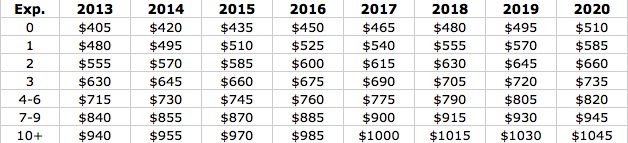
Hypothetically, let’s suppose that when free agency opens next month, a player with three years of experience signs a two-year contract worth the minimum salary, with no signing bonus. His salary for the first year of the deal would be $645K, the 2014 amount for a player with three years of experience. The second year would check in at $745K, the 2015 figure for a player with four years of experience.
Players on minimum base salaries can still receive various kinds of bonuses, but those will count toward the player’s cap number, so teams are generally reluctant to include significant signing bonuses on minimum salary contracts.
As for that cap number, a team can avoid having a veteran player’s full minimum salary count against the cap by signing him to a qualifying contract. The league’s Minimum Salary Benefit Rule ensures that, for a player with four or more years of experience, his cap hit on a minimum salary contract will only be equal to the cap number for a minimum-salary player with two years of experience — for 2014, that figure is $570K. To qualify for this reduced cap number, the contract must be for no more than one year, and the bonus money cannot exceed $65K (this maximum bonus increases by $15K every three years).
In other words, let’s say a player with nine years of experience signs a one-year, minimum-salary contract with the Cowboys for the 2014 season. The deal also includes a signing bonus of $30K. While that player would earn a total salary of $885K (a base minimum of $855K plus the $30K bonus), the cap hit for Dallas would only be $600K — the $570K minimum, plus the $30K bonus. This rule ensures that teams won’t necessarily opt to sign young players over veterans in an effort to minimize cap charges.
While a player can sign a contract with a team and spend a full season with the franchise, that doesn’t necessarily earn him a credited season for minimum salary purposes. A player must be on a club’s 53-man roster for at least three weeks in order to earn a credited season. So if a rookie spends three games on a team’s 53-man roster, and then is cut, he’ll be considered to have one year of experience the following season, even if he didn’t appear in a single game. However, if a player spends two games on a team’s 53-man roster, then is placed on injured reserve, that’s not a credited season.
Players on injured reserve may also not earn their full minimum salaries. The contracts for many young players and veterans with injury histories include what is known as a split salary, so that if the player is placed on injured reserve, his salary is reduced to an IR minimum. Here’s the breakdown of what those minimum salary figures look like for the next several years:
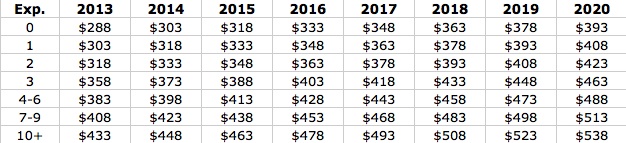
While there are plenty of rules and guidelines surrounding minimum salary contracts, the NFL’s Collective Bargaining Agreement doesn’t include a limit on what a player can earn a season. A team must fit its full roster under the salary cap, which is why we typically don’t see annual salaries larger than $20-25MM. But with no defined maximum salary in place, an NFL team could, in theory at least, pay a player for double or triple that amount, assuming that player was surrounded by a few dozen teammates on minimum salaries.
Note: This is a PFR Glossary entry. Our glossary posts will explain specific rules relating to free agency, trades, or other aspects of the NFL’s Collective Bargaining Agreement. Information from OverTheCap.com was used in the creation of this post.
Free Agent Market For Running Backs
In recent years, many NFL teams have moved away from an offensive game plan that predominantly involves one feature back, instead choosing to rotate two or three backs in and out of the lineup. Several of the league’s most dangerous offenses over the last few seasons, including those in New England and New Orleans, have relied on multiple backs, without any one player racking up huge yardage.
That’s not to say that there aren’t still running backs capable of carrying the ball 300+ times in a season, but the position has increasingly become one that teams feel they can fill without landing a big-name player. No running backs are expected to be selected in the first round of this year’s draft, and the one major trade for a back consummated during the 2013 season (the Colts giving up a 2014 first-round pick for Trent Richardson) turned into something of a cautionary tale when Richardson struggled to produce in Indianapolis.
Nonetheless, teams still need to fill the position somehow, and with many intriguing players set to hit free agency this offseason, it could be a buyer’s market for running backs. The Broncos, Raiders, Patriots, Jaguars, Colts, and Giants are among the teams whose most productive backs are pending free agents, while the list of other clubs who could explore upgrades at the position includes the Dolphins, Browns, Titans, and Falcons. Here’s a breakdown of which players might be on their shopping lists:
First tier:
Maurice Jones-Drew and Darren McFadden are perhaps the most noteworthy names in this year’s group — MJD led the league in rushing as recently as the 2011 season, and McFadden is a former fourth overall pick and is still just 26 years old. Still, both players had disappointing walk years, with injuries playing a role in both cases. That’s a familiar theme for McFadden, who has never played a full season, and it’s also becoming increasingly common for Jones-Drew, who appeared in just six 2012 games before being plagued by nagging injuries in 2013. Both players offer tantalizing upside and should still have something left in the tank, but they’ll need to be paired with solid second and third options in order to keep their workloads in check.
Rashad Jennings, MJD’s former backup in Jacksonville and McFadden’s replacement in Oakland for much of the 2013 season, averaged 4.5 yards per carry and filled in admirably for McFadden with the Raiders. While he may not be relied upon to be a No. 1 back, he’d make an excellent No. 2. The same could be said for Joique Bell, who had an excellent season in Detroit sharing backfield duties with Reggie Bush. Among this year’s free agent backs, none ranked higher according to Pro Football Focus’ metrics than Bell (ninth), though he’ll be a restricted FA and has conveyed a strong desire to re-sign with the Lions.
LeGarrette Blount, Knowshon Moreno, and Donald Brown weren’t expected to carry the loads for their respective clubs when the 2013 season opened, but by January, they were the No. 1 backs for three of the AFC’s top four teams. None of them are older than 27, so they should do well on the open market, though their potential earnings vary. I expect Moreno, who has the strongest career resumé overall, to land the biggest contract of the three, while Brown will likely sign the most modest deal. Brown only assumed the top role in Indianapolis due to Ahmad Bradshaw‘s neck injury and Richardson’s ineffectiveness, and is likely to return to No. 2 duties wherever he ends up in 2014.
Finally, while he’s not currently eligible for free agency in 2014, Chris Johnson is very likely to be released by the Titans. Johnson’s production has certainly slowed down since he rushed for over 2000 yards in 2009, but he has still recorded six consecutive seasons of 1000+ rushing yards since entering the league, and could benefit from a change of scenery.
Second tier:
Injuries in 2013 limited the likelihood of Ben Tate or Andre Brown landing big contracts this offseason, but both players have the potential to match or surpass the production of any of the running backs listed among the first-tier options. Although Tate has been stuck behind Arian Foster in Houston for the last several seasons, he’s believed to have the talent to be an NFL starter, and could get that opportunity in 2014, depending on where he lands. Brown, meanwhile, has flashed a ton of promise during the last two seasons with the Giants, but didn’t take full advantage of his opportunity to start in 2013, averaging just 3.5 yards per carry on 139 attempts.
While Tate and Brown are still fairly young, with their best years potentially ahead of them, many of the other names in this group will draw interest because of performances in years past. Rashard Mendenhall and Peyton Hillis had their best seasons in 2010, but were seeing significant action up until last year, and should be able to land backup roles. Meanwhile, Willis McGahee started six games in 2013 for the Browns, and turned in a career-worst 2.7 yards per carry. That performance could make it an uphill battle to land a backup role in 2014, but considering McGahee reportedly wants to play for several more seasons, he at least believes he has something left in the tank.
James Starks should also draw interest in a part-time role, as he’s coming off the best season of his four-year career, averaging 5.5 yards per carry and racking up nearly 500 rushing yards for the Packers.
The rest:
Every year, we see non-descript backs take advantage of openings created by injuries or poor performance, so it’s likely that at least one or two names in this group will make some noise next season. The rest of the names on the 2014 free agent list include longtime backups like Anthony Dixon and Toby Gerhart, who have been stuck behind Frank Gore and Adrian Peterson respectively for the last several seasons.
There are also former starters such as Ronnie Brown, Felix Jones, and Bradshaw, who aren’t likely to return to a starting role anytime soon. Throw in solid part-timers such as Jonathan Dwyer and Jackie Battle, and return specialists like Leon Washington, and there should be plenty of options available on the free agent market for teams who don’t want to use draft picks to fill out their backfields.
Previously:
Free Agent Market For Quarterbacks
Reserve/Futures Contracts
2014’s free agent period doesn’t officially get underway for another month, but NFL teams have announced new roster additions nearly every day as of late. Players signing contracts now are inking deals that are known as reserve or futures deals. What exactly does that mean? Here’s a quick breakdown:
Reserve/futures contracts essentially function like regular free agent deals, except that only players who didn’t finish the previous season on an NFL team’s active roster can sign them. So a player on a practice squad could ink a futures contract, and many have in recent weeks. After the Super Bowl, for instance, we saw the Broncos and Seahawks lock up each and every player on their respective practice squads, allowing those teams to continue working with those players leading up to the 2014 season.
These deals are known as “futures” contracts because they don’t technically go into effect until the 2014 league year begins on March 11. So signing a player to a futures contract now will not have an impact on a team’s 2013 cap. As for the 2014 books, players on reserve/futures deals are counted toward a club’s cap if they’re among the top 51 highest-paid players on the roster. Often, that’s not the case though, and those players simply count toward a team’s 90-man offseason roster limit.
Players on futures contracts don’t frequently rank among a team’s 51 highest-paid contracts because they’re generally on minimum salaries. There’s no rule that says futures deals can only be worth the minimum or can’t include signing bonuses, but because these players weren’t previously on NFL rosters, they generally don’t have a ton of leverage. As Brian McIntyre notes (via Twitter), only 19 of 374 futures contracts signed since the regular season ended include any sort of guaranteed money, with former CFLer Henoc Muamba receiving the largest guarantee — $107K from the Colts.
We’re only a few more weeks away from 2014’s full free agent class hitting the open market, but in the meantime, we’ll likely see plenty more futures contracts inked. Nick Mensio of Rotoworld.com has been staying on top of these deals throughout the offseason, so to track the players currently on reserve/futures deals, be sure to check out his complete list.
Note: This is a PFR Glossary entry. Our glossary posts will explain specific rules relating to free agency, trades, or other aspects of the NFL’s Collective Bargaining Agreement. Information from Joel Corry, Steeler Addicts, and Bleacher Report was used in the creation of this post.
PFR Originals: 2/3/14 – 2/9/14
On our first Sunday without any football, here’s original content posted by the Pro Football Rumors staff from this past week to ease you through the offseason blues…
- The NFL’s new agreement with CBS will not only affect which channel you watch each Thursday but also the league’s revenue and, vicariously, the league’s salary cap.
- Using Larry Fitzgerald‘s new extension as context, an explanation of how teams restructure contracts.
- An analysis of Eric Decker‘s value in free agency.
- A look at Michael Vick, Josh McCown and the other top free agent quarterbacks.
- A guide to following individual players on Pro Football Rumors.
- One poll asking which of the Seahawks‘ free agents the team should prioritize re-signing and another poll asking who the champs should play in next season’s opener.
Free Agent Market For Quarterbacks
Matt Cassel‘s decision to void the remaining year of his contract may not have been earth-shattering news by NFL standards, but it could have a sizable impact on 2014’s class of free agent quarterbacks. Since teams rarely let reliable starting quarterbacks reach free agency, the options on the open market will be limited, but there still could be a few players capable of competing for starting jobs, and several more who would make solid backups.
The Jaguars, Texans, Browns, Vikings, Buccaneers, and Raiders are among the teams expected to seek a starter this offseason, and many more clubs could have interest in a solid backup. Here are the quarterbacks eligible for free agency who will receive consideration from those franchises in the market for a QB:
First tier:
Michael Vick is the most notable name in this year’s quarterback class, and will be looking to land a starting job somewhere. In fact, he recently expressed confidence that, wherever he ends up, he’ll be the starter in Week 1. That’s certainly possible — Vick didn’t play poorly before his injury, but Nick Foles‘ performance was so impressive that Vick didn’t get another crack at the starter’s job in Philadelphia. He figures to at least get a chance to compete for a No. 1 role in 2014, and is the early favorite to sign for the largest salary of 2014’s FA QBs.
While Vick began 2013 as a starter and finished it on the bench, a few other free-agents-to-be worked in reverse. After other signal-callers were injured or underperformed, Chad Henne and Matt Cassel ultimately took over the No. 1 jobs in Jacksonville and Minnesota respectively, and while they didn’t set the league on fire, both veterans performed well, given their relative dearth of weapons. The Jags and Vikings both figure to be in the market for younger QBs with higher upsides, but each team could bring back its respective incumbent to act as the short-term starter or at least to provide an insurance policy.
Although Josh McCown didn’t finish the season as the Bears’ starter, he filled in admirably when Jay Cutler missed a few games due to injury. He’ll be 35 in July, so no team will pencil in McCown as any sort of long-term answer, but his 13-to-1 TD-to-INT ratio last season pushes him above most of the rest of the backup alternatives.
Second tier:
The shine has come off Matt Flynn and Josh Freeman significantly over the last couple years, with Flynn seemingly unable to produce with any team besides the Packers and Freeman drastically regressing since his breakout season in 2010. Still, both players are still in their 20s and have bounce-back potential in the right system. Neither player should begin 2014 as a starter, but you could find worse No. 2 options.
Speaking of No. 2 options, there are several of those set to hit the open market next month. Shaun Hill, Kellen Clemens, Charlie Whitehurst, Tarvaris Jackson, Colt McCoy, Curtis Painter, and Luke McCown are among the backups eligible for unrestricted free agency. We could see many of those players return to their current teams, given their familiarity with those clubs’ offensive systems. Either way, they’ll sign very modest deals, and none of them should be counted on for significant playing time — even Clemens, who ended up starting more than half of the Rams’ 2013 contests after Sam Bradford went down.
The rest:
Perhaps there’s a diamond in the rough among the rest of the group, which includes familiar names like Brady Quinn, Seneca Wallace, Rex Grossman, and Jimmy Clausen. More likely though, these guys will be looking to catch on as a team’s third quarterback.
Overall, there are some interesting names among the prospective free agent quarterbacks. But unless a team unexpectedly strikes gold with a reclamation project like Freeman, there won’t be any cornerstone players in the group. Clubs looking for a solid veteran who could keep a team afloat if its starter goes down should have several options to consider among this free agent class, but teams in search of a longer-term answer will be better off addressing that need in the draft, or perhaps via trade.
The New TV Deal And The Salary Cap
Earlier today, the NFL announced an agreement with CBS that will see the network produce 2014’s Thursday Night Football games, with half of those broadcasts moving over to CBS from the NFL Network. Most fans will only notice the immediate impact of the agreement based on what channel they tune into each Thursday, but in the longer term, the additional revenue created by the deal will significantly affect the salary cap, creating a bump in spending power for NFL teams, write Mike Florio of Pro Football Talk.
While the exact numbers have not yet been released, Florio estimates that the deal could be in the area of $300MM, and after factoring the loss of advertisement revenue (since the NFL will no longer be the sole provider carrying these games), he believes that the NFL may see a net gain of approximately $250MM. Because the salary cap is calculated based on the previous year’s revenue, the new arrangement will not affect the 2014 cap number. That being said, NFL franchises may have an extra $4MM to work with in 2015.
Having an extra $4MM to work with down the road could be a huge advantage for general managers in tight cap situations this offseason. The Super Bowl champion Seahawks, who are thinking about an extension for Earl Thomas, and eventually Richard Sherman and Russell Wilson, may be able to push some more money for their stars into the future during negotiations this offseason. That way, they could leave room under the cap this year to re-sign key players such as Michael Bennett or Golden Tate, as the team looks to make another run at a championship.
The 49ers are in a similar situation, as they believe their window to win a championship is now. While they talk with Colin Kaepernick about an extension that will certainly pay him like a franchise quarterback, they may be able to keep short-term cap space available for their own free agents.
Another option available to a team looking to improve its roster is the restructuring of veteran contracts. While restructuring is often viewed as a great short-term tool, it can be crippling to a team’s cap situation down the road, as is the case now in Carolina, where the Panthers are trying to find a way to re-sign Greg Hardy despite the dead money already on the cap in 2014. Additional future cap space could alleviate these concerns to a certain extent. One huge restructure has already occurred this offseason, as Larry Fitzgerald and the Cardinals have agreed on a new deal that will benefit both parties. Fitzgerald’s restructured contract will open up $9.4MM of spending money for the Cardinals during this offseason, while it will add an additional $2.35MM each of the next four years. An extra $4MM of cap space from the Thursday Night Football deal should help absorb that blow.
Ultimately, since every NFL club will be playing with the same amount of money, the new TV deal isn’t going to cure any one team’s cap situation, but a good general manager might be able to find a way to use that idea of an extra bit of wiggle room down the road to put the most competitive product on the field in 2014.
Restructuring Contracts
When an NFL team finds itself short on cap flexibility and in need of some space, one of the most effective short-term fixes is to restructure a player’s long-term contract. While cutting or trading players can often be solutions as well, a contract restructure allows the team to keep its roster intact while also providing immediate cap relief.
The base salaries of NFL contracts typically aren’t guaranteed, but players can receive guaranteed money in the form of signing bonuses. While those bonuses are considered to be up-front payments, for cap purposes they can be spread out over up to five years of the contract. For instance, if a player were to sign a four-year deal with a $12MM signing bonus, that figure would prorate equally over the four years of the contract, amounting to a $3MM cap hit per year. If a team were to release that player one season into the deal, the club could avoid paying most of the player’s annual base salaries, but would still be on the hook for the remaining bonus money, along with the cap total for that money.
As such, the most common form of contract restructuring involves converting a portion of a player’s base salary for a given year into a new signing bonus. That bonus can then be spread out over several years, moving it away from the current season. This is exactly the sort of agreement the Cardinals and Larry Fitzgerald reached this week. Here’s a breakdown of what the rest of Fitzgerald’s contract looked like before the two sides agreed to restructure it (click to enlarge):

Taking into account his $12.75MM base salary along with $5.25MM in bonuses, Fitzgerald’s cap number for 2014 was $18MM, an untenable figure for the Cardinals. However, by significantly reducing his base salary for the coming season, Fitzgerald was able to assure himself a spot on the roster, as well as assuring that nearly all of that base salary became guaranteed.
It’s not 100% clear whether Fitzgerald reduced his base salary all the way down to the veteran’s minimum of $955K, but various reports have suggested he bumped that 2014 salary down to $1MM, which is close enough. That would work out to a new $11.75MM bonus, and those are the figures we’ll use to determine his new contract structure, which should look something like this (click to enlarge):

As the final column in that chart shows, restructuring a contract by converting base salary to a signing bonus creates immediate relief ($9.4MM in this case), but also creates problems in future years. A year from now, it seems likely that the Cardinals will have to make another move with Fitzgerald, either cutting him or restructuring his deal again to reduce a $23.6MM cap number for 2015.
There are ways a player can remain under contract with a team while also helping to create or maintain both short-term and long-term cap flexibility. A player agreeing to take a pay cut, for instance, could allow a team to reduce his current cap number without necessarily moving that money further down the line in the contract. However, that generally happens in situations in which the team’s leverage outweighs the player’s leverage.
In most cases then, a restructured contract that sees base salary converted into bonus money is the simplest short-term fix for a club. The bill will come due eventually, but restructuring a deal allows a team to put off a more significant decision for at least one more year.
Note: This is a PFR Glossary entry. Our glossary posts will explain specific rules relating to free agency, trades, or other aspects of the NFL’s Collective Bargaining Agreement. Information from Joel Corry and Over the Cap was used in the creation of this post.
Free Agent Stock Watch: Eric Decker
Few receivers put up better numbers during the 2013 campaign than Eric Decker. In his fourth NFL season, Decker established new career-highs in receptions (87) and receiving yards (1,288), while hauling in 10 touchdown passes. All three totals ranked in the NFL’s top 12, and the 26-year-old’s advanced stats were even more impressive — he placed fourth in DYAR among receivers, behind only teammate Demaryius Thomas, Jordy Nelson, and Anquan Boldin.
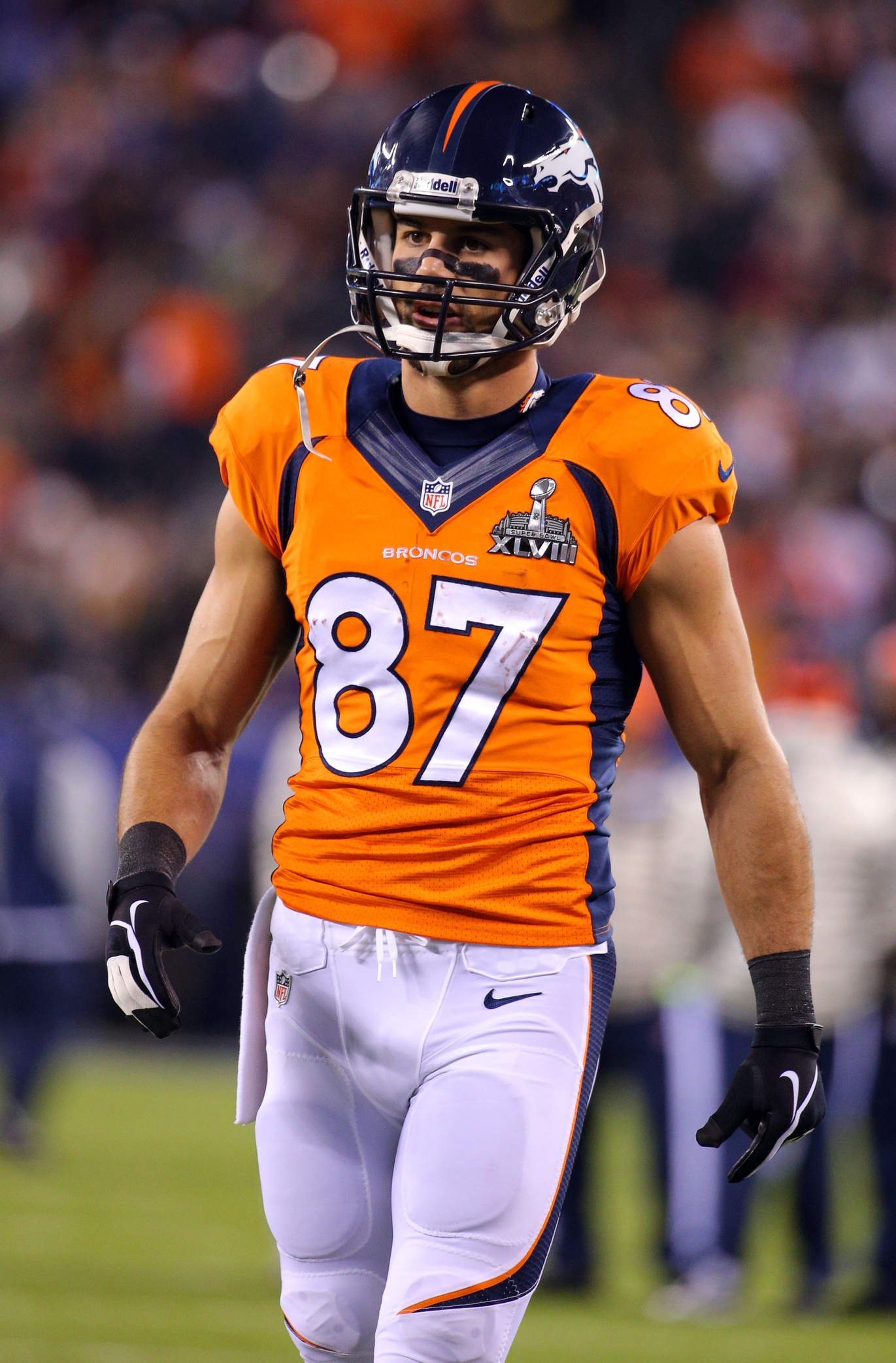 The career year couldn’t have come at a better time for Decker, who is poised to hit unrestricted free agency for the first time this offseason after earning a base salary of just $1.32MM in 2013. He reportedly plans to test the market, which is no surprise given his competition on the market (Boldin and Julian Edelman are the only free agent WRs whose numbers came close to Decker’s 2013 production) and the deals signed by receivers in recent years.
Taking into account Decker’s career totals as well as his 2013 numbers, his resumé arguably looks better than Mike Wallace‘s did when the former Steeler reached free agency a year ago, and Wallace secured a five-year, $60MM contract in Miami, with $27MM in guaranteed money. While Wallace landed the largest free agent deal for a receiver on the open market last year, there were a couple other comparable contracts signed, including Dwayne Bowe‘s five-year pact with Kansas City ($11.2MM per year, $20MM guaranteed) and Greg Jennings‘ five-year deal with the Vikings ($9MM annually, $17.8MM guaranteed). Factoring in Decker’s track record, age, and durability, you could make the case that his stock as he approaches free agency is higher than that of any of those receivers.
Still, as impressive as Decker’s performance to date has been, potential suitors will take notice of a handful of red flags. The fact that Decker had Peyton Manning throwing him the ball helped buoy his overall stat line significantly, and he also benefited from the presence of other receiving threats like Demaryius Thomas, Julius Thomas, and Wes Welker, meaning he frequently faced single coverage. Additionally, there may be question marks about his ability to produce against physical secondaries, particularly after his no-show against the Seahawks in Sunday’s Super Bowl, a game in which he totaled just six yards on one catch.
With or without Manning and the Broncos offense, Decker is a talented playmaker, but the recent history of free agent receivers suggest that interested teams should proceed with caution. After securing big paydays last winter, both Wallace and Jennings failed to put up 1,000-yard seasons, and combined for just nine TDs between them. Wallace was excellent in Pittsburgh playing across from Antonio Brown with Ben Roethlisberger throwing them the ball, while Jennings excelled in Green Bay catching passes from Aaron Rodgers alongside players like Nelson, Jermichael Finley, and James Jones. But being paired with lesser quarterbacks and assuming a number one role limited both Wallace’s and Jennings’ production last season. It’s not hard to imagine Decker’s receiving totals taking a similar hit if he finds himself in a comparable situation in 2014.
As such, it’s possible that teams will temper their enthusiasm for Decker, perhaps submitting bids more comparable to recent deals signed by players like Victor Cruz ($8.6MM per year, $15.63MM guaranteed), Mike Williams ($7.92MM per year, $14.6MM guaranteed), or Antonio Brown ($8.39MM per year, $8.5MM guaranteed). The Jets, Browns, Patriots, Ravens, and Rams are among the teams who could turn to the free agent market for receiving help, though none of those clubs necessarily possess the perfect combination of cap flexibility and offensive firepower that would attract Decker.
If Decker isn’t blown away by any offers on the open market, a return to Denver remains a possibility. The Broncos likely wouldn’t be able to make the most competitive offer in years and dollars, given their limited cap flexibility and the need to take care of several other players who are hitting free agency this year or next. However, the team has the ability to clear some cap space this offseason, and could probably fit Decker in if he were willing to accept a small hometown discount. For his part, Decker recently indicated he loves the city of Denver and hopes he and the team can work something out.
Still, history suggests that there will be at least one team willing to bet the farm on Decker’s ability to be a No. 1 receiver, or at least to share that role with another player. Concerns about whether Decker can sustain his previous level of production on another offense and with another quarterback may keep his price below Wallace’s range, but it’s not hard to imagine the Minnesota native landing a five-year contract worth in the neighborhood of $10MM annually, with between $15-20MM in guaranteed money.