
Although Bryce Young and C.J. Stroud became extension-eligible this offseason, early buzz pointed to neither 2023 first-round quarterback signing an extension this year. Nothing appears to have changed on the Stroud front, but Young may not be completely closed off with regards to an early Panthers deal.
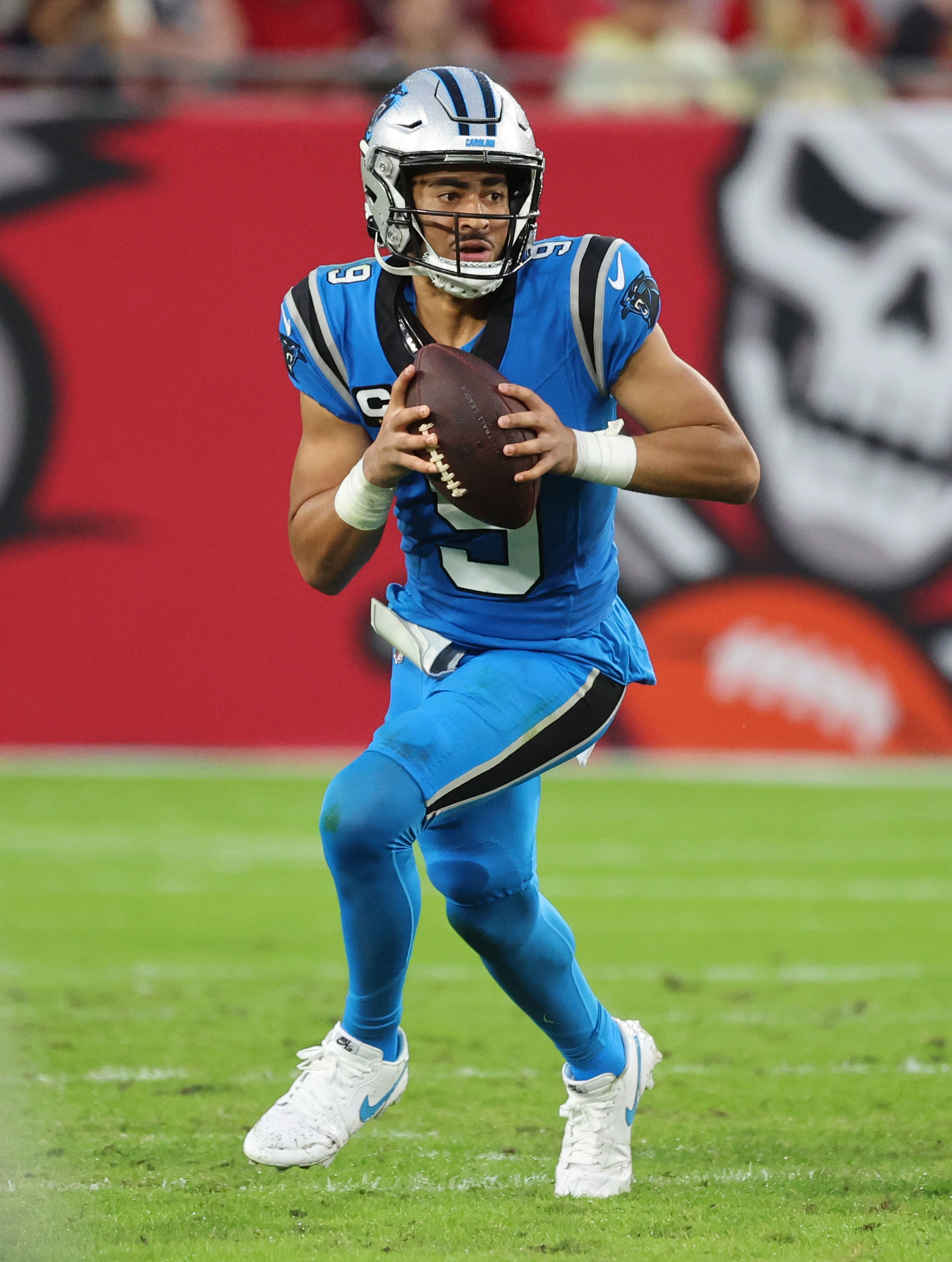 Were the 2023 No. 1 overall pick eager to sign a second Panthers contract before this season, CBS Sports’ Jonathan Jones notes the team could be amenable to accommodating him.
A February report indicated the Panthers were more likely to wait until after 2026 — when they see more from the diminutive passer — to make a decision on paying him, but the team could certainly have an opportunity to give the inconsistent player a club-friendly deal before the 2026 season begins. Though, Jones notes 2027 still seems the more likely point when Young will sign a Carolina extension — if, in fact, that comes to fruition.
Paying a quarterback early for this purpose would still bring quite the risk, seeing as the cost and guarantees would be high — even if Young would not approach the top of the soaring QB market. He quarterbacked the NFL’s 27th-ranked offense last season and needed 16 starts to (barely) clear 3,000 passing yards. His 6.2 yards per attempt represented a career-high mark, illustrating where the former Heisman winner was to start his career. Both parties might be better off by waiting here. The Panthers are picking up his $25.9MM fifth-year option, buying more time.
Young doing an extension now would seemingly be a bet against himself. A stronger 2026 season would catapult the Alabama alum into better position to score a true upper-crust QB extension, when the cap will probably be — based on its recent growth — beyond $320MM. The Panthers will also have a better chance to maximize Young in 2026 — provided new play-caller Brad Idzik proves capable — by having him on a rookie contract.
Traditionally, teams pay first-round quarterbacks after their third seasons. The player receives a sizable guarantee ahead of Year 4, rather than being tied to a rookie salary when a new deal is allowed, and the team lands security. But Young’s uneven play looks like it will move him to the Tua Tagovailoa route. The Dolphins waited until Year 5 to extend Tagovailoa, who had submitted uneven work through three seasons and struggled from a health standpoint. Young has not faced issues on the latter front, but his 22nd-place QBR finish in 2025 marked a career high. The Panthers, who also waited until Year 5 to pay Cam Newton, should want to see if the scrutinized QB can at least replicate that season before making a big offer.
 The Newton deal — agreed to during Jerry Richardson‘s ownership tenure and with Dave Gettleman as GM — aged far better than the Tagovailoa contract. A rising QB market led the Dolphins to give Tagovailoa a four-year, $212.4MM extension that came with $93.17MM fully guaranteed $167.17MM guaranteed in total. That came after the Dolphins had more information (via Tua’s fourth-year performance), compounding a misstep.
The Panthers seeing Young deliver another unremarkable season could move them to a Tagovailoa-like decision, but the fallout ($99.2MM in dead money) from that recent divorce will undoubtedly serve as a reminder to front offices about QB overpays. The Panthers have plenty to consider when determining Young’s value over the next year or so.
Young, 24, even being in the extension conversation does represent growth after Carolina benched him two games into his second season. Trade rumors followed. Young proving worthy of a new deal would bring a comeback victory of sorts for a Panthers franchise that took plenty of heat for drafting him over Stroud — largely based on influence from owner David Tepper. But the Tagovailoa development serves as a warning for the Panthers and other teams contemplating big-ticket contracts for marginal QBs. This season will need to reveal plenty about Young’s upside, or the Panthers may need to consider moving on — a la the Buccaneers and Titans (Jameis Winston, Marcus Mariota) after those passers played out fifth-year option seasons.
The irony is that as CJ Stroud has regressed, David Tepper might be vindicated in taking Young first.
The Bears got the most out of the top two picks in that draft.
Tepper might be intoxicated at the prospect of being vindicated 🙂