
Although running back Kenneth Walker posted his second 1,000-yard regular season and then took home Super Bowl LX MVP honors, the Seahawks did not re-sign the four-year veteran in free agency. Walker ended up joining the Chiefs on a three-year, $43.05MM deal when the negotiating period opened March 9. Leaving Seattle did not come as a surprise to Walker, who told Mike Florio of Pro Football Talk that he saw it coming months ago.
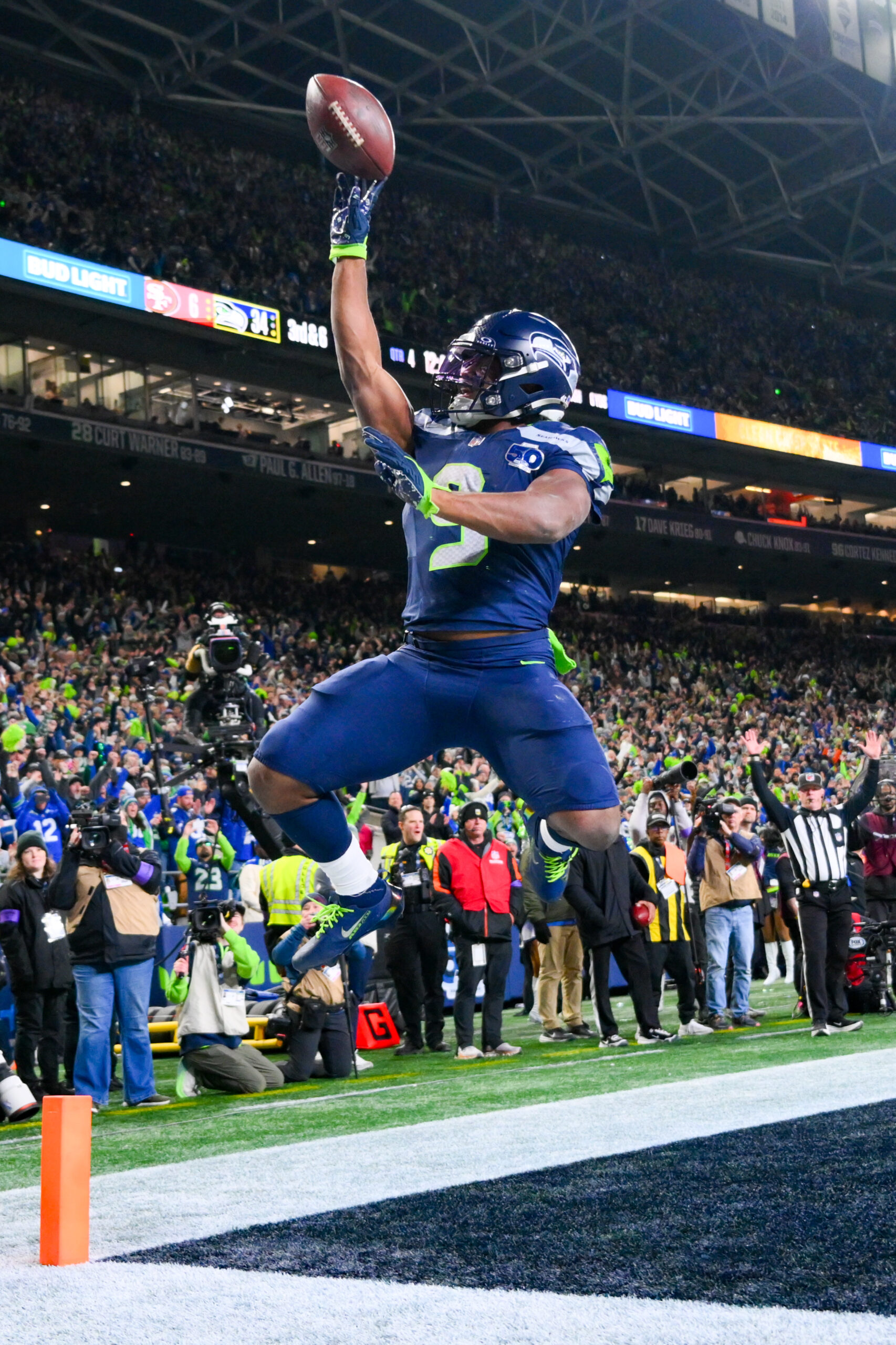
“I would say probably, if I’m being honest, probably like sometime during the season,” Walker said. “You know, things ain’t working out how I was expecting to, and that’s all right. It worked out for the team. So sometime during the season and then we get to free agency, pretty much knowing like you weren’t gonna be there no more.”
As the Seahawks were preparing to face the Patriots in the Super Bowl, general manager John Schneider said he “would love” to keep Walker. The 25-year-old went on to further boost his stock with a 135-yard performance against the Pats, helping the Seahawks to a 29-13 romp.
Walker made it known after the Super Bowl that he hoped to stay in Seattle, but it is unclear if the reigning champions even made him an offer. Without a long-term deal, the Seahawks still could have attempted to retain Walker for another year via the $14.29MM franchise tag (as the Jets did with Breece Hall) or the $11.32MM transition tag. They deemed those prices too rich, though, and allowed their former second-round pick to walk away for a significant raise.
Walker now sits fourth among RBs in total value, average salary ($14.35MM) and guarantees ($28.7MM). The Chiefs expect him to boost a running game that ranked a lackluster 25th in the league last year. Meanwhile, several weeks after Walker left, the Seahawks spent a first-rounder on his replacement, Jadarian Price. As the 32nd pick in the draft, Price’s fully guaranteed rookie deal will check in at approximately $16.73MM over four years.
With the regular season still four months away, Price, free agent addition Emanuel Wilson, George Holani and Kenny McIntosh are among the Seahawks’ healthy backfield options. They also have Zach Charbonnet, who shared snaps with Walker over the previous three years, but his status for the start of 2026 is uncertain after he tore his ACL in the divisional round.


So we now know exactly what a first-round NFL pick is worth (at least the 32nd). $40.66 million ($14.35 million x 4 years – $16.73 million over 4 years). I don’t count the fifth year option as it’s as expensive as Kenneth Walker (north of $14 million) for running backs with more than one Pro Bowl (example Jahmyr Gibbs). Single Pro Bowl rings in over $11 million.
If Walker’s replacement doesn’t receive at least one Pro Bowl nomination within three years, he won’t be a full replacement. Though in fairness, Walker has not yet received a Pro Bowl nomination, despite his recent Super Bowl MVP award.
Pulling math equations out of thin air to claim a 1st-round pick is worth $40.66MM is flawed.
A rookie is not a guaranteed 1:1 replacement for a UFA.
When the pick is a bust or a backup, that $40MM in value does not exist. Instead of a positive pick value, there is a negative value with the UFAs production now gone and the draft capital wasted.
To achieve that “value” the rookie must produce at the exact same level as the UFA, extremely rare when the 32nd pick has a 50% bust rate according to Rotowire.
The NFL’s fixed rookie wage scale sets the value of the pick, not the UFAs free agency contract or made up salary cap equations.
There are free math and reading comprehension courses online, pick one and check in with how you “value” your progress.
Na, na, na, na, Mr Wood.
There’s a good chance Walker will get injured and not produce at the same level. Running backs at high picks tend to deliver fairly reliably.
Yes, there’s some juggling to do about rookie vs vet, injury vs health, specifics of the players but as a ballpark figure, my original post is in the neighbourhood.
The whole point is we’re already considering what the draft capital was worth. The Seahawks save ~$40 million of salary cap across four years but lost a first round pick.
That’s the whole point. I’m not sure it’s the right decision. Bird in the hand, as you say. But there have been running backs who had one big season and been done: Peyton Hillis, LaMont Jordan, Justin Forsett, Rob Kelley to name a few.
Using injury risk to devalue the UFA while ignoring the bust rate for the pick is flawed.
If the pick busts, which is 50% at 32, the team loses the production, the $16M, and the draft capital.
That’s a negative value, not a $40M win.
You’re confusing a budget with actual talent.
Saving money on the cap is useless if the pick provides zero value on the field.
If Seattle ‘saves’ $40M but the run game disappears because the pick is a bust, they haven’t gained $40M in value, they’ve just made their team worse for a lower price tag.
A pick’s value is based on the player you get, not the contract of the guy who left or random math equations pulled out of thin air.
Do you really think running back picks at 32 have a 50% failure rate in 2026? I didn’t think so.
You’re a bit breathless from your huff and puff and blow your house down rhetoric.
It’s a complex situation, I probably would have kept Walker myself. But the math more or less adds up.
You’re inventing a 4th year of salary that doesn’t exist to pad your numbers. Walker’s deal is 3 years. The actual cash difference is $26.32MM, not $40.66MM.
But your logic fails regardless of your bad math. You’re defining the value of a draft slot by the contract a player signs with a different team. If a punter left Seattle and signed a contract with another team for $1MM over 4 years, your formula would be ($1M x 4) – $16.73M. That would mean the 32nd pick has a negative value of -$12.73MM. Does the 32nd pick magically lose $53MM in value just because the guy who left signed a smaller contract? No.
The 2024 Vikings replaced Kirk Cousins ($180MM) with the 10th pick ($21MM). By your math, that 10th pick was ‘worth’ $159MM. No one in the NFL believes a mid-first-round pick has a market value of $159MM.
RotoWire analyzed 800 picks over 25 years, every pick at 32 has a 50% bust rate. You’re valuing a coin flip as a guaranteed $40M win. If the 32nd pick were actually worth $40M, Seattle could trade it for $40M in assets. They can’t because the market knows the pick is only worth the rookie wage scale.
The only dollar figure you can assign to a draft slot is the rookie wage scale. No other dollar amount is associated with that slot, especially not the contract of a UFA who walked to another team. You’re valuing a budget surplus, not the draft pick.
I still don’t accept your half of first round draft picks failed math: it would have to be divided by position. QB’s have about a ~40% success ratio, WR about a ~25% success ratio (to my surprise TE are not much better with only a ~33% hit rate), offensive linemen about ~75% success ratio (lower for tackles, higher for centers/guards). RB are in the ~70% category of success by position.
Since the Seahawks could of kept Walker for the $40 million vs a roughly equivalent rookie, at that point in time the Seahawks valued $40 million as worth more than the draft pick. This would be a ridiculously low value on pick 5 or 6 where a team can pick up a top-tier offensive lineman or pass rusher.
But the 32nd pick is effectively the first pick of the second round.
There is no need to get worked up about these calculations. Putting an exact dollar value on that 32nd pick is more a fascinating how many angels can dance on the head of pin intellectual challenge than an exact science.
Of course, for Walker it’s deeply personal. He can however console himself with his Super Bowl MVP award. Forever, whatever happens, Walker will remain at least a footnote in NFL history.
You went from claiming we know exactly what a pick is worth to calling it an intellectual challenge the second your math was exposed. You invented a 4th yr of salary that does not exist just to pad your numbers. The actual difference is $26.32MM, not $40MM.
Using a positional hit rate for pick 32 is like using the average height of the NBA to claim that “all tall” people are 6’6″. RotoWire shows pick 32 has a 50% bust rate. Even using your numbers, a 30% chance of a double loss where you lose a Super Bowl MVP and waste a first round pick is a disaster.
If the 32nd pick were actually worth $40MM, Seattle could trade it for $40MM in assets. They can’t. This isn’t some theoretical mystery, there is no set dollar value for effectively the first pick of the second round just like there is no physical space for angels.
I’m not surprised K-9 was frustrated with his usage. It was frustrating to watch sometimes as a fan. We all wanted more K-9. I do think that spreading the load around had a lot to do with how much gas he had in the tank down the stretch. The cap is what it is and you can’t keep eveyone. I like Price and he will get lots of carries. He could be very good.
I think he had become frustrated with his offensive line as well. He had to make alot of his yardage on his own throughout and it took a toll on his body. He still should have become a better pass protector. It would have helped him and Geno Smith stay on the field longer.
The Chiefs travel to Seattle during the season so Kenneth will get the opportunity to show Schneider what he gave up. I don’t think Walker will have any trouble getting motivated for that game.
Have you seen the Seahawks play defense. They will be up for that game too! The seahawks know what they gave up, $15 million a year.
Any NFL player should be motivated for every game. I think Walker knows this was a business desicion. He had a great career in Seattle, fans loved him and he made a nice salary while there.
True, but with his struggles behind a suspect line, trying to navigate against guys constantly in the box, he probably felt he didnt earn enough money and wanted to get a signing bonus the Seahawks werent willing to give in free agency.
The Seahawks line has a better grade/ranking than the Chiefs. Their QB didn’t make it through the season behind that line. I think what he wanted was, yes the money, but also to not share carries, especially inside the 20, with another back.