
PFR’s Cowboys Offseason Outlook indicated the team exited last week with the league’s worst cap situation. Dallas came into today more than $56MM over the $301.2MM salary ceiling. They are moving back toward cap compliance with some expected adjustments.
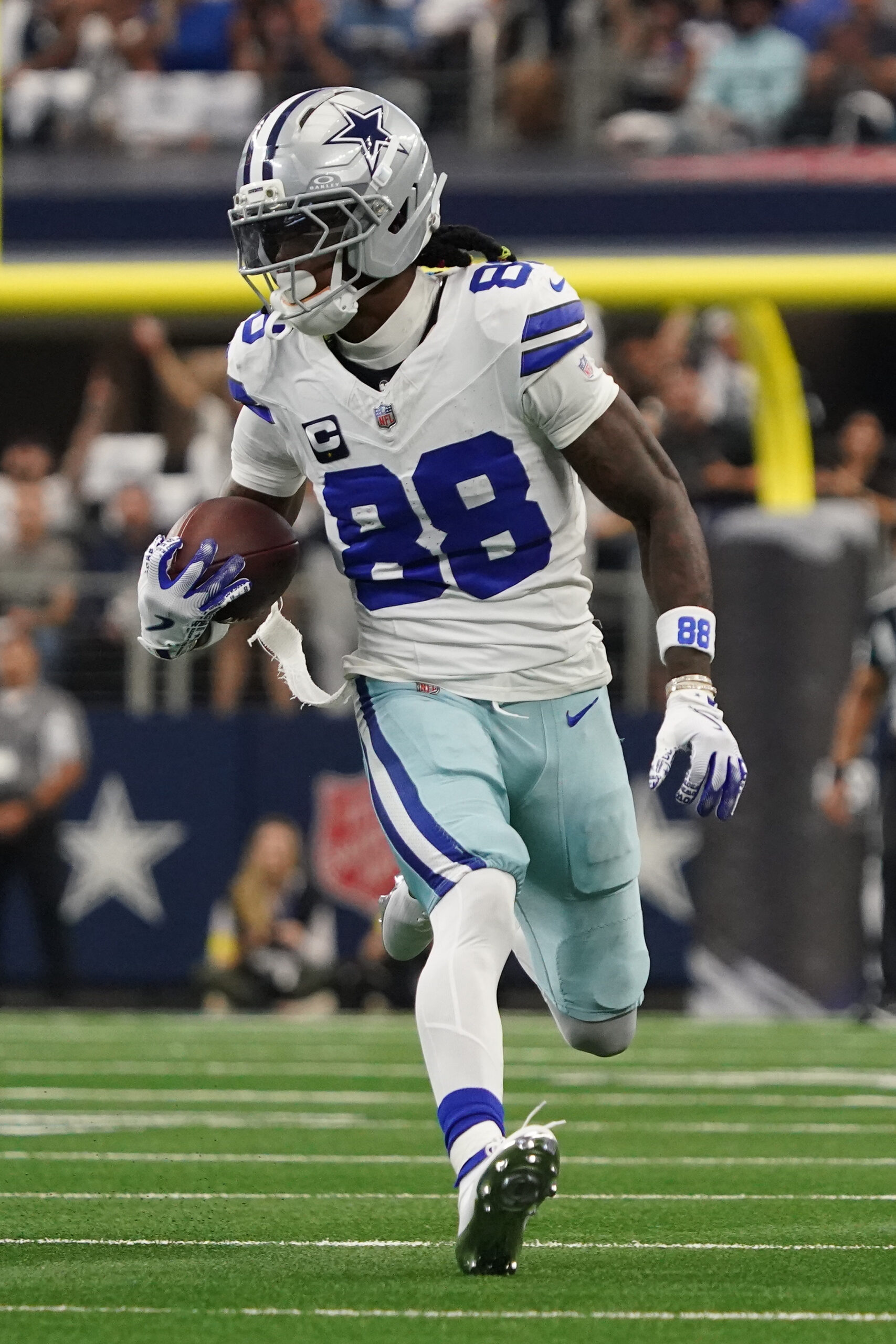 The Cowboys restructured Dak Prescott and Tyler Smith‘s contracts Wednesday, ESPN’s Field Yates and Adam Schefter tweet. These moves will create $47MM in cap space, bringing Dallas within $10MM of the 2026 cap. The team also restructured CeeDee Lamb‘s deal to clear more room, per ESPN.com’s Todd Archer. Other possible conversions are available as well. The Lamb move, expected to clear $19MM more in space, slides the Cowboys under the cap.
Dallas used a $28.29MM franchise tag to keep George Pickens off the free agent market. That sank the team deeper into the red. But Pickens is firmly in the Cowboys’ 2026 plans. As a result, contract updates are coming to make it affordable. Quinnen Williams and Osa Odighizuwa‘s deals are also on that list, per the Fort Worth Star-Telegram’s Nick Harris, and a rumored Kenny Clark extension effort would reduce the 2025 trade pickup’s cap hit.
Prescott, 32, is tied to the NFL’s richest contract — a four-year, $240MM extension agreed to hours before Week 1 of the 2024 season. This move will reduce the 11th-year quarterback’s $50.52MM 2026 cap number while inflating future numbers on the through-2028 contract. Before this restructure, Prescott was already due to count more than $74MM against Dallas’ 2027 cap. Another restructure would be on tap before that point.
The Cowboys backed themselves into a corner with Prescott based on previous restructures. His no-tag clause and the void year-driven penalties that would have come in 2025 absent an extension armed the upper-crust QB with extraordinary leverage. He used it to score the $60MM-per-year extension — which still hovers well above the QB market 18 months later.
Lamb is signed through 2028 on a $34MM-AAV extension. The Cowboys have now restructured his deal twice as well. Lamb was due to count $38.24MM on Dallas’ 2026 cap and more than $41MM next year. While Lamb’s 2027 number will balloon, his 2026 figure will drop to create spending space. Smith, who signed the NFL’s most lucrative guard deal last fall ($24MM AAV), is signed through 2030. His cap number will drop from $27.5MM.
The NFL really needs to move to fully guaranteed deals. Your cap hit should be the total guarantee divided by the length of the deal.
It is really that simple. There is no need for void years, roster bonus, workout bonus, restructures, front load, back load, and all this nonsense.
I’ve wondered about that for some time. Of course the owners would push back on that. Could the NFL and NFLPA find a middle ground (like guarantee all salaries but eliminate signing bonuses) to create cost certainty for both sides?
Only real leverage the players have is adding the 18th game imo.
They could demand guarantees, if not full guarantees more solid and less partial guarantees on their non bonus salary in exchange for playing 1 more week, with an additional bye week.
But the NFLPA is so weak, and their leadership corrupt for big business, and non-player interest acting; it’s more likely they’ll fold without much actual collective bargaining for the league and owners whims like they have before for comparative cookies. NFLPA is notoriously star player oriented, and leaves most of the practice squad guys, and jobbers in the dust so who knows their priorities under new (but similar) executive leadership. Again, like Tretter is a candidate, for some reason.
Legit, full guarantees would be more of a boon for the guys who maybe spend 1-3 years in the NFL, not the big guys with the voice to make actual change so, it remains to be seen.
More guarantees is one thing, but having cap hits automatically be an average of the contract every year doesn’t make sense. It doesn’t help either party and it doesn’t account for the fact that the cap goes up year over year.
Oooof it works for NHL.
The NHL is extremely different from the NFL in a number of ways, including sheer amount of money we’re talking about. I don’t see how your suggestion would help players OR teams other than maybe the Bengals, who can’t be bothered to work the cap to their advantage.
What Macbeth suggested is another Sportsball Mashup. That’s a tragedy found mainly within Murica.
The NHL is very different, and that is why it is easy to comprehend and the NFL’s cap nuances are absolutely ridiculous.
Every NHL deal is guaranteed. The average paid per year is the cap hit. Very simple, very easy to understand. You have a fixed cap you can’t go over. You sign a 10 year 100m deal, your cap hit is 10m per season. You can retain salary if you trade a player. You can buy out a player and a portion of that hits your cap. That is really the end of the NHL cap.
Why wouldn’t we want something similar and more simple?
Do restructures, pre June 1 release/trades, post June 1 release/trades, extensions, void years, base salary, guaranteed salary, signing bonus, option bonus, workout bonus, and roster bonus add any real value or incentive for the league?
Try to explain what a void year is to a casual fan. It is nonsensical.
The cap gymnastic conversation (possibly intentional at this point to generate buzz/conversation for the league) is exhausting.
To touch on your point about average contract value per year not making sense, why does that not make sense and being able to hide money through 4 different bonuses, void years, and putting the entire guarantee in year 1 make any more sense?
You don’t have to pay this much attention to it if you don’t like it. It’s actually pretty easy to explain a void year. It’s payment deferred until after the active life of the contract. They do it in baseball, too. They just don’t call it the same thing. And all that maneuvering does help the fans. It helps teams keep their cores together, like in Philadelphia. It helps teams move on from big mistakes, like in Denver.
Baseball’s cap and contract structure isn’t simple either and neither is the NBA with things like exceptions and Bird rights. Baseball is especially egregious with the Dodgers paying 380m in salary this year with literally half of the league spending less than half of that number.
The NHL has made it extremely easy to figure out, while allowing teams to keep their cores together. The Penguins have had their 3 main core guys for nearly 20 years now and many other teams have as well.
The NHL is the model. There is parity in competition, simplicity in contracts, and it is consistent.
I would love to see a less complex cap. No more restructures, teams being 100m over the cap, or wondering how many void years and different bonuses the new free agent your team signs are given and how that impacts them in 2035. You would see shorter deals, more movement, more excitement, better trades, and a more interesting transparent product.
It seems like your big problem is that you personally find the machinations off putting more than anything to do with whether it serves a purpose. Evenly distributed contracts wouldn’t help teams or players.
Explain why they wouldn’t help teams or players?
It removes so much flexibility. Let’s say you’re a rebuilding team with tons of cap space. You can be creative and plan one of your big contracts so that there’s a huge payout early on when you have space, like the 49ers did with Jimmy G. Or if you’re a team like the Eagles, you can keep a core together by curating when everyone’s payouts come. Howie Roseman basically restructures everyone’s contracts from the start so that the base salaries are low and the guarantees are paid out on a schedule that works together. This makes it easier to keep players.
Who exactly does it benefit not to do that and why?
(I agree with you about more of contracts being guaranteed in the first place, but we’re only going to get so far on that count in a league structured the way it is and with so many injuries.)
I’d be fine with a middle ground of guaranteed contracts but you can structure them how you want like baseball. It isn’t ideal and leaves open the possibility of cap manipulation (Like the proposed Kovalchuk deal in the NHL where they tried to do like 17 years in order to lower the cap hit across the seasons).
Like if you signed a guy to a 3 year deal for 30 million but wanted to do the 20 million in year 1 and then 5 in year 2 and 3 I don’t see an issue with that.
The main issue I have is that the cap gymnastics every year are just completely unnecessary. Guaranteed contracts benefit players, teams, and fans then you can eliminate the silly tags, restructures, and void years.
The restructures and void years are fine.
Need to get rid of the franchise tag as well
Ahh Jerry the GM getting outflanked yet again.
How?
Jerry has to do this ever year since he continually restructures and backloads more than anyone
The Saints were previously the worst about this, and it finally caught up to them.
It’s a strategy that banks on the cap continually rising, but does anyone think that is a given considering the state of the US economy?
Yes, because the league is likely adding an 18th game and is definitely up for new TV deals in 2029. The cap is going to go up even if there’s a major reckoning for the economy.
As for the Saints, they also traded away a lot of draft picks, which makes the strategy even worse.
Kicking the can down the road. I hope this works out within 2 years. If not it will have to be rebuilt from the ground up.
Imho- Dak’s contract is horrible for a quarterback with a 2-5 playoff record. I would not be surprised if Lamb is trade bait next off season