
Offseason In Review: Chicago Bears
The Bears were a trendy playoff pick heading into the 2014 season, but a 5-11 finish was followed by the dismissal of both general manager Phil Emery and head coach Marc Trestman. Now, Chicago might be entering rebuilding mode, though they did use free agency to bring in several interesting players.
Notable signings:
- Eddie Royal, WR: Three years, $15MM. $10MM guaranteed.
- Pernell McPhee, LB: Five years, $38.75MM. $8.75MM guaranteed.
- Antrel Rolle, S: Three years, $11.25MM. $4.9MM guaranteed.
- Alan Ball, CB: One year, $3MM. $1MM guaranteed.
- Jarvis Jenkins, DE: One year, minimum salary. $330K guaranteed.
- Jimmy Clausen, QB: One year, $1.125MM. $262,500 guaranteed.
- Will Montgomery, C: One year, minimum salary benefit. $200K guaranteed.
- Thomas Gafford, LS: One year, minimum salary benefit. $150K guaranteed.
- Sam Acho, LB: One year, minimum salary benefit. $80K guaranteed.
- Mason Foster, LB: One year, minimum salary benefit. $80K guaranteed.
- Vlad Ducasse, G: One year, minimum salary benefit. $40K guaranteed.
- Jacquizz Rodgers, RB: One year, minimum salary benefit. $40K guaranteed.
- Sherrod Martin, S: One year, minimum salary benefit.
- Bear Pascoe, TE: One year, minimum salary benefit.
- Tracy Porter, CB: One year, minimum salary benefit.
- Dante Rosario, TE: One year, minimum salary benefit.
- Daniel Thomas, RB: One year, minimum salary benefit.
- Zach Miller, TE: One year, minimum salary.
There’s no doubting that Eddie Royal is a solid football player — he was excellent out of the slot for the Chargers last season, catching 72 passes for 778 yards and seven touchdowns. And while his $5MM annual salary isn’t all that exorbitant (although it’s higher than Julian Edelman, for example, and equal to that of Emmanuel Sanders), it’s pretty surprising that the Bears handed Royal $10MM in guarantees. That’s more than Torrey Smith, who is widely regarded as a superior pass-catcher, garnered, and it ranks 16th among all receivers (not counting rookie deals). It might seem like Royal has been around forever, but he just turned 29, so perhaps his relative youth helped him score this contract, but I have a hard time believing many other clubs would have agreed to this deal. Chicago must be certain that the Royal/Jay Cutler relationship is strong enough to post positive results over the next three years.
Making the Royal deal all the more surprising is the fact that he got more guaranteed money than the Bears’ true free agent prize, pass-rusher Pernell McPhee. It’s hard to even label McPhee with a position, as we’ve seen him get after the quarterback from all along the defensive line and several linebacker positions, and it will be interesting to see where new Chicago defensive coordinator Vic Fangio asks 26-year-old line up. It’s a little hard to believe that while his total contract is valued at nearly $40MM, McPhee was only able to secure $8.75MM in guarantees. That could have something to do with his relative lack of experience, as 2014 was the first season that he topped 600 snaps on defense. We’ve seen other defensive players leave Baltimore via free agency and tank before, but the Bears certainly have high hopes for McPhee, who ranked as the second-best 3-4 outside linebacker in the league, according to Pro Football Focus (subscription required).
Elsewhere on the defensive side of the ball, the Bears added veteran safety Antrel Rolle, inking the former Giant to a three-year deal. Chicago ranked 29th in DVOA against the pass last season, running out the likes of Chris Conte for extended stretches of time. At age 32, Rolle probably isn’t the same player that he was during his early career in Arizona or his first few seasons in New York, but he should add a level of stability to Chicago’s back end that it hasn’t had in recent years. He’ll also act as a complement, and perhaps mentor, to second-year pro Brock Vereen, the projected starter at free safety.
Rolle wasn’t the only experienced defensive back signed by the Bears this offseason, as they also brought in cornerback Alan Ball, who spent the last two years in Jacksonville. He isn’t a star (PFF rated him as the No. 40 CB in ’14), but like Rolle, he’ll bring a level of competency a Chicago defense that sorely needs it. During the offseason, some around the league had said that the Bears’ defense was so poor last year that they might need 10 new starters (with Kyle Fuller being safe). Given the presence of Fuller and Tim Jennings, Ball won’t be on those new starters, but he will be an insurance option if something happens to the top two corners.
Outside of those four signings, the Bears didn’t do all that much in free agency. However, I was particularly impressed by new general manager Ryan Pace‘s use of the minimum salary benefit to bring in players who could contribute at a low cost. Sam Acho, for instance, could turn out to be a valuable addition, as the 26-year-old former Cardinal is capable of playing either inside or outside linebacker. Mason Foster, also only 26 years old, has four years experience as a starting middle linebacker. Will Montgomery ranked as the league’s 15th-best center per PFF last year despite playing less than 600 snaps. Those were my three favorite MSB additions, but it’s not impossible that players such as Jacquizz Rodgers, Tracy Porter, or Daniel Thomas could contribute something in 2015, as well. Pace was able to bring in a bevy of high-quality role players who won’t embarrass themselves if thrust into increased playing time, and did so while handing out less than $600K in guarantees.
Notable losses:
- Lance Briggs, LB
- Eben Britton, T
- Jeremy Cain, LS
- Chris Conte, S
- Brian De La Puente, C
- Roberto Garza, C: Released
- Khaseem Greene, LB: Waived
- Jay Feely, K
- Danny McCray, S
- Josh Morgan, WR
- Montell Owens, FB
- Stephen Paea, DL
- Trevor Scott, DE
- Darryl Sharpton, LB
- Charles Tillman, CB
- D.J. Williams, LB
The Bears didn’t seem to make much of an effort to re-sign Stephen Paea, as the defensive lineman told reporters when he signed with Washington that he chose the nation’s capital over Dallas, Detroit, and Tampa, with no mention of Chicago. The 26-year-old graded as the No. 11 DT in the league according to PFF, and given that he’s earning just slightly more annually than Eddie Royal, I wonder if the Bears would have been wiser to spend that ~$5MM per year on Paea. Although he’s only played defensive tackle thus far in his career, the 6’1″, 300-pounder has the size to play 3-4 end (and it’s the role he’ll play in Washington).
Sentimentally, Chicago lost two of its most beloved defenders, linebacker Lance Briggs (who remains unsigned) and cornerback Charles Tillman (who joined the Panthers). Briggs, 34, played in only eight games last season but was the Bears’ third-best defender per PFF, while Tillman appeared in just two games before injuring his triceps. It makes sense that neither was retained given that the club is going younger on defense, but I wonder if Briggs might be an option later in training if Vic Fangio is unhappy with his crop of inside linebackers.
Another long-time Bear — center Roberto Garza — was released in April despite having signed a one-year extension in December. The pact was inked by the club’s regime, so it’s clear that Ryan Pace & Co. didn’t value Garza at the same level. Garza, 36, had been with the Bears since the 2005 season, playing 154 regular season contests (145 starts) during that stretch, primarily at center and right guard. Chicago also declined to bring back fellow center Brian De La Puente, who had a very successful season in ’14 during which he saw 501 snaps, mostly while filling in at center for Garza during the early portion of the year. De La Puente is only 30 years old and had to surprisingly accept a one-year deal for the minimum salary benefit last offseason, and he remains unsigned as of this writing.
Safety Chris Conte offered youth (he’s entering his age-26 season) and experience (more than 600 snaps in each of his first three seasons), but he’s dealt with shoulder injuries throughout his career and has produced at merely an average level. In 2014, Conte graded as the No. 63 safety among 87 qualifiers per PFF. He’d been better than that in the two seasons prior, but he’s always been in the middle of the pack relative to his peers. The Bears moved on, adding the veteran Antrel Rolle as a replacement, while Conte followed ex-Bears HC Lovie Smith to Tampa Bay.
Josh Morgan actually played a decent number of snaps while acting as Chicago’s third receiver last season, but the team added Kevin White in the draft and will hope that Marquess Wilson will take the next step and supplant Morgan, who signed with the Saints. The only notable departure who saw more than 400 snaps was inside linebacker D.J. Williams, who, at age 33 and having dealt with multiple injuries in recent years, might be nearing the end of his NFL run.
Trades:
- Acquired a 2015 fifth-round pick from the Jets in exchange for WR Brandon Marshall and a 2015 seventh-round pick.
The Bears didn’t move around at all during the draft, but they did swing a trade near the beginning of the league year, shipping veteran receiver Brandon Marshall to the Jets. Marshall was among the NFL’s best receivers as recently as 2013, but last season saw him catch just 61 passes for 721 yards, and he missed the final three games with broken ribs. The 31-year-old was due a 2015 base salary of $7.5MM and scheduled to count $9.575MM against the cap.
Marshall’s 2015 salary was set to become guaranteed on the third day of the 2015 league year, so Chicago was forced to quickly make a deal to clear his that total. The club will carry $5.625MM in dead money this year as a result of the trade.
Draft picks:
- 1-7: Kevin White, WR (West Virginia): Signed
- 2-39: Eddie Goldman, DT (Florida State): Signed
- 3-71: Hroniss Grasu, OL (Oregon): Signed
- 4-106: Jeremy Langford, RB (Michigan State): Signed
- 5-142: Adrian Amos, S (Penn State): Signed
- 6-183: Tayo Fabuluje, T (TCU): Signed
Kevin White and Eddie Goldman, Chicago’s top two selections, will be counted on to start almost immediately, with White replacing the production of Brandon Marshall, and Goldman pushing Will Sutton for snaps at nose tackle. It remains to be seen how White will acclimate to the NFL; there’s no doubting his speed and/or raw ability, but some wonder if he’ll need some time to refine his game.
Hroniss Grassu, like Goldman, will have to compete for snaps with Will Montgomery, and the veteran probably has the edge here, though Grassu could also act as insurance at guard in case Matt Slauson suffers another injury. Jeremy Langford will join Ka’Deem Carey, Jacquizz Rodgers, and Daniel Thomas in the race to back up Matt Forte, and most think Langford has the most long-term value of that group.
Other:
- Hired Ryan Pace as general manager to replace Phil Emery.
- Hired John Fox as head coach to replace Marc Trestman.
- Hired Adam Gase as offensive coordinator to replace Aaron Kromer.
- Hired Vic Fangio as defensive coordinator to replace Mel Tucker.
- Signed DE Ray McDonald, but released him following his May arrest.
- Declined 2016 fifth-year option for LB Shea McClellin ($7.751MM).
- Claimed TE Chris Pantale off waivers from the Jets.
- Signed 15 undrafted rookie free agents following the draft.
Phil Emery‘s run as the Bears’ general manager — highlighted by the ill-advised seven-year extension handed to Jay Cutler — officially came to end in December, and the team fired head coach Marc Trestman on the same day. Though the duo had fielded a largely successful club in 2013, 2014 saw number of issues — discord among players, offensive coordinator Aaron Kromer throwing Cutler under the bus, failed signings such as Jared Allen and Lamarr Houston — come to the forefront, leading the pair to be ousted after only two years on the job.
To replace Emery, the Bears settled on former Saints executive Ryan Pace as their new GM after a search that saw Chicago meet with Chris Ballard of the Chiefs, Brian Gaine of the Dolphins, and Lake Dawson of the Titans. At 37, Pace becomes the youngest general manager in the league. It was fair to wonder if Pace would employ the same sort of contract structures in Chicago that often led the Saints to having little or no cap space, but given that Pace’s title was player personnel director, he probably doesn’t deserve blame for New Orleans’ cap woes.
Aside from the Broncos, the Bears interviewed the fewest candidates of any club searching for a new head coach. Chicago was one of only two teams who were replacing its general manager in addition to its HC, so it’s possible they wanted to have Pace in place before getting too deep into its coaching hunt. But it’s also conceivable the Bears simply got lucky, as just four days after Denver parted ways with John Fox, Chicago scooped him up, signing the 60-year-old to a four-year contract. Fox, entering his 14th season as an NFL head coach, will bring Adam Gase with him from Denver to head up the offense, while adding former 49ers DC Vic Fangio to lead the defense (and shift to a 3-4 scheme).
The one true black mark of Chicago’s offseason was the signing of defensive end Ray McDonald, who had already been in legal trouble twice (domestic violence and sexual assault) before joining the Bears. Financially, it was a no-risk signing for the club, but the optics could not have been worse. The public relations backlash only increased when McDonald was arrested again just two months after inking his contract, this time on charges of domestic violence and child endangerment. Chicago released McDonald almost immediately, but the reaction following the incident was clear — Pace had made the first big mistake of his tenure.
Top 10 cap hits for 2015:
- Jay Cutler, QB: $16,500,000
- Jared Allen, DE/OLB: $12,500,000
- Matt Forte, RB: $9,200,000
- Jermon Bushrod, LT: $8,050,000
- Lamarr Houston, DE/OLB: $6,990,000
- Pernell McPhee, OLB: $6,675,000
- Martellus Bennett, TE: $6,125,000
- Brandon Marshall, WR: $5,625,000 (dead money)
- Eddie Royal, WR: $5,500,000
- Tim Jennings, CB: $5,250,000
2014 will probably be something of a rebuilding year for the Bears. Turnarounds can happen quickly in the NFL, and given that Chicago hired a veteran coach in John Fox, it’s probably aiming to be in contention again in the very near future. But with three other solid teams in the division, it’s quite possible that the Bears are cellar-dwellers once again, barring vast improvement on the part of either Jay Cutler or the defense as a whole.
Contract information from Over the Cap and Spotrac was used in the creation of this post.
Offseason In Review: Detroit Lions
The Lions had 23 free agents and only $18.44MM worth of cap space this offseason, leading to some tough choices over the spring. Their limited space also meant saying farewell to a defensive superstar.
Notable signings:
- Matt Prater, K: Three years, $9MM. $750K guaranteed.
- Rashean Mathis, CB: Two years, $3.5MM. $750K guaranteed.
- Kellen Moore, QB: Two years, minimum salary. $340K guaranteed.
- Isa Abdul-Quddus, S: One year, $1.5MM. $300K guaranteed.
- Josh Bynes, LB: Two years, $1.81MM. $250K guaranteed.
- Josh Wilson, CB: One year, minimum salary benefit. $200K guaranteed.
- Lance Moore, WR: One year, minimum salary benefit. $80K guaranteed.
- Don Muhlbach, LS: One year, minimum salary benefit. $80K guaranteed.
- Dan Orlovsky, QB: One year, minimum salary benefit. $80K guaranteed.
- Darryl Tapp, DE: One year, minimum salary benefit. $80K guaranteed.
- Corey Wootton, DE: One year, minimum salary benefit. $80K guaranteed.
- Taylor Mays, S: One year, minimum salary benefit.
- Chris Owens, CB: One year, minimum salary benefit.
- Greg Salas, WR: One year, minimum salary benefit.
- David Ausberry, TE: One year, minimum salary.
- Phillip Hunt, DE: One year, minimum salary.
The Lions had to kiss a lot of frogs before finding their kicking prince in 2014. Eventually, they settled on Matt Prater and locked him up to a three-year extension worth $9MM. Prater, 30, began the 2014 season by serving a four-game suspension in Denver for violating the league’s substance abuse policy, and was ultimately cut by the Broncos, ending a seven-year tenure with the club. After signing with the Lions, Prater was a little shaky in his first few games, but settled down and ended up making 21 of 26 field goal attempts. In 2013, he was a Pro Bowler, making all but one of 26 field goal attempts for the Broncos.
Back in February, Lions GM Martin Mayhew said that he would like to retain Mathis for the 2015 season and praised Mathis’ “position versatility.” In mid-March, he was able to check that off on his offseason to-do list. In 2014, Mathis started all 16 regular season games for the Lions, finishing with 54 total tackles, one interception for a touchdown, and two forced fumbles. The advanced metrics at Pro Football Focus (subscription required) placed him as the 12th best cornerback in the entire NFL last season with an overall score of 9.1. For reference, that posting put him ahead of such notables as Chris Culliver, Brandon Flowers, Aqib Talib, and Dominique Rodgers-Cromartie.
Before the start of free agency, the Lions locked up both of Matthew Stafford‘s backups – Dan Orlovsky and Kellen Moore. Orlovsky, 31, didn’t see game action in 2014, as Stafford stayed healthy for the whole season. The former Buccaneer last played in a regular season game in 2012 for Tampa Bay. Moore, 25, didn’t come close to appearing in a regular-season game for the Lions in 2014, and has yet to appear in a game during his three-year NFL career. However, the team was likely impressed by his performance during the preseason last year — Moore completed 35 of 51 passes for 361 yards, three touchdowns, and no interceptions during those exhibition games, with a passer rating of 108.4.
Isa Abdul-Quddus isn’t a big-name player, but as Birkett notes, he’s a valuable backup and a key player on special teams, where he racked up five tackles. He did end up starting four games last season, and posted 22 total tackles on the year. The Lions originally claimed the 25-year-old off waivers from the Saints last February.
Linebacker Josh Bynes, a restricted free agent, was not tendered an offer by the Lions, but he was re-signed at a lower rate. The 25-year-old appeared in 26 games for the Ravens from 2011 through 2014 and made nine starts along the way. He began the season on the Ravens’ taxi squad, but the Lions signed him to their active roster in late September.
Wide receiver Greg Salas, a fourth-round pick by the Rams in 2011, has bounced around the league a bit over the years but hopes to have a longer stay with the Lions. Over the course of his four-year NFL career, the 26-year-old has accumulated 43 receptions, including eight last year for New York — most of those catches came in Salas’ rookie season, when he hauled in 27 balls for the Rams.
Notable losses:
- Bill Bentley, CB: Waived
- Reggie Bush, RB: Released
- Nick Fairley, DT
- Andre Fluellen, DT
- C.J. Mosley, DT
- Ashlee Palmer, LB
- Dominic Raiola, C
- Garrett Reynolds, OL
- Rob Sims, G
- Ndamukong Suh, DT
- Cassius Vaughn, CB
All season long, the possible departure of Ndamukong Suh hovered over Ford Field like a dark cloud. In March, what many viewed as the inevitable took place when Suh inked a lucrative free agent deal elsewhere. The good news for the Lions is that they won’t have to see a whole lot of their former start defensive tackle since he signed on with the AFC’s Dolphins. By PFF’s count, Suh racked up 72 total quarterback pressures in 2013, well ahead of any other DT besides Gerald McCoy, and he generated 57 quarterback pressures in 2014, tops in the league among defensive tackles. Another notable name, who we’ll get to in a bit, will now be charged with stuffing the run in Detroit.
Suh was the most notable defensive tackle to leave the Lions this offseason, but he wasn’t the only one. Nick Fairley inked a one-year deal with the Rams that will pay him a base of $5MM with incentives that can take him up to $7.5MM. Fairley had his 2014 season derailed by injuries, but he was very effective when healthy, as evidence by the widespread interest in him in March. A former 13th overall pick, Fairley had his best season in 2013, when he recorded 35 tackles and six sacks to go along with a pair of forced fumbles. Despite that impressive showing, the Lions elected not to exercise his relatively inexpensive ($5.477MM) fifth-year option for the 2015 season, allowing him to reach free agency.
Reggie Bush, 30, spent the last two seasons in Detroit. The former second overall pick had an excellent season in 2013, racking up more than 1,500 yards from scrimmage in just 14 games, establishing a new career high. However, he was plagued by injuries in 2014, and wasn’t overly effective when he did play. Overall, Bush accumulated just 297 yards on the ground and another 253 through the air in 11 games. Having inked a four-year, $16MM contract two years ago, Bush had been under contract through the 2016 season. A total of $3.556MM in dead money will now count toward the Lions’ cap in 2015.
Joining Suh in Miami will be defensive tackle C.J. Mosley, who hooked on just last month. Although he wasn’t as coveted a free agent as his ex-Lions teammate, Mosley was a solid contributor in Detroit last season as well. Pro Football Focus’ grades (subscription required) ranked him 26th out of 81 qualified defensive tackles, viewing him as slightly above average against both the pass and the run.
Over the years, Dominic Raiola became synonymous with two things: the Detroit Lions and dirty play. He’ll no longer be a part of the former in 2015 and it’s not clear if he’ll get a chance to show off the latter anywhere else. The veteran center was not re-signed as 2014 third-rounder Travis Swanson appears poised to take over the position.
Rob Sims, 31, helped give the Lions stability at left guard when he joined the team in 2010. Now, after his contract lapsed, he’s still looking for work. The veteran struggled early on in 2014 as he continued to recover from offseason injuries. He allowed two sacks against the Bills in Week 5 and garnered a negative grade from Pro Football Focus (subscription required) in half of the Lions’ first ten games. But once his injuries started to get behind him, Sims played well down the stretch. Starting in Week 11 against the Cardinals Sims earned a positive grade from PFF in every game.
Andre Fluellen, 30, spent nearly all of his career with the Lions since being drafted by the team in the third round back in 2008. However, he never played a significant role in Detroit, acting as a part-time contributor over the course of 77 career games (75 with Detroit). In 2014, Fluellen recorded 10 tackles, two sacks, and a fumble recovery in 183 defensive snaps. We’ll have to see if he takes on a bigger role with the Bills in 2015.
Trades:
- Acquired DT Haloti Ngata and a 2015 seventh-round pick from the Ravens in exchange for a 2015 fourth-round pick and a 2015 fifth-round pick.
- Acquired a 2015 fifth-round pick from the Buccaneers in exchange for DE George Johnson (RFA) and a 2015 seventh-round pick.
- Acquired a 2015 first-round pick (No. 28; G Laken Tomlinson), a 2015 fifth-round pick (No. 143), a 2016 fifth-round pick, and OL Manny Ramirez from the Broncos in exchange for a 2015 first-round pick (No. 23; DE/OLB Shane Ray).
- Acquired a a 2015 third-round pick (No. 80; CB Alex Carter) from the Vikings in exchange for a 2015 third-round pick (No. 88; DE Danielle Hunter) and a 2015 fifth-round pick (No. 143; TE MyCole Pruitt).
- Acquired a 2015 fourth-round pick (No. 113; DT Gabe Wright) from the Eagles in exchange for a 2016 third-round pick.
The Lions lost the heart and soul of their defense to free agency this offseason but they moved quickly to find a replacement. The Ravens expressed optimism they would be able to retain the 31-year-old Haloti Ngata via some sort of contract restructure involving either an extension or a pay reduction, but that was not the case. On March 10th, Detroit received Ngata and a seventh-round pick while sending a fourth- and fifth-round pick to the Ravens. Ngata is reuniting with Teryl Austin, Detroit’s defensive coordinator, who previously coached in Baltimore. The Lions will assume Ngata’s base salary of $8.5MM for the upcoming season. The nine-year veteran has started 133 games in his career, accruing 25.5 sacks.
Defensive end George Johnson tried to make the case that he should be classified as an unrestricted free agent this offseason, but his battle fell short when the NFLPA eventually saw things Detroit’s way. As a restricted free agent, many expected that he would stay put in Detroit. The 27-year-old carved out a role for himself as the preferred bookend off of the bench in 2014 and the Bucs took notice, inking him to a three-year, $9MM deal. The pact included de-escalators for years two and three and the Lions initially disputed the offer sheet, saying that they were unclear on what exactly they had to match. Rather than get an arbitrator involved, the two sides agreed to a deal in which Detroit received a fifth-round choice for the defensive end.
Draft day was incredibly slow in terms of trades but the Lions made a move in the first round that armed them with multiple picks plus a veteran offensive lineman in Manny Ramirez. The Broncos were smitten with linebacker Shane Ray and when he fell to Detroit at No. 23, Denver came calling. The Lions grabbed guard Laken Tomlinson at No. 28.
Extensions and restructures:
- Glover Quin, S: Restructured contract. Converted $3.255MM of 2015 base salary into signing bonus.
Draft picks:
- 1-28: Laken Tomlinson, G (Duke): Signed
- 2-54: Ameer Abdullah, RB (Nebraska): Signed
- 3-80: Alex Carter, CB (Stanford): Signed
- 4-113: Gabe Wright, DT (Auburn): Signed
- 5-168: Michael Burton, FB (Rutgers): Signed
- 6-200: Quandre Diggs, CB (Texas): Signed
- 7-240: Corey Robinson, T (South Carolina): Signed
By drafting Laken Tomlinson at No. 28, the Lions got themselves a very capable replacement for Rob Sims at left guard. The Duke standout started all four years in college and hasn’t allowed a sack in the last two seasons. Tomlinson was widely pegged as a second-round guy, but late in the first round was hardly a stretch for him. In his draft profile on Tomlinson, Mike Mayock of NFL.com cited his lack of range and athleticism as a concern.
In the second round, the Lions found someone to help replenish the running back chart and potentially overtake Joique Bell as the No. 1 guy. Last year, Bell ran for 860 yards and seven TDs and showed that he can move the chains, even with a weak offensive line. Bell will probably be the Week 1 starter, but Abdullah could see more carries come his way as the season goes on.
Other:
- Exercised 2016 fifth-year option for T Riley Reiff ($8.07MM).
- Claimed QB Garrett Gilbert off waivers from the Patriots.
- Signed 12 players to reserve/futures contracts.
- Signed 12 undrafted rookie free agents following the draft.
In March, Mayhew expressed some uncertainty about Riley Reiff’s option, but it would’ve been a huge surprise if the club had actually declined the option. In April, they did what we all knew they would do. By exercising Reiff’s fifth-year option, the Lions extended the 26-year-old’s rookie contract by one year, keeping him locked up through the 2016 season. In 2014, Reiff’s Pro Football Focus grade (subscription required) placed him in a tie for 23rd out of 84 qualified offensive tackles.
Top 10 cap hits for 2015:
- Calvin Johnson, WR: $20,558,000
- Matthew Stafford, QB: $17,721,250
- Ndamukong Suh, DT: $9,737,500 (dead money)
- Haloti Ngata, DT: $8,500,000
- Stephen Tulloch, LB: $5,800,000
- Golden Tate, WR: $5,350,000
- Ezekiel Ansah, DE: $5,071,228
- DeAndre Levy, LB: $4,500,000
- Jason Jones, DE: $3,983,334
- Chris Houston, CB: $3,900,000 (dead money)
After finishing 11-5 and securing a Wild Card in 2014, the Lions will look to take a step forward in 2015 and overtake the Packers for the divisional crown. The big question is, how will their defense fair without one of the league’s most tenacious lineman?
Contract information from Over the Cap and Spotrac was used in the creation of this post.
Community Tailgate: Who Will Win NFC South?
We’re still over a month and a half away from the start of battles on the NFL gridiron, but there’s no offseason when it comes to debate amongst fans. Earlier this summer, we launched a new series here at PFR that will be known as the Community Tailgate. What’s the Community Tailgate all about? Well, it’s pretty simple. Every weekday, we’ll highlight one of the top stories going on in the NFL. Then, in the comment section below, we want you to weigh in and let us know what you think.
Of course, while the debate may get spirited, we ask that it all stays respectful. If you need a reminder of our rules, please check out our commenting policy. Basically, we ask that you refrain from inappropriate language, personal insults, and attacks. Speaking of commenting: we’ve made it much easier to leave a comment here at Pro Football Rumors. You are no longer required to be a registered user – simply put in your name, email address, and comment and submit.
As the 2015 season inches closer, we’re examining each NFL division, asking you which team you expect to finish atop the East, North, South, and West. Having already taken a closer look at the East and North divisions, we’re shifting our focus to the NFC South, home of 2014’s most tepid division race.
A year ago, it only took seven wins – and, of course, a tie – for the Panthers to snag the NFC South crown, and Carolina is bringing back most of its key players that contributed to that team. Armed with a handful of veteran additions, including offensive tackle Michael Oher, cornerback Charles Tillman, and return specialist Ted Ginn Jr., the Panthers will be looking to repeat as division champions.
The Saints entered 2014 as favorites in the South, but it never came together for Drew Brees‘ squad, and the disappointing season resulted in a major overhaul over the last few months. Jimmy Graham, Kenny Stills, Curtis Lofton, and Ben Grubbs are among the players who were traded or released, and while the team brought in some veteran talent like C.J. Spiller, Max Unger, and Brandon Browner, there will be more pressure on the club’s younger contributors to produce in 2015.
While Carolina and New Orleans could only muster seven wins apiece, the Falcons and Buccaneers combined for just eight in total. It’s not clear yet whether either team has a bounce-back season in store, but there are major changes afoot in both Atlanta and Tampa Bay — the Falcons hired former Seahawks defensive coordinator Dan Quinn to be their new head coach, while the Buccaneers used the No. 1 overall pick in the draft to land a new quarterback, Jameis Winston. Quinn should help plug the leaks on the Falcons’ defense, and the Bucs could be an intriguing sleeper if Winston provides solid quarterback play.
What do you think? Does the NFL’s worst division from 2014 look any better in 2015? Which team do you expect to win the NFC South this season? Make your pick and let us know what you think in the comment section!
Extension Candidate: Nick Foles
Quarterback Nick Foles burst on the scene as a member of the Eagles in 2013, appearing in 13 games and totaling league bests in yards per attempt (9.12) and and rating (119.2 rating) on the strength of an astounding 27:2 touchdown:interception ratio. As a result, expectations with Foles were sky high entering last year, but he missed half the season because of a broken collarbone and his numbers took a significant step back (6.96 YPA, 13 TDs, 10 INTs and an 81.4 rating).
Eagles coach and football czar Chip Kelly decided Foles wasn’t an ideal fit for his offense, so he traded the 26-year-old to the 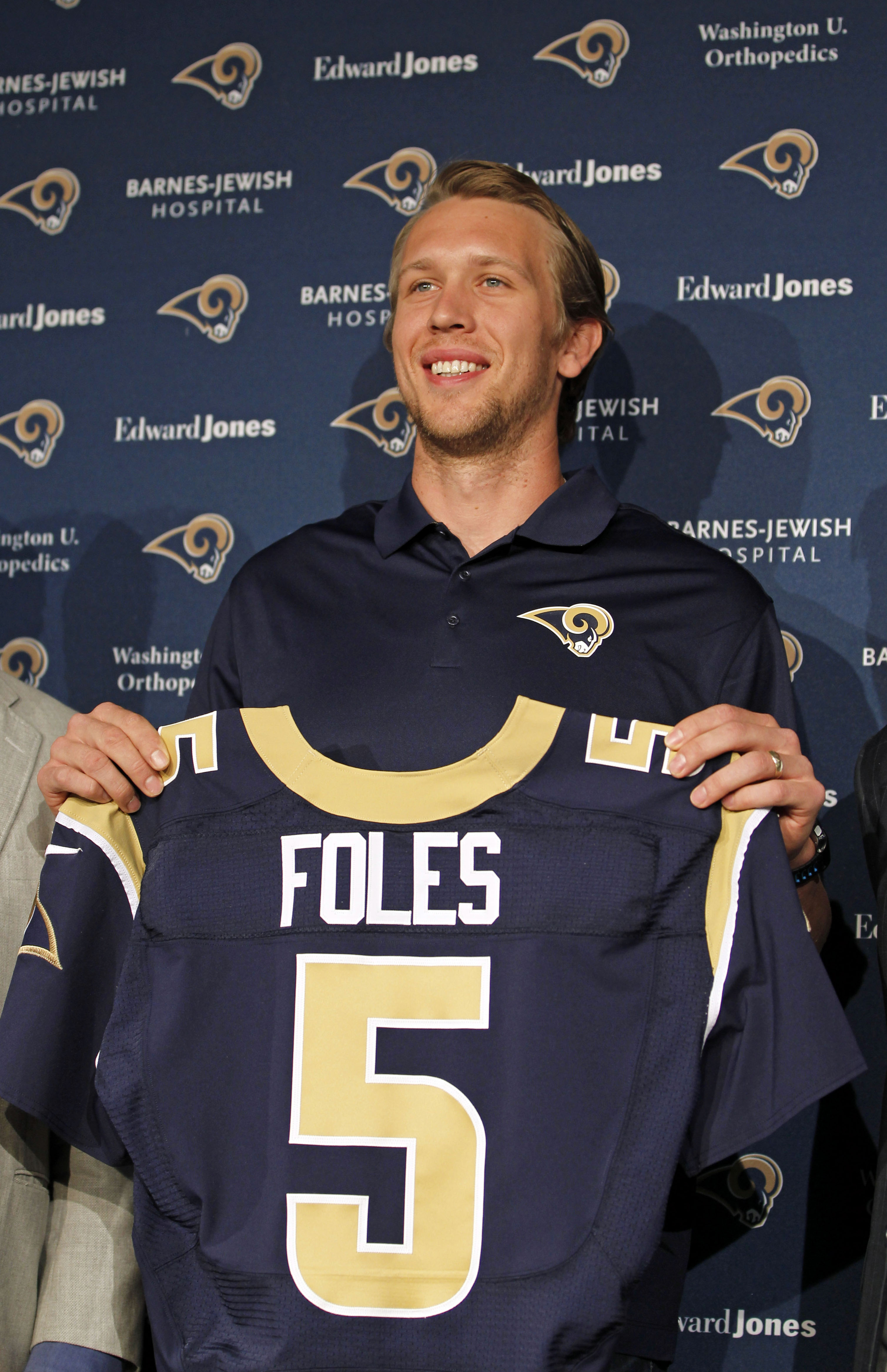 Rams in a deal involving draft picks and, more importantly, Sam Bradford – another QB who has battled inconsistency during his career – earlier this offseason.
In St. Louis, Foles will try to rebound from a mediocre 2014, give the Rams their first taste of consistently above-average QB play since Marc Bulger’s heyday nearly a decade ago, and help the team break its 10-year playoff drought. If Foles accomplishes those things – or, at the very least, reestablishes himself as a legit starter – he’ll be in line to cash in by next offseason as a free agent. There’s a chance it could happen before then, though, as the three-year veteran and the Rams have both expressed interest in a contract extension. Head coach Jeff Fisher acknowledged discussions on a new deal, USA Today’s Howard Balzer tweeted in June, after NFL.com’s Ian Rapoport reported (via Twitter) that the initial talks between the two sides would “ramp up” prior to the season. Foles has already stated both a fondness for St. Louis and a desire to remain there, but noted that his agent would handle contract negotiations, ESPN’s Nick Wagoner tweeted last month.
Given the fact that he has put up less-than-stellar numbers in two of three seasons, it would be a gamble for the Rams to give Foles an extension prior to ever seeing him throw a pass in their uniform. But, considering how important quarterbacks are and how badly Rams QBs have struggled during their playoff drought, it might be a worthwhile risk for general manager Les Snead to lock up Foles now instead of waiting and possibly seeing his price rise exponentially thanks to a bounce-back season.
The question is: How much is it going to cost for the Rams to keep Foles long term? Wagoner took a look at the issue earlier this month and concluded that the Bengals’ Andy Dalton could be used as a comparable for a hypothetical Foles contract.
Dalton signed a six-year extension worth up to $115MM (with a guaranteed $17MM, which has already been paid out) last summer. At the time, Dalton had three things in common with present-day Foles: three years’ experience, one Pro Bowl appearance, and career-best outputs in 2013. In terms of counting stats, Dalton – unlike Foles – had three straight seasons of at least 3,300 yards, including a 4,200-plus-yard campaign in 2013, three consecutive years of 20-plus touchdown passes (33 in ’13) and quarterbacked three playoff teams in a row. Incidentally, Dalton and Foles were one spot apart in Pro Football Focus’ ranking system for QBs in ’13 (Dalton was 16th, Foles 17th – subscription required).
Foles hasn’t accomplished enough to earn a deal in Dalton’s neighborhood in terms of total value, but Dalton’s contract isn’t as enormous as it looks. Given the fact that Bengals have already paid Dalton his guaranteed money, his deal isn’t an anvil going forward. That allows the Bengals to evaluate Dalton on a year-to-year basis and decide whether to continue on with him. Wagoner notes that a similar structure would make sense for the Rams on a hypothetical Foles deal.
As far as length, annual value and guarantees go, Wagoner wrote that something in the range of $12MM to $14MM per annum for four years (with roughly $20MM in guarantees) might get an extension done. If Foles signs a contract in that vicinity and pans out, he’d be a steal for the Rams. Those financial numbers would be relatively modest for a solid starter, as the yearly salary and total guaranteed money would place just inside the top 20 among today’s QBs, according to Over The Cap. For Foles’ part, accepting a contract along those lines would allow him to secure himself financially now and, if he fares well, give him another crack at a hefty payday in a few years.
There would be risk on both sides if they were to strike a deal, clearly. If the two are realistic about Foles’ worth, though, the reward should outweigh any wariness.
Photo courtesy of USA Today Sports Images.
2015 Release Candidates: NFC South
Most clubs have fairly set rosters at this point, as OTA, minicamp, and preseason performances won’t do much to alter roster composition. The majority of key releases came in March, but there are still several scenarios where certain contributors could lose their roster spot in the coming months. For the most part, we’ll focus on situations where the cap savings would be in excess of $1MM.
Because free agency has already passed, financial ramifications won’t play a huge role in these decisions; there aren’t a ton of high-profile free agents on which to spend that saved money, so these calls will mostly be made based on performance. However, any cap space saved through these potential releases could be rolled over into 2016, so that’s something clubs have to consider.
We’ve already looked at the AFC East, NFC East, AFC North, NFC North, and AFC South, so let’s dive into the NFC South…
Atlanta Falcons:
- Jonathan Babineaux, DT: The Falcons have accumulated quite a bit of defensive line depth over the past few years, signing Tyson Jackson, Paul Soliai, Adrian Clayborn, and O’Brien Schofield and using draft picks on Vic Beasley, Ra’Shede Hageman, and Grady Jarrett, as well as re-signing Kroy Biermann earlier this year. The lone constant has been the 34-year-old Babineaux, who has been with Atlanta since being selected in the second round of the 2005 draft. Given his age, the club’s newfound depth at his position, and the fact that the Falcons could save nearly $3MM by cutting him, he sounds like an ideal candidate for release, right? However, new head coach Dan Quinn likes to use a rotation along his defensive line, and more importantly, Babineaux was pretty good last year, grading as the league’s No. 28 defensive tackle and rushing the passer quite effectively, according to Pro Football Focus (subscription required). Prediction: not released.
Carolina Panthers:
- Jerricho Cotchery, WR: Spending 70% of his time in the slot last season, Cotchery nearly replicated his reception and yardage statistics from the year prior, catching 48 balls for 480 yards, but his touchdown numbers lagged far behind, as he scored just once as compared to 10 times in 2014 with the Steelers. The Panthers invested a second-round pick in Michigan receiver Devin Funchess, and the club likely hopes that he’ll ascend to the starting lineup immediately, joining last year’s first-rounder Kelvin Benjamin. Free agent addition Ted Ginn Jr. figures to take some of Cotchery’s snaps in the slot, and other than Ginn Jr., Carolina is going with at youth movement at receiver, with Jarrett Boykin, Mike Brown, and Stephen Hill fighting for playing time. Cotchery isn’t a bad player, but he doesn’t seem to fit with the team’s roster construction, and the Panthers can save $1.5MM by cutting him. Prediction: released.
- Roman Harper, S: Harper, 32, started all 16 games for the Panthers last season, posting 41 tackles and a career-high four interceptions. Based on PFF’s metrics, Harper produced his best season since 2010, but his overall grade of +0.1 was still just barely above-average, ranking 46th among 87 qualifiers. Carolina’s issues in the secondary have been well-documented in the past couple years, but now that the club has some other options in the back end — Tre Boston emerged as a rookie last year, and the Panthers signed Kurt Coleman to a two-year deal in March — I don’t see Carolina being too desperate to hanging on to Harper, especially given that they can save $1.5MM by severing ties. Prediction: released.
- Mike Tolbert, RB: Tolbert is an odd player in today’s NFL: He doesn’t fit the H-back mold, instead acting as a running back/fullback hybrid that doesn’t really exist in the league anymore. After suffering a hairline fracture in his left leg during Week 3 of last season, Tolbert was placed on IR/designated to return, ultimately coming back in Week 13. He’s nearly 30 years old, but given that Carolina doesn’t have a ton of depth behind Jonathan Stewart after releasing DeAngelo Williams, Tolbert should be safe. The Panthers would incur $1MM in dead money by cutting him. Prediction: not released.
New Orleans Saints:
- Ben Watson, TE: Those around the Saints have talked up third-year pro Josh Hill as the leading candidate to replace tight end Jimmy Graham, who was traded to the Seahawks over the offseason. But Hill doesn’t have much in the way of experience, having logged just 20 receptions during his first two seasons, and earlier today Mike Triplett of ESPN.com wrote that he expects New Orleans to use a committee approach at tight end. All of which is to say that 34-year-old Ben Watson is probably safe for 2015; the club would only save $1.5MM by cutting him, and they probably value his veteran presence enough to keep him around. Prediction: not released.
- Had the Saints not restructured the contracts of Marques Colston, Jahri Evans, and David Hawthorne earlier this year, they all would have been candidates for release.
Tampa Bay Buccaneers:
- Michael Koenen, P: Koenen is the sixth-highest paid punter in the league in terms of annual value, and his 2015 cap hit is also sixth at his position. However, he finished fourth-worst in terms of net punting average last year, and though he finished with a positive grade from PFF, he still ranked only 23rd among 41 qualifiers. Koenen has no remaining bonus money or guarantees left on his current deal, so the Buccaneers could cut him at anytime, clearing out his $3.25MM salaries for ’15 and ’16. Maybe they’ll wait until training camp or the preseason to see how Koenen looks, but I think they’ll probably cut him and look for a cheaper (and younger) option. Prediction: released.
- Brandon Myers, TE: Now 29 years of age, Myers has seen a swift decline since his high-water mark season with Oakland in 2012: His receptions have dropped from 79 to 47 to 22 in the past three seasons, while his receiving yards have decreased from 806 to 522 to 190. 2014 second-round pick Austin Seferian-Jenkins is expected to take on a larger role next season, Luke Stocker will maintain his in-lone blocking job, while Tampa also re-acquired Tim Wright via waivers. It doesn’t look like there will be a spot for Myers, or his $3MM+ in cap charges over the next two seasons. Prediction: released.
PFR Originals: 7/12/15 – 7/19/15
The original content and analysis produced the PFR staff during the past seven days:
- Four of the five franchise-tagged players reached extensions with their respective clubs, and Luke Adams posted a recap of all the action complete with contract details.
- In our Offseason In Review series, Zach Links covered the Browns, Steelers, and Vikings; Rory Parks looked at the Packers; I wrote up the Bengals; and Sam Robinson examined the Giants.
- Working through each division, I touched on the AFC South while looking at 2015 candidates for release.
- Writing that Muhammad Wilkerson probably won’t be able to reach the $100MM stratosphere occupied by J.J. Watt (and now) Justin Houston, Rob DiRe wondered if the Jets defensive end will be able to reach a long-term deal worth $70MM in his examination of the extension candidate.
- Luke went over some important remaining 2015 NFL dates on the calendar, including league meetings, the trade deadline, and more.
- We continued our Community Tailgate series, posting topics for discussions and encouraging you to voice your thoughts in the comments section. The subjects covered by Luke and Zach last week:
- Is Justin Houston was worth a $100MM contract? (link)
- Would the Broncos would reach a long-term pact with Demaryius Thomas? (link)
- Which franchise player long-term extension with the most surprising? (link)
- Who will win the NFC North? (link)
- Will Chris Johnson land a contract? (link)
Important Remaining 2015 NFL Dates
Way back in December, with the 2014 NFL season winding down, we took a look ahead at many of the important offseason dates on the league’s calendar, including the opening of free agency and draft weekend. However, the last of those key dates came will come and go by the end of July, so with training camps and the preseason nearing, it’s time to revisit the NFL calendar and check out the most crucial remaining dates in 2015.
Via an official announcement from the league, here’s a breakdown of several of the key dates we’ll be keeping an eye on at PFR in the coming weeks and months:
August 11: Summer league meeting in Schaumburg, Illinois to discuss Los Angeles situation.
September 1: Teams must reduce their 90-man rosters to 75 players by 3:00pm central time.
September 5: Teams must reduce their 75-man rosters to 53 players by 3:00pm central time. Any players on the active/PUP or active/non-football injury or illness lists may be moved to the reserve versions of those lists.
September 6: Claiming period for players waived during final roster cuts ends at 11:00am central time. After that time, teams may establish a practice squad of 10 players. After 3:00pm central time, teams are permitted to place one player on the injured reserve list with the designation to return.
September 9: After 3:00pm central time, all contracts for each team must fit under the salary cap (top-51 rule expires at 11:00pm central time).
September 29: Waiver priority order adjusted to become based on the reverse order of 2014’s standings.
October 6-7: Fall league meetings in New York City.
October 16: Players who are on the reserve/PUP and reserve/NFI lists are allowed to begin practicing for a period not to exceed 21 days. Players must be activated or placed on injured reserve by 3:00pm central time on the day following the expiration of that 21-day window.
November 3: Trade deadline at 3:00pm central time.
November 4: All released players subject to waivers for rest of regular season and postseason.
November 17: Unsigned franchise players and draft picks must sign with their respective teams by 3:00pm central time in order to play in the NFL in 2015.
November 24: Players who are on the reserve/PUP and reserve/NFI lists who have not begun practicing are no longer eligible to be activated after 3:00pm central time.
Community Tailgate: Will Chris Johnson Sign?
We’re still more than a month and a half away from the start of battles on the NFL gridiron, but there’s no offseason when it comes to debate amongst fans. Earlier this summer, we launched a new series here at PFR that will be known as the Community Tailgate. What’s the Community Tailgate all about? Well, it’s pretty simple. Every weekday, we’ll highlight one of the top stories going on in the NFL. Then, in the comment section below, we want you to weigh in and let us know what you think.
Of course, while the debate may get spirited, we ask that it all stays respectful. If you need a reminder of our rules, please check out our commenting policy. Basically, we ask that you refrain from inappropriate language, personal insults, and attacks. Speaking of commenting: we’ve made it much easier to leave a comment here at Pro Football Rumors. You are no longer required to be a registered user – simply put in your name, email address, and comment and submit.
Today, our Community Tailgate feature focuses on a report from Jason La Canfora of CBSSports.com, who wrote today that veteran running back Chris Johnson, having survived a drive-by shooting earlier this year, hopes to land with an NFL team after training camps get underway.
“Right now is kind of a dead period,” Johnson told La Canfora on CBS Radio. “But things should pick back up when (camps start). I’ve just been working hard, getting back healthy, getting in shape. Now it’s just waiting and working out and seeing what my next situation is going to be.”
Johnson, who was shot during that aforementioned drive-by, has since been medically cleared for all football activities, and La Canfora spoke to some NFL executives who believe the former Titan showed more burst last year in New York than he had in some previous seasons.
It may take an injury or two for Johnson to draw any serious interest, but a few execs who spoke to La Canfora cited the Cowboys as a possible suitor. La Canfora also identifies the Ravens, Chiefs, Broncos, and Patriots as possibilities, particularly if any of those teams have injury problems in their respective backfields.
What do you think? Will we see Johnson on a regular season roster this year, or is his time as an NFL contributor behind him? If he does continue his playing career, which team do you think he’ll be playing for this fall? Let us know your thoughts in the comment section below!
Offseason In Review: Green Bay Packers
Notable signings:
- Randall Cobb, WR: Four years, $40MM. $13MM guaranteed.
- Bryan Bulaga, T: Five years, $33.75MM. $8MM guaranteed.
- Sean Richardson, S: One year, $2.55MM. $2.35MM guaranteed. Matched Raiders’ RFA offer sheet.
- B.J. Raji, DT: One year, $1.75MM. $500K guaranteed.
- Scott Tolzien, QB: One year, $1.2MM. $100K guaranteed.
- Letroy Guion, DT: One year, $2.75MM.
- Don Barclay, OL: One year, $1.542MM. Signed original-round RFA tender.
- John Kuhn, FB: One year, minimum salary.
In January, the Packers suffered one of the more crushing playoff defeats in recent memory, blowing a 16-0 halftime lead in the NFC Championship Game in Seattle and ultimately succumbing to the Seahawks in overtime, 28-22. That game saw a fake field goal attempt result in a touchdown, a recovered onside kick, and a two point conversion that is still difficult to explain.
Despite all that, the fact remains that Green Bay was within a hair’s breadth of advancing to the Super Bowl for the second time in the Aaron Rodgers era. The Packers were finally able to establish a legitimate running game with the emergence of Eddie Lacy, and their defense was at least good enough to support the league’s most prolific offense, which racked up 486 points as Rodgers cruised to his second league MVP award.
As a result, the team did not really need to make a big splash in free agency, and it did well to retain two foundational pieces of its offense, pieces that would have been quickly scooped up by another club. Randall Cobb, perhaps the best slot receiver in the league at the moment, agreed to stay in Green Bay on a four-year, $40MM pact, which was probably $4-8MM less than he could have received on the open market. Indeed, Cobb may have had as many as seven other offers on the table, but because he chose to remain with the team that drafted him, the Packers now have the luxury of fielding one of the most dynamic receiving tandems in the game for the next few years. Cobb and fellow wideout Jordy Nelson, who signed a four-year extension with Green Bay in July 2014, combined for 2,806 yards and 25 touchdowns last season, and since entering the league in 2011, Cobb has caught a league-best 75.2% of his targets. Nelson and Cobb, along with Lacy and Rodgers, will give the Packers more than enough firepower to continue terrorizing opposing defenses.
After re-signing Cobb, the Packers quickly moved on to star right tackle Bryan Bulaga, who was also generating plenty of interest from other teams. Bulaga graded out as the league’s fourth-best right tackle last season, according to Pro Football Focus’ advanced metrics (subscription required), and he was able to stay healthy after losing almost half of 2012 and all of 2013 to injury. He received especially high marks for his pass-blocking performance in support of Rodgers, yielding just four sacks–two of which came in one game–and two other quarterback hits over the course of the season. Like Cobb, Bulaga agreed to take a contract a little under market value in order to stay in Green Bay as an integral part of a legitimate championship contender. Although the five-year, $33.75MM deal was a little out of the Packers’ comfort zone, when you have a quarterback like Rodgers, you have to give him the weapons he needs to succeed. By retaining Cobb and Bulaga one year after extending Nelson, Green Bay has managed to do just that.
Defensively, the modest one-year deals given out to B.J. Raji and Letroy Guion may not seem like major moves, but they help provide veteran stability to a fairly deep defensive line rotation. Raji has not been much of a factor in the pass rush since 2010, but after missing all of 2014 with a torn bicep, his return should at least help boost a defense that ranked 23rd against the run last year.
Guion played well at nose tackle in Raji’s stead last season, and although he could be suspended for as many as four games to begin the 2015 campaign, he should continue to be productive when he does see the field, particularly since he will likely be playing more snaps at defensive end as a result of Raji’s return. By combining Guion and Raji with Mike Daniels’ consistently excellent play against both the run and pass, not to mention potential contributions from Josh Boyd and former first-round pick Datone Jones—who will serve a one-game suspension to open the year—the Packers will field a solid, if unspectacular, defensive front.
Notable losses:
- Brandon Bostick, TE: Waived
- Jarrett Boykin, WR
- Jarrett Bush, CB
- Matt Flynn, QB
- A.J. Hawk, LB: Released
- DuJuan Harris, RB
- Davon House, CB
- Brad Jones, LB: Released
- Jamari Lattimore, LB
- Tramon Williams, CB
Although the Packers did not perform particularly well against the run last year, they made up for it by generating a great deal of pressure on opposing quarterbacks and by getting a strong performance from the back end of their defense. Unfortunately, the depth of their secondary will be tested in a big way after losing Davon House and Tramon Williams to free agency.
Williams had started almost every game for the club since 2010, and though his excellent 2010 campaign resulted in his only Pro Bowl nod, he has been a consistently above-average corner for years. At age 32, he is certainly closer to the end of his career than the beginning, and it makes sense that the Packers would not want to match the three-year, $21MM deal that Williams landed from the Browns, but his presence will certainly be missed.
House, meanwhile, was ranked above Williams in PFR’s Top 50 Free Agents, and though he saw only part-time action in nickel and dime packages with Green Bay, it is clear that he is ready for a full-time role (House allowed only 46.8% of passes thrown into his coverage to be completed, which ranked fourth among qualified corners). The Jaguars will give him that opportunity, and they will pay him accordingly, with a four-year, $25MM deal. Without House and Williams, Green Bay will need to rely on rookies Damarious Randall and Quentin Rollins, the team’s first two selections in this year’s draft, to help solidify the secondary.
Otherwise, the Packers did not suffer any major losses this offseason. The team released longtime linebackers A.J. Hawk and Brad Jones, but the on-field ramifications of those releases should not be terribly significant. Hawk, of course, had played for the Packers since Green Bay selected him with the No. 5 overall pick in the 2006 draft, and he averaged over 100 tackles per season in his nine years with the club. However, as our Luke Adams wrote when Hawk was released, “toward the end of his tenure with the franchise, the 31-year-old’s production no longer matched his salary. In 2014, he saw his playing time scaled back toward the end of the season and in the playoffs as he struggled with an ankle injury, and he recorded a -14.4 grade for the season, according to Pro Football Focus’ metrics (subscription required).” Similarly, Jones’ playing time was significantly reduced in 2014, and the team was able to clear over $7MM in salary cap space by releasing both him and Hawk.
Green Bay also ended its on-again, off-again relationship with Matt Flynn. Both Flynn and fellow backup signal-caller Scott Tolzien were unrestricted free agents, but the team elected to retain Tolzien on a one-year pact while Flynn ultimately signed with the Patriots.
Jarrett Boykin, who put together a nice season with the Packers in 2013 while filling in for an injured Cobb, caught just three passes last season and left to seek greener pastures in Carolina.
Although he will be best remembered for failing to secure the fateful onside kick that allowed Seattle to complete its comeback in last year’s NFC Championship Game, it was somewhat curious that the Packers decided to release Brandon Bostick given the team’s relative dearth of tight end talent.
Trades:
- Acquired a 2015 fifth-round pick (No. 147; QB Brett Hundley) from the Patriots in exchange for a 2015 fifth-round pick (No. 166; LS Joe Cardona) and a 2015 seventh-round pick (No. 247; CB Darryl Roberts).
In one of the more surprising moves of this year’s draft, the Packers moved up 19 spots in the fifth round to select former UCLA signal-caller Brett Hundley. Although much has been made of the similarities between the respective draft day experiences of Hundley and Rodgers—the anxious and frustrating wait, being drafted by the Packers when they already have a beloved Hall-of-Fame caliber quarterback in place, etc.—there is one major difference: Hundley will not be groomed to be Rodgers’ heir apparent. Rodgers has too many good years ahead of him for that. Rather, Hundley, who is an excellent athlete with flaws that can be fixed, may be the heir apparent to Tolzien, and if he can hone his mechanics while improving his ability to read defenses, he can develop into a quality backup that could hold some trade value in the latter stages of his rookie contract.
Draft picks:
- 1-30: Damarious Randall, S (Arizona State): Signed
- 2-62: Quinten Rollins, CB (Miami (OH)): Signed
- 3-94: Ty Montgomery, WR/KR (Stanford): Signed
- 4-129: Jake Ryan, ILB (Michigan): Signed
- 5-147: Brett Hundley, QB (UCLA): Signed
- 6-206: Aaron Ripkowski, FB (Oklahoma): Signed
- 6-210: Christian Ringo, DE (Louisiana-Lafayette): Signed
- 6-213: Kennard Backman, TE (UAB): Signed
As noted above, the Packers will need to rely on Randall and Rollins to develop into at least capable rotational pieces in order to sufficiently overcome the losses of Williams and House. Both players are highly versatile and certainly have the potential to become quality starters in the league. Ty Montgomery may not see the field much as a receiver, but his return abilities may help the Packers find the endzone even more than they did last season. Jake Ryan is a quality middle-round selection who may be able to start at inside linebacker sooner rather than later, thereby allowing Clay Matthews to shift to outside linebacker. Aaron Ripkowski is a prototypical old-school fullback who could take over for John Kuhn in the near future. Christian Ringo may crack the roster as a rotational defensive lineman or as a member of the practice squad, and Kennard Backman is a limited player who may nonetheless have a chance to crack a thin tight end corps.
Other:
- Promoted Edgar Bennett to replace Tom Clements as offensive coordinator.
- While Bennett gets the OC title, Clements will assume Mike McCarthy‘s play-calling duties.
- Learned DE Datone Jones will be suspended for the first game of the 2015 season.
- Declined 2016 fifth-year option for LB Nick Perry ($7.751MM).
- Signed 17 undrafted rookie free agents following the draft.
The Packers’ coaching staff saw saw no major hirings or firings of note, but there was one major shakeup. Tom Clements, who had previously served as the team’s offensive coordinator while head coach Mike McCarthy dialed up the offensive plays, was promoted to associate head coach and given play-calling duties. Edgar Bennett, a long-time positional coach who presided over the running backs for six seasons in Green Bay before serving as the wide receivers coach the past four years, was elevated to offensive coordinator. Bennett certainly deserves the promotion, as the receiving corps has flourished under his guidance.
Nick Perry has largely disappointed in his career in Green Bay, and the Packers consequently declined to pick up his fifth-year option, which would have cost the team $7.75MM. As a result, Perry is eligible for free agency at the end of the 2015 season. He played in all but one game last year and recorded 4.5 sacks, but he was on the field for less than 35% of the team’s defensive snaps and is not likely to see a major uptick in playing time this season, likely his last in a Packers uniform.
As noted previously, the depth of the defensive line will be tested early with the possible suspension of Guion and the one-game ban that Datone Jones received. Jones was not fully healthy until the end of last year and has not yet lived up to his status as a first-round pick, but he still has potential that he could begin to realize as a healthy part of a solid defensive line rotation.
Top 10 cap hits for 2015:
- Aaron Rodgers, QB: $18,250,000
- Clay Matthews, OLB: $12,700,000
- Julius Peppers, DE/OLB: $12,000,000
- Sam Shields, CB: $9,062,500
- Josh Sitton, G: $7,000,000
- T.J. Lang, G: $5,800,000
- Randall Cobb, WR: $5,350,000
- Morgan Burnett, S: $5,131,250
- Jordy Nelson, WR: $4,600,000
- Mike Neal, DL: $4,250,000
The Packers won the NFC North for the fourth consecutive year in 2014 and earned a first-round bye in the process, narrowly missing out on a trip to the Super Bowl. Although the Lions remain a worthy opponent and the Vikings are a trendy pick to get back into the playoffs in 2015, the Packers should once again be the favorites to capture the division. Despite the lack of a true playmaker at tight end, Richard Rodgers showed some promise as a rookie in 2014 and should provide enough of a receiving threat to take some pressure off the team’s explosive wideouts, and though there are no truly elite players on the other side of the ball outside of Matthews, there is enough quality at all three levels to at least maintain a middle-of-the-pack defense. But with Aaron Rodgers under center and the weapons he has at his disposal, there is no reason to think that the Packers cannot avenge their 2014 heartbreak and book a date to San Francisco in February 2016.
Contract information from Over the Cap and Spotrac was used in the creation of this post.
Offseason in Review: Minnesota Vikings
The Vikings didn’t do a whole lot of business in free agency but they did upgrade through trades and the draft.
Notable signings:
- Shaun Hill, QB: Two years, $6.5MM. $3.2MM guaranteed.
- Tom Johnson, DT: Two years, $7MM. $2.25MM guaranteed.
- Terence Newman, CB: One year, $2.25MM. $750K guaranteed.
- Cullen Loeffler, LS: One year, $1.05MM. $300K guaranteed.
- Joe Berger, G: Two years, $2.155MM. $130K guaranteed.
- Matt Asiata, RB: One year, $800K. $100K guaranteed.
- Mike Harris, T: One year, $1.542MM. Signed original-round RFA tender.
- Casey Matthews, LB: One year, minimum salary benefit.
- DuJuan Harris, RB: One year, minimum salary.
- Mike Kafka, QB: One year, minimum salary.
After trading Matt Cassel – who we’ll talk about in a bit – the Vikings moved quickly to fill his spot on the depth chart by signing Shaun Hill. The seasoned veteran has played for four teams, including a stint with the Vikings from 2002-05. His latest stop was in St. Louis, where he played nine games (eight starts) last year and threw eight touchdowns against seven interceptions for an 83.9 passer rating.
Tom Johnson signed with the Vikings last offseason on a one-year contract, coming off of a three-year stint with the Saints. He impressed the coaching staff with a strong year in 2014 the led him to staying with the Vikings. He graded out positively as a rotation player on the defensive line according to Pro Football Focus (subscription required), and should continue to help the team going forward. Minnesota didn’t have many impact free agents hitting the open market this year but Johnson was one of the guys they wanted to retain.
Terence Newman spent the last three seasons in Cincinnati, starting 41 regular season contests for the Bengals during that stretch. By signing with the Vikings, the 36-year-old has reunited with Mike Zimmer, who was the defensive coordinator in Cincinnati when Newman joined the Bengals. In 2014, Newman logged 75 tackles to go along with 15 passes defended and an interception, and graded as a middle-of-the-pack cornerback according to Pro Football Focus’ grades, placing 56th out of 108 qualified players at the position (subscription required).
Running back Matt Asiata was given an opportunity to shine in 2014 thanks to the absence of Adrian Peterson and, for a handful of games, he shined like a diamond. In March, Asiata was a restricted free agent and neither the running back nor the team knew what kind of role he would fill in 2015 thanks to Peterson’s status being up in the air and the emergence of freak athlete Jerick McKinnon. The two sides ultimately agreed to an incentive-laden deal that would protect Minnesota in the event of Peterson’s return and reward Asiata if he was starting and getting 20+ carries per game. Now that AD is back in action (more on that further down the page), it’s unlikely that Asiata will get to cash in on most of those incentives.
Notable losses:
- Jasper Brinkley, LB
- Vlad Ducasse, G
- Jerome Felton, FB: Opted out
- Greg Jennings, WR: Released
- Charlie Johnson, G: Released
- Christian Ponder, QB
- Corey Wootton, DE
Greg Jennings was asked to restructure his contract in order to remain with the team, but the two sides were unable to reach an agreement and that led to the wide receiver being released in mid-March. Jennings’ release saved the Vikings $5MM, but $6MM worth of dead money remains on the team’s 2015 cap. Jennings was catching passes from a combination of Matt Cassel, Christian Ponder, and even Josh Freeman during his first year with the Vikes, and never appeared to be an ideal fit. Even after Teddy Bridgewater emerged as the starter in 2014, Jennings’ production was unspectacular — he recorded just 59 receptions for 742 yards last season. That’s a far cry from his best work. During the three seasons in which he played all 16 games, from 2008 to 2010, Jennings posted three straight 1,100-yard seasons, averaging about 75 receptions, 1,223 yards, and eight touchdowns per year.
Ponder, 27, started 36 games during his four years with the Vikings, though he was essentially the team’s No. 3 signal-caller in 2014, behind Teddy Bridgewater and Cassel on the depth chart. The former No. 12 overall pick is now with the Raiders and will serve as the understudy to Derek Carr. All throughout 2014 it was widely speculated that Ponder’s time in Minnesota was drawing to a close.
As a youngster with the Jets, the rap on Vlad Ducasse was that he was an extremely green (no pun intended) lineman with immense strength. Throughout his first four seasons with the Jets and his 2014 campaign with the Vikings, Ducasse still looked rather raw and never fulfilled his second round potential. The UMass product started just five games during his time with New York. He topped that number in ’14 alone, starting six contests in Minnesota while playing at both guard positions. In total, Ducasse played in 13 games last season, totaling 417 snaps, but graded as the league’s No. 61 guard among 78 qualifiers per Pro Football Focus (subscription required). The Vikings, understandably, didn’t make a great effort to keep him.
Jasper Brinkley wanted to return to Minnesota and in March, he made that known to everyone.
“I would love to come back,’’ Brinkley said. “They gave me an opportunity and it still feels like home for me. I would love to definitely come back. Coach Zimmer is doing great things with the team, turning the culture around there and everything is on the up and up.’’
Ultimately, however, that was not to be, as Brinkley wound up signing a two-year pact with the Cowboys. The veteran started 11 games for Minnesota last season, compiling 54 tackles and one sack.
Veteran guard Charlie Johnson started 61 of 64 potential regular season games for the Vikings over the past four years, but he was not welcomed back for the 2015 season. Despite his extensive experience (115 career starts), the 31-year-old received a negative grade from Pro Football Focus (subscription required) in each of his four years in Minnesota, including a -12.1 mark in 2014.
Corey Wootton, 28, spent the first four seasons of his NFL career in Chicago before joining the Vikings for the 2014 season. While he has never been an every-down player, Wootton saw 22 starts and totaled 10 sacks during his final two seasons with the Bears. Last year in Minnesota, he came off the bench and recorded just a single sack.
Trades:
- Acquired a 2015 fifth-round pick and a 2016 seventh-round pick from the Bills in exchange for QB Matt Cassel and a 2015 sixth-round pick.
- Acquired WR Mike Wallace and a 2015 seventh-round pick from the Dolphins in exchange for a 2015 fifth-round pick.
- Acquired a 2015 third-round pick (No. 80) and a 2015 sixth-round pick (No. 193; DL B.J. Dubose) from the Chiefs in exchange for a 2015 third-round pick (No. 76; WR Chris Conley).
- Acquired a 2015 third-round pick (No. 88; DE Danielle Hunter) and a 2015 fifth-round pick (No. 143; TE MyCole Pruitt) from the Lions in exchange for 2015 third-round pick (No. 80; CB Alex Carter).
- Acquired a 2015 fifth-round pick (No. 146; WR Stefon Diggs) and a 2015 sixth-round pick (No. 185; T Tyrus Thompson) from the Falcons in exchange for a 2015 fifth-round pick (No. 137; DT Grady Jarrett).
Exit Jennings, enter Mike Wallace. On March 13th, the Vikings acquired Wallace and a seventh-round pick from the Vikings for a fifth-round choice. Wallace, who spent the first four years of his career in Pittsburgh, signed a five-year, $60MM contract with the Dolphins prior to the 2013 season. He subsequently caught 140 passes for nearly 1,800 yards and 15 touchdowns during his two years in Miami. The Dolphins will replace him with fomer Saints wide receiver Kenny Stills, who hauled in 63 passes for over 900 yards as a second-year man in 2014. Wallace is coming off a campaign that saw him tie a personal best with 10 TDs, giving him 47 for his career, and the Vikings hope to see more of that in 2015.
The Vikings probably didn’t mind parting with a fifth-rounder since they added one from the Bills in the Matt Cassel trade. For the Vikings, Cassel was largely expendable since he was their backup to Teddy Bridgewater. The Bills, however, were faced with major question marks at the quarterback position and needed to make a move for a proven vet.
Extensions/Restructures:
- John Sullivan, C: Extended through 2017. Base salaries of $7MM, $5.5MM, $5.5MM. $1MM signing bonus.
Pro Football Focus (subscription required) ranked John Sullivan as one of the league’s better centers in 2014, with a +7.5 run-blocking grade buoying him to a 12th-place finish among 41 qualified players at the position. It was no surprise that the Vikings offered him another year on his deal.
Draft picks:
- 1-11: Trae Waynes, CB (Michigan State): Signed
- 2-45: Eric Kendricks, ILB (UCLA): Signed
- 3-88: Danielle Hunter, DE (LSU): Signed
- 4-110: T.J. Clemmings, T (Pittsburgh): Signed
- 5-143: MyCole Pruitt, TE (Southern Illinois): Signed
- 5-146: Stefon Diggs, WR (Maryland): Signed
- 6-185: Tyrus Thompson, T (Oklahoma): Signed
- 6-193: B.J. Dubose, DL (Louisville): Signed
- 7-228: Austin Shepherd, OL (Alabama): Signed
- 7-232: Edmond Robinson, OLB (Newberry): Signed
The Vikings were widely connected to Michigan State standout Trae Waynes in the weeks leading up to the draft and they did not make fools of the prognosticators. Waynes possesses top-end speed and many believe that he will be a natural fit for Zimmer’s system. Mike Mayock of NFL.com is one of the many pundits who feels that Waynes is an outstanding corner, particularly in press coverage. As a junior in 2014, Waynes three interceptions and eight pass breakups and finished sixth on the team with 46 tackles.
After taking Anthony Barr in 2014, the Vikings went back to the well when they took fellow UCLA linebacker Eric Kendricks. Kendricks boasts solid in-game speed and can also drop back for man-to-man coverage when needed. If Kendricks can add weight to his frame without losing speed, he could have a very bright NFL future ahead of him.
Other:
- Learned RB Adrian Peterson was reinstated by the NFL.
- Exercised 2016 fifth-year option for T Matt Kalil ($11.096MM).
- Exercised 2016 fifth-year option for S Harrison Smith ($5.728MM).
- Signed, and then released, S Taylor Mays. $10K in dead money will remain on 2015 salary cap.
- Claimed TE Brandon Bostick off waivers from the Packers.
- Signed nine players to reserve/futures contracts.
- Signed 10 undrafted rookie free agents following the draft.
Of course, the biggest story for Minnesota didn’t have anything to do free agency, trades, or the draft. Instead, the Vikings waited and waited to find out if they’d have the services of embattled running back Adrian Peterson and in April, they got confirmation of his reinstatement. Just one problem: Peterson and his agent said that he would not suit up for the Vikings without a sign of a “commitment,” which everyone took to mean that AD wanted the remainder of his contract guaranteed. Ultimately, the Vikings did not blink in that stare-down and came out on top. The 30-year-old is under contract for three more years, and is scheduled to earn a $12.75MM base salary this season.
Since entering the league as the 29th overall pick in 2012, Harrison Smith has evolved into one of the NFL’s most effective free safeties — in 2014, he had his best year yet, compiling 92 tackles, five interceptions, and three sacks for the Vikes.
Matt Kalil, on the other hand, has struggled. Although he earned a Pro Bowl berth in his rookie season, and has started all 48 regular season games at left tackle for Minnesota since being selected fourth overall, the 25-year-old has regressed over the last couple years, according to Pro Football Focus’ data (subscription required). PFF assigned Kalil a -21.1 grade as a pass blocker in 2014, which ranked 83rd out of 84 qualified tackles. Still, neither player’s salary is fully guaranteed until the first day of the 2016 league year, so as long as Kalil doesn’t sustain a significant injury, the Vikes will still be able to move on from him after this season if they so choose.
Top 10 cap hits for 2015:
- Adrian Peterson, RB: $15,400,000
- Mike Wallace, WR: $9,900,000
- Everson Griffen, DE: $8,200,000
- John Sullivan, C: $7,333,333
- Phil Loadholt, RT: $6,750,000
- Kyle Rudolph, TE: $6,440,625
- Matt Kalil, LT: $6,290,644
- Greg Jennings, WR: $6,000,000 (dead money)
- Brian Robison, DE: $5,650,000
- Chad Greenway, LB: $5,575,000
For several months there were rumblings that Peterson would force his way out of Minnesota – possibly into the welcoming arms of Jerry Jones. As we look ahead to training camp, No. 28 is still in purple and the Cowboys are, somewhat surprisingly, without a blockbuster running back. The Vikings held on to Peterson and with all of their other core players under contract through 2016, they didn’t lose much of anything this offseason. The Vikings have a real chance to take the NFC North, but much of their success will rest on the 30-year-old shoulders of Peterson, who may have to battle some rust before getting back to his old form.
Contract information from Over the Cap and Spotrac was used in the creation of this post.