
NFC West Notes: Wilson, Irvin, Lee, Gunter
Contract talks between the Seahawks and Russell Wilson are going “a little slow,” according to head coach Pete Carroll, reports Bob Condotta of the Seattle Times (via Twitter). They are talking, but are not progressing as fast as the two sides would like. Condotta writes that Adam Schefter of ESPN followed that news up by reporting that Wilson is looking for guaranteed money of a quarterback while the Seahawks are trying to sign him for less (via Twitter).
Here are some other notes from around the NFC West:
- Condotta also points out that while Carroll says nothing is final about a possible extension for former first-round pick Bruce Irvin, but also says nothing to a report that the Seahawks would like to trade the young linebacker (via Twitter).
- The 49ers have not asked punter Andy Lee to take a pay cut, but drafting Clemson punter Bradley Pinion in the fifth-round certainly puts his future with the team in question, according to Jason Cole of Bleacher Report (via Twitter). Cole notes that Lee is scheduled to make $2.05MM in base salary in 2015, suggesting the team could look to save some money at that position on the roster.
- The Cardinals felt forced to trade up in the fourth round to select Delaware State’s Rodney Gunter, as they were convinced that another team drafting in that area was going to take their coveted defensive line prospect, according to Kent Somers of AZCentral.com (via Twitter).
- After drafting Missouri receiver Bud Sasser in the sixth round, Jim Thomas of the St. Louis Post-Dispatch notes Rams have now gone with an offensive player in all six of their selections in the 2015 NFL Draft (via Twitter). They have taken three offensive linemen, a quarterback, and a running back to go along with Sasser so far, in hopes of building up an offense that has been far behind their stout defense the past few seasons. The last defensive player they have chosen was Michael Sam in the seventh round last year.
Saints Acquire No. 167 Pick From Washington
The Saints have moved back into the fifth round to pick No. 167, finding a trade partner in Washington, reports Mike Jones of the Washington Post (via Twitter). That No. 167 pick was originally owned by the Seahawks, who traded it to Washington as part of the package to move up into round three for Tyler Lockett.
The Saints have used that selection to continue to bolster their secondary by drafting cornerback Damian Swann out of Georgia, according to Larry Holder of NOLA.com (via Twitter). The Saints had already added cornerback P.J. Williams out of Florida State in the third round.
Washington will receive a a sixth-round pick in this draft (No. 187) along with a sixth-round selection in the 2016 NFL Draft to move back, according to Jones (via Twitter).
Colts Acquire No. 151 Pick From 49ers
The Colts have traded up in the fifth round to No. 151, trading with the 49ers according to the team’s official Twitter account. The Colts will give up their fifth-round pick (No. 165) and a seventh-round pick (No. 244) in order to move up to that spot.
The Colts make the trade in order to select Stanford defensive tackle David Parry, reports Mike Chappell of IndySportsCentral.com (via Twitter).
The team has made an effort to rebuild their defensive line this offseason by signing Kendall Langford. They also drafted Parry’s teammate on the defensive line Henry Anderson yesterday in round three. After losing in the AFC Championship game to a Patriots’ team that was able to run all over them, becoming more stout in the front seven was a priority for general manager Ryan Grigson.
Packers Acquire No. 147 Pick From Patriots
The Packers have moved up to No. 147, finding a trade partner with the Patriots, reports Ben Volin of the Boston Globe (via Twitter).
The Packers have used that pick to select UCLA quarterback Brett Hundley, according to Adam Schefter of ESPN (via Twitter).
Hundley will slide in as a developmental backup for Aaron Rodgers. The UCLA passer was once thought of as a future superstar, but failed to developed despite impressive statistics in college. The Packers aren’t remotely looking to move on from their All-Pro passer, but Hundley does provide tremendous upside if he can improve his accuracy and decision making in the NFL.
The Packers could come away with a high-end backup in Hundley, who – if he develops properly – could be traded to a quarterback-needy team in a few years for a nice pick, while providing some injury insurance for Rodgers in the meantime. The 32-year-old Rodgers isn’t expected to retire anytime soon, but Hundley may be ready to be a Pro-Bowl talent at quarterback by the end of his rookie deal if he can overcome some of the weaknesses in his game.
In return for pick No. 147, the Patriots will receive a fifth rounder (No. 166) and a seventh rounder (No. 247) from Green Bay, writes Jeff Howe of the Boston Herald (via Twitter).
Pro Football Rumors Mock Draft 2.0
The NFL draft gets underway later today, finally giving football fans across the country (and around the world) the opportunity to find out how their favorite teams will supplement or rework their rosters over the weekend. The prospects drafted in the next three days will swing games next season, and in some cases, they’ll become part of a future championship team’s core group of players.
Since our first Mock Draft almost three weeks ago, we have examined every position group in our 2015 NFL Draft Breakdown Series. With dozens of prospects analyzed, scouting reports read, and team needs examined, here is our updated version just in time for tonight’s first round.
- Tampa Bay Buccaneers – Jameis Winston, QB, Florida State
Winston still seems like a lock for the first pick. If the Buccaneers are running a long con on everyone, maybe they will go with Marcus Mariota or even trade the pick to a quarterback-needy team. That wouldn’t be the craziest draft-day scenario of all time, but Winston should find out he is staying in the Sunshine State on Thursday. - Tennessee Titans – Marcus Mariota, QB, Oregon
Mariota almost fell out of the top 10 in our first mock, but with a number of teams reportedly interested in trading for him, his stock is on the rise. I still don’t see the fit in Ken Whisenhunt‘s offense, but I think the Titans are more likely to either draft Mariota or trade the pick so someone else can take him, rather than drafting another player here. If the Buccaneers are serious about their interest in Mariota, the Titans could trade up one spot for Winston, who fits Whisenhunt’s preferences on the field.
- Jacksonville Jaguars – Amari Cooper, WR, Alabama
Cooper is the best receiver in this class, and the Jaguars could grab a number one receiver here and put together a formidable set of weapons for Blake Bortles to work with in Jacksonville. I still think this pick could go in a couple different directions, with Dante Fowler Jr. as the presumed favorite, but after the team was so secretive about selecting Bortles last year, their reported interest in Fowler has Jedi-mind tricked me into going the other way here. I’d guess we’re looking at a 35% chance of the team drafting Fowler and a 35% chance for Cooper, with a Leonard Williams pick or a trade down comprising the remaining 30%. - Oakland Raiders – Leonard Williams, DT, USC
The Raiders miss out on their presumed top receiver if the draft breaks out this way, but still have the opportunity to take Kevin White at No. 4 if they so choose. Unfortunately for David Carr‘s stat line, given this year’s deep receiver class, the team can’t pass on Williams, who may have given Cooper a run for his money at this spot anyway. - Washington – Dante Fowler Jr., OLB, Florida
Marijuana-related incidents have created character red flags for Randy Gregory and Shane Ray, but fortunately for Washington, Fowler is still on the board. The team could use a versatile pass rusher, and can afford to pass on a receiver. Brandon Scherff could be a good fit here, and Washington would probably love to trade down to a spot where it would be more appropriate to nab a cornerback or offensive lineman, but GM Scot McCloughan and co. should be happy Fowler is available if they don’t want to roll the dice on Gregory or Ray. - New York Jets – Randy Gregory, OLB, Nebraska
Gregory might be the best overall player in this draft, and if Washington is scared off, the Jets reap the benefits. This probably doesn’t happen if Cooper or Mariota is available, and if they get a good offer to trade down, the Jets could target Scherff or Andrus Peat. However, this scenario worked out perfectly for the team to take Gregory. - Chicago Bears – Kevin White, WR, West Virginia
The Bears could use a pass rusher, but White is too good a value to pass up. Ray’s marijuana incident could take him out of the running here, and I am sure Chicago is hoping Williams somehow falls to this spot. In this scenario though, White slides into Brandon Marshall‘s spot on the offense, as the Bears try to rebuild on the fly. - Atlanta Falcons – Shane Ray, OLB, Missouri
Ray’s incident only costs him a few spots from our last mock to this one, as Dan Quinn gets a big-time pass rusher for his first stint as a head coach. Pass rusher is Atlanta’s biggest need, and both Vic Beasley and Bud Dupree would be in play here. Neither has an off-the-field issue on the record, but Ray is leaps ahead of both as a polished edge rusher. The Falcons would really like to make a move up to No. 3 to grab Fowler, whom Dan Quinn coached at Florida. It would be a big jump, but Quinn has a good relationship with Jaguars head coach Gus Bradley, and if we see a blockbuster move from either team, I expect it to net the Falcons the top pass rusher on their board. - New York Giants – Brandon Scherff, OT, Iowa
Somehow, no matter how the draft plays out, the Giants seem to have a good chance at getting Scherff at this spot. The best offensive lineman in the draft and one of the most fun players in this class to watch, he should be a day one starter somewhere along the offensive line. Where he plays doesn’t matter so much — the Giants are smart enough to figure that out later. - St. Louis Rams – DeVante Parker, WR, Louisville
The Vikings would probably love Parker, but the Rams can’t pass him up. St. Louis hasn’t had any consistency in its passing game since Torry Holt and Isaac Bruce retired, and Parker could change that in a hurry — he’s just about as good a prospect as either Cooper or White. - Minnesota Vikings – Trae Waynes, CB, Michigan State
Teddy Bridgewater doesn’t get his former Louisville teammate, and while the Vikings would probably rather trade down a few spots, they get their tall, fast cornerback to pair with Xavier Rhodes in the secondary. The team could fill their need at receiver later in the draft, and address the offensive line sometime on day two. - Cleveland Browns – Vic Beasley, OLB, Clemson
My instinct is to purposely sabotage this pick, but that’s only because I am taking the Mock Draft too seriously and trying to channel the Browns’ thought process. Then again, I’m not a fan of Beasley, but he does have the physical tools to warrant a pick here. Cleveland could also get an interior defensive lineman or a receiver in this spot, but the feeling is both those positions will be in play at No. 19. - New Orleans Saints – Marcus Peters, CB, Washington
The Saints have needs at cornerback, pass rusher, receiver, and offensive line, and they own five picks in the first three rounds. Still, I see them coming out with defense. Dupree would be an easy fit if New Orleans weren’t in win-now mode, and the team could get good value among their pick of offensive linemen. Beasley would have been a slam dunk, but the Saints get a good cover corner in Peters. - Miami Dolphins – La’el Collins, OG, LSU
The Dolphins have a bunch of holes on the team, and the Ndamukong Suh signing will have their salary cap hamstrung for years. If Parker, Wayne, or Peters fall to this pot, Miami could go in another direction, but with all three off the board, Collins could shore up the offensive line at a number of spots and immediately begin protecting Ryan Tannehill. Of course, Collins is wanted for questioning by police in Louisiana, but if we take their word that he’s not a suspect in that case, I’m assuming he won’t plummet down teams’ draft boards. - San Francisco 49ers – Arik Armstead, DE, Oregon
Cornerback is still a possibility here, even with the top two off the board, and Peat would make sense as a swing tackle. However, the Niners should be thrilled to get Armstrong, who should help create nightmares for quarterbacks when he’s paired with Aldon Smith. - Houston Texans – Breshad Perriman, WR, UCF
Without an obvious need besides inside linebacker, the Texans are free to take a flier here. I would hope if it came down to receiver they would pull the trigger on Dorial Green-Beckham, but Perriman is more likely. With DeAndre Hopkins and Cecil Shorts on the roster, Perriman’s speed could add a new dimension to the offense. - San Diego Chargers – Andrus Peat, OT, Stanford
Melvin Gordon and Todd Gurley are both in the running here, but I hate the idea of using a first-round pick on a running back. Peat, on the other hand, is a swing tackle with the talent to come in and start on either side of the line. It’s more likely San Diego finds a running back in rounds two or three rather than finding a starting-caliber tackle in those rounds. Malcolm Brown and Danny Shelton would both also make a lot of sense here. - Kansas City Chiefs – Dorial Green-Beckham, WR, Missouri
I once again thought of giving the Chiefs Cameron Erving to plug in at center, but this team needs a receiver in a bad way, even after signing Jeremy Maclin. I like Green-Beckham a lot more than most, and my job isn’t on the line by writing his name in here — I understand why this is a risky move for a general manager to make. Still, Andy Reid isn’t afraid of a troubled player, and nobody on the board is going to help this team score touchdowns in the passing game better than Green-Beckham. - Cleveland Browns (from Buffalo) – Danny Shelton, DT, Washington
The Browns already got their pass rusher at No. 12, and I think the way the board falls they pass up a receiver here to really solidify their defense. Shelton isn’t my favorite player, but he’s a mammoth on the interior defensive line, and he should help open up things for other players in the defense. While Jaelen Strong and Nelson Agholor could be options, the Browns can afford to wait until round two for a pass catcher at this point. - Philadelphia Eagles – Bud Dupree, OLB, Kentucky
The Eagles need a corner in a bad way, but I don’t view Kevin Johnson as a great fit and Jalen Collins is a bit of a reach. I imagine Dupree’s physical skills will really entice Chip Kelly, even if that leaves Marcus Smith as the odd-man out in the linebacker depth chart. I was tempted to give the team a running back here just to make enemies in Philly, but realistically Kelly could go a number of ways, and I’m pretty sure he values players very differently than I do (or anyone else does, for that matter), so this was a tough pick. - Cincinnati Bengals – Cameron Erving, C, Florida State
Without an obvious pass-rushing option on the board, I am leaving Erving to the Bengals. He should solidify a very good offensive line and keep a strong team moving forward. Cincinnati could target a receiver or defensive line help here, or even go for one of the tackles, but Erving is the sort of prospect who could improve the team as a rookie, and the value in that is too hard to pass up. - Pittsburgh Steelers – Kevin Johnson, CB, Wake Forest
If Dupree were available here, he’d have been a great project with high upside for the Steelers, but the team is in desperate need of secondary help and Johnson is a very solid corner who can hold up in man coverage or in the cover three. Pittsburgh needs a safety as well, but without a standout in that group, Johnson is a more valuable player. - Detroit Lions – Malcolm Brown, DT, Texas
I don’t know how the Lions landed Brown again in this version of the mock, but good for them. They keep filling the hole left behind by Suh and Nick Fairley, Brown will join Haloti Ngata as a menacing interior line duo. The team could have targeted Gurley or a cornerback, and could always improve along the offensive line. - Arizona Cardinals – Todd Gurley, RB, Georgia
I don’t want to give the Cardinals a running back, but I just have to at this point. If Johnson or one of the better pass rushers is on the board, it’s easier to let Gurley go, but the board is begging them to take the Georgia runner. Andre Ellington averaged 3.3 yards per carry in 2014, and Arizona needs the extra juice in the backfield. Taking Gurley over Gordon is risky given his injury history, but he’s the better prospect. - Carolina Panthers – Ereck Flowers, OT, Miami
I think this is a pretty easy call for the Panthers. I know they need secondary help and would love another receiver, but with Flowers on the board, they have to prioritize tackle. Corner and receiver will come later in the draft — for now, they have a probable starter at right tackle who has the potential to move to the left. - Baltimore Ravens – Byron Jones, CB, UConn
The Ravens are a great candidate to move back off this spot, and there isn’t an obvious fit with the team. Gordon could come in and help immediately, but I don’t see Ozzie Newsome pulling the trigger on a first-round running back. The best corner available is probably P.J. Williams, but his DUI charge might scare teams off, even though it was dismissed — and Jalen Collins‘ footwork is even scarier. Jones is a versatile player who should be able to handle himself on the outside. If not, the contingency plan to move him to safety if necessary, which would fill a need anyway. - Dallas Cowboys – Eddie Goldman, DT, Florida State
I still love Goldman here, as he’s just too solid to pass up. I think he ends up being a very good run defender for a long time, and he makes the linebackers better by eating up space on the inside of the Cowboys’ defense. Running back is in play, and cornerback or free safety could be positions Dallas looks at, but Goldman is the guy who brings the immediate impact, assuming the team is confident he will hold up against NFL offensive linemen. - Denver Broncos – D.J. Humphries, OT, Florida
This is another pretty easy decision, as Humphries can come in and start from day one in an attempt to extend Peyton Manning‘s championship window. Humphries will have a lot of pressure to fill in at right tackle and keep his quarterback healthy. Jordan Phillips and Carl Davis could both be replacements for Terrance Knighton in that defense, and Phillips especially could handle the nose tackle role well. - Indianapolis Colts – Jordan Phillips, NT, Oklahoma
I thought pass rusher would be a good idea here, but with Robert Mathis, Trent Cole, and – for the optimistic – Bjoern Werner on the roster already, that might be a luxury pick. The Colts added to the defensive line already, but bringing in this big fella could change the dynamic of the middle of the defense. Safety is also in play, and Damarious Randall could be the first safety taken here if the Colts think they’ve done enough with the defensive line. There are also a few guards that are valued as early second-round picks the Colts could jump on. - Green Bay Packers – Eric Kendricks, ILB, UCLA
I wanted to get cute with the Packers because they don’t have many holes, and I wanted to fit Shaq Thompson into my round one. However, common sense won out. The reason the Packers don’t have holes is because they don’t get cute. They target good football players. Kendricks is the best linebacker in the draft, and the Packers’ only real need is at inside linebacker. Kendricks can play the run and cover tight ends. He makes the defense better and allows Clay Matthews to stay on the edge. Phillips would have been a great fit here as well, and the Packers could also consider Davis. - New Orleans Saints (from Seattle) – Eli Harold, OLB, Virginia
The Saints could definitely look at a receiver here, and I considered given them one of Agholor and Phillip Dorsett, but the Saints just gutted their offense, and it appeared that the purpose was to get better on defense — Harold makes them better on defense. He does a great job getting after the quarterback, and should improve at the next level - New England Patriots – P.J. Williams, CB, Florida State
With Darrelle Revis and Brandon Browner moving on after only one season, Williams fills a need and is a great value at corner. He could have gone higher without the off-the-field concerns, and Bill Belichick could turn around his bad luck with corners by hitting this pick. Of course, it would surprise me more if I’m right about this pick than if the team traded back a few spots and picked up an extra pick somewhere along the way.
Like last time, I’m letting the Bills and Seahawks in on the fun by projecting a player to them with their first picks in the second round.
50. Buffalo Bills – Lorenzo Mauldin, OLB, Louisville
Last time we ran through the possibilities for the Bills at No. 50, I had them taking a running back, not because it was their biggest need but because it was the position and player I was most certain would be available. The subsequent three weeks have provided some clarity, and if Rex Ryan is thinking like I am, he could view Mauldin as a perfect fit as a pass-rushing specialist in his defense. Whether Mauldin is there or not depends on what happens with the pass rushers early in the draft. This is a player I thought would be a great fit for the Jets in round two if they decided to go with another position in round one. He’s also a guy the Saints could target if they miss on a pass rusher with both of their first-rounders. Some projections have him falling to the third round, but he’d be a solid pick here, and the Bills could look to add depth at running back or in the secondary later in the draft.
63. Seattle Seahawks – Hroniss Grasu, C, Oregon
The Seahawks will draft at least one receiver and one corner in this draft, but I doubt they’ll prioritize any position over the interior offensive line with their first pick. A.J. Cann and Tre Jackson are my favorite players on the inside, and Laken Tomlinson has a chance to go ahead of both of them. It isn’t clear who will end up being available at No. 63, and Ali Marpet might still be a logical choice based on the board, but I worry about waiting 62 picks to take a Division III prospect with my first selection. Marpet might be a good value, but if a D-III player headlines your draft board and flames out, that’s going to stick out. Grasu is a more known commodity, and could step in at center right away to replace the departed Max Unger.
2015 NFL Draft Breakdown: Safeties
With the NFL draft now right around the corner, we have one last position group to parse through before our 2015 NFL Draft Breakdown Series comes to a close. We finished up the offensive side of the ball last week, and have gotten through most of the defense so far.
If you missed the previous installments of the series, you can go and check out the other positional breakdowns here:
- Quarterbacks
- Running Backs
- Wide Receivers/Tight Ends
- Offensive Line
- Defensive Line
- Pass Rushers
- Linebackers
- Cornerbacks
Finally we’ve arrived at our last breakdown, examining a group of safeties that are coming into the NFL at a very strange time for the position.
Earl Thomas and Kam Chancellor still give teams hope that they know what they’re doing when evaluating safeties. Thomas is the prototypical center fielder, while Chancellor fills the in-the-box tackler role. However, Thomas is one of the hardest hitters in the league, and Chancellor runs well in both zone and man coverage.
Another traditional safety who general managers can wrap their heads around is Devin McCourty, a converted corner. Calvin Pryor and Ha Ha Clinton-Dix were valued as first-round picks, but Deone Bucannon and Jimmie Ward unexpectedly sneaked into the end of day one. Four safeties were taken in the first 33 picks in 2013 as well. Teams need versatile defenders in the middle of the field, to play outside linebacker and nickel corner and cover deep middle, and over the past few years they’ve been willing to pay a premium to acquire them.
Day One:
- Landon Collins, Alabama
- Damarious Randall, Arizona State
Safety is considered to be one of the weakest position groups in this draft, and the player who has been at the forefront of the class is Collins, whose stock epitomizes the league’s feelings about the class as a whole.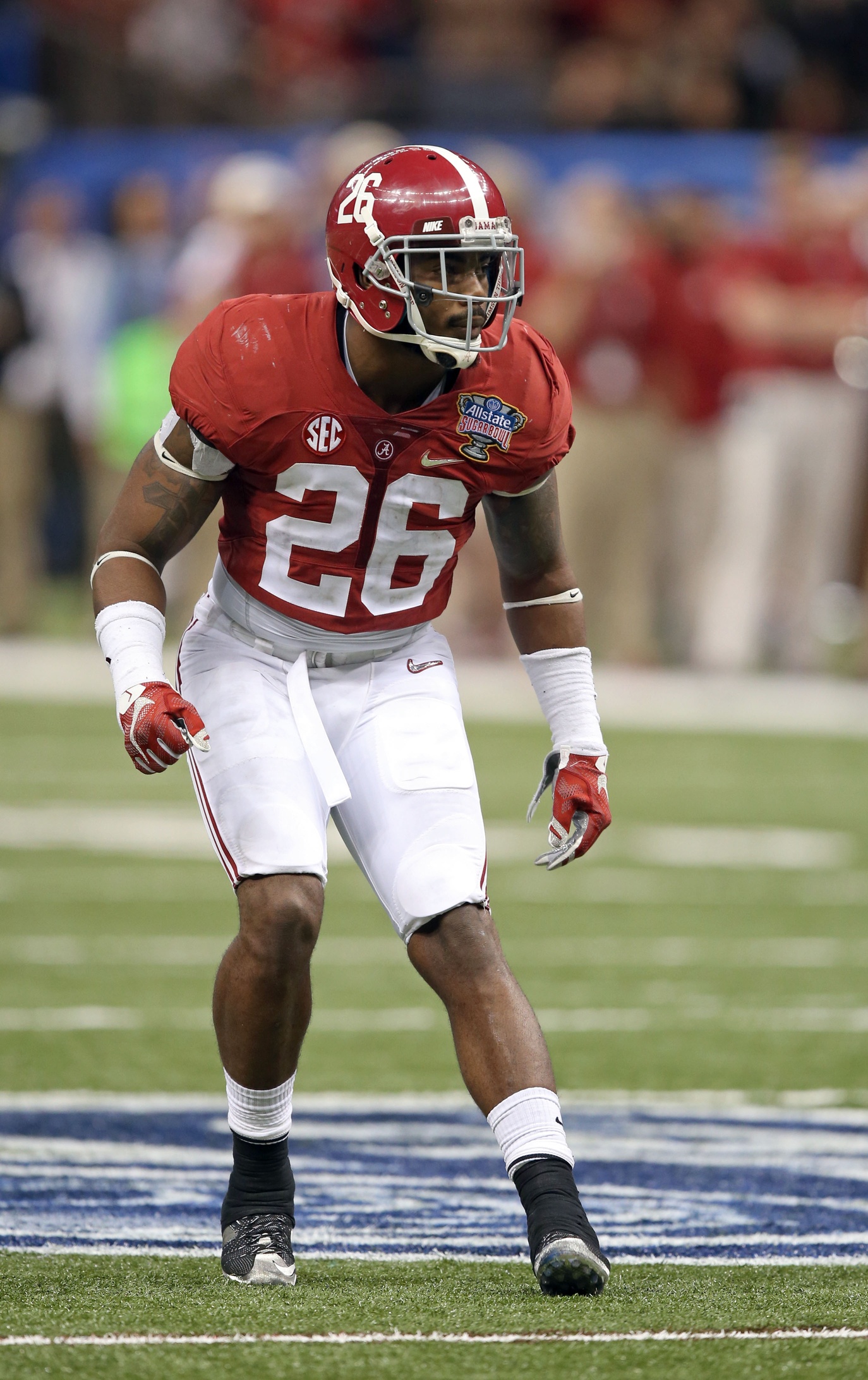
Collins is not going to come in like Ward and cover slot receivers as a nickel corner. He isn’t going to go back to deep center field and track down the long throws like Clinton-Dix does. He isn’t even going to be a hybrid safety like Pryor who can play in the box and down the field. Collins essentially has one strength, and one strength only: coming up and stopping the run from the strong safety position.
Teams might not mind adding that skill to the team, but it has diminished value in today’s NFL. First of all, defensive backs who tackle well don’t always translate that skill to the pro game. Pryor struggled with it early last year, and even a cornerback like Dee Milliner went from being the nation’s best tackler at his position to one of the NFL’s worst his rookie year.
The hope is that Collins can be a bigger, stronger version of Bucannon, which is fine. Of course, that considerably narrows down his list of potential suitors. The Eagles and Patriots have need at the position, but will likely look for a more versatile player. And while the Cowboys, Ravens, and Panthers could add a safety, those three teams figure to value a player with coverage skills over a run stopper. The Steelers and Colts are both looking to replace safeties. The Colts could be wary of taking another player in the mold of LaRon Landry, and Troy Polamalu is above simply being replaced, but no matter where Collins goes, I imagine his struggles in coverage will be a subject of conversation in the draft room.
For anyone who believes those problems are overstated, the last two defensive drives of the Ole Miss game should be submitted into evidence. With Alabama up a touchdown, Collins is lost in no-man’s land during a 34-yard post down the center of the field that went for a touchdown to tie the game. Two minutes of game time later, he gets beat badly in man coverage on a wheel out of the backfield on third-and-goal from the 10-yard line. He stays flat-footed and allows the running back to run right past him for the game-winning score, turning around just in time to see the ball float gently into the hands of his man.
There will be a point in the draft where Collins’ value is too great to pass on him. Still, like some of the pass rushers in this class, his dependence on scheme fit could cause him to drop significantly if one or two of his logical suitors decide to pass on him.
Collins’ versatility issues have opened up the door for a riser at the safety position, with Randall now generating some buzz as a first-round pick and possibly the first safety off the board. In Randall, we have without a doubt a superior safety in coverage, even if he isn’t the premier center fielder teams would target a little earlier in the first round.
Randall doesn’t have ideal height, but he’s one of the best athletes at the position. Pundits have suggested he might have the ability to transition to cornerback if he’s coached well, though he’d be a much less polished prospect if he made that move. Despite his small frame, he does try to play with some physicality, even though he rarely goes for the big hit and can often be found grabbing at ankles.
There isn’t a lot of tape of Randall tightly contesting throws or taking on bigger runners, and both of those aspects could be a concern. I’m not so sure the transition from corner to safety will be that easy, but he does have the talent to come off the board in the first round. Unless a team falls in love with Collins’ size and needs a safety to play in the box, I’d guess Randall would make more teams happy and has a better shot to come off the board first.
Considering how weak the safety class is at the top, I don’t believe there’s a huge drop-off when we move to the next tier, and a few later-round players may even provide more upside in the right situation.
Day Two:
- Eric Rowe, Utah
- Derron Smith, Fresno State
- Quinten Rollins, Miami (Ohio)
- Kurtis Drummond, Michigan State
In terms of coverage skills, this group could have some real potential. Not necessarily highly regarded, Drummond played well for a very good Michigan State defense. He was able to come up strong against the run, and also did a good job of stepping up on short throws. Drummond isn’t overly physical, and wouldn’t be the sort of in-the-box safety Collins would be, but he helps protect the outside part of the field, quickly flying there when the ball makes its way towards the sidelines.
Drummond is a little late attaching himself to receivers running down the field, and doesn’t display exceptional timed speed. If his instincts in coverage were better, he could get away with a slow time, but he probably has a ceiling in terms of his effectiveness going stride for stride with speedy receivers on vertical routes.
Smith has his own flaw, as he’s another player who’s a little small for someone with average athleticism. He doesn’t have the speed to run with faster receivers or the height to battle taller tight ends, but he displayed plenty of ball skills at Fresno State, intercepting 15 passes across 56 games. Smith plays well in the underneath zone, and if he can hold his own against the run near the line of scrimmage, he might be given the chance to make some plays on intermediate routes and turn defense into offense.
The day-two upside really shines through with the other two players in this grouping — Rowe and Rollins both primarily played corner in 2014, and could be given the chance to make the transition to safety in the NFL.
Rowe was a combine top performer in the 40-yard dash, bench press, vertical jump, broad jump, three-cone drill, 20-yard shuttle, and 60-yard shuttle, per NFL.com. He played free safety for his first three seasons at Utah, and displays great ball skills at both positions, along with adequate tackling ability. His over-the-top athleticism isn’t on full display at cornerback, where there are questions about whether he can play all the routes in a man-to-man scheme, but his zone skills show off the traits he learned as a safety.
At 6’1″ and 205 pounds, Rowe should transition quickly back to free safety, where he provides the combination of size, speed, and strength that could make him an impact player. Given his ability to find the ball and great instincts, he might have hurt his stock by moving to corner as a senior. Some teams are still considering him on the outside, and while clubs would salivate to have a tall corner with his physical skills, he has more upside in the middle of the field.
Rollins is an even more interesting case. He played point guard on the basketball team for four years before deciding to use his last year of eligibility to walk onto the football team. A raw corner without top-end speed and agility, it’s remarkable how high his stock has risen. His footwork isn’t polished, but he isn’t clumsy, and it should get better with work.
What stands out for Rollins is how he explodes in small spaces. He’s not the greatest tackler ever; after one year of college experience that shouldn’t be expected. Still, there were a few instances on tape where he puts huge hits on receivers, and – most impressively – he does it without having running starts. He has natural power with his movements, and a move to safety could merge his natural instincts with a comfortability with space. Throw in his soft hands, and Rollins is the sort of potential gem who could be a high-risk, high-reward pick.
Late Round Sleepers:
- Anthony Harris, Virginia
- Adrian Amos, Penn State
- Jaquiski Tartt, Samford
- James Sample, Louisville
- Dean Marlowe, James Madison
- Ibraheim Campbell, Northwestern
- Clayton Geathers, UCF
Defensive backs are solid picks no matter how late in the draft they come. Corners can find a footing despite being fourth or fifth on the depth chart, giving them a chance to slowly work their way into favor, and safeties with at least one above average skill can find the field situationally. On top of that, they’ll get first crack at seeing the field on special teams, given their combination of speed and tackling ability.
Many of these late-round picks will start off slowly, with small snap counts and special teams contributions. That sliver of hope could eventually result in an opportunity for them to really break out.
Campbell and Geathers both project as strong safeties that play well against the run. Geathers is a 6’2″, 218-pound monster who does a great job gaining speed and smashing into the line. He often goes for the big hit, which might not work at the next level, but he has the size to play in the box or even become a pseudo-outside linebacker in the right system.
Campbell has a similar reputation, without the athleticism or cover skills to hold up in man-to-man coverage. However, while he might not be perfect, he did a very good job on multiple occasions of finding his way to the play when asked to cover the middle of the field. He tracked the ball well in the air, and was able to make some plays as a center fielder, as well as in underneath coverage.
Sample presents a big frame similar to Geathers’, with a little better athleticism. He held up well at Louisville, consistently making his presence known in the secondary even if his overall performance was unspectacular. Although he’s exclusively a football player, he doesn’t have a ton of experience due to injuries and a transfer from Washington.
In my opinion – one that’s unbiased as possible considering he’s a former high school teammate of mine – Marlowe has the size and athleticism often seen in more highly-touted prospects. He was very versatile at JMU, contributing as a free safety, strong safety, and corner on different snaps. He was able to do that in part because of the weaker competition, but he always stepped up in the few chances he got against big conference schools.
Marlowe is projected by most draft experts to be a run supporter at strong safety, knocking his athleticism and instincts in coverage. His timed speed might not make anyone think he can line up at corner and lock down receivers. But from the safety spot, it and his game speed are good enough that I’m not concerned with his ability to play the middle of the field. He has excellent ball skills, and the ability to break on passes to make a play in a hurry.
Add that to his reputation as a big hitter and consistent tackler, and I don’t see why Marlowe isn’t more highly sought after. For a player who could be available in the seventh round or as an undrafted free agent, he has the ability to contribute in a number of ways.
Harris has the height desired for a free safety, but packs it into a slight frame of only 183 pounds. He’s another player whose 40-yard dash time is in the mid-4.5 range, but he’s something of a tweener in terms of tackling and coverage ability. Harris is constantly diving to make plays on runners, often taking players down by grabbing ankles. To his credit, he saved a lot of big plays with those shoestring tackles, and didn’t let those players get away on the collegiate level. In coverage, he did well with the plays happening in front of him, but seemed out of control and even a little panicked when forced to turn his hips, often making the decision to get deep on a play a hair too late.
Amos has been given the nickname “Hulk” by some of the Penn State faithful, and given his large frame at safety, it’s easy to see why. Amos is able to put some big hits on receivers unfortunate enough to be led into his zone, and he does a good job playing the ball when in the area.
He timed out dramatically differently at the combine and his pro day, with his 40-yard dash improving from 4.56 to 4.37. That pro day number is dubious, but he was one of the better performers in the two shuttle drills at the combine, which made his dash underwhelming to begin with. If he is truly a 4.37 player, he could buy himself some leeway to be coached up in the NFL.
Tartt can’t compete with Amos’ pro day speed, but before that he looked like one of the physical specimens in the class. He feasted on lower competition, but his size and combine performance have propelled him up draft boards as a possible high-upside selection.
There wouldn’t be many outcomes that would surprise me from among this overall group of safeties. There should be talent available in every round of the draft, but there will be plenty of players who never make it beyond one or two NFL seasons. It may ultimately be a weak class, but even if it fails to produce a bona fide star, teams should be able to develop impact starters if their scouting departments can identify the right guys.
Photo courtesy of USA Today Sports Images.
2015 NFL Draft Breakdown: Cornerbacks
With the NFL draft now just two days away, we’re continuing to take a closer look at the notable prospects for each position. We finished up on the offensive side of the ball last week, and have also examined front-seven players on the defensive side.
If you missed the previous installments of the series, you can go and check out the other positional breakdowns here:
- Quarterbacks
- Running Backs
- Wide Receivers/Tight Ends
- Offensive Line
- Defensive Line
- Pass Rushers
- Linebackers
Next up is one of the most important positions in today’s NFL, as cornerbacks get their in-depth treatment in this breakdown. Corner is one of the game’s most exceptional positions, as it takes such elite athleticism and skill to succeed on the outside. Unfortunately, this is a position that ultimately comes down to who will fail the least.
Tall corners measure in at 6’0″ or 6’1″. The giants are 6’2″. Those players are expected to cover A.J. Green, Julio Jones, Calvin Johnson, and Mike Evans, all of whom would hover over them with leaping ability that is tough to match. It makes it unfair, but the corners who can keep up with the elite playmakers on the outside are worth the high draft picks, and eventually the big contracts.
Top 15 Lock:
- Trae Waynes, Michigan State
When it comes to cornerbacks in the 2015 NFL draft, Waynes has separated himself from the rest of the pack. Looking through big boards and mock drafts across the web, there’s very little consensus about which players are first-round talents and who fits where, but Waynes shows up time and time again at the top of those lists.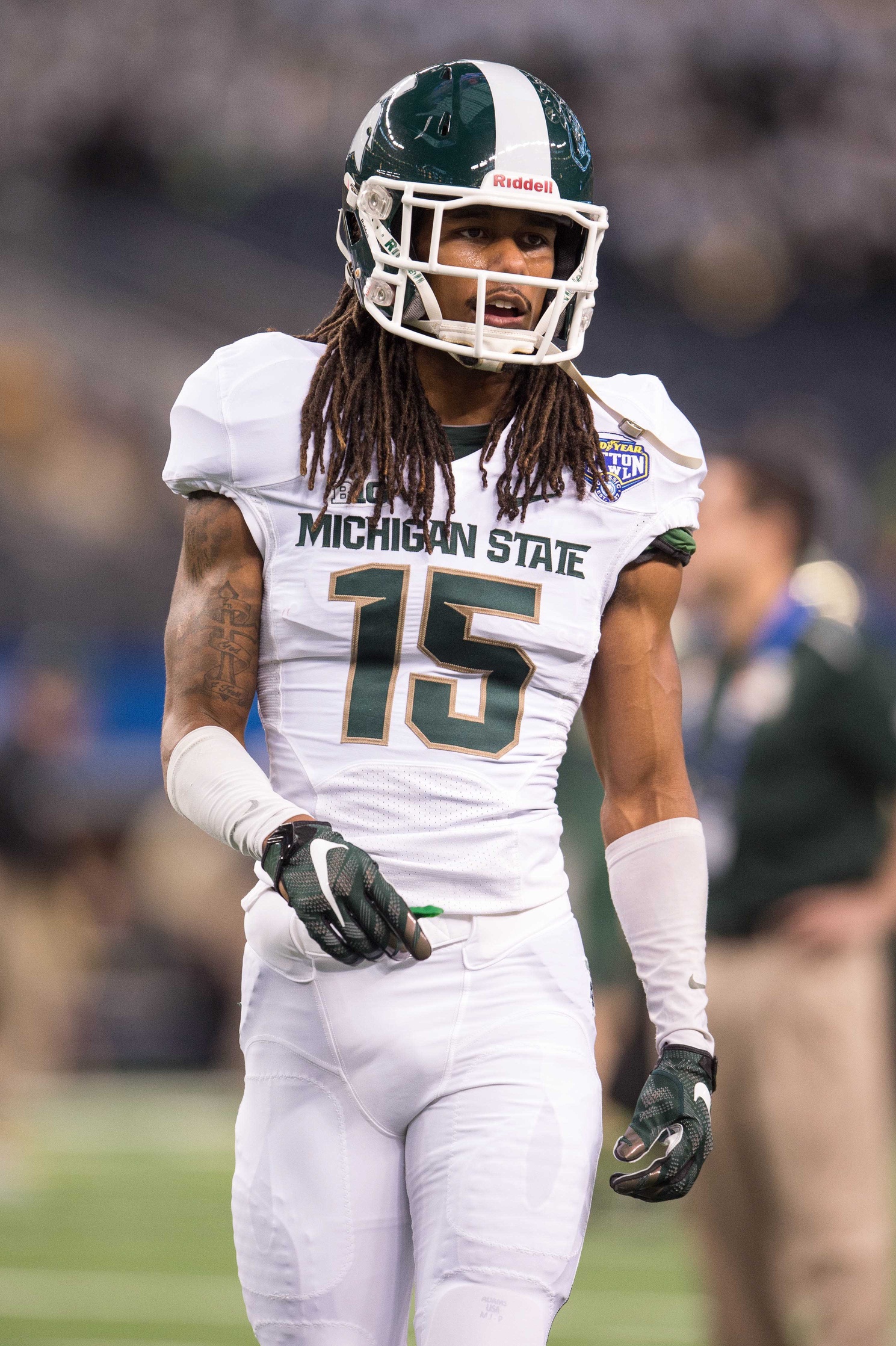
Waynes is a speedster, with great ability to run down the field with receivers on deep routes. The closing speed and the way he turns from his backpedal to a sprint sticks out on tape. The next big plus on his résumé during the college season was his size. He was listed at 6’1″ at Michigan State, and he matched up well with big receivers. Often on broadcasts he was lauded as a future top-15 – possibly top-10 – pick.
Despite those praises, the film shows he didn’t have unbridled success. He ran well with receivers down the field, but it wasn’t like he was a lock on deep routes all season. He was beaten down the field a few times in the Baylor game, and that’s a problem, because he struggles on shorter routes as well. In press coverage he tends to race back too fast and leave himself vulnerable to hitches, curls, and outside breaking routes.
When Waynes plays with cushion, he gives up inside leverage and leaves the middle of the field wide open. He has the speed to close on crossing routes, but got burned with quick slants, as he is slow to come towards the line of scrimmage out of his backpedal.
I think his stock was down a little at the end of the college season, but he turned things around by running a 4.31 40-yard dash at the NFL combine. He only measured in at 6’0″, but he still has the size to compete at the next level. Waynes has a lot of work to do with technique and recognition, but he has above-average to good ball skills, and – most importantly – he’s squeaky clean off the field. I don’t know if the team that drafts him can plug him in and not worry about that side of the field, but he does have the physical skills to survive on the outside.
First-Round Talents:
- Marcus Peters, Washington
- Kevin Johnson, Wake Forest
- Jalen Collins, LSU
- P.J. Williams, Florida State
- Byron Jones, Connecticut
Every player in this group has a chance to join Waynes in the first round this year, but I would be surprised if all five heard their names called on day one.
The main reason this group is labeled “First-Round Talents” is because of the inclusion of Peters and Williams. Both players have struggled with non-football issues, despite having killer seasons in 2014.
It’s remarkable how similar these two players are — they’re the two best tacklers of the top corners. Neither is 100% in terms of making every tackle, but they pursue the play and maintain outside integrity. Both players have some highlight hits on film, and they try to get in on every play. Washington and Florida State both blitzed them off the corner, often in running situations, and each did impressive jobs getting to the running back in the backfield.
Peters specifically does a great job sniffing out screens and reverses and killing them in the backfield. He doesn’t jump up to leave his responsibilities, but he’s able to hedge his bet and wait for the quarterback to make a decision before shutting it down. Neither player got beat down the field on a regular basis, even though neither of them possesses the pure speed of Waynes.
Both Peters and Williams are pretty awesome in man coverage, and play the ball well in the air. They show good technique to keep receivers close and play the ball with their off hand. Peters has the better ball skills, including the ability to make athletic interceptions, and exhibits good hands when a quarterback puts the ball up for grabs. Each measured in with good size, and Peters has the talent to be the best corner in the draft. Williams has the ceiling to be in that conversation. There are also some scouts who project Williams to safety if he struggles on the outside.
However, Peters had multiple incidents with the coaching staff, and was ultimately dismissed from the team. He’s definitely scaring teams off with a reputation as uncoachable, and it really hurts his draft stock, especially when he didn’t exhibit elite physical skills at the combine. As for Williams, the dismissal of his DUI case is a plus, but his arrest may make teams a little more inclined to consider another corner in the first round. Given their on-field skills, Peters is likely to stick in round one, while Williams makes more sense as a candidate to slide down into day two of the draft.
Collins doesn’t have notable issue off the field, but he has plenty when he puts his pads on. Collins is legitimately big, at 6’1″ and 203 pounds, and runs really well, especially for a player his size. He made some plays in college, coming away with a game-winning interception against Texas A&M and often showing ability as a tackler that matches his size.
Unfortunately, the overall package doesn’t match his draft stock. Collins struggles with footwork, and is inconsistent dropping back into coverage. He can get physical on the sidelines, but doesn’t move well to the middle of the field — he also only had 10 starts in college, including just seven last year, which leads me to wonder why his coaches didn’t have more faith in him. I don’t want to kill him for getting torched by Amari Cooper, but he got torched by Amari Cooper. It was very obvious in that matchup which player was polished and which one needed some work.
Collins wasn’t a sure tackler, and wasn’t always too interested in tackling in general. He gave up on a lot of plays chasing runners down the field. His physical skills could push him into the first round, and the Eagles could make sense as a team that could work with him to eventually provide a tall, long option on the outside. Out of the players in this group though, he’s the most likely to frustrate a fan base, at least early in his NFL career.
The most versatile player in the group is Jones, who has been projected equally at corner and safety across boards. He has great size and length, and has all the traits necessary to be a leader on defense in college. He excels at finding the ball, and does a good job defending the run and tackling receivers. He didn’t go up against the greatest competition at UConn, but he made sure to be heard in every game. Jones has been a frequently-mentioned target for the Patriots at No. 32, given his high character and versatility, but he’s a rising prospect who might not be around at that spot.
Don’t worry, I didn’t forget about Johnson, who has spent the process as the second- or third-best cornerback on most boards. However, Johnson is somewhat forgettable. He shows he has the ability to run with players down the field, but he also has plays where he does a shaky job keeping up. He’ll put a few big hits on tape, then have a slew of film where he’s happy to watch his teammates make the tackle.
Johnson doesn’t jump out on a consistent basis, and there are stretches of tape where he doesn’t show up. Some would argue that’s a good thing for a corner — for instance, Collins showed up more frequently on the tape because quarterbacks looked to pick on him at times. But the thing about Peters and Williams, and even Jones, is that they find a way to impact the game even when quarterbacks start ignoring their side of the field.
Johnson could quietly be a solid first-round pick with a high floor — maybe the highest floor at the position. However, even though he may be the closest teams will get to a sure thing at corner in this class, he has a number of things to work on, since he’s going to come into the league against bigger, faster, and smarter receivers, and quarterbacks who will look to exploit him.
Day Two Picks:
- Ronald Darby, Florida State
- D’Joun Smith, Florida Atlantic
- Senquez Golson, Mississippi
- Ifo Ekpre-Olomu, Oregon
- Charles Gaines, Louisville
The biggest difference between these five corners and the six who have a legitimate shot to go in the first round is height. None of the top-tier cornerbacks have the numbers 5’9″ or 5’10” associated with their names, and all five in this group are in that range.
The highlights of this group in terms of name recognition are Darby and Ekpre-Olomu. Darby, of course, is known from his run to the National Championship as a sophomore and Florida State’s inclusion in the BCS College Football Playoff this past year. Along with teammate Williams, Darby brought a lot to the table in terms of ability. With a blazing fast 40-yard dash and top-flight agility, he’s really able to run with receivers and should be able to translate that to the next level.
Darby isn’t a very good tackler, and he got picked on often by quarterbacks avoiding Williams. While taller receivers were able to get an advantage over him, it is concerning how easily shorter players like Phillip Dorsett and his Hurricane teammates were able to separate from Darby when the teams met in the second half of the season.
Ekpre-Olomu provides a different case. Had he declared for the draft last year he may have had a chance of becoming a first-round selection. I imagine his stock would have been picked apart during the process and he would have dropped, but not as much as he did this year, between inconsistent performances and a leg injury that cost him the latter part of the season.
The Oregon corner does pack elite athleticism and excellent ball skills into that small frame, but his size caught up to him when asked to play more physical at the line of scrimmage and when playing the run. He isn’t a slouch in those areas, but his technique is not up to par with some of the other players in this class.
Smith might be the first player taken amongst this group, even though he didn’t see many elite pass-catching threats on the outside during his time in college. He plays the ball well, but his measurables aren’t over the top to put him into the first round discussion. Gaines did run those top-flight times, and he’s an explosive athlete, but that didn’t always show on the field. Gaines’ small hands also provide concern in terms of his ball skills improving at the next level, despite being recruited to Louisville as a wide receiver.
Golson is a hot name rising up draft boards. Scouts love how much effort he puts into the game, and his production not only matches but exceeds that. Last year at Mississippi he intercepted nine passes and deflected 16 more. He was drafted by the Boston Red Sox but is committed to football, despite being undersized. He did struggle covering taller receivers, and doesn’t have a lot of experience in press-man schemes, but he provides an interesting option for NFL teams that miss out on the top couple of guys.
Tall corners are all the rage in the days of Richard Sherman and Patrick Peterson, but height isn’t everything, and plenty of players excel despite not hitting the 6’0″ benchmark. There are many late-round options who come in tall and raw, but this middle class highlighted here could be undervalued because of their height, among other things.
Photo courtesy of USA Today Sports Images.
2015 NFL Draft Breakdown: Linebackers
With the NFL draft just days away, we’re continuing to take a closer look at the notable prospects for each position. We already finished up the offensive side of the ball, and last week we started on the defense, breaking down the players who will make their living at the line of scrimmage.
If you missed the previous installments of the series, you can go and check out the other positional breakdowns here:
Today we’ll file through some of the men playing under-appreciated positions in the modern NFL, looking at this year’s crop of linebackers. Many of the pass rushers will be lining up at outside linebacker in the 3-4, but for the sake of consistency, here we are going to focus on 4-3 outside linebackers and all inside linebackers, regardless of scheme.
These guys might get after the quarterback occasionally, but they’re primarily known as run stuffers or for covering tight ends and running backs in the middle of the field.
Lateral Space Eaters:
- Shaq Thompson, Washington
- Eric Kendricks, UCLA
- Stephone Anthony, Clemson
Kendricks is the most highly regarded linebacker in this draft. This is a player who won awards named after Dick Butkus and Ronnie Lott in 2014, leading the team with 149 tackles. He can really move, which is why he’s a part of a group I call the lateral space eaters. Kendricks patrols the field, sideline to sideline, and – even more impressively in today’s NFL – he can run with tight ends and running backs down the field.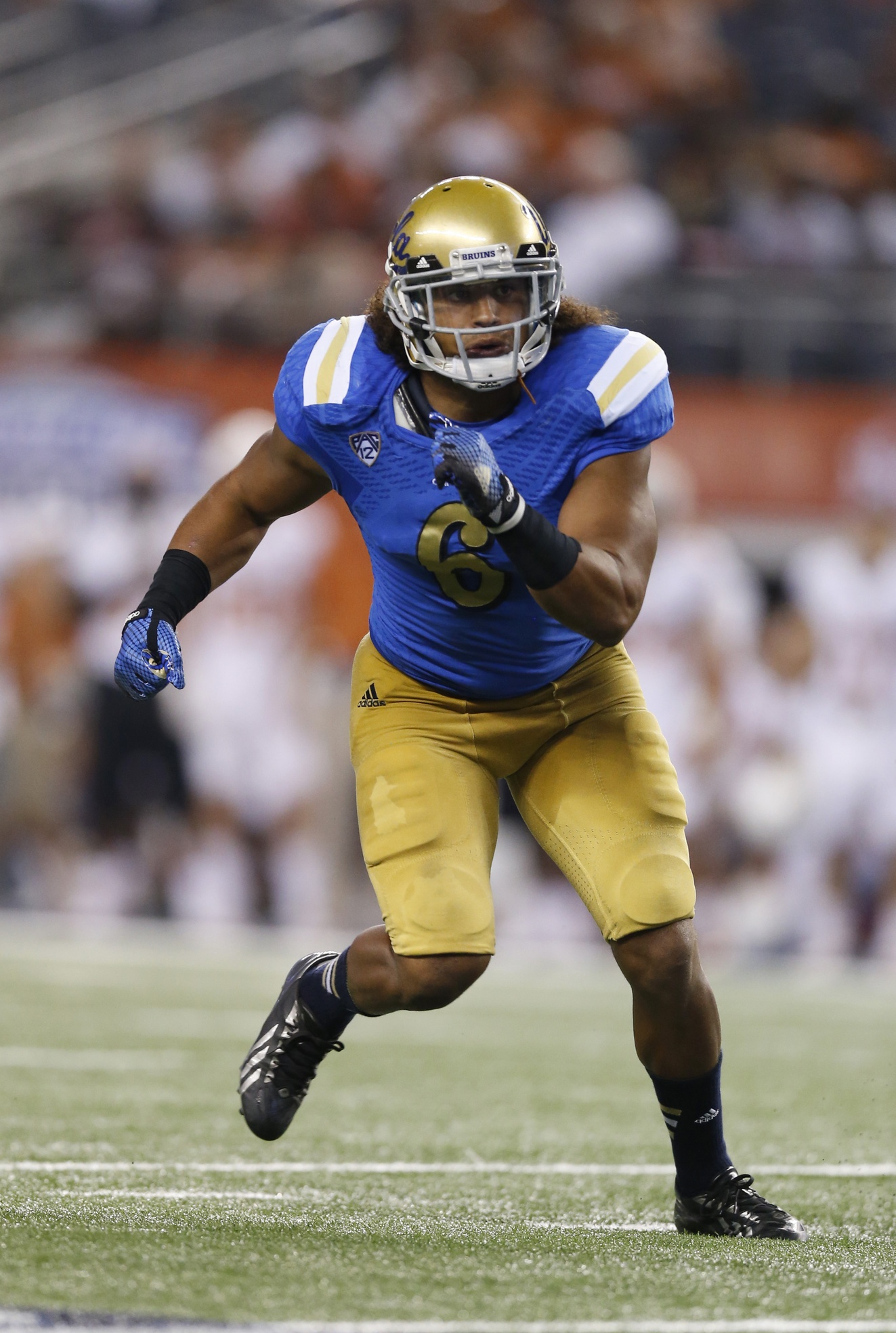
Of all the players at this position, Kendricks is by far the most polished in coverage. His brother Mychal Kendricks has been a successful if underrated player for the Eagles, and while Eric doesn’t have the same physical skills, he does impress in similar ways.
Anthony is the big, fast, physical specimen that looks great settling into his defensive stance before the snap. He has some of the most impressive speed side-to-side, and does a better job than Kendricks of using his acceleration to fill holes at the line of scrimmage. He has the skills to perform in coverage, even if he often gets lost in man-to-man and fails to be disciplined in his zones.
Thompson is the most interesting linebacker in this class. Many have him pegged as a safety, at 6’0″ and 228 pounds. He flies around the field, covering space in a split second, and can adjust from playing in coverage to coming up to stop the run in an instant — he has supreme aggression, and is a heavy hitter. He also has the ability to not only run with tight ends and running backs, but to effectively cover slot receivers. Every evaluator lists Thompson’s weaknesses, but then notes a team could use him as a hybrid safety/linebacker in the way the Cardinals used Deone Bucannon.
However, Thompson and Kendricks are both short enough that, despite their cover skills, taller players could really take advantage of them when NFL quarterbacks put balls high up in the air. None of the three players has proven they can take on a running back in the hole, and all three have the propensity to get washed out on power running plays.
There are late first-round teams that could use these players, and unlike the next group, they provide some upside and versatility due to the athleticism. However, they’re far from the Week 1 stars that even C.J. Mosley was last year.
Between-The-Tackles Thumpers:
- Benardrick McKinney, Mississippi St.
- Denzel Perryman, Miami
- Paul Dawson, TCU
If teams don’t like the athletes above, they could get a bargain with one of the run-stuffing inside linebackers in this group.
Perryman is the guy who stands out here, playing like a big (read: slow) bully who stays in the middle of the field and acts like a backup to a big-bodied nose tackle, plugging up holes and forcing plays outside. Still, Perryman is only 5’11”, with short arms and below average athleticism. Not to mention, his ability as a tackler between the tackles has been overstated. He seems slow to recognize the play and read the offensive line, and while he succeeds when he meets the running back in the hole – where the previous group did not – he was often late getting there, allowing runners to get to the second level, where they could make a move or lower their shoulder for extra yards.
McKinney is a similar player on film, even if he’s much bigger by the tape measure. He has the speed and size to play outside and be vertical, but doesn’t seem interested in using those skills to his advantage. He doesn’t change direction well, and when he guesses, he often takes himself out of the play. While he has the speed and size to run with tight ends, he doesn’t have the agility necessary to make him a real threat in coverage in a big spot. He has some upside, but looks like a player who wants to stay in the space between the guards and take on backs and blockers near the line of scrimmage.
Dawson provides a different type of player. He probably fancies himself as a lateral player who can cover receivers and run down plays sideline-to-sideline. The 4.93 seconds it took him to run 40 yards at the combine disagrees with him. He ran better at his Pro Day, but it’s still alarming for a player who relies on his athleticism despite being a small 6’0″, 235 pounds.
In addition to his on-field red flags, he had a reputation of being a problem within the TCU locker room, and observers question both his motivation and his dedication to the film room. Once players get a bad reputation, it can snowball into a number of deficiencies, but he doesn’t have the natural talent to overcome a bad attitude, which could negatively affect his stock.
I have a personal love for Brandon Spikes, who never covered anybody but did a phenomenal job chasing down running backs off the snap. Spikes spent a lot of time proving his ability as a tackler and run stopper in college, and only fell in the draft due to his off the field concerns. He was always a negative in coverage, which was fine because of how strong he was against the run — that cemented his role in the NFL. I don’t think any of these players have that upside, even though stopping the run is their strength.
Day Two/Three Plug Ins:
- Jake Ryan, Michigan
- Zack Hodges, Harvard
- Ben Heeney, Kansas
- Hayes Pullard, USC
- Ramik Wilson, Georgia
- Bryce Hager, Baylor
- Taiwan Jones, Michigan State
- Jeff Luc, Cincinnati
For a team seeking a linebacker with some upside, most pundits would likely recommend picking off one of those top six players, in what is a fairly weak class at the position. There’s a little something for everyone in that group, without a lot of overlapping skill sets.
At the same time, the players up there might not exactly fit a team’s needs. Some will end up as two-down players, and others will struggle mightily in one aspect of the game or another. Grabbing Thompson in the first round might mean acquiring a player who provides little to nothing as a linebacker against the run. Conversely, drafting Perryman might leave a team with a player who will never see the field on third and long, when offensive players make their money.
The alternative to taking a limited player high is grabbing one of these day two and day three players later on in the draft.
A player like Ryan doesn’t run to the sidelines like anyone in the first group, and doesn’t take on blockers like anyone in the second group. However, the upside of Ryan comes threefold. First, he can do a little of both those things. Second, he could eventually develop into a solid three-down player. Third, and most important: you can get Ryan in the middle rounds, after you already added a couple of impact players elsewhere on the roster.
Ryan has played both inside and outside linebacker, and is comfortable in either position. He is solid in every aspect of the game, but not much better. He gets beat to the sidelines, at the line of scrimmage, and in coverage. That being said, NFL.com has him as a fourth or fifth-round pick. A draft class that features Ryan and three other players ahead of him is an easier one to swallow if I’m an NFL fan, especially for those borderline first-round picks.
A guy like Wilson could provide the size and athleticism needed for teams to survive in the modern NFL. He needs some coaching, but he should have a chance to come in with low expectations and earn a starting spot. Hodges and Heeney have some upside as contributors, and I could see both players developing into starters down the line if they can build on their strengths and their weaknesses don’t sink them. Jones is in the same boat, although he has a better floor, based on the competition he faced on a regular basis.
I think there are plenty of impact players to be had in this overall group of linebackers, and the drop-off from Kendricks to Hodges is gigantic — I don’t want to downplay that gap. At the same time though, I think Kendricks has a chance to go in round one, and that would inflate the value for all these players. If a team doesn’t have a desperate need at the position and isn’t in cruise control with its roster (ie. the Packers), it would be easier to fill those big holes elsewhere earlier in the draft and hope a combination of one of these other prospects can be paired with a veteran to fill one spot on the field in a platoon situation.
Photo courtesy of USA Today Sports Images.
Martin Mayhew on Ihedigbo, Gurley, Draft
Lions general manager Martin Mayhew has the very difficult task of keeping the team in the playoffs despite losing their stud defensive tackles Ndamukong Suh and Nick Fairley this offseason.
Here are a few topics Mayhew weighs in on as he tries to keep the team competitive with the Packers in the NFC North, and among the top teams in the conference. :
On safety James Ihedigbo skipping spring workouts (via Dave Birkett, Detroit Free Press):
These workouts are voluntary. As we talked last year, there was a guy (Suh) who missed last year, and you guys were irate. And I told you then it was voluntary. It’s voluntary now. I look forward to talking with James. I understand what he’s going through. I’ve been through that myself as a player, when I felt like, at a time in my career, that I was underpaid and I had to deal with that. So I have empathy for him and I understand what he’s going through. I look forward to sitting down and talking with him. I have great respect for him as a player, as a man. I’ve got to know him a little bit away from football, and I understand how he feels and I look forward to sitting down and talking with him, at some point.
On Georgia running back Todd Gurley (via Kyle Meinke of MLive.com):
I will sort of equate it to the character situation. Every individual player should be evaluated on his own merits. I wouldn’t just say this guy had an Achilles tear, so he’s off our board. You know, where is he in that process? How long ago was that? How did he perform last year? Who was his surgeon who did his surgery? How is he in the rehab process? Where is he right now? Every single guy is evaluated on his own merits and what his situation is specifically.
On trade activity during the NFL Draft (via Justin Rogers of MLive.com):
I made the point at the league meeting that we’ve never started a draft and finished a draft with the same picks, so I think we’ll have a different number of picks at the end of this draft. Frequently, we’ll be very comfortable that there are going to be a number of players where we are on the board and we’ll stay put, or if we feel like our guys are going ahead of us then we’ll move up. If we feel like there are a number of guys that are behind us that we’d like to have or guys within our range — if we have 10 players and we can go back eight spots and get one of those guys. So, it really varies depending on what’s going on with that particular draft.
On trading picks for veterans in the later rounds of the draft:
I think early on that was something a lot of times that we did because of the difficulty of signing those guys as free agents. I think we’re in a place now where we have a pretty solid core of quality players and we really want to add some youth to that group. I think the draft is the best way to do that.
AFC East Notes: Mariota, Gurley, Patriots
There has been a lot of talk about the Jets making a move to go up at get Marcus Mariota, but Mark Cannizzaro of the New York Daily News gives one big reason why the team shouldn’t trade up for the Heisman-trophy winner.
New general manager Mike Maccagnan was hired because of his track record as an evaluator who will build through the draft, and Cannizzaro wants him to trust his abilities and not give up future picks to move up in the draft. If Mariota should fall that would be different, but believes Maccagnan should give himself as many chances as possible to draft players and worry about the franchise quarterback another time without mortgaging multiple picks for one player.
Here are some more notes from around the AFC East:
- The Dolphins seem to be very high on Todd Gurley, but that doesn’t mean they are planning on targeting the Georgia running back in the first-round, writes James Walker of ESPN.com. The Dolphins got a great season out of Lamar Miller in 2014, and Gurley’s injury history is a red flag that high in the draft for a team with so many needs.
- The Patriots could go a number of ways in the draft, returning a solid roster from their Super Bowl team despite losing a few big names on the defensive side of the ball. Judy Cohen of WEEI.com picks out a player who could come in and help on that side in Arizona State defensive tackle Marcus Hardison. Hardison could be a day two pick, and could even fall to round four it the Patriots wait on him.
- Another player Cohen takes a close look at is offensive tackle Ty Sambrailo. He could be a great pick as a swing tackle for the Patriots, with the physical tools to handle either side of the line. He played quarterback and tight end in the eighth grade and high school before moving to the defensive and offensive lines. Sambrailo is expected to be a day two pick.