
NFC Mailbags: Collins, Bears, Vikings, Saints
It’s Saturday morning, and that means ESPN.com’s writers are going through their mailbags and answering questions from readers. Here are some notes from the NFC:
- The Packers are in a great position going into the draft, without any glaring needs on the roster. One spot the team could target in the first round is cornerback, and Rob Demovsky believes that team could target the 6’1″ Jalen Collins if he is on the board at No. 30.
- The Bears could go a number of ways at No. 7, but the best options that are likely to be there are the leftover between Amari Cooper and Kevin White, writes Jeff Dickerson. One of them is likely to be off the board before the Bears come to the podium, but present good options at that spot. Dickerson also picks out Dante Fowler Jr., Leonard Williams, and Shane Ray as options.
- Ben Goessling receives a great idea from an evil mastermind, saying the Vikings should take a running back with the 11th pick and create an even bigger market for Adrian Peterson. Unfortunately, Goessling rightly believes that would be a dangerous way to use the No. 11 pick in the draft.
- The Saints are in an interesting position picking at No. 13, and Mike Triplett addressed the chances of the Saints of moving up or down from that spot. With nine picks in the draft, he could see them trading up if they have an elite grade on a player, but he could also see them moving down a few spots if they get the right offer. It seems more likely they stay put and wait for their guy at No. 13.
AFC North Notes: Steelers, Wilson, Mosley, Browns
For years, the Steelers have had no problem finding value in pass-rushing outside linebackers. It wasn’t long ago that they were one of the few teams running a 3-4 defense, and were able to find defensive ends that were considered undersized and transition them to a new position, writes Ed Bouchette of the Pittsburgh Post-Gazette.
Those times are gone however, as many other teams have transitioned to either a 3-4 or a multiple defense and have learned to value the athletic pass rushers who have questions about putting their hand in the dirt and playing like a traditional pass rusher. It is much harder to find those classic Steelers’ linebackers late in the draft, and that used to be a huge advantage for the team’s defense on draft day.
Here are a few more notes from around the AFC North:
- The Ravens have shown interest in 6’2″, 205-pound cornerback Julian Wilson out of Oklahoma, writes Aaron Wilson of the Baltimore Sun. “I met with them and it was really good,” said the versatile cornerback. “We went over board work, going over coverages my team was doing and some Ravens stuff. They wanted to see if I had a good understanding of the game.“
- With the NFL Draft less than a week away, the Ravens are looking at the success of last year’s first-round pick for what they expect to add to the team. C.J. Mosley is following an excellent rookie season by doing all the right things, writes Mike Preston of the Baltimore Sun. “Learning the little things about the defense, definitely,” Mosley said. “Definitely getting back stronger after I get this cast off [he had left wrist surgery this offseason] and still learning from my vets, because there are still a lot of things to learn as far as [being a] defensive player, being a young player. Getting in touch with Daryl Smith more and seeing the things that helped him progress each year in his long career, that can help me out.“
- The Browns have been quiet about their plans for the NFL Draft despite having two top-20 picks, but that hasn’t stopped other teams from dreaming about them. Tucker Bagley of PhillyMag.com has rounded up a few Eagles’ stories, two of which has Philadelphia using Cleveland as a jumping board in a three-team trade to get Marcus Mariota. Cleveland would likely settle for some combination of Sam Bradford and draft picks in those situations.
2015 NFL Draft Breakdown: Pass Rushers
With the NFL draft just a week away, we’ll continue taking a closer look at the notable prospects for each position. We already finished up the offensive side of the ball, and started on the defense by analyzing some of the guys in the trenches.
If you missed the first half of the series, you can go and check out the other positional breakdowns here:
Today, we’ll move on to the money makers on defense, in what is likely the strongest position group at the top in the entire draft. Here is a breakdown of some of this year’s premier pass rushers, starting with the four players who hope to be taken in the first 10 picks of the 2015 NFL draft.
Top 10:
- Randy Gregory, Nebraska
- Shane Ray, Missouri
- Dante Fowler Jr., Florida
- Vic Beasley, Clemson
In today’s pass-happy NFL, there’s a general consensus that the most important player on offense is the quarterback, and the most important player on defense is the one who can torment the quarterback. Teams value these players far above anyone else, which is evident based on how much money they make and where they’re drafted. Most observers expect two quarterbacks to be selected in the first 10 picks, and there’s a very good chance they come off the board first and second. But pass rusher is going to be the position that dominates the beginning of the first round.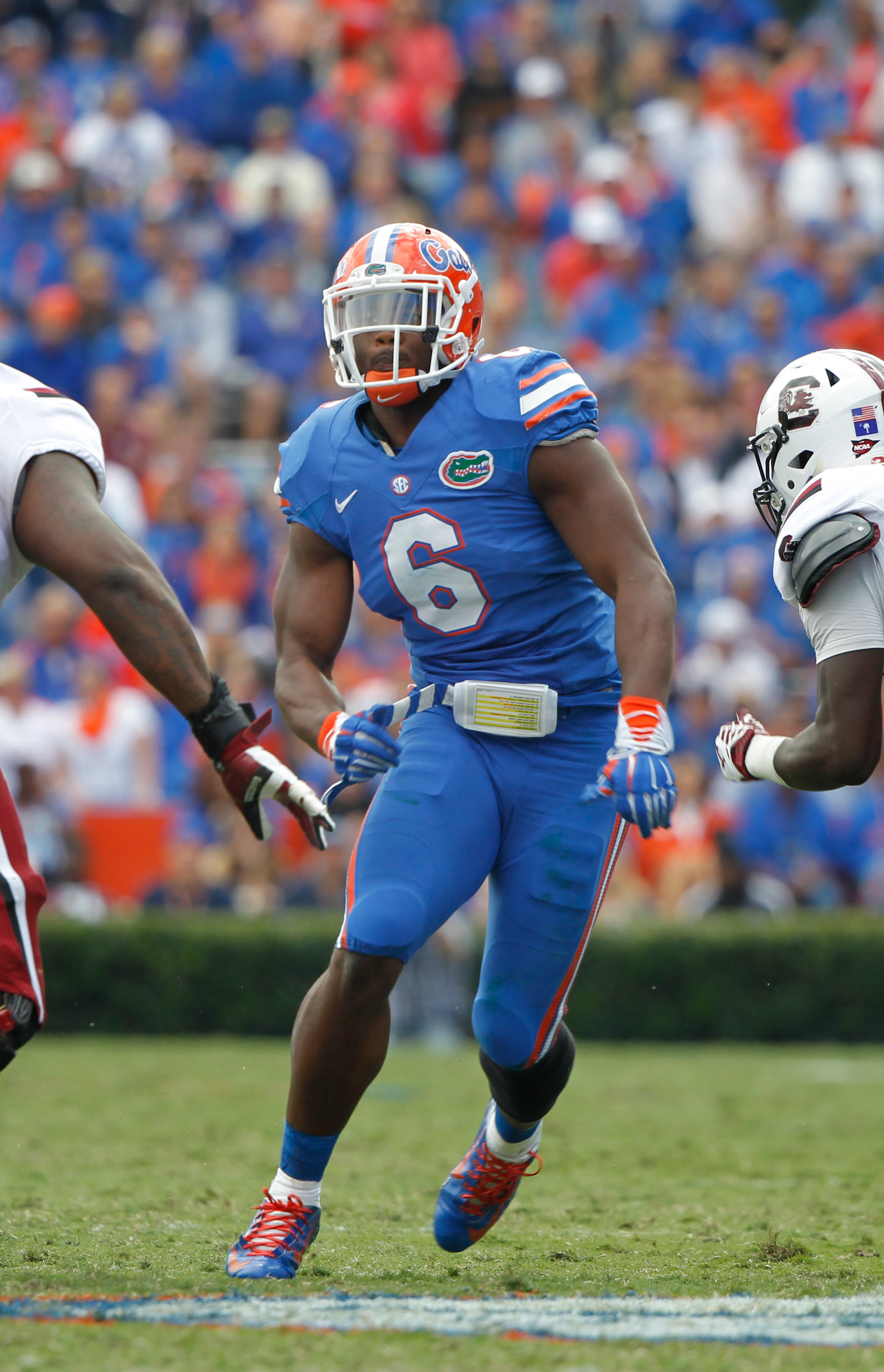
If you include Leonard Williams, an interior defensive lineman will be expected to get after the quarterback, half of the first 10 picks should be pass rushers. In my first Mock Draft, I projected these five players to go second, third, fifth, sixth, and eighth, with Williams going No. 2 to the Titans and the four players above making up the rest of those picks.
Fowler is presumed to have found a fit in Gus Bradley’s defense in Jacksonville, as a player who can rush the quarterback from all over the field. At Florida, Fowler was the clear leader on the defense, lining up as a stand-up edge rusher, with his hand in the dirt, and – most intriguingly – in the middle of the formation, before barreling through a crack of daylight in the interior of the offensive line. Fowler displayed explosiveness through defenders, and once he was in the offensive backfield, he made sure the quarterback would know he was there by quickly jutting his body into the pocket and getting his hands up.
The sack numbers for Fowler weren’t quite there in college, as he only totaled 8.5 in 2014, and that figure was inflated by a three-sack performance in the Birmingham Bowl against East Carolina. He was able to make plays against the run, but did a lot of that damage between the tackles. Setting the edge and forcing runners inside was not his strong suit, and he hasn’t exhibited any ability to hold up in coverage, though he was not asked to do so often. His athleticism gives hope that he could turn into a Pro Bowl-caliber player, and he should be especially useful to a coach with the creativity to exploit his various strengths.
Up next is Beasley, a player who has proven that he could produce sacks coming off the edge. With 33 career sacks, including 12 as a senior and 13 as a junior, Beasley has consistently generated pressure over his last three collegiate seasons. The most incredible thing about watching him is how committed he is to beating tackles with his one elite skill: speed.
Beasley explodes off the edge. He’s quick off the snap, and he’s too fast for offensive tackles to handle. When profiling offensive linemen, I noted that Cameron Erving had a very impressive day against Beasley, aside from two plays where he had trouble dealing with his speed rush. Well, those two plays were spectacular jumps by Beasley, and he was barely touched on his way to the quarterback either time. He flashed right past Erving and was draped on the quarterback before anyone had a chance to react. That’s how he got the job done, for better or worse, and he did get it done time after time. He is the all-time leader in sacks at Clemson, and he plans to continue racking up the big numbers in the NFL.
What should worry general managers about Beasley is how little he seems concerned with doing anything else. At times he doesn’t even pretend to be concerned about setting the edge. In that Florida State game specifically, he got caught trying to blast through an inside hole and completely abandoning his outside integrity on a few plays, most embarrassingly on the 12-yard touchdown run that ended the game in overtime. He was asked to drop into coverage more than these other top pass rushers, but not often enough that it would be considered a developed skill at this point.
As a pass rusher, Beasley hasn’t proven he can develop secondary options, relying heavily on his speed off the edge and ability to hand fight before bending in. It looks impressive, but when a tackle is able to get hands on him, the fight more or less ends there. His spin move is lacking, and he doesn’t have much of a counter to the inside for those who set up wide against him. Converting speed to power is a phrase that’s becoming very trendy in NFL draft circles, and it’s not one that’s brought up in association with Beasley’s name. The physical skills are great, and one elite pass rush move is better than relying solely on athleticism, but he will have a long way to go to exploit offensive tackles on the next level.
Ray is a different type of pass rusher than Fowler and Beasley. At Missouri, he played almost exclusively with his hand in the dirt, and originally projected as a 4-3 defensive end in the NFL, where he would have been undersized. Ray’s speed is comparable to Fowler’s and Beasley’s, but it would be a stretch to say he’s the athlete that either of them are. If we describe Beasley as dropping into coverage sparingly and Fowler as barely, then Ray was even less than that (although NFL.com writes that he was able to do so without issue when asked).
What Ray does do is rush the passer. He had 14.5 sacks in 2014, a school record. For most schools, having a player break the sack record is notable. For Missouri, who put highly regarded pass rushers Justin Smith, Aldon Smith, Sheldon Richardson, and Kony Ealy into the NFL, Ray’s mark is downright superb. If either of the Smiths or Richardson was in this draft knowing what we know about them now, they would be very high picks (granted, disregarding Aldon’s penchant for off-the-field trouble).
Ray was third in the nation in sacks, and also ranked third in tackles for a loss, which would create the impression that he’s equally capable of playing the run. That’s probably not true though, at least not now. He doesn’t have the size to be strong against the run from defensive end, and even moving back to linebacker, it would take time for him to learn how to keep his outside integrity. The tackles in the backfield in college came more because he’s a heat-seeking missile and ran through running backs that happened to be between him and the quarterback, not because he was particularly disciplined.
Going back to his draft profile on NFL.com, Ray is called “an alpha male packaged in an explosive frame,” which is a variation of what I call an “Alley Guy,” a term used by my high school football coach and subsequently by many of the people I talk to about football. An Alley Guy is the person you’d pick to walk with you through a dark alley at night, who wouldn’t only make it out the other side but would ensure you’d make it out too. Ray is a violent hitter, with a relentless motor and a stop-at-nothing attitude. He might be my favorite player in this draft – and the ultimate Alley Guy of the top picks – but he isn’t the best prospect of this group. That title is reserved for the player who is most likely to be the one that drops out of the top 10.
Gregory is the most complete prospect of these four pass rushers, and his collegiate film would make him a strong candidate for the (probably meaningless, but still fun) title of “Best Player in the Draft.”
Gregory has been thrown in with these pass rushers as if they were all asked to do the same things in college, and in that measurement his 7.0 sacks fall short. Most of his negative evaluations as a pass rusher are about him being timid, slow off the snap, and unable to beat tackles with speed to the edge. What I saw on tape was not a player who was asked to rush the passer on every down, but instead a true edge setter on the defensive line, tasked with working from the outside in. In my eyes, being slow off the snap was less about Gregory’s abilities and more about his responsibilities in the Nebraska defense.
As a run stopper, Gregory always maintained outside integrity, and always used his long arms first to keep tackles off him while he read the play, and then to eject off the block to make a tackle. He has the speed to stop the outside runs by stringing them out and cutting off the sideline, and he has the counter move to react to cutbacks while never giving up the edge. The long arms come in handy again when it’s time to corral runners who think they’re out of reach.
Playing at around 235 pounds as a defensive end meant that there were times Gregory was overpowered at the line of scrimmage, especially with double teams. However, I expect him to add on to his frame and drop back to a 3-4 outside linebacker, where his discipline will remain a strength and his weight won’t be as significant a weakness. Even playing that light in college, he was strong enough to win most battles at the line of scrimmage anyway, and played with good enough leverage that being out-muscled occasionally wasn’t a huge factor.
When Gregory was asked to rush the passer, I saw the explosion he was criticized for not having. Given his limited opportunities to forego all responsibilities to get after the quarterback, a luxury the other three players here seemingly had on 95% of their snaps, Gregory’s sack number begins to look more impressive. Additionally, his 10.5 sacks as a sophomore, when he was let loose a bit more, shows he does have the ability to get after it when he needs to. That being said, if I’m a team that needs someone who can get after the quarterback right away, I can see why the other three would be ranked ahead of Gregory. But he really shines as a complete football player that is strong at every aspect of the game (pass coverage excluded — who knows if he can, but we may be asking too much).
The giant red flag for Gregory, of course, is his positive test for marijuana at the NFL combine, a time when players know they’re going to be tested. Many pundits would say that NFL general managers aren’t scared off by marijuana use in general — however, the inability to stay away from it when a player knows he’ll be tested is a concern. Especially in an era where Josh Gordon misses more games than he actually plays, if teams are concerned that drug violations could keep Gregory off the field on Sundays, he may very well fall out of the top 10 despite his tremendous talent.
Late First/Early Second Round:
- Bud Dupree, Kentucky
- Eli Harold, Virginia
- Owamagbe Odighizuwa, UCLA
This group is not all that far behind the top four, but the flaws are much more obvious. Dupree particularly is interesting based on the physical tools he brings. At 6’4″ and nearly 270 pounds, Dupree should not be so fast that tackles can’t keep up with him and so strong that they can’t bully him, but he is truly both. He is approaching the “freak athlete” category, and based on his potential he has worked himself near the top 10 picks in the minds of some draft experts.
However, it will take a lot of coaching for Dupree to live up to any first-round selection. While he’s gifted physically, raw doesn’t even begin to describe how he plays. I knocked Beasley for a reliance on his athleticism, but even he knows how to use his hands and shoulders to bend around blockers. Dupree just goes and hopes for the best. If he gets the edge he can be dangerous, but tackles are prepared and able to cut him off. He has no counter move back to the inside, and no ability to win a battle with his hands at the point of attack. Over and over on film he runs straight into the arms of his blocker, and gets locked up at the line of scrimmage or – if he’s lucky – a few yards beyond.
Just to stay on the field in passing downs, Dupree will have to learn how to play with leverage, how to ward off blockers with his inside hand while keeping his outside arm free, and how to remain in the play while being blocked. After that, he needs to add a variety of pass rush moves and he needs to be able to use his speed and strength advantages together, as opposed to treating them as mutually exclusive skills. If a coach can do all that, he might have himself a player capable of huge numbers – even 15+ sacks in a season – but it’s a lot to ask based on what Dupree has shown on film. He does come with the added bonus of some proven ability to drop into coverage and run down field, which may take some of the pressure off how much he needs to learn going towards the line of scrimmage.
Harold’s biggest flaw is one that sticks out more on tape, and probably has him red-flagged as a risk, but it’s also a reason he may be an undervalued commodity in this draft. Based on a brief overview of some of Harold’s game film, his tackling is an obvious concern. The amount of times he had a running back squared up in the backfield and just whiffed on him is excruciating to watch. The angles he took stringing runners to the sidelines that ended in him diving at ankles and coming up with grass are embarrassing. The number of sacks he left on the table because he couldn’t quite get his arms around a quarterback will probably keep him out of the first round.
Then again, a smart team could watch his tape and not see a player who only had 7.0 sacks last year, but instead find a player who got to the quarterback on a consistent basis. They might not see a guy who struggled against the run, but a player who was in the right position and wasn’t able to finish the play. Watching Dupree play, I tried to guess his arm length and I shorted him by an inch, which doesn’t say much for his tape, but it does say that he might not be getting the most out of his talent. Considering all the work Dupree needs just to be an adequate pass rusher, one can imagine what a comparably easy fix it could be to focus in on disciplined tackling with Harold — I think a coach would view this as a far simpler task. Now, struggling with tackling shows a lack of physicality that will only get worse at the next level, and it’s not like this is a dominant player who is consistently maintaining his leverage against the run and the pass. But Harold could be a player who isn’t far off from realizing his talent if he can translate his strengths to the next level.
Odighizuwa is a player that many fans were expecting to break through in college, but he was never able to stand out early on due to inexperience and injury. Therefore, despite having a large sample of game film, it’s difficult to project him based on his last year at UCLA. He had six sacks, and his explosiveness could be seen on the field, but there was always the question of whether he would hit his stride.
At the combine, Odighizuwa came to impress, posting great numbers in drills across the board, per NFL.com. He was a top performer for his position in the 40-yard dash, vertical jump, broad jump, 20-yard shuttle, and 60-yard shuttle. He also has proven to be relentless with his motor, trying to get the most out of every snap, and he has versatility — the size to play 4-3 end, and the athleticism to rush as a 3-4 linebacker. He may be able to sneak into the end of round one, but he’d definitely be a high upside pick early on day two.
Day Two:
- Danielle Hunter, LSU
- Preston Smith, Mississippi State
- Hau’oli Kikaha, Washington
- Lorenzo Mauldin, Louisville
- Trey Flowers, Arkansas
- Henry Anderson, Stanford
Kikaha is the most notable player from this group, leading the nation with an outstanding 19 sacks in 2014. Despite those numbers, he has been knocked around through the draft process. True, he doesn’t have ideal size for a pass rusher, but I question the perception that he’s a specialist who doesn’t provide much run support and doesn’t set the edge, because it’s the same criticism I have for everyone above him on this list except for Gregory.
What Kikaha does do is get after the quarterback with every step. He never gives ground, meaning every movement of his arms or drive from his legs is specifically taken to get him a little closer to the passer. There are no questions of motor here with those sack numbers. The only game in which he was held without a sack was against Arizona. His box score from the Oregon game is telling, with 10 tackles and 2.5 sacks against that up-tempo, run-oriented offense, showing he can match up well with misdirection and against numbers disadvantages, even against a mobile quarterback. Knee injuries probably contribute to his perceived ceiling as a prospect.
Where Kikaha fails to excite, Mauldin should make some team very happy in round two. He has limited scheme versatility, fitting best when he’s blitzed from a linebacker spot, but that specific skill could prove very valuable for a team drafting high that misses out on a pass rusher in round one. Washington and the Jets especially could target him if they decide to fill other holes with their first-round picks.
Mauldin plays with reckless abandonment, throwing his body into the heart of the play. He does a great job shedding blocks on the move, and goes after the quarterback with aggression. One of his most impressive traits is switching from playing the pass to playing the run on the fly. He gets the edge, and turns inside well to pursue the run up the middle. He looks like he could be a menace, and if the draft breaks correctly, he has a chance to sneak into the end of the first round, or close to it.
Smith looks on tape to be the rare 4-3 defensive end who plays as a specialist against the run. Although he failed to impress with pass rushing moves off the edge, he was a very good edge setter against the run. He was able to keep containment even while rushing the quarterback, and forced runners to stay inside the hashmarks for the most part. Based on these skills, he looks like a very promising player in line for a long NFL career. He did have nine sacks in 2014, and has surprising athleticism and size, but he’ll have to work to make those aspects of his game show better in order to stay on the field on third downs in passing situations.
Flowers is another player who is limited athletically, but finds a way to disrupt passing games. He has good strength and sheds blockers well, especially coming back inside with a counter move. He only had 6.0 sacks in 2014, and probably isn’t an option for 3-4 teams, but he’s a solid player who should be able to find a way to impact games. Anderson is a much bigger body, but plays similarly. His three-sack double-OT game against Utah buoyed his numbers, but aside from that, he was a 5.5-sack player in 2014. He works toward the quarterback, and has the size to handle the run. Anderson should be able to play end in a 3-4, and has experience working from the interior defensive line, but both he and Flowers will likely need to exhibit the ability to bump down to defensive tackle to stay on the field for high snap counts in the NFL.
Hunter is the 6’5″, long-armed pass rusher coaches put together in laboratories. Unfortunately, too often he doesn’t seem to know what he’s doing on the field. He seems like he’s more interested in wrestling with blockers than getting past them, and doesn’t even necessarily win those fights (even when the blocker is a running back in pass protection). He often finds himself on the floor after putting his head down and diving into the line, or if he sees grass and takes a stab at tackling no one. Whatever the opposite of having a nose for the football is, Hunter has that instead, which is reflected by his 1.5 sacks in 2014. Still, his size and physicality is interesting, and the more he falls, the more a coach will talk himself into being able to work with him to at least add a big body to the defensive line, even if the production as a pass rusher never comes.
Like quarterbacks, pass rushers will always draw interest from teams high in the first round of the draft, and 2015’s draft will be no different. However, there’s value to be had outside of those top 10 picks, and there will be players with perceived flaws that need to be coached up and developed. Every year some less-heralded prospect turns into an impact player on defense for an NFL team, and I expect someone will emerge from day two or day three and become a good starter who finds his way into a few seasons with double-digit sacks.
Photo courtesy of USA Today Sports Images.
2015 NFL Draft Breakdown: Defensive Line
With the NFL draft just nine days from getting underway, we’ll continue taking a closer look at the notable prospects for each position. We already examined the offensive side of the ball, so today we will move on to the defensive side of the ball.
If you missed the first half of the series, you can go and check out the other positional breakdowns now:
As we begin to break down the defense, we’ll start with the anchors along the trenches, taking a look at the top defensive linemen. Pure pass rushers are excluded; they’ll get their own post later this week. While a few of these guys will provide some pass rushing value from the line, no one here is likely to play 3-4 linebacker and pin his ears back. These guys are more traditional hand-in-the-dirt linemen, and that starts with the one player who is head and shoulders above the rest.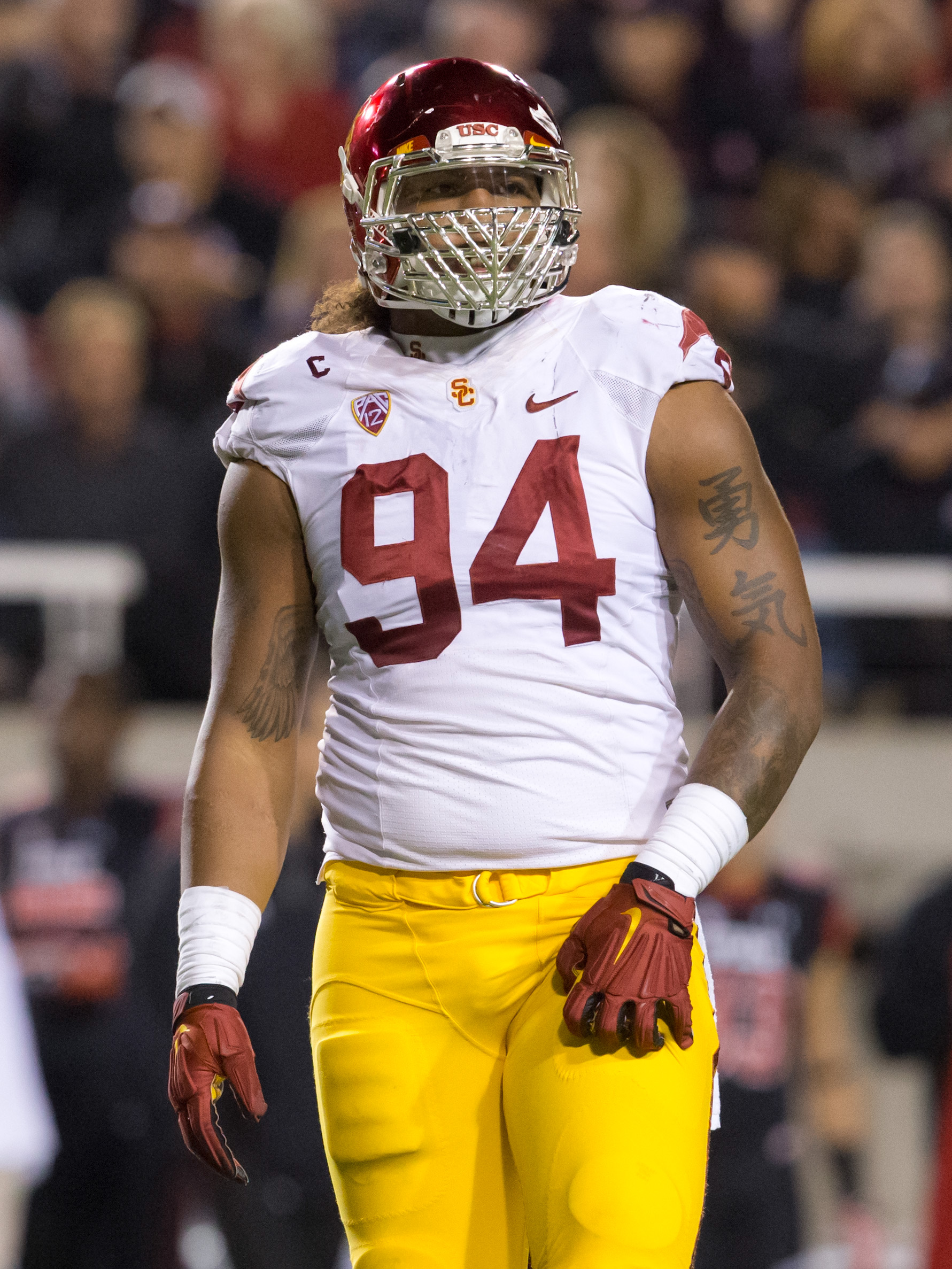
Top Five:
- Leonard Williams, USC
The prize of this class is Williams, who for many draft experts is the number one player on the board. Across most mock drafts, Williams is the top choice for the Titans if the team elects not to take Marcus Mariota or trade the second overall pick.
Having been compared to such players as Richard Seymour, Williams provides one of the most versatile skill sets for a top-five pick in years. He played 4-3 defensive end at USC, but showed the ability to bump inside to defensive tackle and cause havoc from different spots.
Team that need a defensive end or tackle should be salivating at the 6’5″, 302-pound monster, who fits well in a 4-3, but may be even more dangerous as a 3-4 end. While Williams did a great job rushing the passer, he was equally as effective in the running game. He uses his long arms to harass offensive tackles unfortunate enough to have to block him, and does a great job shedding blockers at the point of attack. Those arms and strong hands allow him to finish plays by grabbing hold of any ball carrier trying to get away from his grasp. Williams is able to set the edge, and continue working his way inside until he either squeezes the play into dust or pushes it out to the other side of the field. He was the tone setter for the Trojans’ defense, drawing all of the offense’s attention and yet still making the plays necessary to stop drives in their tracks.
It isn’t all roses with the USC lineman, of course. As a sophomore, he got his butt kicked at the line of scrimmage in more than a few games. He added weight and strength before his junior season, and was able to win off the snap on almost every play in 2014, despite facing constant double teams from opponents. He struggled pursuing the ball across the formation and down the field early in his career, and that didn’t completely correct itself at USC. This leads to questions – which may or may not be fair – about his motor.
Williams isn’t the most polished player, but the production was there and the physical skills are so outrageous that it’s really no question that he should be alone atop the defensive line rankings. His ceiling probably doesn’t include a bunch of 20-sack seasons, but teams drafting him will expect consistent pass rush that puts him in the double-digit range, along with a run-stuffing workhorse to build the defense around.
First Round:
- Danny Shelton, Washington
- Arik Armstead, Oregon
- Malcolm Brown, Texas
- Eddie Goldman, Florida State
Armstead is a 6’7″, 292-pound marvel who didn’t have production to match his physical skills. Oregon was probably hoping he’d develop into a feared pass rusher by the time Mariota was a senior — that never came to fruition, but Armstead held up against the run and has a huge tackle radius, which is different than length, even if length is the most important contributor to tackle radius. Former Duck Dion Jordan, who was picked third overall in 2013, had great length, but didn’t have a great tackle radius.
Armstead could line up in multiple spots along the defensive line, and is scheme versatile. He has plenty of upside, and is probably the only other first-round pick along the defensive line who isn’t strictly a big-bodied inside run stuffer. He’s also likely the only player in this post who even has a chance at playing 3-4 outside linebacker for a creative defense that learns how to turn his length into consistent production.
Shelton, Brown, and Goldman are all similar players on film. They line up in the middle of the formation, and they lean up against interior offensive linemen at the snap of the ball. Most mock drafts I see have the three going in exactly that order, but for my money, the value runs in the opposite direction.
Shelton had the most notable workout, pushing big weight on the bench press. He needs to push weight, standing at 339 pounds. With the weight, he unsurprisingly lacks explosiveness. He isn’t particularly fast off the snap, and doesn’t drive his legs well into the line. Understanding that he’s often double-teamed, he tends to get pushed back off the line of scrimmage with alarming ease. He contributed to a lot of tackles, but a scary number of them were between two and five yards down field, enough that a running back could put the same play on his own highlight tape if he wanted to. Shelton closes quick when he does see a hole in the offensive line, but was disappointing as a space eater despite his size.
Brown does a better job getting up the field, although he’s also not going to penetrate enough to provide interior pass rush. There’s no Ndamukong Suh or Gerald McCoy in this draft, and the respective grades show it. Brown does give more than most in that area, and could be particularly helpful for a team that could use some secondary pass rush along with a strong tackler against the running game.
Goldman does the best job of the three in remaining stout at the line of scrimmage and making tackles for short gains. He was really able to leave his mark on the game, and while he was rarely spectacular, he was consistently solid. He comes into the NFL as a player who should immediately be able to join a defensive line rotation as a run defender. I believe he should fit in well at defensive tackle, but he could play defensive end or nose in a 3-4 defense. Goldman won’t provide much pressure on the quarterback, if any at all, but he’ll pursue upfield enough that he should prevent passers from stepping up in the pocket to avoid the rush off the edges. He may not have the highest ceiling due to his average athleticism, but he could end up having a steady NFL career.
Day Two:
- Michael Bennett, Ohio State
- Carl Davis, Iowa
- Jordan Phillips, Oklahoma
- Xavier Cooper, Washington State
- Grady Jarrett, Clemson
- Mario Edwards Jr., Florida State
The two players here who have legitimate claims to being included in the first-round group are Davis and Phillips. Davis tormented interior linemen at Iowa, proving to be too strong for the smaller guards and too fast for the bigger ones. He gets up the field off the snap, but his most impressive trait is his ability to move quickly laterally down the line of scrimmage, stringing outside runs out and filling cutback lanes.
Phillips is a behemoth in the middle of the defense, an immovable object that simultaneously eats blockers while remaining disruptive if given the opportunity. There is some concern about his consistency, but when he’s playing well, he provides flashes of Casey Hampton, who made a career opening up holes for pass rushers by drawing attention to himself in the middle of a 3-4 defense.
Both of those players will definitely be in play in round one, and I would imagine there are teams that have them much higher on their boards than some of the players mentioned above. Still, both Davis and Phillips rely on scheme fit and that could drop them into round two.
Edwards lined up on the edge a lot at Florida State, but he needs to be able to make the full transition to defensive tackle in order to stick on an NFL team. Mostly a non-threat as a pass rusher, playing him outside of Goldman did discourage offenses from running the ball on Florida State. However, athletic runners were able to get outside of him and force the Seminoles to change their game plan. What Edwards does have is plenty of strength and versatility. He can play all along the defensive line in either a 4-3 or 3-4 scheme, as long as he’s not asked to get after the quarterback.
Normally a deep group, interior defensive linemen will be hard to find in this draft. After Phillips and Davis, the best options are Bennett, Cooper, and Jarrett. Those three players have upside – Bennett especially has been rising up draft boards and Cooper has been pointed to as a sleeper-type player – but overall they’re part of a weak class. That could be the reason raw talents like Shelton and Armstead are going to be in consideration in or near the top 10, and it’s one reason Williams stands out so much despite being a step or two behind top-five defensive linemen we’ve seen in past drafts. Ultimately, teams that have needs at the position will need to get their guy with an early pick, or else they’ll have to hope they can develop a prospect into a surprise performer as a rookie.
Photo courtesy of USA Today Sports Images.
2015 NFL Draft Breakdown: Offensive Line
With the NFL draft fast approaching, we’ll be taking a closer look this month at the notable prospects for each position. We’ve already examined quarterbacks, running backs, and receivers, so today we’ll look at the top offensive linemen.
First-Round Tackles:
- Andrus Peat, Stanford
- Ereck Flowers, Miami
- D.J. Humphries, Florida
- T.J. Clemmings, Pittsburgh
When teams look for offensive linemen in round one, they’re typically chasing cornerstone left tackles to protect their quarterback’s blind side. While the 2015 NFL draft class doesn’t feature the sort of highly-touted prospects that come off the board in the first 12 picks and slide right into the starting lineup, there are a number of high-upside players who could impact a team this coming season.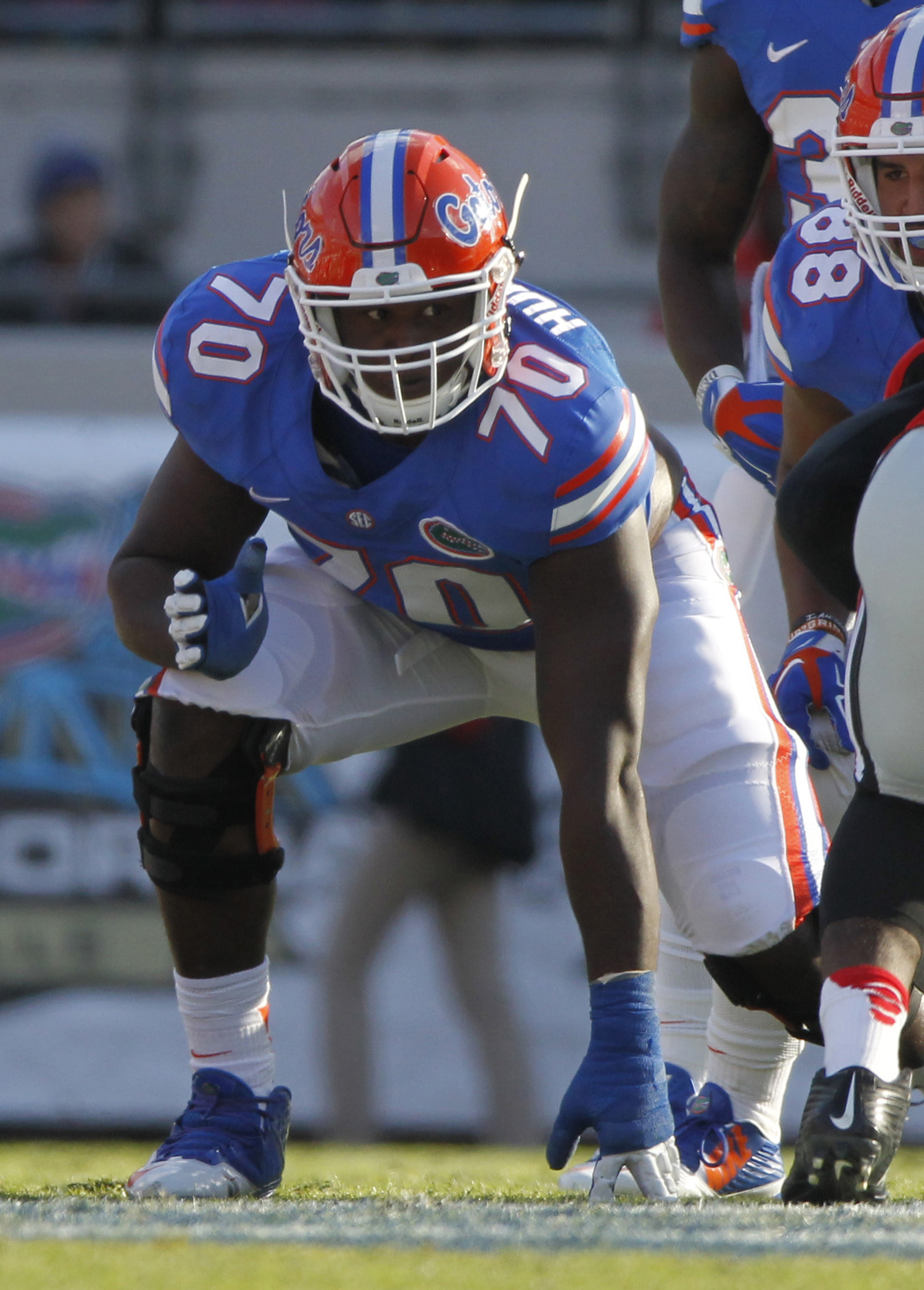
That list starts with Peat and Flowers. Both were highly sought after recruits coming out of high school. Peat was regarded as the top high school player in his class, and grew to become the 6’7″, 313-pound stalwart expected to be a first-round pick. Flowers wasn’t quite as highly regarded, but still committed to Miami as a four-star recruit. Standing at 6’6″ and weighing in at 329 pounds, his stock is very similar to Peat’s.
Both players are very solid in both the running game and the passing game. I saw the ability to force defensive lineman inside and drive them down the field, and both players showed they’re capable of coming off the first block to target a second player down the field on longer runs. That ability to recognize when a block is made and to continue the play is an important skill — it’s one that Vikings’ 2012 fourth overall pick Matt Kalil didn’t show on film, which should have been a red flag at the time, despite his consensus status as a top pick. As Kalil has struggled to recognize blocking schemes and finish plays in the NFL, that inability and/or unwillingness to get to the second level is something teams should carefully study in their evaluations.
Both Peat and Flowers also hold up in pass protection, with Peat particularly kicking out of his stance quickly off the snap. Each player is able to get wide and force pass rushers to take long routes to the quarterback, where it is easy for an offensive tackle to remain in punching distance to push them around the back of the passer who should have room to step up and avoid any pressure in the pocket.
Humphries and Clemmings represent slightly different packages. No sane human would refer to them as small, and Flowers and Peat aren’t considerably bigger, but these two have a reputation for being athletic marvels who are less polished and less solid at their positions. Humphries got the job done at Florida, but he could be found reaching at times in the run game rather than using the force of his body to move defensive linemen. This issue is exacerbated by the shortness of his arms, and puts his body in position where he is unable to draw strength from his legs.
Clemmings played right tackle at Pittsburgh, which is unusual for a player with an eye on moving over to the left side as a pro. Left to right is the usual progression for players transitioning from college to the NFL, though all of these tackles will likely have the opportunity to start their NFL careers on the right side if their new teams think they’ll need that time to adjust. Clemmings is a favorite of some scouts for his extreme athleticism, and the former basketball player can certainly move. He’s raw, but he has the footwork, frame, and arm length to develop into a top left tackle in the right situation.
First-Round Interior Linemen:
- Brandon Scherff, Iowa
- La’el Collins, LSU
- Cameron Erving, Florida State
This group is made up of nominally interior linemen for draft purposes, but actually all three players spent most or all of their college careers at left tackle. There is a chance all three stick at tackle in the NFL, but most have them valued more realistically at guard or center.
Guards don’t get the same respect as tackles when it comes notoriety or contracts, and they’re especially discounted on draft day. However, there is some consensus that Scherff will be the first lineman off the board, and he’s worthy of that honor. While the group of left tackles is best described as solid, Scherff is spectacular. In the running game, he’s as dangerous as they come, finishing every block to the ground and then diving on the poor defensive end or linebacker he just victimized. His Youtube highlight tape is the most entertaining and fun to watch of any player in the draft, an honor usually reserved for receivers, running backs, quarterbacks, or maybe a hard hitting defensive player. His arms are short for tackle, and he got fooled with a finesse pass rush occasionally, so I understand the feeling that he will have to be moved to guard. That being said, like Zack Martin, if Scherff is the best offensive lineman in the draft, then it makes sense to pick him and figure out later where he’ll play.
Collins has similar issues with arm length, though he held up very well at left tackle in the SEC. He’s a strong player and a good run blocker, even if he isn’t as fun to watch as Scherff. Pass rusher Dante Fowler Jr., the presumed favorite of the Jaguars selecting at three, was haunted by Collins in college. “My sophomore year, we went to Baton Rouge and played against LSU, and I’m not going to lie, I got my butt whooped,” Fowler told Jenny Vrentas of MMQB.SI.com. “That was one of my worst games just because of how I got tossed around.”
Fowler continued to say he was motivated by the “butt whooping” and came back harder in 2014. I rewatched that game; you wouldn’t even notice he was on the field for the most part. Collins isn’t the brute that Scherff is, nor does he have the sheer athleticism and technique of Peat, but he is a really solid player who can do a lot of different things for a football team.
Erving is a little different. He started his career at left tackle, and would have drawn some second-round interest if he had declared for the draft a year ago. Instead, he returned to Florida State, where he struggled at times. Players were able to blow by him, and his play made you question whether his stock would drop by the time the draft came around. One of his best games at left tackle came against Clemson and pass rusher Vic Beasley. Beasley torments with athleticism, but Erving held him at bay for most of the game, allowing him to pressure the quarterback only a few times. Specifically, Erving was beat with speed off the edge for Beasley’s two sacks. However, Beasley was pushed around in the running game, which Florida State leaned on during some big moments late in the fourth quarter and especially in overtime.
Erving moved to center for the Miami game, and didn’t look great at first — he was very inconsistent with his snaps, moving slowly out of his stance while focused on looking through his legs at his target in the shotgun behind him. However, the Hurricanes were shockingly unable to take advantage of his lack of confidence. Only a few short weeks later against Georgia Tech in the ACC championship game, Erving looked as if he had been playing center his whole life, and I think that would be a great spot for him to stay in the NFL.
Day Two:
- Jake Fisher, Oregon
- Hroniss Grasu, Oregon
- A.J. Cann, South Carolina
- Ty Sambrailo, Colorado State
- Laken Tomlinson, Duke
- Tre’ Jackson, Florida State
- Reese Dismukes, Auburn
- Ali Marpet, Hobart
- Arie Kouandijo, Alabama
- Daryl Williams, Oklahoma
- John Miller, Louisville
- Cedric Ogbuehi, Texas A&M
- Rob Havenstein, Wisconsin
Fisher is in the discussion at the end of the first round, and Cann may be too, depending on how desperately teams need help at the position and how many offensive linemen are off the board ahead of them. Fisher isn’t a far cry from the likes of Humphries or Clemmings, but there’s likely a sense that he’s less of a known commodity coming out of Oregon’s up-tempo spread. He was rarely asked to sit in pass protection to allow Marcus Mariota time to progress through reads on deeper drops. Oregon did move him around, playing him at both tackle spots and even bumping him inside, which should add to his value. His teammate Grasu will be easier to project — while playing tackle in that offense might relieve some of the physical pressures of the position, Grasu had to be both strong and smart to keep the offensive line together.
Grasu is part of a pretty strong group of interior linemen with a good chance at being taken on day two of the draft. Cann and Jackson were standouts at guard and have both the size and strength to handle interior defenders. Cann’s strength and mobility were on display, as he can often be found running up to the second level to deliver punishing blows on would-be tacklers. Jackson lined up next to Erving often in Florida State’s scheme, and the pair combined to be a force in the running game, springing Seminole runners for huge gains through the teeth of opposing defenses.
Tomlinson, Marpet, and Miller are a trio of players who have risen up draft boards to present secondary options at guard. If Cann, Jackson, and Grasu live up to their status as early second-round picks and come off the board fairly early, teams like the Bills and Seahawks could still hope to fill a tremendous need when they come to the podium for the first time in round two. Both teams are looking to plug holes in the interior of their offensive lines, and I expect they’d like to see as many players in this group as possible still available for them in round two. The Seahawks have a number of draft picks, and I wouldn’t think it’s out of the question for them to go up and get one of these guys if their man is still on the board in the middle of the second round.
Also in this group are three very different but very interesting offensive tackles, in Sambrailo, Ogbuehi, and Havenstein. Ogbuehi has drawn some first and second-round grades, and is a big, strong prototypical left tackle who had success at Texas A&M, following the mold of Luke Joeckel and Jake Matthews. Ogbuehi presents good quickness and has some strength that should translate to the NFL, but was often caught out of position blocking both against the run and the pass. He was frequently able to get away with this poor technique in college based off his athleticism, working his way into good position or overpowering defensive linemen, but it’d be difficult to imagine that trend continuing in the NFL.
Sambrailo is regarded much differently. There aren’t as many concerns about technique, athleticism, or strength — the main question is essentially whether or not he is a good football player at this stage. He misses on blocks and fails to recognize blitzers often enough that it’s a problem, and while he’s a brute in the running game, he does get beat across his face and sometimes over-pursues his block. Some evaluators have him as a possible late first/early second-round pick , while others seem him slipping into the third day of the draft.
Havenstein is a player who is thought of as solid to a fault. He tested poorly at the combine, and went from a strong stalwart to an underwhelming physical talent. NFL.com describes him as a “Three-year starter who doesn’t look the part in his uniform,” but the 6’7″ tackle was the anchor on an offensive line that sprung Melvin Gordon for 2,500 yards, 29 touchdowns, and a first-round grade. Fans of Wisconsin and Big Ten defensive ends are probably surprised he has been pegged as a third-round pick by many draft expert. For a team in need of a right tackle who fires off the ball, Havenstein could be just the mauler they are looking for.
It’s a strange time for offensive linemen in the draft, as in recent years top picks such as Joeckel, Kalil, Eric Fisher, Chance Warmack, and Jonathan Cooper have all failed to provide stability to their teams’ offensive lines. If Scherff drops past the Giants and Rams, we could see an NFL draft without an offensive lineman as a top-10 pick for the first time since 2005. Maybe this is a referendum only on the quality of prospects in this draft, or possibly the needs of the teams picking in the top 10. But it does seem like teams may be less likely to regard highly-rated offensive linemen as safe picks, as clubs are being more cautious about selecting them over more dynamic players at other positions.
Photo courtesy of USA Today Sports Images.
Adrian Wilson Retires As Cardinal
MONDAY, 3:13pm: Wilson has signed a one-day contract with the Cardinals to retire as a member of the team, tweets Darren Urban of AZCardinals.com. Per Mike Garafolo of Fox Sports (via Twitter), Wilson will be part of Arizona’s staff, as a coach and personnel man.
SUNDAY, 6:56pm: The Cardinals have announced that they will hold a special press conference tomorrow at 1:00pm local time, writes Josh Weinfuss of ESPN.com (via Twitter). In attendance at the conference will be team president Michael Bidwill, general manager Steve Keim, and former safety Adrian Wilson.
The purpose of the press conference has not been announced, but it is expected that Wilson will announce his retirement from the NFL, writes Ian Rapoport of NFL.com (via Twitter).
Wilson is a five-time Pro Bowler and three-time All-Pro selection, all as a member of the Cardinals. The third-round pick out of North Carolina State spent 11 years with the team after being drafted in 2001.
After a sharp decline in performance during the 2012 season, the team allowed Wilson to leave in free agency. He joined the Patriots, but injured his Achilles tendon prior to the beginning of the regular season, placing him on injured reserve. During the 2014 offseason, Wilson signed with the Bears, although he never played in a regular season game with the team.
As an impressive career comes to a close, coaching might be in Wilson’s future plans. Rapoport mentions that the press conference tomorrow could serve the dual purpose of announcing Wilson’s as well as introducing him as part of the team’s coaching staff.
Eagles Sign Tim Tebow
MONDAY, 2:51pm: The Eagles have officially signed Tebow to a one-year deal, the team announced today (Twitter link).
SUNDAY, 5:41pm: The Eagles begin their offseason program tomorrow, and are bringing ex-Broncos, Jets, and Patriots quarterback Tim Tebow in as a fourth signal-caller, reports Jay Glazer of Fox Sports 1 (via Twitter). Glazer adds while the opportunity to come in this low on the depth chart is not ideal for Tebow, it could be his best chance of making an NFL roster (via Twitter).
Adam Schefter of ESPN confirmed that the team had reached an agreement with Tebow. Schefter writes that the Eagles tried to trade third-string quarterback Matt Barkley to make room on the roster, but were unable to bring enough back in return for the former Trojan. Instead, they decided to bring Tebow in for the offseason program to compete for a spot on the roster.
The signing represents a reunion for Tebow and current (presumed) backup Mark Sanchez. There shouldn’t be much of a quarterback controversy this time around, as Sanchez is being paid like a player that expects to see the field. The team also brought in Sam Bradford from the Rams, who should be given every opportunity to win the starting job. G.J. Kinne is also listed on the roster as a quarterback, but he’s more of an all-purpose threat.
Tebow figures to be competing with Barkley for a spot on the roster, assuming there is a realistic chance he stays with the Eagles come September. The team is expected to finalize the one-year contract tomorrow morning, according to Schefter.
AFC Notes: Jets, Colts, Richardson, Rivers, Charles
The Jets have question marks surrounding their first-round selection in the upcoming NFL Draft, with a number of players making sense for the team. Geno Smith is a question mark at best, therefore Marcus Mariota could be in play if he slips to No. 6, writes Rich Cimini of ESPNNewYork.com. Cimini also examines the possibility of the team selecting offensive lineman Brandon Scherff, but points the Jets towards a pass rusher or receiver instead.
Here are a few other notes from around the AFC:
- The Colts have a lack of depth along the defense, and could dramatically improve their team through the draft despite picking so late in the first-round. The team could stand to add along the defensive line, safety, and corner with high draft picks, according to Stephen Holder of IndyStar.com.
- Trent Richardson‘s grievance over having the final year of his contract voided by the Colts still looms over the 2015 season, but this is not unusual as the timeline for these proceedings can often take a while, according to Mike Wells of ESPN.com. He writes that he wouldn’t be surprised if the team is forced to pay a portion of his 2015 salary, but doesn’t expect the Colts will be on the hook for the whole thing.
- The Titans’ attempts at acquiring Philip Rivers from the Chargers may all be for show, but the deal makes a lot of sense to many NFL pundits, writes Jim Wyatt of the Tennesseean. Wyatt breaks down the possible compensation that would be included in order to make the deal happen, based on a number of different opinions.
- Chiefs running back Jamaal Charles has been one of the consistent, driving forces of the team’s offense for most of the past six years (excluding the torn-ACL season from 2011), and has been outspoken after the offense took a step back in 2014, writes the Associated Press on USAToday.com. He specifically pointed to the offensive line as a part of the team that needs improving. “I definitely want them to address that,” he said. “I’m not a GM, so I can’t do that job. But it was challenging last year playing with guys — some got hurt, some got suspended. So it was hard playing. I never knew how crucial it was to my career that I needed linemen.”
Stevie Brown Narrowing Down Offers
SUNDAY, 2:08pm: The Titans have not offered Brown a contract and aren’t “currently in the mix” for him, tweets Jim Wyatt of the Tennessean.
SATURDAY, 2:40pm: Safety Stevie Brown is reportedly narrowing down his free agent choices, currently mulling over five or six offers, according to Adam Schefter of ESPN (via Twitter). Some of the teams that have expressed interest in the 27-year old former seventh-round pick include the Cowboys, Falcons, Titans, and Raiders, writes Schefter.
The Giants are also interested in keeping Brown in New York. He is expected to come to a decision soon.
Brown began his career with the Raiders and Colts, before coming to the Giants in 2012 where he picked off eight passes to go along with 76 tackles in his breakout campaign.
The Dallas Morning News originally ran with the story as reported by Schefter, before updating the story to contradict the report. According to a source, the Cowboys have not had any interest in Brown.
Extra Points: Manziel, Rivers, Parker, Kendricks
Ben Levine parsed through both AFC and NFC mailbags earlier this morning, but as a few more ESPN mailbags have come available throughout the day, let’s take a look at a few more notes from around the NFL:
- With Johnny Manziel out of rehab, one could wonder if the Browns are evaluating him before the draft in case the potential of a trade arises. Tony Grossi notes that NFL rules dictate only strength and conditioning coaches can be on the field and in the weight room, and no footballs are allowed during that time, so the Browns would not be able to evaluate Manziel that closely.
- Grossi also examines various trade options for the Browns, such as moving down from both No. 12 and No. 19 for more picks, or using those picks to acquire Sam Bradford and Robert Griffin III, dismissing all as positive options for the club.
- With the idea that the Titans could add Philip Rivers, Paul Kuharsky admits that the veteran passer would likely help the team turn their fortunes around faster than anyone they could select at No.2.
- Kuharsky also explains how the Titans would likely be given the opportunity to discuss a contract extension with Rivers prior to a trade, or that a mention of parameters would be though of as a “ballpark” figure would be brought up by the team and his agent.
- The Dolphins weakest position is at linebacker, which is worrisome because it is not a deep position group in the draft. However, James Walker still believes the team must target a wide receiver in round one, and highlights DeVante Parker as the team’s best option.
- If Parker is not available, Walker doesn’t recommend the Dolphins reach for the next receiver. Instead, he picks Todd Gurley as an option based on being the best player available.
- Given a projected first three picks of Eric Kendricks, Carl Davis, and Rob Havenstein, Derek Newton thinks the Panthers would be extremely well set up with that haul. Newton also points to cornerback Quinten Rollins as a potential third-round pick.
- In the best Panthers question of the day, Newton is asked who would win in a pickup game between 11 Cam Newtons and 11 Luke Kuechlys. Newton correctly chooses the team of Kuechlys. I can’t imagine five Newtons successfully blocking against five Kuechlys.