
Draft Notes: Beasley, Jones, Dunkley, Delaire
Our own Ben Levine collected a number of notes surrounding prospects for the upcoming NFL Draft earlier today, and as they keep pouring in, here are some additional notes from around the NFL:
- The Raiders have sent four of their people to South Carolina to get a closer look at Clemson pass rusher Vic Beasley, reports Scott Bair of CSNBayArea.com. Beasley would be a slight reach at fourth overall, and isn’t a perfect scheme fit, but could be an interesting prospect especially if the team is serious about trading down.
- Connecticut cornerback Byron Jones has been rising up draft boards, and could be a day-one selection by the time the NFL Draft commences. Jones has visits lined up with the Cardinals, Cowboys, Eagles, Bills, Bears, and 49ers, according to Aaron Wilson of the Baltimore Sun (via Twitter).
- South Florida cornerback and return specialist Chris Dunkley will be visiting with the Ravens, Patriots, Bills, and Lions next week, according to Wilson. He has already met with the Falcons, Dolphins, and Chargers.
- Wilson also writes that Towson pass rusher Ryan Delaire will be attending both the Ravens and Washington’s local prospect days. Delaire had his medical recheck this weekend, and seems healthy. He could be an interesting prospect in the later rounds of the draft.
- University of Akron receiver Zach D’Orazio had a private workout with the Browns today, according to George Thomas of Ohio.com. D’Orazio is a former quarterback, who has the size and speed to present a matchup advantage running routes out of the slot.
Reaction To Stefen Wisniewski Signing
The Jaguars came to terms with one of the more interesting free agents of this offseason in Stefen Wisniewski, signing the former Raider to a one-year deal worth $2.5MM.
Here is some reaction from around the league about Wisniewski’s value, interest, and NFL future:
- Wisniewski also visited with the Patriots, Seahawks, Titans, and Washington in free agency, writes Ryan O’Halloran of Jacksonville.com.
- One reason the Seahawks might have been hesitant to pursue Wisniewski more adamantly is that the center would likely cost a compensatory draft pick, according to Bob Condotta of the Seattle Times (via Twitter).
- Darren Wolfson of 5 Eyewitness News believed the Vikings had some interest in Wisniewski, but the team never called to pursue him. (via Twitter).
- Many Raiders fan were hoping the team could re-sign Wisniewski to play guard next to free agent acquisition Rodney Hudson, but neither the player nor team were interested in that arrangement, according to Bill Williamson of ESPN (via Twitter). Williamson believes the coaching staff did not think very highly of him as a player (via Twitter). He adds that Wisniewski could be added to a long list of recent Raider draft picks to not make it to their second contract in Oakland (via Twitter).
- The one-year deal will allow Wisniewski to prove his value before reaching free agency again next offseason, where he could command a larger contract, writes Mike Garafolo of Fox Sports 1 (via Twitter).
2015 NFL Draft Breakdown: Wide Receivers
With the NFL draft fast approaching, we’ll be taking a closer look this month at the notable prospects for each position. We’ve already examined quarterbacks and running backs, so today we’ll shift our focus to wide receivers (with a few top tight ends thrown in as well).
Because of the tremendous depth at receiver, and the number of prospects with first-round grades, the names in this post will be split up a little differently than the quarterbacks and running backs were. Let’s start with a pair of players who are fighting to be the first receiver selected.
Top-10 Picks:
- Amari Cooper, Alabama
- Kevin White, West Virginia
It’s no secret that the Raiders have a tremendous need at receiver. They hit on their first- and second-round picks in 2014, scoring what looks like a superstar defensive playmaker and a potential franchise quarterback. The next step in the rebuild is to surround David Carr with weapons, so he can give Khalil Mack some leads to protect.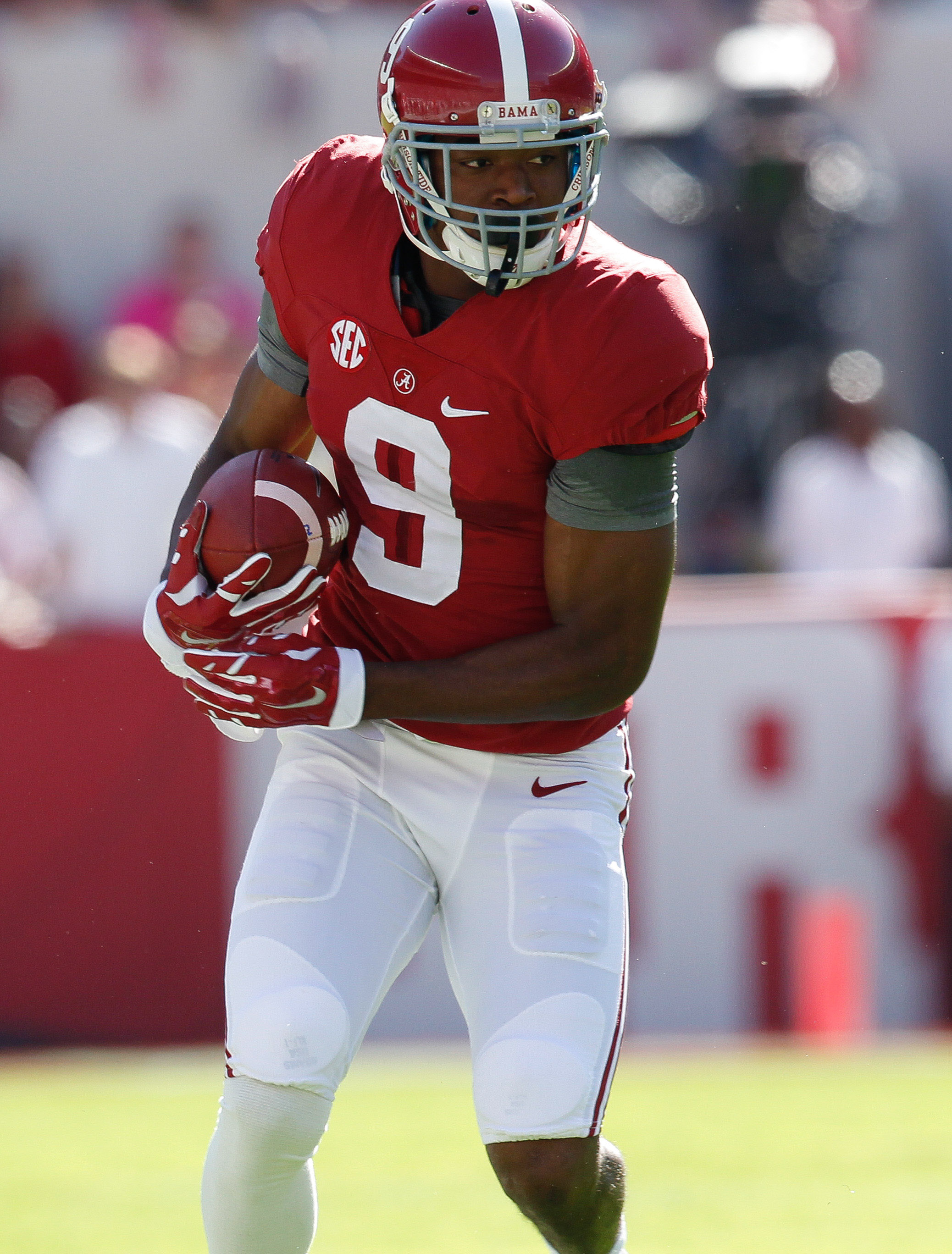
The leader for the top player at the wideout position for the entire collegiate season was Cooper. Coming into the year, he was a potential breakout candidate; by the end of it, he was a Heisman finalist. Cooper caught 124 passes for over 1,700 yards and 16 touchdowns, and for those that watched him religiously, even those numbers don’t adequately convey how dominate he was.
Cooper set Alabama single-game record for receiving yards in a game with 224, doing it twice, against Tennessee and Auburn. He set school single-season records for catches, yards, and touchdowns. He is also Alabama’s all-time career leader in all three categories, and his 124 receptions as a junior was also an SEC record.
Cooper’s reported 40-yard dash times varied, and following the combine, scouts were underwhelmed with his number. However his 4.42 time has been disputed, with some scouts clocking him as fast as 4.31. Watching him play on Saturdays, he certainly looked to have that type of speed.
Far from a one-trick pony, Cooper was used as a deep threat often, running past cornerbacks on the outside and beating safeties with double moves in the middle of the field. The Alabama offense also got him involved with screen passes on the line, let him work the intermediate routes, and threw the ball up to him in the red zone.
While Cooper tore apart the nation in 2014, it would be interesting to see how he stacked up against last year’s class of receivers. A case could be made that he would have compared favorably to Sammy Watkins, but Mike Evans‘ giant frame and Odell Beckham‘s athleticism might have given them the advantage as prospects. Cooper doesn’t overwhelm with size, and while he made some impressive catches, he dropped enough throws that you wouldn’t compare his hands to Larry Fitzgerald‘s or Antonio Brown‘s.
Cooper is never going to be A.J. Green, Julio Jones, or Dez Bryant. They are the rare cases of a player that can do absolutely everything on a football field. No matter how well Cooper develops, becoming a 6’4″ leaper with superior strength and speed all in one isn’t in the cards. However, this draft class doesn’t necessarily feature the sort of can’t-miss superstars we sometimes see at the top of teams’ boards, and that leaves Cooper as a pretty good bet as a top-five pick.
White wasn’t necessarily in Cooper’s class until late in the process, but it appears he has surpassed Cooper on many boards. A number of mock drafts have the Raiders taking White at No. 4 and leaving Cooper waiting.
White’s 4.35 speed compares favorably to Cooper’s, and he also has the 6’3″, 215-pound frame that reminds teams of those elite receivers who consistently jump over defenders to make unstoppable catches.
Few would argue that White is as polished as Cooper. White spent two years at junior college, and then didn’t play football for a season before winding up at West Virginia. He struggled to adjust in his first season, then broke out with a huge 2014 campaign.
Cooper broke all the records, but White wasn’t far behind in terms of production. When a player catches 109 balls for nearly 1,500 yards and 10 touchdowns, he isn’t considered “raw.” He might be moving ahead of Cooper based on potential that may never be reached, but he is a good player right now. He catches the ball well, as the drops he struggled with in 2013 didn’t persist last year. White’s routes are also more polished than you would expect for a player who was so raw for so long. He has the body control to take advantage of his size, making plays down the field and on the sidelines, and he has real speed.
Both Cooper and White are poised to be dangerous pros, and they lead a class that could see 10 receivers selected in the first two rounds, with a bunch more that will be off the board by the end of round three. Cooper and White should both be off the board in the top 10 picks. If they aren’t, the Vikings and Browns would almost certainly pounce at No. 11 and No. 12.
I watched both receivers play a lot, and going back to the stats and the film, the two players are closer than I remember them being at the time. All that being said, I would be surprised if a team takes White first. I’m not saying it would be a mistake to do so — just that I would be surprised to see it.
First Round:
- DeVante Parker, Louisville
- Breshad Perriman, UCF
- Dorial Green-Beckham, Missouri/Oklahoma
- Jaelen Strong, Arizona State
With Cooper and White both possibly coming off the board in the top 10 picks, Parker becomes the best available player at the position. The dropoff from those top two wideouts to Parker has been overstated. He presents a similar speed and size comparison, and is strong tracking the ball in the air and catching the ball at its highest point. What Cooper and White provide that puts them over the top is a slight strength advantage, and the ability to pick up yards after the catch. Parker doesn’t consistently make people miss while running with the football, and doesn’t have the balance to shed tacklers.
Talent wise, Green-Beckham could actually make a case for himself as the best receiver in the draft. At 6’5″ and 237 pounds, he is the sort of imposing figure that makes quarterbacks drool. He looks like Calvin Johnson, towering over even some of the bigger college cornerbacks. Evaluators will go on and on about his vertical speed and his catch radius, but the most impressive part of his tape is how often Missouri decided to get him the ball on bubble and jailbreak screens. Green-Beckham showed excellent mobility, agility, and ingenuity running with the football, shocking for a player of his size.
Of course, DGB isn’t even necessarily thought of as a first-round pick, since drug and domestic violence issues have overshadowed his talent. His great film is all from 2013, because he was dismissed from the University of Missouri at the end of that season. He transferred to Oklahoma, but declared for the draft before ever playing a down for the Sooners. Green-Beckham has on-field issues too — his route-running is a little stiff, and while it’s normal for a tall receiver to struggle in and out of breaks, his overall athleticism dictates that it shouldn’t be such an obvious weakness. I was also concerned by how he seemed to struggle with physical corners despite his size, and how he seemed to drop his competition level late in games when the team was down by more than a touchdown on the scoreboard.
Green-Beckham could slip down to the second round due to character concerns, but there are two other wide receivers still left for the first round. Perriman is among the fastest receivers in the draft, and standing at 6’2″, he’s a monster athlete. He should be able to thrive as a deep threat from his first year in the NFL, and he got better as his final collegiate season went on. However, for all his athleticism, he struggled running routes, and failed to look smooth when asked to change directions. He is raw, and it’s difficult to project him making an immediate Pro-Bowl-caliber impact.
Strong is a little more polished and – aptly – a little stronger, but he lacks the speed to create separation and get open down the field. While his 40-yard dash was adequate, he’s forced to become a possession receiver on offense. Teams today need that deep threat more than ever, and although he might make a very good pick for a team in the top 25, Strong’s star power isn’t there to compete with Cooper and White.
Day Two:
- Sammie Coates, Auburn
- Devin Smith, Ohio State
- Phillip Dorsett, Miami
- Nelson Agholor, USC
- Rashad Greene, Florida State
- Tyler Lockett, Kansas State
A number of the guys in this group have gotten some first-round buzz, but I expect them all to be available on day two of the draft. Smith and Dorsett boast the blazing speed to get deep, but size concerns prevent them from locking in first-round grades from most evaluators. A number of other factors come into play there, with neither player exhibiting such strong hands or route-running skills that they will easily be able to exploit other areas of the field without serious development at the next level. Dorsett looks to have a little more burst after the catch, and was able to turn the corner on some crossing routes and split would-be tacklers with speed at times for Miami.
Agholor was thought to have that type of speed as well, which made him a borderline first-round talent early in this process. While Smith and Dorsett were able to back up their film at the Combine, Agholor’s 40-yard dash time was less impressive. However on film, he is able to use his speed (and slightly bigger frame) in many more ways then the other two burners. He exploits the middle of the field and does a great job getting out of breaks, and even caught some passes on traditional running back routes out of the backfield, which provides a lot of value for offensive game plans when versatility creates mismatches. Agholor was also very good at traditional west coast routes such as slants, curls, and quick outs, catching passes in tight coverage that Miami and Ohio State wouldn’t dare throw to their speedsters. He still plays fast on film despite his timed speed, and he shows flashes of potential that could compare him to Randall Cobb, another second-round pick who blossomed by being able to obliterate defenses with his skills before the catch.
Greene is a little closer to Smith and Dorsett than Lockett is, but both figure to make it to the third round or even the fourth if their skills as returners don’t get them selected earlier. The speed isn’t quite on full display here, and the other important skills just are not developed. Lockett especially tries to catch every pass like it’s a punt, trying to trap it against his body. Rarely on film does he attempt make a true hands catch, whether wide open or in traffic, and he looks like he might end up like a Devin Hester clone on offense. As talented a returner as he might be, I doubt he matches Hester’s historic value on special teams.
Coates is an interesting prospect here. He flashed some top-end speed at Auburn but it’s his ability to go up and play the ball in the air that makes him intriguing. Watching him on film you would assume he’s a 6’3″ leaper, but at merely 6’1″, that ability might not translate to the pros. He struggles with his routes, but his raw talent could be a big plus for a team late in the draft — if he had measured in at 6’2″ or taller, Coates may have been a borderline first-round pick.
Tight Ends:
- Maxx Williams, Minnesota
- Devin Funchess, Michigan
- Clive Walford, Miami
- Jeff Heuerman, Ohio State
These four tight ends are in the same boat as the day two receivers. It isn’t a deep position group this year, so they may get bumped up a half a round by teams with need at the position. None truly warrants a first-round grade, though Williams becomes a possibility as early as perhaps the 16th overall pick. The consensus best tight end of the draft, Williams is a sturdy option. He isn’t a mauler as a blocker, but he gets his hands dirty. He brings value as a receiver, mostly on intermediate routes but with some vertical threat as well, and he boasts the best functional hands of the position — there are some with better hands, but they lack route-running and blocking skills to such an extent that it becomes a chore to even put them on the field.
Funchess is thought to be a big-play option that was expected to draw interest, but he’s only listed as a tight end in order to bump up the value of his pass catching abilities (and to bump down the value of his second contract). He would likely rank in the same area as a receiver, lacking the true athleticism to succeed on the outside. He does provide a big body, and the right team could use him as a tight end to have him take advantage of slower linebackers or smaller nickel corners.
However, thinking that a team is going to get away with having Funchess as an in-line blocker would be a big mistake. That job should be reserved for Heuerman, who has only reasonable experience catching passes but could turn his skill set into a nice career as a blocking tight end with the versatility to play fullback. That would provide flexibility for a team that doesn’t want to carry a fullback on the roster, but could use one now and again.
Walford might be the standout of this group. He’s a good – but not great – pass catcher, letting a few slip through his hands during his time at Miami. He does have the ability to make tough catches in traffic, and while he might not necessarily threaten vertically, he allows the quarterback to push the ball downfield with some deep crosses and corner routes. Most intriguingly, he picks up speed after the catch, enabling him to eat up yards while bouncing off smaller tacklers. Combined with his above-average ability as a blocker, where he may not necessarily bury people but does play with leverage and positioning to wall off and reach both defensive ends and linebackers, Walford could emerge as a very good all-around tight end.
Photo courtesy of USA Today Sports Images.
Washington Re-Signs Kai Forbath
THURSDAY, 8:26am: Washington has officially announced Forbath’s new contract for 2015.
WEDNESDAY, 5:31pm: Kicker Kai Forbath has signed a deal that will keep him in Washington for another season. Forbath announced the signing on his Instagram account.
Forbath won’t be handed the starting job in Washington, despite making his field goals at a rate of 88% for his career. J.P. Finlay of CSNWashington.com writes that the team drafted Zach Hocker out of Arkansas last season, and although his accuracy has been suspect, Hocker has shown a huge leg on kickoffs.
As long as Forbath keeps connecting on his field goals, he should be able to hold on to his position. However, Hocker’s powerful leg will put him in position to take over the starting job if he can even come close to matching Forbath from an accuracy standpoint.
Sturm On Cowboys: Peterson, Trades, Draft
Bob Sturm took questions from Cowboys fans in his Wednesday chat for the Dallas Morning News.
Here are some of the highlights from his Q&A session:
On whether it would be a good idea to trade their second-round pick for Adrian Peterson:
“I think so. Again, I don’t like it at all. They had 3 choices this offseason for RB (maybe 4). Choice 1 was pay the NFL rushing champion to stay here (which he wanted to do). They passed. Choice 2 would be take a RB and although he is unproven, he will cost about $4m for 4 years (or $1m per season). So, the price is worth it. Choice 3 is to trade a top pick AND pay Peterson “Murray money”. This makes no sense because of age, work load, and the fact he costs you a 1st or 2nd round pick when Murray would not cost you any of that. Choice 4 is to use McFadden and Randle and see how that works. Peterson, to me, is the worst choice. However, he is Adrian Peterson and that is plenty exciting for all involved, I admit..”
On the difficulties in completing a trade for Peterson:
“There are many reasons why this trade is difficult, and I admit that one of them might be history. But, the bigger one is that the Cowboys have done everything possible to give all leverage away on this deal. They have practically telegraphed their desires publicly for a year, and this doesn’t assist in helping you get a cheap deal. Most of the principles in the Walker deal are long gone, but they know Jerry deep inside needs Peterson. Again, I don’t think the Cowboys should consider this.”
On options at cornerback in the draft:
“Well, there are a lot of really strong corners in that range. I agree that Trae Waynes and Kevin Johnson are gone. Marcus Peters is likely gone too. I would take Johnson and Peters if they are there. [Byron] Jones from UConn is next with [Eric] Rowe from Utah and [Ronald] Darby from Florida State for me. Each have their pluses and minuses. Jones might be a better athlete than a player – with his Combine performance being so much of his buzz. Rowe looks like a much better safety to me and Darby is a track guy who isn’t the best tackler ever. But, all of them are solid players.”
On whether the team should trade down from No. 27:
“One reason I don’t dive into the mock draft business is because I have found that trying to figure out what ONE franchise is planning to do is next to impossible. Trying to figure out what ALL of the franchises are doing is so absurd it is a waste of everyone’s time. That said, I would agree that those are reasonable ideas as are a few others – NYJ come to mind to get back into Round 1. But, when I look at who did deals last year, they often were not telegraphed and that is how it usually works. So, I still believe the trade-down is ideal, but finding the partner requires value issues, need issues, and the Cowboys agreeing with us that they need to trade out of #27.”
On whether he would prefer an interior lineman or edge rusher in the first round:
“I think they will look at both of those spots – as well as CB, RB, and LB – try to place values on each and try to take the BPA – best player available. I think you need both badly as DT is thin for penetrating forces and DE is likely weak unless you are going to do a longterm deal with Hardy. So, Malcom Brown or Eddie Goldman are great there – but so are so many of the edge guys. Look and see what #27 has.”
On where in the draft the Cowboys will find their running back:
“It seems to me that if you want a RB, you better plan on Round 2 being the place. And as we mentioned already, that is still not a great guarantee. Round 3 may get picked over before it gets to 91. I suspect they have their plan – which, unfortunately, may include trading one of those top picks to Minnesota.
“I have 5 RBs on the board in the 1st 2 rounds. Gordon and Gurley in Round 1, [Jay] Ajayi, [Tevin] Coleman, and Duke Johnson in Round 2. But, that view may not get them to pick #60 in Round 2. In fact, I am expecting that Ajayi and Coleman might be gone before #50. This is why I would prefer to trade back from #27 and pick up a 2nd and a 3rd, use the 2nd to get my RB and then have #60 and 2 3rds to work on my defense. But, if I can’t trade back, the other option is to use #27 on defense, then use #60 and #91 to move up and try to get into the late 40s to grab on of those 5 players. It is difficult to predict how this might work out.”
Darryn Colledge To Retire
Dolphins offensive lineman Daryn Colledge has announced that he will retire from the NFL, reports Ian Rapoport of NFL.com (via Twitter).
The decision was announced through his agency in a series of Tweets. The overall statement reads as followed:
“My friend and client Daryn Colledge is retiring after nine years in the NFL. Daryn did not miss a start, due to injury, during his four years of high school, four years at Boise St, and his first eight-and-a-half years in the NFL, where he played for the Packers, Dolphins, and Cardinals. He had 122 consecutive starts in the NFL. He was a pro’s pro. He retires with a Super Bowl Championship, his health in tact, great friendships, and financial stability. He is a licensed pilot, and the owner of his own plane, and partners with two former Packer offensive linemen in a wine label, 3 FAT GUYS. He’s moving to Italy for a year with his best friend, and wife, Megan and their two beautiful daughters. We should all be so lucky. He’s truly a renaissance man. Congratulations on a career well played, and a life well lived, thus far.”
Colledge played 13 games at left guard for the Dolphins in 2014, struggling throughout the season. Still, the team will have to look for another option along the interior of the offensive line for this upcoming season.
Minor Moves: Wednesday
Here are today’s minor transactions from around the NFL. As always, any additional moves will be added to the top:
- The Chiefs have waived tight end Sean McGrath, according to Adam Caplan of ESPN (via Twitter). McGrath retired last year, but was reinstated and officially waived by the team.
- The Giants have waived cornerback Josh Victorian, according to Caplan (via Twitter). The team has also cut defensive end Paul Hazel, according to Aaron Wilson of the Baltimore Sun (via Twitter).
Earlier Updates:
- The Packers have taken a flyer on developmental quarterback Matt Blanchard of the University of Wisconsin-Whitewater, according to Rob Demovsky of ESPN.com. Blanchard joins Scott Tolzien on the depth chart behind Aaron Rodgers.
- The Giants have added two players, signing defensive back Josh Gordy and linebacker Ryan Jones, writes Michael Eisen of Giants.com. Gordy has played in 59 games since signing with the Jaguars as an undrafted rookie in 2010, and Jones was signed by the Ravens last June but was waived after a foot injury.
- The Saints have signed center Mike Golic Jr., according to Adam Caplan of ESPN (via Twitter). Golic also spent time with the team last offseason.
- The Dolphins have re-signed wide receiver LaRon Byrd, reports Aaron Wilson of the Baltimore Sun (via Twitter).
Chargers To Sign Chris Hairston
4:05pm: Hairston’s deal with the Chargers is a one-year contract, reports Eric Williams of ESPN (via Twitter). Hairston will be able to earn up to $1.235MM in 2015.
2:29pm: The Chargers have signed Chris Hairston to add depth to their offensive line. Hairston announced the move on his Instagram account.
The team likely values his versatility, as Hairston played both guard and tackle for the Bills, and projects as a swing tackle in San Diego. He played for Chargers offensive line coach Joe D’Allesandris in Buffalo, notes Michael Gehlken of the U-T San Diego (via Twitter).
Gehlken expects Hairston to be the primary backup for multiple positions along the offensive line. Hairston hadn’t played significant snaps since 2012, but held his own when he was able to see the field for the Bills that year, according to Pro Football Focus (subscription required).
2015 NFL Draft Breakdown: Running Backs
With the NFL draft fast approaching, we’ll be taking a closer look this month at the notable prospects for each position. Quarterbacks are already in the books, so today we will look at running backs, starting with a pair of players who could break the streak of two straight years without a player at the position taken in the first round.
Potential First-Rounders:
- Melvin Gordon, Wisconsin
- Todd Gurley, Georgia
2012 was the last year any NFL team selected a running back in the first round, and a look at the three backs who came off the board early that year clearly indicates why clubs may have been scared off for the last couple years. David Wilson has already announced his retirement, while Doug Martin and especially Trent Richardson followed up strong rookie years with consecutive subpar seasons.
Now, Gordon and Gurley are on a mission to bring the star power back to the position.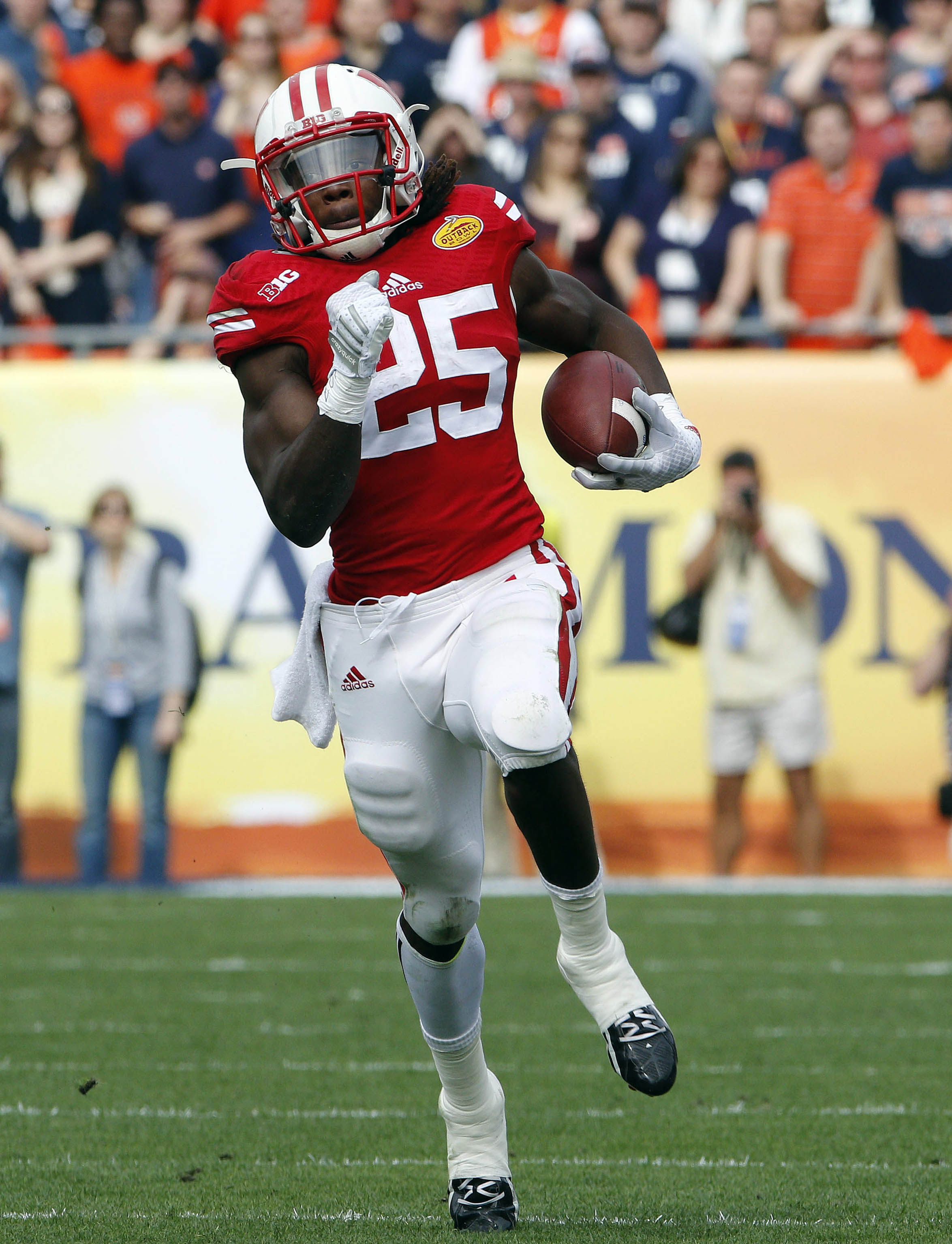
Before getting into the merits of these two backs, let’s briefly look at why no running backs were drafted in round one the past two seasons. In 2013, Giovani Bernard was the first back taken, with the fifth pick in round two. Last year, Bishop Sankey was the top running back chosen, a measly 54th overall. The Bengals and Titans were pretty desperate for backs, but with Bernard and Sankey representing the best options, both were able to wait until round two. In 2013, the Packers and Broncos were also in need of a runner, but were able to wait until the very end of round two to get their men.
The good news for fans of running backs is that Gordon and Gurley are leaps ahead of the crop from the past two years in terms of physical talent. On top of that, the Chargers, Cardinals, and Cowboys are all in dire need of a runner. The Dolphins, Jets, Patriots, Colts, Panthers, Ravens, and Lions also have need at the position.
That being said, I’m skeptical that either player is a lock for a first-round pick. I was only able to squeeze one into the PFR Mock Draft 1.0, with Gordon going to Arizona. Even in the case of that 24th overall pick, there were many talented defensive players on the board, and Cards GM Steve Keim is smart enough not to draft based on need alone. There’s still a chance this is the third straight year we don’t see a running back taken.
Gordon has the slightest edge over Gurley in my eyes strictly based on injury concerns. Clubs like the Chargers, Cardinals, and Cowboys, who are desperate at the position, also happen to be in win-now mode for 2015, and Gurley has been unable to work out for teams after tearing his ACL in one of the most idiotic and unfortunate “amateur” sports stories of 2014. Gordon has no health questions, and should have an immediate on-field impact.
Gordon has an impressive combination of speed, power, and most importantly great balance. He protects the ball, and uses his arms well to ward off would-be tacklers. Gordon’s vision and relentlessness propelled him to over 2,500 yards and 29 touchdowns in 2014. He was among the best in the nation at creating space between the tackles while also maintaining his status as one of the scariest players turning the edge and scampering up the sidelines.
Gordon was able to take pole position as the best running back in the nation after Gurley’s suspension. Prior to the ban, Gurley was a Heisman favorite and was on the way to comfortably being the top back available in the draft. He was suspended for selling his autograph, which only enhanced his stock, saving him from the unnecessary pounding of the SEC. However, the suspension was overturned, and he returned to the field after missing four games only to subsequently tear his ACL.
When Gurley was on the field, however, he was an unstoppable force, blending mind-blowing athleticism and violence as he pounded through some of the best defenses in college football. At times he was untackleable. That may not be a word, but if Gurley had played the whole season uninterrupted by the NCAA or injury, it might have been added to Merriam-Webster. Gurley’s vision and speed is unquestioned even if it isn’t on par with Gordon’s, but the physicality of his on-field performance sets him apart from the pack.
It is tough to see any running back going in the first round if these two playmakers can’t get themselves into the top 32 picks. To really lock himself in as a top pick, a prospect would likely have to be a smooth receiving option in the passing game as well as an accomplished and willing pass protector. Like most college standouts, both these players lack skills as a blocker picking up rushers out of the backfield. Neither player has tremendous experience catching the ball out of the backfield, never mind lining up in the slot and taking advantage of mismatches in the defense.
Going back to 2012, Richardson was supposedly going to be able to have immediate impacts as a rusher, receiver, and blocker. Martin was taken 31st and was also expected to provide value across every aspect of the position. Sankey and Bernard were limited players, and that is the main reason they didn’t garner first-round consideration. Bernard had some value as a playmaker, but even Sankey was probably overdrafted as a mid-second rounder. Gordon and Gurley blow every one of those players away as prospects with the exception of Richardson, who continues to be one of the all-time misevaluations in recent draft history.
If I published a big board, I would probably have both Gordon and Gurley among my top 20 prospects. That being said, there is plenty of value to be found later in the draft, and the potential to take a player at a premium position in round one and worry about running back later still seems to make more sense than targeting Gordon and Gurley, which hurts their stock, fair or not.
Day Two:
- Jay Ajayi, Boise State
- Ameer Abdullah, Nebraska
- Duke Johnson, Miami
- Tevin Coleman, Indiana
The names in this group – and even those in the next group – provide a handful of reasons not to draft Gordon or Gurley with a first-round pick. Johnson and Abdullah both bring the top-end speed teams are looking for in a home run threat. They also come with the added value of having ability in the passing game. Abdullah particularly has drawn comparisons to Darren Sproles, who was transformative as a receiver and returner for the Eagles in 2014. Johnson is a bit more raw, and is often discounted as a complementary back, but he is bursting with potential. DeMarco Murray was never expected to carry the load like he did either, but he translated to the NFL as a star when healthy and with the help of a strong offensive line.
Ajayi is the preferred back in the draft for some evaluators, because he does have the ability to do it all. Watching him play doesn’t evoke the emotional reaction of the first-round hopefuls, but his ability to protect the quarterback and catch the football makes him a complete package who could potentially step in as an every-down back as a rookie. Of course, the jack-of-all-trades players have been scary, especially if they don’t have a single skill they can lean on if one or more of the other aspects of their game are taken away by the defense. Fellow Boise State alum Martin looked great in his first year transferring from blue turf to green, but quickly fell out of favor with the coaches and faded into obscurity on the Buccaneers’ depth chart. Additionally, even the best blockers at running back need to relearn this skill when they first arrive in the NFL.
Coleman provides a different type of value as a possible second or third-round pick. Coleman is what I like to call a churner. The guy never stops moving his legs, never stops trying to power himself for a first down or for a touchdown. Watching film on him immediately makes me think of the of the two little mice dropped into a bucket of cream. As the story goes, the first mouse gives up and drowns, while the second mouse struggles so hard it churns the cream into butter and walks out. Coleman is that second mouse. In his draft profile on NFL.com, under weaknesses, he is described as treating every play like a sprint. I understand why this is a weakness, as it means he lacks patience and likely struggles with vision, but it’s the sort of flaw you wouldn’t mind mentioning in a job interview.
Late or Undrafted:
- David Johnson, Northern Iowa
- Jeremy Langford, Michigan State
- T.J. Yeldon, Alabama
- David Cobb, Minnesota
- Mike Davis, South Carolina
- Javorius “Buck” Allen, USC
- Karlos Williams, Florida State
In my discussion of quarterback prospects, I identified a few players who might be given the opportunity to fight for a roster spot and would be lucky to get a backup job in the NFL. For running backs, there is legitimate hope that one or two of these late-round players will become reliable ball carriers or even Pro Bowlers, while all of them should have the opportunity to make some sort of impact. Allen, Cobb, and Johnson all have supporters– none of those three possess the athleticism to really push the envelope of stardom at the next level, but they were able to move the chains during their college careers, and they do enough things well to warrant a draft pick. Williams is sneaky and shifty, even if he was overshadowed at times on the Florida State offense.
The real prize here could be Yeldon, even if Alabama runners can scare off fans and pundits. Despite the success of Eddie Lacy and the career turnaround of Mark Ingram, it’s hard to get the Richardson stink off. Yeldon, however, provides a similar blend of violence and speed in his running style to Gurley. The Alabama back gets up the field and is devastating in penetrating the heart of the defense. He also shows potential as a blocker and is terrifying in the passing game, even if he did most of his damage catching the football with screens.
Yeldon’s biggest drawback was his ball security. While his fumbling problems might be overstated, as a fan of his I’d be lying if I said I didn’t see him lose the ball in big spots too often. That’s a correctable issue, and if he can stay healthy and be effective, teams are willing to deal with that kind of red flag. Murray was fumbling once a game for the Cowboys during a stretch early in the season, and he was being handed the ball at a record pace anyway. Yeldon does have to stay healthy though, and like many Alabama players he struggled with numerous injuries during his college career.
I pulled Yeldon out for the Bills in the second round in PFR’s first mock draft. I think a team could fall in love with the things he does well and push him up a few rounds, where his strengths probably dictates he should belong. If I had the choice between Gurley or Yeldon, I have to admit Gurley is the better bet, despite my affections. Gordon is too. On the other hand, a team like the Chargers might rather have a top offensive lineman and a second-round talent like Coleman or Yeldon at running back, rather than taking Gordon in the first and missing out a chance to improve the offensive line or a very thin defense.
2015 NFL Draft Breakdown: Quarterbacks
With the NFL draft fast approaching, we’ll be taking a closer look over the next couple weeks at the notable prospects at each position, starting today with quarterbacks. Most of this piece will be dedicated to the top two passers in the draft, given how unusual it is for a starting-caliber player to come out of the later rounds at the position. However, we’ll also touch on a number of intriguing day two and day three options with some potential, buzz, and name recognition.
Top Prospects:
- Jameis Winston, Florida State
- Marcus Mariota, Oregon
Winston and Mariota are the only two quarterbacks that should be getting first-round consideration, and neither is anything close to being a slam-dunk prospect. These two signal-callers couldn’t be any different, even if we throw out the perception of character, where Mariota has been nothing but praiseworthy and Winston has a few red flags.
On the field, the two quarterbacks barely seem like they’re playing the same sport, much less the same position. Winston is the presumed No. 1 guy at the moment, but I wouldn’t be surprised if a handful of teams have Mariota ranked way ahead of Winston on their big boards.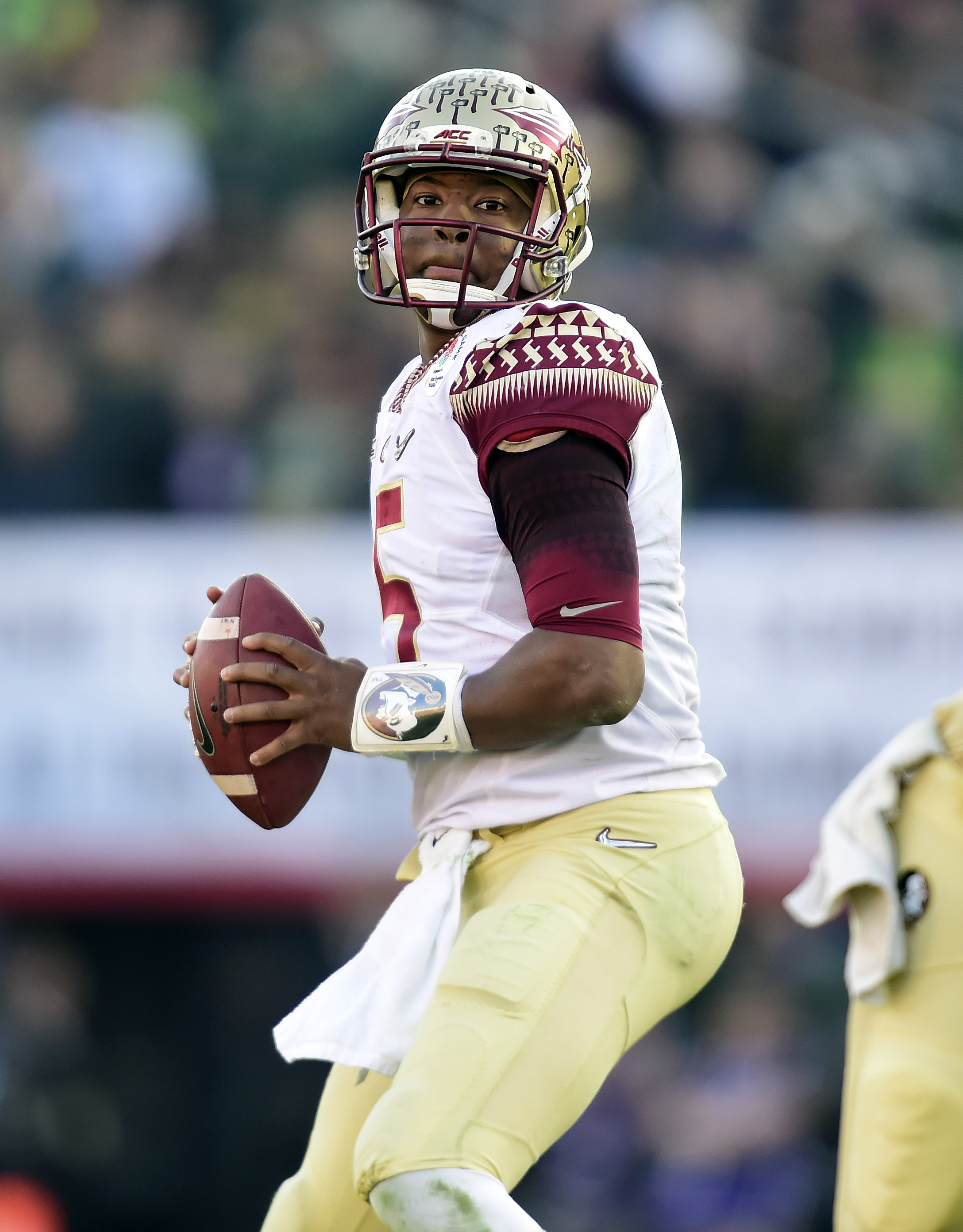
For most teams and talent evaluators, Winston’s strengths and weaknesses are much more palatable. He played in an offense that relatively resembles an NFL-style offense. Many of the route combinations he used are the kind that may be seen at the next level. Particularly, Florida State dialed up reads such as smash concepts (often a corner route with a hitch or arrow to threaten the flat) and high-low reads (two crossing routes ran at different depths) that are common principles in many NFL passing attacks. Winston consistently read the defense before the snap and diagnosed where he should go with the ball.
Winston’s accuracy is very impressive, and even though he does occasionally just miss a throw, that’s not as worrisome as a player who struggles with ball placement play after play. He developed good timing with his receivers, and his most impressive trait is the ability to trust the play concept by throwing the ball ahead of the receivers, often before their break, and completing passes in rhythm that other quarterbacks wouldn’t dare throw.
However, all this praise doesn’t completely absolve his flaws. Winston threw 18 interceptions last season, an unforgivable number against ACC defenses that failed to impress. While he does a great job reading the defense, he’s significantly less impressive at seeing the field during the play. Winston doesn’t necessarily have tunnel vision, and he’s able to manipulate defenders with his eyes, but he fails to recognize ancillary pieces of the defense. He might make a great read on a crossing route, but won’t notice a linebacker dropping to a zone underneath his intended receiver to make a play on the ball.
Many times, a corner would escape Winston’s vision by coming off his receiver to gamble on another route on the field. These gambles paid off, as Winston failed to recognize these small defensive quirks. He also pushed the ball into tight coverages, and relied too heavily on his tremendous arm strength to take advantage of the talent advantage Florida State employed on the outside.
On top of that, Winston has an extremely long delivery, which helps defenders break on throws and could explain why so many linebackers and corners were able to leave their zones to step in front of passes. His throwing mechanics are sloppy and although he has the arm strength to make up for it, it’s a red flag that helped undermine previous first-round picks unable to correct similar problems in the pros.
Mariota presents a very different option. Obviously much can be said about the Oregon offense and the inability for quarterbacks running the read-option spread to successfully adjust to playing quarterback at the NFL level. Robert Griffin III was able to do it for a year, but hasn’t been able to repeat that performance. Colin Kaepernick is a good comparison for Mariota’s skill set, and he has had some success, but he was running a pistol-heavy option offense at Nevada rather than a true spread. Kaepernick also has the arm strength that allows him to get away with other shortcomings as a passer. The only QBs who have consistently performed coming from the spread are Cam Newton and Alex Smith. While both those signal-callers have played well at times, neither gives confidence that Mariota will overcome his difficulties to become a good NFL passer.
Mariota struggles with ball placement, and has not proven he can lead a receiver on a route or throw one open in tight coverage. The inflated completion percentage coming from screens and check downs is not as concerning as having open receivers and putting the ball so square to the receiver’s body that he stops momentum of a player running at full speed. He has adequate arm strength, but was not asked to show it off very much in college. With a strong running game, he was rarely put in obvious passing situations, and struggled to move the chains from the pocket when the defense was able to sit in coverage. He has not been tested on tight throws, electing to move to a check down rather than squeeze a football into small windows, even when down and distance would have called for the harder throw.
What Mariota does do well is get rid of the ball. He is precise with his reads, even if they aren’t necessarily the same reads he would make in a standard NFL passing attack. He makes quick decisions and – more impressively – he delivers the football efficiently. He has an excellent release and good mechanics from the pocket. He also doesn’t look to run as a first option despite overwhelming physical skills, and when he does scramble he’s able to keep his eyes downfield and keep his throwing mechanics as textbook as he can without losing the fluidity one would expect from an athlete of his caliber.
Maximizing Mariota’s skill set early in his NFL require doesn’t require Chip Kelly‘s involvement, but the Oregon QB is a classic square peg. Putting him in a round hole would destroy his development. Still, he does enough stuff from the pocket that I don’t see him needing to run a college offense in the NFL. Good coaching will solve other problems he has, and he possesses the ability to step up in the pocket and accelerate up running lanes for first downs if needed. That being said, it is difficult for me to say with confidence that he is ever going to consistently beat defenses on third-and-long, and he won’t have Oregon’s offense keeping him in third-and-short situations, where the threat of the run opens up passing lanes and makes his job easier.
I wouldn’t have been surprised if the Buccaneers favored either of these two passers, but I would be surprised if there’s any team without a preference, given the stark differences between Winston and Mariota. If this draft class included a can’t-miss offensive tackle or defensive lineman, I’d be very hesitant to leave him on the board in favor of a quarterback, but in a draft that doesn’t look strong at the top, passing on a signal-caller will be difficult.
Even in a world where Mariota goes first to the Buccaneers (which seems unlikely unless Lovie Smith and Jason Licht are playing a very long con with the media), Winston would be an easy choice for the Titans assuming his off-the-field issues haven’t taken him off their board completely. Mariota isn’t as perfect a fit for Ken Whisenhunt, who would likely prefer an arm like Winston’s and undervalue Mariota’s athleticism, but Bud Adams once forced Vince Young on Jeff Fisher, and ownership figures to be involved in this decision as well. If the most recent Heisman-winning quarterback slips (and it isn’t impossible to imagine, with a number of teams after the Buccaneers and Titans having varying degrees of need at the position), at some point his potential will win out, and a team will believe it has a stolen a player it didn’t expect to have a shot at drafting.
Day Two:
- Brett Hundley, UCLA
- Bryce Petty, Baylor
- Garrett Grayson, Colorado State
- Sean Mannion, Oregon State
Second- and third-round quarterbacks aren’t players expected to be stars. If a team believes in them enough to place those standards on them, they would have been first-round picks. For the most part, teams are content to get high-quality backup quarterbacks after round one, as the Broncos and Patriots have done recently with Brock Osweiler and Jimmy Garoppolo. Maybe these players will provide value one day when Peyton Manning and Tom Brady retire, but clubs aren’t leaning on them to propel the franchise into contention. Yes, Drew Brees was a second-round pick, dropping out of the first round due to his size concerns. But for every Brees there is a Geno Smith, and for every Smith there are a dozen players who never get a chance to start despite being drafted relatively early.
Brees is the major outlier, but since he came into the league, the best-case scenario for a second- or third-round pick being developed as a starter falls somewhere in the range of Matt Schaub, Andy Dalton, and Kaepernick. All three are capable players (or in Schaub’s case, was a capable player), but at this point they aren’t among the league’s best QBs.
Hundley provides the most pure upside of this group. He actually represents a near perfect compromise between the two top picks — he’s much more athletic than Winston, with a comparable arm and better mechanics, and while he’s not quite the athlete Mariota is, he offers fewer questions when it comes to familiarity with pro-style offense and is a more confident pocket passer with the ability to make the tough throws, albeit inconsistently. There were reports the Browns were trying to convince him to declare for the draft last year, and may have preferred him over Johnny Manziel in that case.
When his strengths are presented like that, Hundley seems like a very enticing option, but watching him play shows a tremendous gap between him and the top two quarterbacks. He struggles in all the aspects of the game Winston and Mariota consider strengths. Hundley’s pre-snap reads leave much to be desired, and while he has the necessary size and arm talent, he struggles to find clear passing lanes and is unable to lead receivers with their momentum. He runs wildly instead of maintaining pocket integrity and doesn’t keep his eyes scanning the field while scrambling. His best plays are far and few between and his bad plays are ugly.
Coaches may see in Hundley a very malleable developmental project, one that presents in theory a higher upside than either Winston or Mariota based on the overall tools he possesses. The likeliness of a coach actually getting Hundley to that point is a different story. Part of Hundley’s allure came from how outrageous his talent was as a freshman at UCLA. While he had an excellent statistical career, his best passing yardage and passing touchdown totals came as a freshman. That isn’t a red flag in itself, but it only strengthens the argument that Hundley really failed to improve during his career. The same questions and concerns that plagued him as a freshman are questions evaluators have been asking when trying to project him to the NFL. If he was unable to correct virtually any aspect of his game during three years as a starter in college, it’s hard to overlook those flaws he will carry with him to an NFL team.
Petty is an entirely different case. Like Mariota, he is difficult to project coming out of a Baylor offense that involves a number of complicated principles, none of which are commonly used in the NFL. RGIII preceded him and had success running an offense adjusted to incorporate Baylor’s concepts, but Griffin’s success was limited to only one season. At the same time, Petty was impressive with his arm strength and accuracy in that offense. He wasn’t asked to complete the toughest throws in tight coverage, but his ability to make quick decisions and deliver the ball accurately compares favorably to any quarterback in the draft. He was athletic enough for college, an advantage that will likely not translate to the next level, although he should be able to escape pressure and pick up yards when the play breaks down.
Petty doesn’t present the ceiling that Mariota does, but he might be more versatile than he’s given credit for. He has enough talent and skill that he could have the potential to break out in an interesting offense like Nick Foles did. Foles is a drastically different player, but he made the most of a forward-thinking coach and was able to mold his game to an offense that didn’t necessarily suit his strengths, resulting in an MVP-caliber run in 2013. Of all the quarterbacks in this draft projected outside the first round, Petty might provide the most realistic upside, while still holding a floor where he makes a career as a capable backup with potential to keep teams competitive in a pinch. Chase Daniel and Colt McCoy are similar players, both pigeonholed as system quarterbacks who have been versatile enough to be high-end backups that don’t destroy a team’s chances of winning by entering the game.
Grayson and Mannion aren’t guaranteed day-two picks, but each represents an intriguing option. Unlike Hundley and Petty, both provide very conventional skill sets for NFL teams. While Hundley and Petty are more likely to have a team fall in love with them, Grayson and Mannion should be able to slot in for at any team, should the front office decide it can afford to use a pick on a backup quarterback. These players wouldn’t be obvious fits in Seattle or Kansas City where height and arm strength take a back seat to athleticism and decision making, but practically any team with room on its depth chart could be a possibility. Neither player jumps off the page as a star, but they are sound and have enough talent that they could be worth developing. On the right team, they could see the field early on in their careers. Pairing either of them with Ryan Fitzpatrick on the Jets could be a worthwhile gamble if the team is unable to acquire a quarterback in the first round, or uninterested in doing so.
Of course, the risk of using a draft pick on a quarterback in round two or three is the knowledge that more likely than not, that pick will end up being a player who doesn’t turn into a reliable long-term starter. A number of wide receivers, cornerbacks, and offensive lineman with real expectations to make an impact will be available in those rounds, and taking a flyer on a passer takes away a chance to get a player that could actually contribute on the field early in his NFL career.
Late or Undrafted:
- Brandon Bridge, South Alabama
- Connor Halliday, Washington State
- Cody Fajardo, Nevada
- Shane Carden, East Carolina
- Taylor Heinicke, Old Dominion
- Bryan Bennett, Southeastern Louisiana
- Hutson Mason, Georgia
- Ryan Williams, Miami
- Taylor Kelly, Arizona State
- Jake Waters, Kansas State
- Blake Sims, Alabama
- Bo Wallace, Ole Miss
Expecting a high-quality starter out of this group meaning looking for the Brady and Matt Hasselbeck among a haystack full of players who never make an NFL roster or are out of the league in a year or two. Teams hit on these picks occasionally, and longtime standouts like Kurt Warner and Tony Romo went undrafted, but the vast majority of these quarterbacks, some from big-time programs and with name recognition, will be forgotten about by 2016. Arguably the biggest names on this list are Wallace and Sims, who played for SEC powers that won a lot of games in 2014. Wallace garnered early Heisman buzz, and Sims led Alabama to the college football playoff. Neither is likely to get drafted, and both would be surprises to stick on an NFL roster.
Halliday set a number or records under Mike Leach, throwing the ball time and time again in an offense that isn’t quite as unique to college as those employed by Baylor and Oregon, but it isn’t as if Leach has a history of producing quality pros either. Halliday does have some upside, and given his college career, has a decent chance to stick with a team with the opportunity to become a backup.
Fajardo, Carden, and Heinicke also have gotten some buzz with the draft closing in. These smaller school prospects can sometimes surprise with their talent. Unlike Wallace and Sims – or a player with name recognition like Waters – evaluating those smaller school players is difficult due to the competition they faced. While those big-conference quarterbacks may end up being better, they are largely known quantities at this point. Fajardon, Carden, and Heinicke represent an unknown, as there’s a better chance scouts have just missed on them or failed to take them seriously as prospects. This makes them potentially more valuable investments than a guy like Williams who failed to make an impact against better competition in the ACC, or Mason, who did not impress at all in the SEC.
For these players, the goal is to make a team and get a backup job. It may sound reductive to assume the ceiling for this group is NFL backup, but that is the reality for a day-three draft pick at quarterback. Brady, Hasselbeck, Warner, and Romo were all backups to high-profile quarterbacks with no clear path to start (Drew Bledsoe, Brett Favre, Trent Green, and Bledsoe again, respectively). However, all four broke through eventually. These players are used to being top talents in their respective conferences, but all they have to do is make a roster, and then in the right situation, follow the Zach Mettenberger model to rise to starter early in their career. Mettenberger was a third-string quarterback behind Jake Locker and Charlie Whitehurst, but with a new coach in Tennessee who believed in him and a few injuries, he became the presumed starter heading into 2015 — as long as the Titans aren’t shopping for a quarterback with their first-round pick.