
PFR Originals: 12/7/14 – 12/14/14
The original content produced by the PFR staff during the past week:
- Rory Parks examined the free agent case of Giants defensive end Jason Pierre-Paul, noting that although New York could opt to place the franchise tag on its star pass-rusher, a deal that pays JPP somewhere between Robert Quinn‘s $14.2MM AAV and J.J. Watt‘s $16.7MM annual salary would be fair for both sides.
- Luke Adams posted the list of the NCAA underclassmen who have declared for the NFL draft, which includes Wisconsin’s Melvin Gordon and UCLA’s Brett Hundley. The list will be constantly updated and be available on the right-hand sidebar under “PFR Features.”
Early Entrants For 2015 NFL Draft
A year ago, a record 102 NCAA underclassmen gained eligibility for the 2014 NFL draft. 98 players were able to declare their intent to enter the draft because they were three years removed from graduating high school, while four others – including quarterback Teddy Bridgewater – were eligible because they graduated a year early.
The number of early entrants in the NFL draft has been on the rise for the last several years, so it wouldn’t be a surprise to see that number break the three-digit mark again for 2015. And with the college football season already over for many schools, players have begun to announce their decisions to forgo their senior seasons and pursue an NFL career.
We’ll use this post, which can be found anytime on our right-hand sidebar under “PFR Features,” to track those underclassmen who have confirmed their intent to enter 2015’s draft. Here’s the current list of early entrants for the draft, which will continue to be updated for the next several weeks. Players are listed in alphabetical order:
- Nelson Agholor, WR (USC)
- Jay Ajayi, RB (Boise State)
- Kwon Alexander, LB (LSU)
- Javorius Allen, RB (USC)
- Arik Armstead, DL (Oregon)
- Deion Barnes, DE (Penn State)
- Malcom Brown, DT (Texas)
- Alex Carter, CB (Stanford)
- Sammie Coates, WR (Auburn)
- Tevin Coleman, RB (Indiana)
- Jalen Collins, CB (LSU)
- Landon Collins, S (Alabama)
- Amari Cooper, WR (Alabama)
- Xavier Cooper, DE (Washington State)
- Christian Covington, DT (Rice)
- Ronald Darby, CB (Florida State)
- Mike Davis, RB (South Carolina)
- Stefon Diggs, WR (Maryland)
- Lorenzo Doss, CB (Tulane)
- Lemar Durant, WR (Simon Fraser)
- Mario Edwards, DE (Florida State)
- Durell Eskridge, S (Syracuse)
- George Farmer, WR (USC)
- Ereck Flowers, T (Miami)
- Dante Fowler, DE (Florida)
- Devin Funchess, WR (Michigan)
- Jacoby Glenn, CB (UCF)
- Eddie Goldman, DT (Florida State)
- Melvin Gordon, RB (Wisconsin)
- Dorial Green-Beckham, WR (Oklahoma)
- Deontay Greenberry, WR (Houston)
- Randy Gregory, DE (Nebraska)
- Todd Gurley, RB (Georgia)
- Chris Hackett, S (TCU)
- Eli Harold, DE (Virginia)
- Chris Harper, WR (California)
- Dee Hart, RB (Colorado State)
- Braylon Heard, RB (Kentucky)
- Gerod Holliman, S (Louisville)
- D.J. Humphries, T (Florida)
- Brett Hundley, QB (UCLA)
- Danielle Hunter, DE (LSU)
- Jesse James, TE (Notre Dame)
- Duke Johnson, RB (Miami)
- Nigel King, WR (Kansas)
- Tyler Kroft, TE (Rutgers)
- Marcus Mariota, QB (Oregon)
- Ellis McCarthy, DL (UCLA)
- Benardrick McKinney, LB (Mississippi State)
- Patrick Miller, T (Auburn)
- Tyler Moore, G (Florida)
- Andrus Peat, T (Stanford)
- Breshad Perriman, WR (UCF)
- Marcus Peters, CB (Washington)
- Jordan Phillips, DT (Oklahoma)
- Darius Philon, DT (Arkansas)
- Bradley Pinion, P (Clemson)
- Jeremiah Poutasi, T (Utah)
- Shane Ray, DE (Missouri)
- Josh Robinson, RB (Mississippi State)
- Shaq Roland, WR (South Carolina)
- James Sample, S (Louisville)
- Jean Sifrin, TE (UMass)
- Donovan Smith, T (Penn State)
- Jaelen Strong, WR (Arizona State)
- Shaq Thompson, LB (Washington)
- Max Valles, LB (Virginia)
- Trae Waynes, CB (Michigan State)
- Leonard Williams, DE (USC)
- Maxx Williams, TE (Minnesota)
- P.J. Williams, CB (Florida State)
- Trey Williams, RB (Texas A&M)
- Jameis Winston, QB (Florida State)
- T.J. Yeldon, RB (Alabama)
Free Agent Stock Watch: Jason Pierre-Paul
In 2011, just his second year in the league, Jason Pierre-Paul displayed in grand fashion just what made him so appealing to the Giants, who selected him with the 15th overall pick of the 2010 draft. Using a rare and dynamic blend of size, speed, and athleticism, the man affectionately known as “JPP” racked up 16.5 sacks and was ranked by Pro Football Focus (subscription required) as the league’s sixth best 4-3 defensive end out of 67 eligible players. Pierre-Paul also led his position in total tackles, and he earned first-team All-Pro honors in recognition of his efforts as the most dangerous defensive player on the eventual Super Bowl champions.
It would have been difficult to top his outstanding 2011 campaign, but there seems to be a general belief, probably driven in large part by his lower sack totals, that Pierre-Paul has not even come close to replicating his performance from that season. Although he did amass only 6.5 sacks in 2012, PFF (subscription required) ranked him third among 62 qualified 4-3 defensive ends that year, and after an injury-shortened 2013, JPP is up to his old tricks this season, ranking as the fourth-best player at his position among 54 eligible players (subscription required). Although the Giants’ defense as a whole has been fairly pedestrian over the course of Pierre-Paul’s career (according to Football Outsiders’ metrics), Pierre-Paul seems to be holding up his end of the bargain.
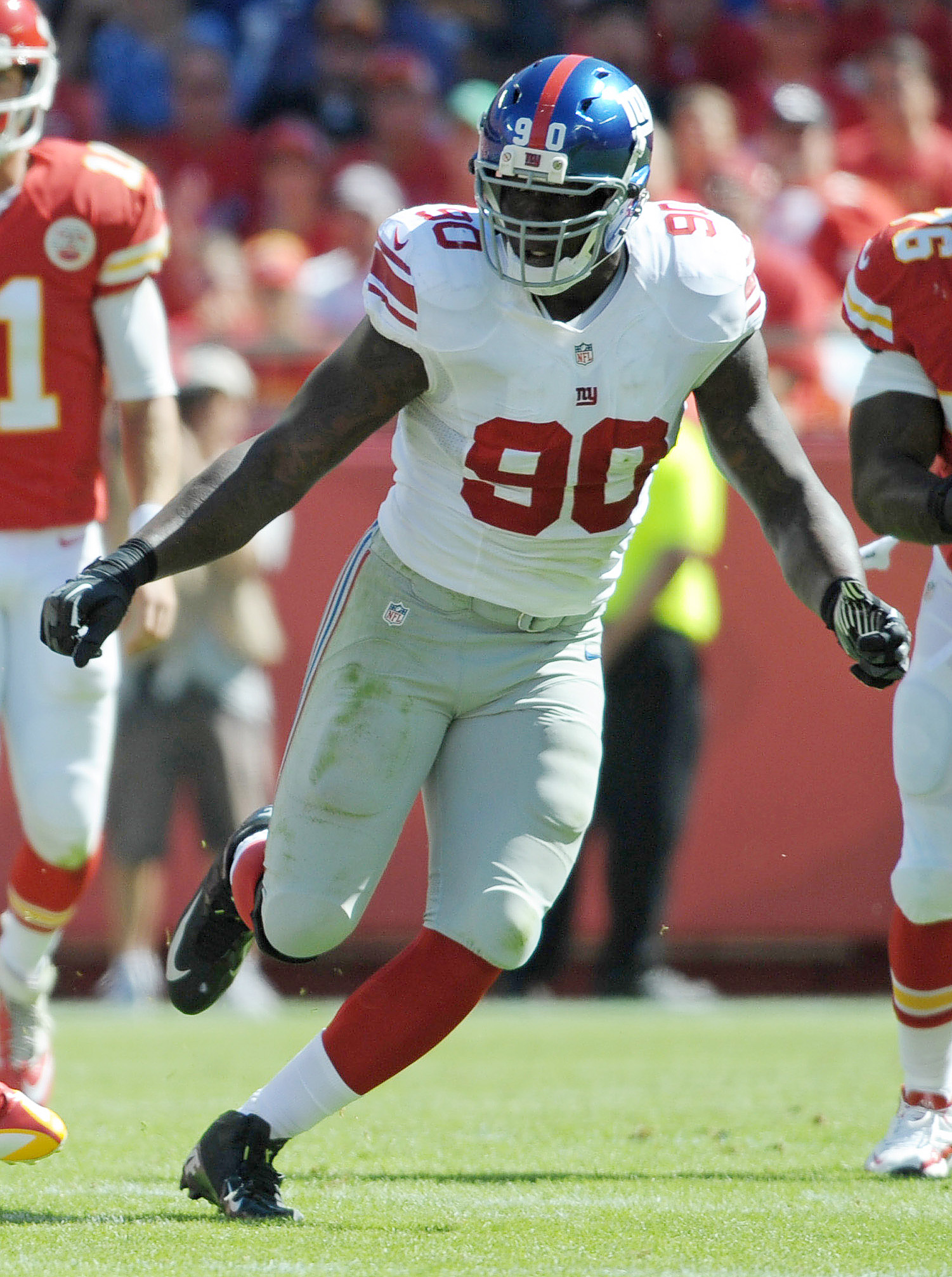
Nonetheless, the two sides appear headed for a parting of the ways after 2014. As PFR’s Rob DiRe wrote last month, Pierre-Paul appeared ambivalent about returning to the club in 2015, stating, “Hey, if I’m here, I’m here, if I’m not, I’m not.” JPP did deliver the usual platitudes while discussing how much he has enjoyed his time as a Giant, but for a struggling team that has a bevy of potentially franchise-altering questions to answer this offseason, a mega-deal for Pierre-Paul might not be the wisest investment, no matter how much cap room New York might have.
So what will a new contract look like for a player in the prime of his career who plays a premium position and who may hit double-digit sack totals for the second time in four full seasons in the league? Robert Quinn, a 4-3 defensive end who was drafted one year later than Pierre-Paul and who has put together three consecutive seasons of 10.5 or more sacks (including a whopping 19 in 2013), signed a four-year extension with St. Louis in September, a deal worth about $67MM.
That contract seems to be a fair benchmark for JPP, although he stands to make more on the open market than he would if he were to sign an extension with New York. Another reasonable comparison might be Justin Houston, a premier pass rusher from the outside linebacker position who expects to land a contract valued somewhere between Quinn’s deal and the extension recently signed by J.J. Watt, a six-year pact worth as much as $100MM (with $51.8MM guaranteed). A five-year deal worth $80MM would seem like a fair price for both Houston and JPP, and that is about what I would expect both players to make on the free agent market.
Of course, the franchise tag remains an option, but as Paul Schwartz of the New York Post pointed out in October, the nearly $15MM projected cost of the tag “is impractical and probably impossible for the Giants to handle.” Schwartz also notes that Pierre-Paul, who was just 21 when he was drafted, is hitting free agency at a younger age than most players, and his willingness and ability to stop the run is not only an underrated part of his game, but also an attribute often difficult to find among so-called pass-rush specialists.
The knocks on JPP, of course, are his injury history—he struggled with back and shoulder injuries in 2012 and 2013—his relatively modest sack total after 2011, and the fact that much of his success is based on his athleticism rather than his technique, which is still raw in many ways. But, as Schwartz wrote, and as Pro Football Focus evaluations indicate, the sack totals are not indicative of Pierre-Paul’s abilities, and if he can complete 2014 in good health, the injury concerns may begin to fade. So while JPP’s next contract will probably not match Watt’s, he could get surprisingly close—especially in this era of the ever-increasing salary cap—and his departure would leave a very big hole in Big Blue. The Giants will have to decide if mending that hole is worth the price.
PFR Originals: 11/30/14 – 12/07/14
The original content produced by the PFR staff during the past week:
- Dallas Robinson updated us on the four players who switched teams during the trade deadline: Percy Harvin (Jets), Mark Barron (Rams), Akeem Ayers and Jonathan Casillas (Patriots).
- As part of the ‘Free Agent Stock Watch’ series, Dallas analyzed the value of Eagles quarterback Mark Sanchez. Using the contracts received by veterans Kyle Orton and Matt Cassel, Dallas guesses Sanchez will receive a three-year deal worth $18-20MM.
- Rob DiRe took a look at the various assets collected by the Rams. Ultimately, Rob concluded that the team is a quarterback away from contending.
- Luke Adams asked which NFC contender will miss the playoffs. The Cardinals, who currently lead the conference with a 10-3 record, garnered the most votes, with about 36% of readers guessing that they’ll miss out on the tournament.
Free Agent Stock Watch: Mark Sanchez
After being selected fifth overall in the 2011 draft, and subsequently leading the Jets to the AFC Championship game in each of his first two NFL seasons, Mark San chez‘s career in New York came to an ignominious end earlier this year. He missed the entire 2013 season after suffering a shoulder injury during a preseason game, and was released on March 21, a week after free agency began. Sanchez quickly joined the Eagles, signing a one-year contract worth $2.25MM to act as Nick Foles‘ backup.
It’s possible that Sanchez, given his lack of success with the Jets, was unable to find a starting role on the free agent market. However, many theorized that the USC product wanted to latch on with Chip Kelly & Co. in Philadelphia, play in a more dynamic offense than the one he struggled in in New York, and face better free agency prospects in 2015. If that was Sanchez’s plan, it certainly worked out, as he excelled during the preseason, leading to trade speculation even before the regular season got underway. And while Sanchez surely wasn’t hoping for an injury to lead to his ascension to the starting QB job, Foles’ broken collarbone has allowed Sanchez to seize the signal-calling reins in Philadelphia.
Since becoming the starter in Week 8, Sanchez has performed well, completing more than 63% of his passes for 1,404 yards, eight touchdowns, and six interceptions, leading the Eagles to a 4-1 record and maintaining the top spot in the NFC East. Advanced metrics aren’t as complimentary of Sanchez — Pro Football Focus grades him as just the 26th-best QB in the league since Week 8 (subscription required), while Football Outsiders ranks him 29th in DVOA (a rate stat that doesn’t penalize for lack of playing time).
Nevertheless, Sanchez has kept the Eagles afloat in Foles’ absence, as Philadelphia’s offense has continued to function with its backup under center. Because of that, it’s fair to look at the possibility of Sanchez remaining with the Eagles for 2015 and beyond. A November report suggested that Foles’ future with the club was in jeopardy, as general manager Howie Roseman had grown frustrated with the third-year QB and had already begun researching alternatives. Kelly later denied the report’s implications, but it’s apparent that Foles is not the ideal quarterback for Kelly’s system. Sanchez probably isn’t the prototype for a Kelly offense either, but most insiders believe that he has more impressive physical tools than Foles.
The Eagles also have second-year quarterback Matt Barkley on the their depth chart, and while he’s not a candidate to see significant playing time, it speaks to the muddled QB situation in Philly. Ideally, Kelly would surely prefer to add a quarterback like Oregon’s Marcus Mariota — a mobile, dual-threat option perfectly suited to his offensive scheme. With that an unlikely possibility, the Eagles could look to retain both Sanchez and Foles, and let the two engage in a training camp battle. However, Sanchez would probably want to be promised a starting job, so if he does return to Philadelphia, Foles could become trade bait.
The more likely scenario, though, sees Sanchez depart Philadelphia in search of a long-term deal that ensures him a starting gig. He shouldn’t have trouble finding a job, especially because quarterback talent is so diffucult to acquire. With even mid-tier options like Andy Dalton and Alex Smith receiving big money extensions, the QB market is usually barren, so a mediocre talent such as Sanchez can be rewarded on the open market. Additionally, Sanchez is clearly the No. 1 option among free agent quarterbacks. Brian Hoyer is the only other FA QB whom teams might feel comfortable employing as a starter, and it’s safe to say that Sanchez will be in higher demand than the Browns quarterback.
So where does Sanchez fit? PFR’s Luke Adams recently examined the state of the quarterback position around the league and identified eight teams who have no clear-cut 2015 starter. The Jets probably don’t want to reunite with its former draft pick, and the Bills, Browns, Buccaneers, and Titans will probably turn to internal options or a high draft-pick next season. By my estimation, that leaves three teams that could show heavy interest in Sanchez during the offseason — the Texans, Washington, and the Rams.
We’ll place the Texans and Washington in one bucket, as I think their level of intrigue regarding Sanchez could be similar. The Texans have all the pieces of a contending team in place except for a capable quarterback; Arian Foster is one of the best running backs in the league, and J.J. Watt and the rest of Houston’s defense is excellent. The QB combination of Ryan Fitzpatrick and Ryan Mallett has been lackluster this season, however, limiting the Texans’ upside. Fitzpatrick is under contract for 2015 but isn’t guaranteed any money, while Mallett is injured and will be a free agent at season’s end, though the team has expressed interest in retaining him. The club also has rookie Tom Savage, but Sanchez could add the boost the team needs to get over the hump.
Unlike Houston, Washington doesn’t have a solid core to build around. The team has a few sound offensive pieces, but its offensive line and its defense could use some work. Regardless, the club is expected to move on from Robert Griffin III during the offseason, leaving a void at quarterback that neith Colt McCoy nor Kirk Cousins will likely be able to fill. Head coach Jay Gruden runs a offensive scheme that has some similarities to that of Kelly, with an air attack that focuses on accuracy and quick passes. It’s a system that Griffin has failed to grasp, but one that Sanchez could potentially thrive in.
The best destination for Sanchez, though, might be St. Louis, where Sam Bradford is expected to be released after suffering yet another major injury. Like the Texans, the Rams have pieces in place to contend — Tre Mason and Stedman Bailey highlight a young offensive core, while the Rams’ defense ranked 10th in defensive DVOA even before today’s shutout of Washington. St. Louis showed interest in Sanchez before the season, and Rams offensive coordinator Brian Schottenheimer is familiar with Sanchez from the duo’s time in New York. As PFR’s Rob DiRe passed along last week, competent quarterback play could vault St. Louis into contention in the NFC West.
As Jason Fitzgerald of Over the Cap wrote in November, a player of Sanchez’s caliber could generally expect ~$2MM to act as a serviceable backup. Now that he’s proven his ability to return to a starting role, however, Sanchez could be looking for a larger contract. A handful of comparable QBs signed free agent contracts prior to this season — Kyle Orton joined the Bills on a two-year, $11MM pact ($5.5MM guaranteed), and Matt Cassel re-signed with the Vikings on a two-year deal worth $10.5MM ($5.25MM in guarantees). Sanchez has youth, upside, and better production on his side, so he can probably garner a more favorable deal than either Orton or Casseel did. A three-year pact in the $18-20MM range, with perhaps $8MM guaranteed, sounds about right, and I wouldn’t be surprised if it’s the Rams that offer that figure to Sanchez.
Updates On Players Traded At Deadline
The trade deadline passed a little over a month ago, and while the NFL never sees the level of activity that do other sports, there were several notable players dealt. With 33 days worth of observation, we can begin to assess how certain trades have worked out for the acquiring teams, and if the players involved will remain on their new clubs’ rosters for the long term. Using our list of 2014 NFL trades, here’s a look at the four deals that occurred within a month of the October 28 deadline:
Jets WR Percy Harvin (acquired from Seahawks on 10/18):
- After sending a conditional 2015 fourth-round pick to Seattle for Harvin, the Jets have employed their new weapon on roughly 68.3% of their offensive snaps. He’s responded by catching 18 passes on 32 targets, totaling 176 yards; he’s also rushed the ball 11 times. New York has utilized Harvin on special teams as well, where he’s returned 11 kickoffs, averaging nearly 24 yards per return. The Jets are turning back to Geno Smith at quarterback, so perhaps the club will use the final five games to determine if Harvin meshes with the second-year QB (although it’s far from guaranteed that Smith will return as the starter next season). Because it acquired Harvin via trade, New York isn’t responsible for any of his prorated bonus money, meaning the club essentially holds a year-to-year option on the receiver. The 26-year-old is owed nearly $10MM in 2015 base salary, and given the Jets’ abundance of cap room, I’d tentatively expect them to retain Harvin.
Patriots LB Akeem Ayers (acquired from Titans on 10/22):
- It’s odd to think that a player who seemingly couldn’t find a place on the defense of a 2-5 team could immediately slot in as a contributor to one of the best defensive units in the league, but that’s what happened with Ayers, whom the Patriots acquired for just a 2015 sixth-round pick. Ayers, a 2011 second-rounder, has already notched three sacks in only four games with New England. He’s played on about 72.7% of the the Pats’ defensive snaps, after seeing action in just one game (10 snaps) with Tennessee. Ayers is still just 25 years old, and though it’s only been a month since the trade, it looks like the Titans may have given up on a player with untapped potential. Ayers will hit unrestricted free agency after the season.
Patriots LB Jonathan Casillas (acquired from Buccaneers on 10/28):
- Casillas hasn’t had nearly the impact in New England that has Ayers, as he’s played on less than 16% of defensive snaps. That number is a bit skewed however, as his role has been slowly growing each week — after playing just one snap in his Patriots debut, he saw action on 12 and 22 snaps in Weeks 11 and 12, respectively. Casillas, 27, is a reserve on a talented linebacking corps that includes Dont’a Hightower, Jamie Collins, and Ayers, so while he might not play much, he could be a valuable piece if a starter suffers an injury. New England actually gave up more (a 2015 fifth-round pick) for Casillas than they did for Ayers; like Ayers, Casillas will be a free agent at season’s end.
Rams S Mark Barron (acquired from Buccaneers on 10/28):
- Barron garnered the highest draft pick compensation of any of the four players traded near the deadline, as the Rams surrendered 2015 fourth- and sixth-round picks to acquire the 25-year-old defensive back. After playing on nearly half of St. Louis’ defensive snaps in Week 10, his role has been drastically reduced — he saw time on just 25 of 136 snaps during Weeks 11 and 12. Barron, the seventh overall pick in 2012, seems to have fallen behind both T.J. McDonald and Rodney McLeod on the Rams’ depth chart. He’s under contract for 2015 at a base salary of roughly $2.363MM. St. Louis holds a 2016 option on Barron, but if his playing time doesn’t increase, it could signal that the club doesn’t view him as a integral part of its future.
PFR Originals: 11/23/14 – 11/30/14
The original content produced by the PFR staff during the past week:
- With the offseason roughly two months away, Luke Adams looked at the 16 teams who are facing decisions at the quarterback position.
- Rob DiRe asked which veteran running back is the best option for the Cowboys in 2015, and about 46% of voters thought that Adrian Peterson would fit well in Dallas.
- Luke wondered which disappointing team will end up with the first overall pick in next year’s draft, and the majority of readers thought the Raiders have the inside track at the No. 1 selection. Thanks for voting!
- Luke also listed the numerous features that can be found at PFR, from our new Trade Rumors app to our early work on 2015 free agency.
Teams Facing Offseason Quarterback Decisions
No position in the NFL – or, arguably, in any of North America’s major sports leagues – is more crucial to a team’s success than quarterback. And by our count, half the teams in the league shouldn’t have to worry about the position this offseason at all.
Many of these 16 clubs have an established veteran who remains under contract for multiple seasons, like the Packers with Aaron Rodgers or the Patriots with Tom Brady. Others don’t necessarily have an elite veteran quarterback, but have recently committed a high draft pick to a young signal-caller who is still expected to be the long-term answer — think Teddy Bridgewater in Minnesota or Blake Bortles with the Jaguars.
However, the other half of the league’s teams have some uncertainty at the position. In some instances, a team will actively pursue a starting quarterback in the draft of free agency. For other teams, it’s simply a matter of ensuring that the current QB gets locked up for a few more years beyond next season.
Here’s an early look at those teams that should need to address the quarterback situation in one way or another during the offseason:
Teams with no clear-cut starter for 2015:
- Buffalo Bills: Both players who have started at quarterback this year for the Bills could theoretically be back for the 2015 season — Kyle Orton has a second-year option on his deal, while E.J. Manuel‘s rookie contract runs through 2016. Neither player has asserted himself as a real answer for the club this season, but without a first-round pick, the Bills will be hard-pressed to find a long-term solution in the offseason.
- Cleveland Browns: Unlike many of the teams in this group, the Browns actually may have two plausible options at quarterback, rather than none. The question GM Ray Farmer and his staff must answer is whether the team will hitch its wagon to Brian Hoyer or Johnny Manziel, or whether both players will return for 2015. Hoyer is eligible for free agency in March, so Cleveland could simply let him walk if the team believes Manziel will be ready to take over.
- Houston Texans: Even if the Texans had seen enough from Ryan Mallett to think he was their future starter, he’s a free agent at season’s end, so there’s no guarantee he returns. Perhaps Houston views Tom Savage as its future starter, but I’d be surprised if the team doesn’t seek out alternatives this winter.
- New York Jets: Like the Bills, the Jets haven’t had any success with their young quarterback (Geno Smith) or their veteran stopgap (Michael Vick). Smith could get one more chance in 2015 depending on how he finishes this season and who is coaching the team next year, but there are certainly no guarantees for the former second-round pick.
- St. Louis Rams: Coming off another season-ending knee injury and owed a base salary of nearly $13MM in 2015, Sam Bradford is a strong candidate to become a cap casualty in the offseason. Austin Davis likely isn’t the Rams’ long-term signal-caller of choice, so St. Louis looks like a team that could target a QB in the draft. The Rams are currently projected to select 12th overall.
- Tampa Bay Buccaneers: Mike Glennon received a vote of confidence as the Buccaneers’ “quarterback of the future” in the offseason from head coach Lovie Smith, but with Glennon currently backing up ineffective veteran Josh McCown, it’s not clear if the Bucs continue to stand by that stance. Glennon and McCown are both under contract for next season, so maybe Tampa Bay will try again with the duo and hope for better results, but with a potential top-five – or at least top-10 – pick on the way, the club will have to at least consider drafting a QB.
- Tennessee Titans: Former first-rounder Jake Locker is on an expiring contract and appears to be on his way out of Tennessee. That could leave Zach Mettenberger as 2015’s starter, but the LSU product was a sixth-rounder and will have only a half-season of experience heading into next year. Presumably, like the Bucs, the Titans would have to take a long look at quarterbacks with their potential top-10 draft pick.
- Washington: Amazingly, it was only two and a half years ago that Washington was giving up the farm in order to land Robert Griffin III. Now, it’s looks like there’s a reasonable chance that RGIII’s time in D.C. is coming to an end. Head coach Jay Gruden doesn’t seem any more enamored with Kirk Cousins than he is with Griffin, and Colt McCoy isn’t a long-term solution, so Washington is another team that could target a quarterback near the top of 2015’s draft. If they don’t go that route, Griffin could ultimately get the nod for at least one more year.
Teams facing decisions on options or extensions:
- Carolina Panthers: As the first overall pick in 2011, Cam Newton remains under contract for one more season because the Panthers exercised his fifth-year option for 2015. Still, it seems unlikely that the team would let him play Week 1 without a new deal. In all likelihood, it’ll be a matter of when – not if – Newton and the Panthers reach a long-term agreement, which could provide a notable benchmark for the quarterbacks from the 2012 draft.
- Indianapolis Colts: One of those 2012 quarterbacks is Andrew Luck, and again, it’s a matter of when – not if – he signs a new long-term contract with his current team. He becomes eligible for an extension this winter, but the Colts could choose to simply pick up his 2016 option and put off long-term negotiations another year.
- Miami Dolphins: Unlike Luck, Ryan Tannehill isn’t a lock to have his fifth-year option exercised. Still, despite Tannehill’s ups and downs over the years, and despite an expected price tag of about $15MM on that 2016 option, I’d expect the Dolphins to exercise it. It’s not immediately fully guaranteed, and even if it were, Tannehill has done enough this year that he’s worth keeping around for an extra year at that price, if not locking up to a full-fledged, multiyear deal.
- New York Giants: Eli Manning and the Giants have both expressed interest in continuing the relationship, and I anticipate that’ll be exactly what happens. Manning’s current pact expires after the 2015 season, so the two sides should get serious about an extension this winter.
- Philadelphia Eagles: Perhaps the Eagles should be included in the section above, since we can’t say with 100% certainty that Nick Foles will reclaim his starting role in 2015, given how shaky he was early this season. Still, I’d be pretty surprised if Philadelphia went another direction. Because he wasn’t a first-round pick in 2012, Foles doesn’t have a fifth-year option, meaning his deal will expire after 2015, and the Eagles will have to make a decision on him soon. In my view, Foles could start the ’15 season without a new deal and – if the Eagles like what they see – he could sign an in-season extension like Carson Palmer did with the Cardinals this year.
- Pittsburgh Steelers: Another instance where it’s only a matter of time until a new deal gets done — the Steelers will likely sign Ben Roethlisberger to a contract this offseason that locks him up beyond 2015. The team has already indicated that negotiations will resume at season’s end.
- San Diego Chargers: Another veteran who should remain with his current team, Philip Rivers is expected to re-open extension discussions with the Chargers after the season. His current deal expires after 2015.
- Seattle Seahawks: Like Foles, Russell Wilson is a third-round pick whose rookie contract doesn’t feature a fifth-year option. As such, the Seahawks may be more aggressive about working out a multiyear extension sooner rather than later with their franchise quarterback, whose deal runs through the 2015 season.
Pro Football Rumors Features
Pro Football Rumors passes along the latest news and rumors on NFL player movement 365 days a year, but those aren’t the only updates you’ll see on the site. On our right sidebar, you’ll find a number of additional features and featured posts. Here’s a rundown of a few of them:
- Using your iOs and Android devices, you can use our app to follow the latest stories on PFR, MLB Trade Rumors, and Hoops Rumors. The Trade Rumors app is highly customizable, allowing you to add feeds for any of the 92 MLB, NBA, and NFL teams, as well as for any of the thousands of players in our archives.
- We’re inching closer to the offseason, and in several NFL cities, fans may already be looking ahead to free agency, considering what players their favorite teams could add to their rosters this winter. You can find the full breakdown of 2015 veteran free agents by position using our list, which is updated weekly during the season.
- Several players figure to receive contract extensions from their respective teams between now and the start of the 2015 free agent period, and we’ve identified a number of potential recipients in our Extension Candidate series, which profiles players eligible for extensions and assesses their value. As the list shows, many of the players we’ve profiled have since had their contracts extended.
- The NFL isn’t known as a trade-happy league, but by our count, 50 trades were consummated by teams in 2014, and you can find them all on our recap of 2014 NFL trades. Meanwhile, you can keep tabs on traded draft picks for 2015 with our tracker.
- We keep tabs on the latest roster moves around the NFL via our lists of roster counts and practice squad rosters. Additionally, we provide a breakdown of how teams used the designated-to-return slot on their injured reserve this year.
- The Pro Football Rumors glossary highlights a number of aspects of the NFL’s salary cap, free agency, and Collective Bargaining Agreement. Feel free to let us know if there’s a specific concept that you’d like us to discuss in a future Glossary piece.
- We value your input at PFR, which is why we regularly publish polls and have a regular feature called Pigskin Links, in which we highlight a few interesting recent articles from football blogs. You can find our poll archives here and our Pigskin Links pieces right here.
- While a handful of our notable articles can be found under the “Featured Posts” section on the right sidebar, the PFR Originals archive rounds up all the original posts from our staff. Recently, we took a look at early returns on contract extension decisions for 2011 first-rounders, examined the teams with the most salary on injured reserve, posted the first edition of our 2015 free agent power rankings.
PFR Originals: 11/16/14 – 11/23/14
The original content produced by the PFR staff during the past week:
- Zach Links rounded up the best of the football blogs in the latest edition of Pigskin Links.
- Luke Adams posted the complete list of 2015 NFL Free Agents, a compilation that will be updated throughout the year.
- I examined the FA class and published the first edition of our 2015 Free Agent Power Rankings, with Chiefs linebacker Justin Houston taking the top spot.
- Luke noted that five clubs failed to use their injured reserve/designated to return slots, and looked at how the remaining 25 teams did utilize their IR-DTR spot.
- The Patriots quickly snatched up veteran running back LeGarrette Blount after he was let go by the Steelers, and he’s already rushed for a touchdown against the Lions today. Zach wondered if Blount is a good bet to return to New England in 2015, and about 58% of voters said yes.
- Before Blount signed with the Patriots and Ben Tate was claimed by the Vikings, Luke asked if either running back would make a worthwhile addition for the remainder of the season. The majority of readers felt that Tate, who was waived by the Browns, would be the better option. Thanks for voting!
- Don’t forget to download the free Trade Rumors app, available for both iOS and Android.