
Offseason Outlook: Tampa Bay Buccaneers
Pending free agents:
- Da’Quan Bowers, DT
- Kaelin Clay, WR (ERFA)
- Chris Conte, S
- Andrew DePaola, LS (ERFA)
- Larry English, DE
- T.J. Fatinikun, DE (ERFA)
- Jeremiah George, ILB (ERFA)
- Mike Jenkins, CB
- Jorvorskie Lane, FB (RFA)
- Danny Lansanah, OLB (RFA)
- Doug Martin, RB
- Tony McDaniel, DT
- Bradley McDougald, S (RFA)
- Henry Melton, DT
- Sterling Moore, CB
- Bobby Rainey, RB
- Russell Shepard, WR (RFA)
- Jacquies Smith, DE (ERFA)
- Keith Tandy, S
Top 15 cap hits for 2016:
- Gerald McCoy, DT: $13,000,000
- Vincent Jackson, WR: $12,209,778
- Lavonte David, OLB: $10,000,000
- Logan Mankins, G: $7,000,000
- Alterraun Verner, CB: $6,750,000
- Jameis Winston, QB: $5,761,654
- Gosder Cherilus, T: $4,500,000
- Bruce Carter, OLB: $4,250,000
- Mike Evans, WR: $3,990,410
- Joe Hawley, C: $3,500,000
- Clinton McDonald, DT: $3,250,000
- Evan Smith, C: $2,500,000
- George Johnson, DE: $2,000,000
- Brandon Myers, TE: $1,916,668
- Demar Dotson, T: $1,750,000
Notable coaching/front office changes:
- Head coach: Promoted OC Dirk Koetter to replace Lovie Smith.
- Offensive coordinator: Hired Southern Mississippi HC Todd Monken to replace Dirk Koetter, though Koetter will continue to call offensive plays.
- Defensive coordinator: Hired former Falcons HC Mike Smith to replace Leslie Frazier.
- Special teams coordinator: Hired Titans ST coordinator Nate Kaczor to replace Kevin O’Dea.
- Director of player personnel: Hired Broncos national scout John Spytek to replace Jon Robinson, who left to become Titans’ GM.
Draft:
- No. 9 overall pick
- Acquired sixth-round pick from Washington in deal for S Dashon Goldson.
- Owe seventh-round pick to Washington in deal for S Dashon Goldson.
Other:
- Current projected cap room (via Over the Cap): $49.85MM
Overview:
Any season that ends with a team firing its head coach is usually regarded as a failure for that club, but the Buccaneers took steps toward relevance during the 2015 campaign. The Bucs improved from 2-14 to 6-10, bettered their point differential by 58, and may have found a legitimate franchise quarterback for the first time in their history.
Tampa’s progress wasn’t enough to save head coach Lovie Smith, whom general manager Jason Licht sent packing after the team closed the season with three straight losses. Even though Smith went an ugly 8-24 in his two seasons at the helm, his firing came as somewhat of a surprise. Conversely, the Bucs didn’t shock anyone by choosing Smith’s offensive coordinator, Dirk Koetter, to take over his ex-boss’ job.
The 57-year-old Koetter worked as the Buccaneers’ OC for just one season, but the unit made clear strides on his  watch. After finishing 29th, 30th and 32nd in points, yardage and DVOA in 2014, the Bucs rose to 20th, fifth and 18th in those three categories last season.
Koetter, whose only previous head coaching experience came in the college ranks (he went a combined 66-44 at Boise State and Arizona State from 1998-2008), also helped guide rookie quarterback Jameis Winston to a terrific showing. Last year’s first overall pick started all 16 of the Bucs’ games, tossed 22 touchdowns against 15 interceptions, and became the youngest QB in NFL history (21) to eclipse the 4,000-yard mark.
Koetter will continue to call the offensive plays in Tampa, but he’ll have assistance on that side of the ball from new coordinator Todd Monken. Like Koetter, Monken has experience as a college head coach, having spent the last three seasons in that role with Southern Mississippi. Monken’s familiarity with Koetter undoubtedly helped lead to his hiring — the two were on the Jaguars’ staff from 2007-10 (Koetter was the offensive coordinator, Monken the receivers coach).
Koetter also has prior ties to newly hired defensive coordinator Mike Smith, who was the Falcons’ head coach from 2008-14. Koetter ran the Atlanta offense during the final three years of Smith’s tenure, and the two were also on Jacksonville’s staff together in 2007. Smith will take over a Bucs defense that finished last season under his predecessor Leslie Frazier as a top-10 unit in terms of yardage allowed, but just 18th in DVOA and 26th in points.
While Licht and the Koetter-led coaching staff obviously hope to break the Buccaneers’ eight-year playoff drought next season, the organization won’t do anything rash in an effort to better its chances. Licht said last week that the Bucs will be “selective and strategic” in free agency, adding that “the best way for us to go is to draft and develop players.”
If Licht is to be believed, that means the Bucs won’t splurge this offseason with the nearly $50MM they currently have in cap space. However, they should still be able to add some useful veterans and further bolster their roster through the draft, in which they have the ninth overall selection and two more picks in the top 75.
Key Free Agents:
 Running back Doug Martin is far and away the most significant pending free agent Tampa has. In theory, the Bucs could’ve avoided this predicament by picking up Martin’s fifth-year option for 2016 last offseason, but it appeared at the time they did the right thing in declining it. The franchise made its decision when Martin was coming off back-to-back subpar seasons, so it looked as if his explosive rookie year (1,900-plus total yards, 12 touchdowns) was a fluke.
To virtually everyone’s surprise, Martin returned to his first-year form last season, eclipsing the 1,400-yard rushing mark for the second time while establishing a new yards-per-carry high (4.9) and adding seven TDs. Martin also made his second Pro Bowl and earned first-team All-Pro honors, and he’ll now look to cash in as a 27-year-old. If Martin has it his way, his next deal will come from the Bucs.
“I love Tampa and Tampa loves me,” he told Mike Florio of Pro Football Talk. “I’ve got a house out there so I do wish I’ll go back to Tampa.”
The club has had “great discussions” with Martin’s camp, Licht told the Tampa Bay Times’ Rick Stroud, who reports that the league’s reigning second-leading rusher is “hoping to hit the jackpot.” Martin could indeed hit the jackpot, as Roy Cummings of the Tampa Tribune wrote in January that his bounce-back effort might lead to a contract similar to the five-year, $42MM deal Philadelphia signed DeMarco Murray to last offseason.
With the franchise tag price of just under $12MM perhaps too steep a total, it’s fair to say the Bucs’ best chance to keep Martin from exploring the free agent market on March 9 is by way of a long-term accord. The question is: Are they confident enough to give that kind of a contract to a player who has had such a a boom-or-bust career? If anyone can afford to take a gamble of that caliber, it’s a cap space-rich team like the Bucs.
Aside from Martin, Tampa isn’t exactly overflowing with notable free agents-to-be. The best of the rest are on defense, where cornerback Sterling Moore leads an unspectacular unrestricted class that also features tackle Henry Melton and safety Chris Conte. All three signed one-year deals to join the Buccaneers last winter.
Moore started in nine of 16 appearances and led Bucs corners in defensive snap percentage (64.9) and pass breakups (six), and added three forced fumbles and a pick. Whether the 26-year-old will stay in Tampa could depend on how he feels about the new coaching staff.
“I came here because I felt comfortable in the system, so that’s obviously something that goes into things, but it’s all about the coaching staff and where I feel comfortable,” he told Rick Brown of ESPN.com before the team fired Lovie Smith.
Melton played under Smith in Chicago from 2009-12 and made the Pro Bowl in their last season together with the Bears, but he hasn’t been the same player since. As a reserve lineman last season, the 29-year-old finished as Pro Football Focus’ 101st-ranked interior defender (123 qualifiers). The site (subscription required) graded him below average among interior pass rushers and toward the bottom as a run defender. If the Bucs let him go, he shouldn’t be hard to replace. Should they keep him, look for another one-year pact, but a lower cap hit than last season’s $3.75MM would be expected.
Like Melton, Conte was an ex-Bear who reunited with Smith last season. Unlike Melton, Conte fared well for the Bucs, starting 13 of 14 appearances and totaling 79 tackles, three interceptions and two forced fumbles. Although Conte’s output netted him a solid 32nd-place ranking out of 88 qualifying safeties at PFF, Licht doesn’t sound fully committed to re-signing him as he goes into his age-27 season.
“Chris Conte did some good things for us and he has a familiarity with (fellow secondary coach) Jon Hoke, who was his coach in Chicago,’’ Licht said, according to Stroud. “We will be discussing the possibility of bringing him back, but we still like Bradley McDougald, who we think has upside and we still have Major Wright under contract and we liked what Keith Tandy did in his role for us last year. But it can’t hurt to bring in competition.’’
Possible Cap Casualties:
Positions Of Need:
 Defensively, Tampa could look to augment both its pass rush and secondary. The Bucs were middle of the pack in sacks last season with 38, but none of their edge rushers had more than seven.
If the team addresses the area through free agency, one name that comes to mind is a controversial one: Greg Hardy. While the soon-to-be 28-year-old’s off-field behavior has been abhorrent, the fact is that he’s a quality pass rusher many teams would covet if not for his character issues.
As a Cowboy, Hardy recorded a decent six sacks in 12 games last season – which wasn’t as prolific as his 11- and 15-sack totals with Carolina in 2012 and ’13 – and ranked No. 28 among 110 edge defenders at PFF.
Considering the baggage that come with Hardy, he shouldn’t get either a long-term deal or an overly expensive one, which would work in the Buccaneers’ favor if they were to pursue him. The Bucs were in the Hardy sweepstakes a year ago, with ESPN’s Adam Schefter reporting that they went so far as to draw up a contract structure for him (Twitter link via Stroud), so there’s already a built-in connection between the two sides. Granted, Hardy went on to become a headache for a Cowboys team that won’t re-sign him, meaning there’s no guarantee Licht will have interest in him this time around.
Licht could, however, have interest in Mario Williams, who will be on the market soon if the Bills release him. That’s expected to happen, as the 31-year-old didn’t fit into Rex Ryan‘s defense last season and is set to count an exorbitant amount against the Bills’ cap in 2016 if they don’t cut ties. Williams, who is one season removed from a career-best 14.5-sack performance, is a good bet to land with a team that uses a 4-3 scheme. If he comes at a reasonable rate, it’s conceivable that team could be the Buccaneers.
If the free agent pass-rushing market doesn’t intrigue Licht, he’ll turn to the draft for help. In his latest mock draft, Matt Miller of Bleacher Report has the Bucs taking Eastern Kentucky’s Noah Spence in the first round. Spence comes with off-the-field red flags, but Miller calls him “the most talented edge rusher in this year’s class.”
The Bucs allowed the fourth-most TD passes (31) and the second-highest passer rating (101.2) in the league last season, which points to weaknesses in their defensive backfield. With the possibility of losing Moore, Conte, Tandy and fellow UFA Mike Jenkins, the need for the team to strengthen its secondary is further magnified. The door hasn’t closed on a Conte comeback, and Licht is a fan of McDougald, Wright and Tandy, so it’s not a sure thing that he’ll bring in outside safety help. Corner should be a different story, however, regardless of whether the team re-signs Moore, Jenkins or both.
In the event the Bucs are willing to open their wallets for the short term, the likes of Adam Jones (Bengals), Leon Hall (Bengals) and William Gay (Steelers) could be names to watch. Unlike those three 30-somethings, Prince Amukamara (Giants) and Patrick Robinson are still in their 20s, and either would improve the Bucs’ secondary without the club having to fork over huge money.
As far as the draft goes, if Licht is open to grabbing a corner at No. 9, Clemson’s Mackensie Alexander and Florida’s Vernon Hargreaves III are surely on his radar. Miller currently projects the two to go eighth and 12th, respectively, right in the vicinity of Tampa’s selection.
On the offensive side, the Bucs should find themselves in the market for running back help if Martin departs. They do have Charles Sims waiting in the wings, though. Sims, who will turn 26 in September, averaged 4.9 yards per carry on 107 attempts and put up impressive receiving numbers (51 catches, 11.0 yards per reception, four touchdowns) last season.
It’s possible the Bucs are more comfortable with Sims as a third-down specialist than as a workhorse. If so, a pending free agent he might serve as a good complement to is the Jets’ Chris Ivory, a bruiser with a career 4.6 YPC. Ivory is coming off his first thousand-yard season, one in which multi-threat Bilal Powell spelled him on third downs (as Sims would do in Tampa), and is expected to carry a much lower price tag than Martin.
Elsewhere, nothing really stands out as a gaping short-term hole in the Bucs’ offense. The line allowed the fourth-fewest sacks in the league last season (27) and helped lead Martin, Sims and the rest of the team’s runners to a league-best 4.8 per-rush average.
The unit has two over-30 tackles in Cherilus and Demar Dotson, but it also has a 22-year-old, Donovan Smith, who was a second-rounder in 2015 and started all 16 games as a rookie. Guard Ali Marpet was also a second-rounder last year, and he started in each of his 13 appearances. Marpet is entrenched as a starter going forward, but the other guard spot could become an issue if the highly effective Logan Mankins retires, which he’s considering. However, there won’t be any shortage of above-average stopgaps available in free agency if Mankins does walk away. Richie Incognito (Bills), Evan Mathis (Broncos) and Chris Chester (Falcons) are among the possibilities.
The Bucs like their receiving corps, according to Scott Reynolds of Pewter Report, but will add at least one more for depth purposes. That suggests they’ll look for a low-cost wideout in free agency or use a mid-round pick on one.
As mentioned earlier, the Bucs don’t seem content with their kicking situation. The market is unlikely to offer many definite upgrades over Barth, however. Josh Brown (Giants), Mason Crosby (Packers), Justin Tucker (Ravens) and Adam Vinatieri (Colts) are the best of the pending free agent lot. While all are superior to Barth, none are great bets to become free agents. Tucker, for one, won’t hit the market, with the Ravens planning to either sign him or tag him (Twitter link via Jeff Zrebiec of the Baltimore Sun). The Colts, meanwhile, intend to keep Vinatieri.
Extension Candidates/Contract Issues:
The Buccaneers could make adjustments to the contracts of Vincent Jackson and Logan Mankins, if he doesn’t retire, per Stroud. Jackson will count ~$12.21MM against the club’s cap next season, while Mankins will bring a $7MM hit.
 Although he missed six games last season and only caught 33 passes and three TDs, Jackson still averaged 16.5 yards per reception – his highest mark since 2012 – and might merit a short-term extension.
A comparable the Bucs could look to if they do try to get something done with Jackson is Andre Johnson, who signed a three-year, $21MM contract with the Colts last offseason. Johnson’s contract includes $10MM in guarantees and cap hits of $7.5MM last season and next season and $6MM in the final year. Johnson, then entering his age-34 season (Jackson is 33), experienced a decline in production before inking the deal as a free agent – he averaged 11.0 yards per catch, his second-worst career total, and pulled in 85 catches (24 fewer than the prior season).
Jackson, while still a big-play threat, was on a 53-catch pace pre-injury last season. That would’ve been his lowest full-season total since 2011. He amassed at least 70 receptions in each season from 2012-14.
Even though he’s a backup quarterback, Mike Glennon is an extension candidate for Tampa as he goes into the last year of his deal.
“Mike Glennon is just so valuable to us right now while we have him, while he’s under contract, I feel like we have two starting quarterbacks with him and Jameis,” Licht told Reynolds.
To extend Glennon could cost the Bucs upward of $7MM in guaranteed money, according to Stroud. The 26-year-old was a third-rounder in 2013 and has since made 19 appearances (18 starts), completing ~59 percent of passes for 4,000-plus yards, 29 TDs and 15 INTs.
Overall Outlook:
With the conference champion Panthers occupying a place in the NFC South, the Buccaneers probably aren’t going to threaten for a division title next season. However, if they’re able to make some meaningful defensive improvements this offseason and Winston takes another step forward in 2016, the franchise’s first .500-plus campaign since 2010 wouldn’t be an unreasonable expectation.
Information from Over The Cap was used in the creation of this post. Photos courtesy of USA Today Sports Images.
Offseason Outlook: Philadelphia Eagles
Pending free agents:
- Seyi Ajirotutu, WR
- E.J. Biggers, CB
- Sam Bradford, QB
- Nolan Carroll, CB
- Thad Lewis, QB
- David Molk, C (RFA)
- Cedric Thornton, DL
- Walter Thurmond, S
- Matt Tobin, T (RFA)
Top 15 cap hits for 2016:
- Jason Peters, T: $9,737,500
- Byron Maxwell, CB: $9,700,000
- Lane Johnson, T: $8,128,388
- DeMarco Murray, RB: $8,000,000
- Fletcher Cox, DT: $7,799,000
- Connor Barwin, DE/OLB: $7,350,000
- Malcolm Jenkins, S: $7,166,668
- Mark Sanchez, QB: $5,500,000
- Jason Kelce, C: $5,200,000
- Brandon Graham, DE: $5,000,000
- Mychal Kendricks, ILB: $4,600,000
- DeMeco Ryans, ILB: $4,500,000
- Darren Sproles, RB: $4,500,000
- Ryan Mathews, RB: $4,000,000
- Zach Ertz, TE: $3,311,563
Notable coaching/front office changes:
- Head coach: Hired Chiefs OC Doug Pederson to replace Chip Kelly.
- Front office: Howie Roseman regained personnel control following dismissal of Chip Kelly. and VP of player personnel Ed Marynowitz.
- Offensive coordinator: Hired former Chargers OC Frank Reich to replace Pat Shurmur.
- Offensive staff: Hired former Browns OC John DeFilippo as QBs coach to replace Ryan Day.
- Defensive coordinator: Hired former Lions HC Jim Schwartz to replace Billy Davis.
Draft:
- No. 13 overall pick
- Owe second-round pick to Rams in deal for QB Sam Bradford.
- Acquired third-round pick from Lions in deal for DT Gabe Wright.
- Acquired fifth-round pick from Steelers in deal for CB Brandon Boykin.
- Acquired seventh-round pick form Cardinals in deal for QB Matt Barkley.
Other:
- Current projected cap room (via Over the Cap): $21.15MM
- Already reached new contract agreements with DE Vinny Curry, T Lane Johnson, TE Brent Celek, and TE Zach Ertz.
- Released WR Riley Cooper.
- Postponed search for new personnel chief.
Overview:
In his first two seasons with the Eagles, Chip Kelly contradicted the notion that an innovative college coach can’t take his act to the NFL and succeed. While the Eagles only appeared in one playoff game during those years – a 26-24 loss to New Orleans in January 2014 – they went 20-13 overall and were one of just seven teams that amassed double-digit victories in both seasons. Kelly then made the mistake of taking control of the Eagles’ roster last offseason and his tenure in Philadelphia began its swift descent off the proverbial cliff.
Critics spent months deriding the out-of-the-box moves made by Kelly, who was either going to prove his detractors right or cement himself as a genius during the 2015-16 campaign. Unfortunately for Kelly, his methods backfired and, after he guided the Eagles to a 6-9 record as part of the subpar NFC East, the team canned the mad scientist with one game left in the season.
Thanks to Kelly’s departure, the Eagles’ front office is back in the hands of executive vice president of football operations  Howie Roseman, with whom Kelly had an adversarial relationship. Roseman and the rest of Eagles brass embarked on a multi-week search for Kelly’s replacement and chose Doug Pederson after failing to reel in either Ben McAdoo or Tom Coughlin.
Pederson, previously the Chiefs’ offensive coordinator, played and coached in Philly in the past, and his third stint with the Eagles got off to a positive start with the hiring of two accomplished coordinators in Jim Schwartz and Frank Reich.
Schwartz last coached in 2014, when he coordinated the Bills’ defense to a fourth-place finish and a league-high 54 sacks. It’s worth noting that, despite having mostly the same personnel, Buffalo’s defense disintegrated sans Schwartz last season, finishing 19th overall and plummeting to 31st in sacks. The Eagles have some enviable pieces on defense and Schwartz figures to get the most out of them as he transitions the unit from the 3-4 base used under predecessor Billy Davis to a 4-3.
One of the Eagles’ defensive stalwarts, edge rusher Vinny Curry, signed a five-year, $47.25MM on Feb. 2 and implied afterward he’d have tested the free agent market in March if not for the change from Davis’ scheme to Schwartz’s (Twitter link via Zach Berman of the Philadelphia Inquirer). Curry also expressed confidence that a long-term deal is coming for fellow lineman Fletcher Cox, who has one year left on his contract. Pro Football Focus (subscription required) ranked Cox as a top-10 interior defender last season, and he’s primed to become even more monstrous in Schwartz’s defense.
In addition to trading up from Davis to Schwartz, it should benefit Curry, Cox and their defensive cohorts that they presumably won’t be on the field nearly as much as they were during the era of Kelly’s fast-paced offense. Exhibit A: Thanks in part to an offense that was worst in the NFL in time of possession, the Eagles accumulated the most defensive plays in the league last season (1,148). That contributed to their horrid rankings in yardage (30th) and points (28th) allowed.
Speaking of offense, while Reich hasn’t had Schwartz-like success as a coordinator, he’s still a solid pickup for Pederson’s staff. The Chargers’ offense was above average – 10th and 15th, respectively – in Football Outsiders’ DVOA during Reich’s two seasons running it. Reich won’t call the plays with the Eagles, however. That responsibility will instead lie with Pederson, who will take on a role that belonged almost exclusively to Andy Reid when Pederson was in Kansas City. Still, Pederson had a hand in the success of a Chiefs offense that ended last season sixth in both DVOA and rushing, despite losing elite running back Jamaal Charles to injury in the early going.
Since late December, Philadelphia has turned over its coaching staff and awarded contract extensions that could be worth upward of $160MM to Curry, tight ends Zach Ertz and Brent Celek, and offensive tackle Lane Johnson. If things go according to plan for the Eagles during the next several months, they’ll lock up Cox, strengthen the remainder of their roster, and find a personnel chief to join their Roseman-led front office.
Key Free Agents:
Five players who started at least 11 games for the Eagles last season are currently without contracts. The most prominent of the bunch is easily quarterback Sam Bradford, whom Kelly acquired from the Rams last winter in a deal that sent QB Nick Foles and a second-round pick to St. Louis.
In his first (and only?) season with the Eagles, Bradford started 14 games – his most since 2012 – and established new career highs in completion percentage (65.0), yards (3,725) and yards per attempt (7.00). He also tossed 19 touchdowns against 14 interceptions. Bradford was particularly effective from November onward, connecting on better than 68 percent of attempts while totaling 10 TDs and four picks.
 The question now is whether the Eagles want to continue with Bradford, who is a good bet to get a raise over the ~$13MM he made last season. For his part, Roseman said earlier this month that “everything is positive about Sam” (link via Berman). Before that, Pederson stated at his introductory press conference that Bradford is “a top-notch quarterback” who “would fit perfectly” in his offense (link via Dave Zangaro of CSNPhilly.com). All of that could be lip service, of course, and it’s no sure thing that Bradford even wants to go forth as an Eagle.
Peter King of TheMMQB.com reported in January that Bradford “isn’t crazy about Philadelphia” as a city, which could lead him to test the market. That won’t be an option if the Eagles apply the estimated $20MM franchise tag to Bradford, a possibility that ESPN’s Adam Schefter has shot down (Twitter link). Both Jeff McLane of the Philadelphia Inquirer and Les Bowen of the Philadelphia Daily News have since contradicted Schefter, tweeting (links: 1, 2) that the Eagles haven’t ruled out tagging Bradford.
If the two sides wish to stay together, a short-term contract would clearly be the best route for the Eagles to take. Bradford hasn’t shown he’s worth big money over the long haul, as inconsistency and various injuries have beset his career since he went No. 1 in the 2010 draft. CBS Sports’ Joel Corry told PhillyMag.com last month that Bradford could be amenable to a one-year deal, while Jason Fitzgerald of Over the Cap wrote in November that a two-year accord worth nearly $30MM might be enough. More realistic, perhaps, is Spotrac’s projection of three years in the $56MM range. In terms of annual value, that would put Bradford in company with Ryan Tannehill, Colin Kaepernick and Jay Cutler. Like Bradford, those three have been much closer to average than great during their careers.
The remainder of the Eagles’ priority free agents are on defense: Lineman Cedric Thornton, cornerback Nolan Carroll and safety Walter Thurmond all scheduled to hit the market next month.
Thornton, who has started in all 45 of his appearances with the Eagles the past three years, will probably have to shift from 3-4 end to 4-3 tackle if he wants to remain with the team. That isn’t necessarily a deal-breaker, though, as the 27-year-old began his career with the Eagles in ex-coordinator Jim Washburn‘s 4-3 in 2012. Moreover, the Washburn-led Eagles lined up in a “wide nine,” which Schwartz has also utilized.
When the Eagles hired Schwartz, he praised their front seven personnel and mentioned Thornton (link via Bowen), so the change in scheme shouldn’t rule out his return. However, the Eagles could have a difficult time keeping Thornton because of the expected position switch. There’s a chance Thornton will get more money elsewhere to serve as a starting end in a 3-4 than as a presumed reserve tackle in the Eagles’ 4-3.
Carroll’s future in Philadelphia is in jeopardy because of the presence of Eric Rowe, whom the club could promote to full-time starter opposite Byron Maxwell. Rowe, a second-round pick last spring, took the reins from Carroll in November after the latter broke his leg. If the Eagles liked what they saw and think Rowe deserves to continue as a starter, that might seal Carroll’s fate. Carroll, who made $2.9MM in 2015-16, started in all 11 of his appearances, picked off two passes and ranked as PFF’s 53rd-best corner (111 qualifiers).
Arguably of greater importance than both Thornton and Carroll is Thurmond, who proved to be an excellent buy-low investment by the Eagles. After signing a one-year deal, Thurmond moved from corner – where he spent the first five seasons of his career – to safety and proceeded to start all 16 of the Eagles’ games while playing just under 99 percent of their defensive snaps. The 28-year-old also intercepted a career-high three passes and finished as PFF’s 26th-best safety (88 qualifiers). As a result, odds are Thurmond won’t have to settle for a third straight single-year contract (he previously signed one in 2014 with the Giants). With a raise on the way, Thurmond expects to be one and done in Philly.
“They only have $17MM in cap space. Economically it doesn’t make sense for them. I would love to be here. I love playing here. But that’s the way it is,” he told Bob Grotz of the Delaware County Daily Times in January.
While Thurmond isn’t hopeful about continuing with the Eagles, the team will try to re-sign him, according to Geoff Mosher of 97.5 The Fanatic (Twitter link).
Possible Cap Casualties:
The Eagles racked up their first cap casualty of 2016 with the recent pink slip given to receiver Riley Cooper, whose exit saves them $2.9MM this year.
The team could also conceivably cut running back DeMarco Murray, Ian Rapoport of NFL.com reported earlier this month. 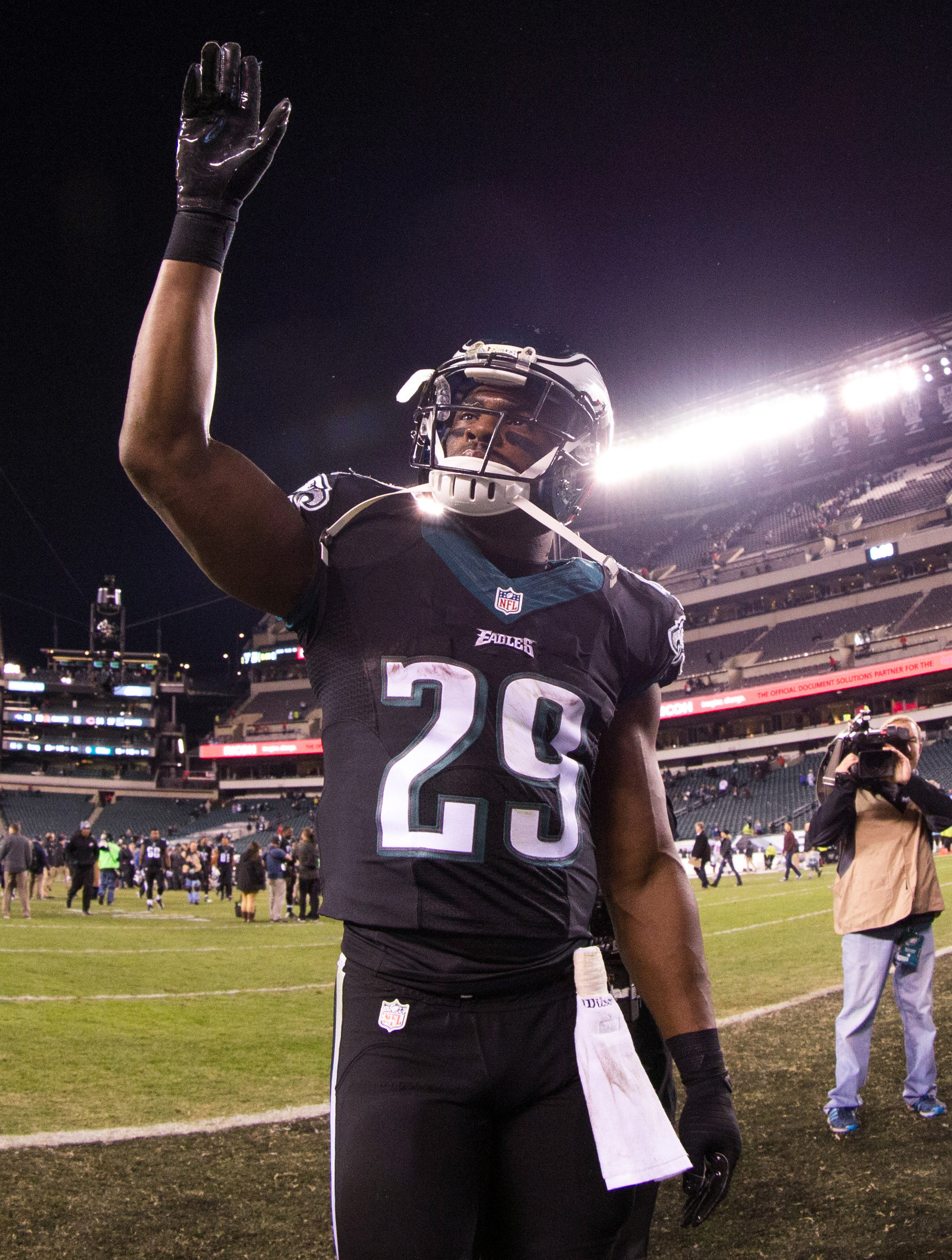 That wouldn’t benefit the Eagles financially, however, as releasing Murray prior to June 1 would leave them with $13MM of dead cap this year. If they designate him a post-June 1 cut, he’d still eat up $8MM of their cap.
In response to Rapoport’s notion that Murray and the Eagles “are headed toward a stare-down,” Murray expressed his commitment to the club. After signing a five-year, $42MM deal last winter to leave the Cowboys for the Eagles, Murray failed to fit into Kelly’s offense. Compared to Murray’s final year in Dallas, his carries dropped by 199, his yardage fell by 1,100-plus, and he averaged 1.1 fewer yards per rush and scored six fewer touchdowns.
Given that Kelly is gone and Murray’s contract is an anvil, it would seemingly make sense for the Eagles to let him have another shot next season and hope he can regain something resembling his prior form. Murray, 28, is only one season removed from earning AP Offensive Player of the Year honors.
With Murray in the fold, the Eagles are on their way to dedicating an excessive amount of cap next season – $16.5MM, to be exact – to their top three running backs. They’d be able to recoup $3.5MM of that total by sending Darren Sproles packing. That could be a long shot, though, given that Sproles is a dual threat on offense and has made back-to-back Pro Bowls as a returner. Still, Sproles will soon turn 33 and saw most of his numbers decline from the previous year.
An even bigger long shot is releasing longtime left tackle Jason Peters, who currently has the largest cap hit on the team. While the Eagles stand to save a significant amount by moving on from the eight-time Pro Bowler (over $6.7MM pre-June 1 or $8.7MM+ after), it’s doubtful they will. The 33-year-old is out of his prime, but he’s still a terrific player. Pederson agrees, having spoken highly of Peters last month.
“I think J.P.’s got several good years left in him,” he told Reuben Frank of CSNPhilly.com. “I think that he does the right things in the offseason to get himself ready to go for another year.”
It’s safe to say linebacker DeMeco Ryans is at greater risk of losing his roster spot than anyone listed above. The soon-to-be 32-year-old is valued in Philly for his veteran leadership, but his play has tailed off and cutting him would save the Eagles $3.5MM.
Giving the ax to Mark Sanchez, who’s the best QB the Eagles have under contract, would also open up $3.5MM of room. The only way that will happen is if the club find two other viable signal-callers this offseason.
Positions Of Need:
Quarterback is obviously the Eagles’ primary concern. If Bradford isn’t in their plans, one player who has come up lately as a potential replacement is the aforementioned Foles, who was among the league’s worst QBs in 2015. Prior to last season, Foles had an up-and-down three years in Philly – including a stellar 2013 highlighted by 27 TDs against two INTs – and Schefter recently tweeted that the Eagles are interested in bringing him back. McLane and Bowen once again rebutted Schefter’s report, however.
Other than Foles, whom the Rams must trade prior to March 11 if they want to avoid taking on his $6MM bonus for 2016, veteran options include Kirk Cousins, Brock Osweiler, Ryan Fitzpatrick and Chase Daniel – all of whom are unsigned. The chances of Cousins actually reaching the market are close to nonexistent, while Osweiler and Fitzpatrick are expected to re-sign with the Broncos and Jets, respectively. Daniel spent the last three years as Alex Smith‘s backup in Kansas City and worked under Pederson, but the 6-footer lacks height and has thrown a meager 77 passes in the pros since going undrafted in 2009.
Robert Griffin III and Kaepernick are still signed in Washington and San Francisco, respectively, but it surely won’t be for much longer in RGIII’s case. Based on the trajectory of Griffin’s career in recent years, it would be foolhardy for any team to count on him as a starter. However, Kaepernick isn’t a lock to stay with the Niners, and he might be worth a look for the Eagles if he’s cut. The 28-year-old was an above-average starter from 2012-14 and continues to possess world-class mobility. That could appeal to Pederson, who comes from coaching an offense that took advantage of Smith’s fleetness.
Without signing Bradford or acquiring any of the other vets, the Eagles would almost have to gamble on a QB in the first round of the draft. In his most recent mock draft, Matt Miller of Bleacher Report has 6-foot-7 Paxton Lynch (Memphis) going to the Eagles with the 13th pick.
Should the Eagles eschew the QB position in the opening round, they could address their offensive line instead. Aside from their starting tackles (Johnson and the aging Peters) and center Jason Kelce, the Eagles’ line is bereft of dependable blockers. Part of that stems from not having drafted an O-lineman since 2013, when Johnson went fourth overall.
That will change this year, potentially in the first round. The Eagles don’t have a second-rounder, so they might have to use their top pick to add big-time young talent to their line. It’s a safe assumption that the first- and second-ranked tackles, Laremy Tunsil (Ole Miss) and Ronnie Stanley (Notre Dame), will be gone by No. 13. Taylor Decker (Ohio State) and Jack Conklin (Michigan State) should be on the board, however. As for guard, the Eagles have been connected to Kansas State’s Cody Whitehair.
Of course, there will also be free agents available with the ability to improve the Eagles’ line. Pederson happens to be familiar with Jeff Allen, one of the foremost guards scheduled to reach the market. Allen joined the Chiefs as a second-rounder in 2012, the year before the club hired Pederson. Given their less-than-ideal guard situation and Pederson’s connection to Allen, it’ll be a surprise if the Eagles don’t pursue the 26-year-old.
The Eagles also need to bolster their receiving corps, having gotten minimal production from 2015 first-rounder Nelson Agholor and 2014 third-rounder Josh Huff. It’s too early to write off either player, especially Agholor, but the fact is that that the club’s only proven wideout is Jordan Matthews. Assuming the Eagles don’t join the Alshon Jeffery sweepstakes or splurge on the position in the form of another first-rounder, free agents-to-be like Rishard Matthews (Dolphins), Rueben Randle (Giants) and Mohamed Sanu (Bengals), to name a few, could be on their radar.
Even after signing Maxwell to a mammoth deal and using a high pick on Rowe a year ago, the Eagles’ secondary continues to stand out as a problem. Maxwell and Rowe didn’t exactly dominate last season, and even if they had, the Eagles would still need more help behind them. That’s especially true in light of Carroll’s status as a pending free agent. With Thurmond a candidate to bolt this year and Malcolm Jenkins possibly on his way to doing the same in 2017, safety is even more of a worry for both next season and the long term.
Elsewhere on defense, the Eagles’ front four is in outstanding shape on paper. Connor Barwin, who is moving from linebacker to defensive end (link via Matt Lombardo of NJ.com), joins a line that will also heavily feature Cox, Curry, Brandon Graham and Bennie Logan.
At linebacker, Jordan Hicks, Mychal Kendricks and Kiko Alonso figure to get the lion’s share of playing time. Kendricks and Alonso both struggled last season, but the hope is their play will recover under Schwartz. Regardless, the Eagles could use more linebacker depth, especially with Ryans’ future in question.
Extension Candidates/Contract Issues:
As mentioned, the Eagles have made sizable financial commitments to Curry, Johnson, Ertz and Celek in recent weeks. Next on their agenda is Fletcher Cox, who will be more expensive than everyone in that group.
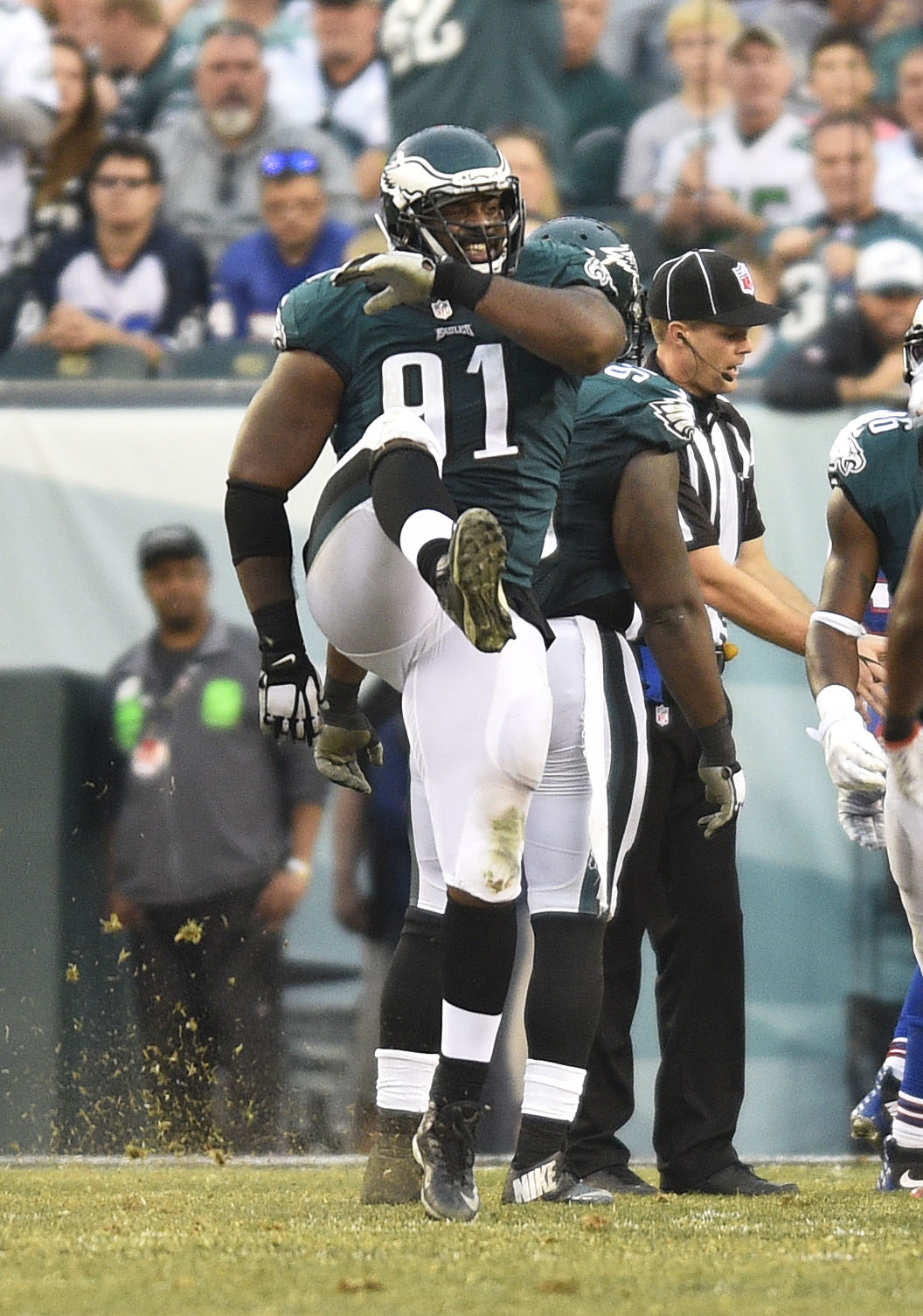 The 25-year-old is poised to become one of the league’s richest defenders, in fact, with Eliot Shorr-Parks of NJ.com forecasting $50MM+ in guaranteed money and Jason Fitzgerald adding (via Twitter) that Cox has a chance to surpass the deal Marcell Dareus signed with the Bills last year. Dareus averages $15.85MM per year, with $60MM in total guarantees ($42.9MM fully guaranteed), as the league’s second-highest-paid DT. Earlier this week, Shorr-Parks reported that the Eagles are getting close to an extension with Cox, which the player seemed to deny (on Twitter).
A first-rounder in 2012, Cox is entering his fifth-year option season and is scheduled to make $7.799MM. The former Mississippi State standout earned his first Pro Bowl nod last season after tallying career highs in tackles (71), sacks (9.5) and forced fumbles (three).
Like Cox, Malcolm Jenkins is coming off a wildly successful campaign and is going into a contract year. Jenkins started all of the Eagles’ games, finished tops among NFL defensive backs in snap percentage (99.8), made 109 tackles, created five turnovers (three INTs, two fumbles), and ranked as PFF’s second-best safety. The seven-year veteran is now eagerly anticipating his next contract, which he hopes comes from the Eagles.
“Believe me, I’m waiting. I’m trying to get in line just like everybody else,” he told SiriusXM Radio this month (via McLane). “That’s something I can’t control. But I’m definitely interested in staying. I want to be in Philly long-term.”
Jenkins, who signed with the Eagles for three years and $16.25MM in 2014, is slated to rake in $5MM next season. Considering his track record, Jenkins’ next contract should put him in the top tier of safeties. One fairly comparable player is Devin McCourty, whom the Patriots signed to a five-year, $47.5MM deal last offseason. McCourty was entering his age-28 season then and had one Pro Bowl and a pair of second-team All-Pro honors to his name. He now ranks in the top three among safeties in contract value, guarantees ($22MM) and annual amount ($9.5MM). Jenkins, with one Pro Bowl bid and a second-team All-Pro selection on his resume, is in line to become a free agent at 29.
The Eagles are also at risk of losing Bennie Logan in a year. The 2013 third-rounder has missed only two games in three seasons and is fresh off a year in which PFF rated him as the league’s 13th-best interior defender against the run, but there hasn’t been reported talk of an extension for him. Logan is set to cap off his rookie contract with a base salary worth around $1.64MM next season. While the value of his next deal is hard to gauge, it’ll be worth appreciably more than his current salary. An accord in the range of $4MM to $5MM per annum would place Logan among the league’s 15 highest-paid 4-3 DTs in yearly value.
Overall Outlook:
Evidenced by the contract extensions they’ve doled out since their season ended, the Eagles are clearly making a concerted effort to retain their homegrown core. But deciding whether to keep Bradford, an outside acquisition, could be their most agonizing and important choice in the coming months. The Eagles certainly aren’t devoid of talent, so they’ll be prime bounce-back candidates in 2016 if they make the right move under center.
Information from Over The Cap was used in the creation of this post. Photos courtesy of USA Today Sports Images.
Offseason Outlook: New York Giants
Pending free agents:
- Danny Aiken, LS
- Prince Amukamara, CB
- Robert Ayers, DE
- Jasper Brinkley, ILB
- Josh Brown, K
- Barry Cofield, DT
- Jerome Cunningham, TE (ERFA)
- Craig Dahl, S
- Orleans Darkwa, RB (ERFA)
- Zak DeOssie, LS
- Larry Donnell, TE (RFA)
- Daniel Fells, TE
- Adam Gettis, G (ERFA)
- Marcus Harris, WR (ERFA)
- Jayron Hosley, CB
- Bennett Jackson, CB (ERFA)
- Cullen Jenkins, DT
- Markus Kuhn, DT
- Trumaine McBride, CB
- Brandon Meriweather, S
- Brandon Mosley, G
- Hakeem Nicks, WR
- Jason Pierre-Paul, DE
- Rueben Randle, WR
- Dallas Reynolds, C
- George Selvie, DE
- Will Tye, TE (ERFA)
- Myles White, WR (ERFA)
- Brad Wing, P (ERFA)
Top 15 cap hits for 2016:
- Eli Manning, QB: $24,200,000
- Victor Cruz, WR: $9,900,000
- Dominique Rodgers-Cromartie, CB: $8,000,000
- Will Beatty, T: $5,000,000 (dead money)
- Shane Vereen, RB: $4,916,666
- J.T. Thomas, LB: $4,000,000
- Dwayne Harris, WR: $3,800,000
- Jonathan Casillas, LB: $3,416,666
- Ereck Flowers, T: $3,270,871
- Odell Beckham Jr., WR: $2,838,054
- Rashad Jennings, RB: $2,812,500
- Justin Pugh, T: $2,655,513
- Marshall Newhouse, T: $1,950,000
- Geoff Schwartz, G: $1,916,667 (dead money)
- John Jerry, G: $1,900,000
Notable coaching/front office changes:
- Head coach: Promoted OC Ben McAdoo to replace Tom Coughlin.
- Offensive coordinator: Expected to promote QBs coach Mike Sullivan to replace Ben McAdoo.
- Offensive staff: Expected to hire former Rams OC Frank Cignetti as QBs coach.
- Defensive coordinator: Expected to retain Steve Spagnuolo.
Draft:
- No. 10 overall pick
- Owe conditional seventh-round pick to Steelers in deal for P Brad Wing.
- Conditions aren’t known, but since Wing spent the entire season on Giants’ roster, the conditions were almost certainly met.
Other:
- Current projected cap room (via Over the Cap): $53.62MM
- Must exercise or decline fifth-year option for 2017 for T Justin Pugh.
- Already released T Will Beatty, G Geoff Schwartz.
- LB Jon Beason announced retirement due to health issues.
- DT Jay Bromley being investigated by police.
Overview:
It’s a new year and a new look on the sidelines in New York. Well, sort of.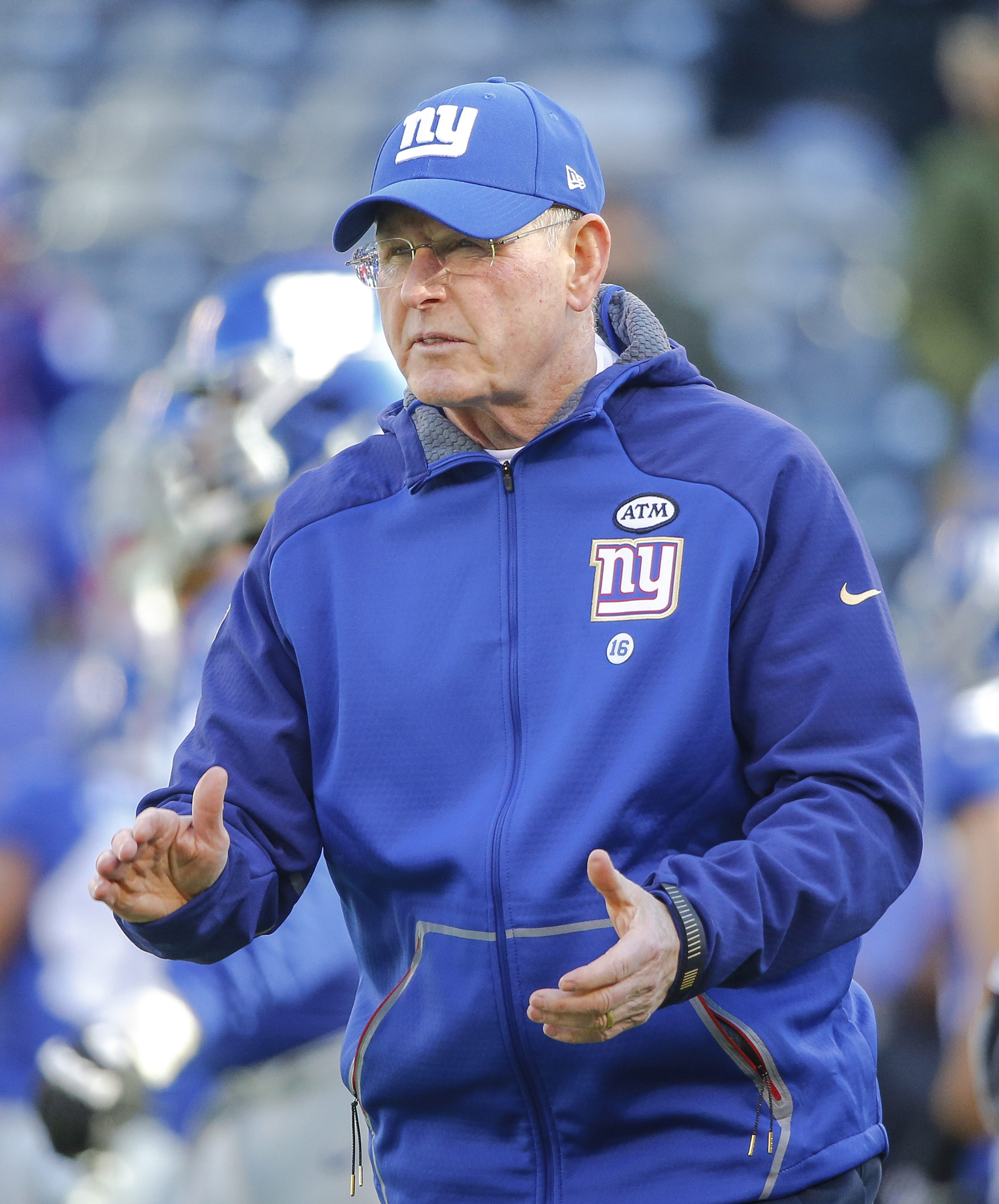
In January, Tom Coughlin and the Giants opted to go their separate ways. Coughlin, who previously served as head coach of the Jaguars, led the Giants to a 102-90 record during his 12 seasons with the team. He also added eight victories in 11 postseason contests, with all of those wins coming in two seasons – 2007 and 2011 – during which the Giants won the Super Bowl. In recent years, however, Coughlin’s Giants struggled, having failed to earn a postseason berth since that 2011 Super Bowl season. After going 9-7 in 2012, New York has had three straight losing years, finishing 6-10 in a weak NFC East in 2015 and sealing Coughlin’s fate.
After Coughlin’s departure, the Giants decided to cast a wide net in their head coaching search. The Giants interviewed the likes of Teryl Austin, Doug Marrone, Mike Smith, Adam Gase, and Hue Jackson. They also showed interest in Panthers DC Sean McDermott and were said to be fawning over Saints head coach Sean Payton. Still, they prioritized two interviews in particular – one with defensive coordinator Steve Spagnuolo and one with offensive coordinator Ben McAdoo. In mid-January, the Giants decided that the right man for the job was in-house all along when they promoted McAdoo to head coach.
McAdoo, who was hired as the Giants’ offensive coordinator in 2014, has helped Eli Manning enjoy perhaps the most productive two-year stretch of his NFL career. Although the club has posted a 6-10 record in consecutive seasons, Manning has thrived, averaging 4,423 yards and about 33 touchdowns per season over the last two years, to go along with a 92.9 rating. The Giants finished in the top eight in the NFL in terms of both yards per game (372.3) and points per game (26.3) in 2015.
Manning was vocal in his support of McAdoo and told a New York radio station earlier this month that he felt that McAdoo reminded him a lot of Coughlin. Manning’s endorsement alone did not get McAdoo the job, but there’s little doubt that it played a part.
After winning a combined 12 games over the last two seasons, the Giants are hoping to achieve a double-digit win total in 2016. Can they do it? Here’s a look at their offseason to-do list and their potential options.
Key Free Agents:
The Giants are expected to have more than $50MM in cap space at their disposal this spring, thanks to the massive list of free agents you see at the top of this article. There are several notable free agents that the Giants will consider hanging on to, including cornerback Prince Amukamara.
Amukamara has had an up-and-down run with the Giants since his entry into the league in 2011, but some of his problems can be chalked up to injury. Of course, that’s a double-edged sword when evaluating a free agent. Amukamara’s only 16-game season came in 2013 and in the last two years, he has only taken the field for 19 contests. Still, in his 11 games in 2015, Amukamara was a difference maker, notching 63 total tackles, 10 pass deflections, one fumble recovery, and one interception. When healthy, Amukamara has demonstrated the ability that made him the No. 19 overall pick in the 2011 draft. I’d expect the Giants to make an effort to re-sign Amukamara before free agency officially gets underway, but the team will only go so far to retain him given the options that are out there at cornerback.
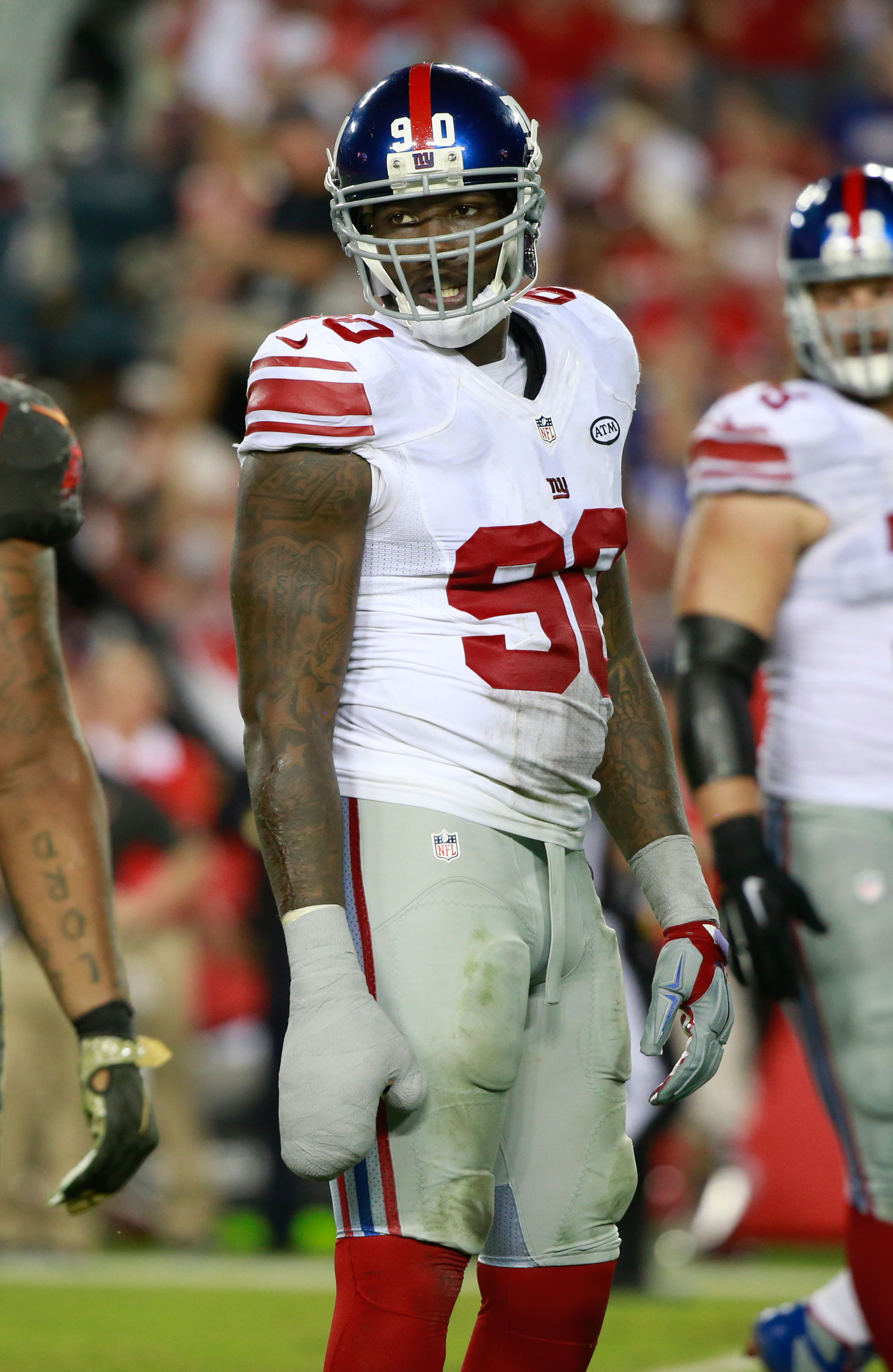 For the last year, Giants fans have been buzzing about the future of defensive end Jason Pierre-Paul. Of course, JPP’s story took a bizarre and tragic turn last July when a fireworks accident cost him a finger and probably millions of dollars. Pierre-Paul got back to football in the fall and was extremely motivated on the field to prove the naysayers wrong. However, for all of his grit and work ethic, he did not look like the same player he did before the hand injury.
Some reports indicated that Pierre-Paul turned down a ~$60MM contract offer from the Giants prior to his 4th of July accident. At this stage, it’s highly unlikely that anyone will be making such an offer to the once-dominant defensive end. Still, Pierre-Paul showed that he can cause trouble for opposing quarterbacks and he could still hold value for the Giants (and other clubs) on a short-term deal. One has to think that the Giants will first explore re-signing JPP to a short-term deal that includes performance-based incentives. JPP’s reps, meanwhile, probably will push for more guaranteed money up front.
The football world (not to mention the fantasy football world) has been waiting for wide receiver Rueben Randle to take off and establish himself as a star wide receiver. We’re now four years into his NFL career and onlookers are no longer waiting with bated breath. Randle has shown flashes in the past, but he has yet to put it altogether and the Giants can probably find a better partner for Odell Beckham Jr. elsewhere. For his part, Randle says he wants to stay in New York.
Defensive end Robert Ayers has played in exactly 12 games in each of the last two seasons for the Giants, but he has proven to be a disruptive force each time. This past season, Ayers notched a career-high 9.0 sacks to go along with 41 total tackles, and the Giants’ pass-rush unit would be lacking if he signs elsewhere.
Last summer, Jasper Brinkley inked a two-year contract with Dallas that included $2MM in guaranteed cash. Months later, the Cowboys decided they’d rather give Brinkley that dough to go elsewhere, and less than 24 hours after he hit the open market, the Giants were there to scoop him up on a one-year deal. A former fifth-round pick, Brinkley started 11 games for Minnesota in 2014, compiling 75 tackles and a sack. This past year, Brinkley started 9 games (playing in 15 total) and racked up 66 total tackles with four forced fumbles and one sack. Brinkley was initially brought in to serve in a reserve role, but a November injury to Jon Beason made him a more central part of the team’s front seven. Now that Beason is retiring (more on that later), Brinkley could be retained as a strong rotational option. Then again, Brinkley will turn 31 in July and the Giants may opt to go younger at linebacker.
Possible Cap Casualties:
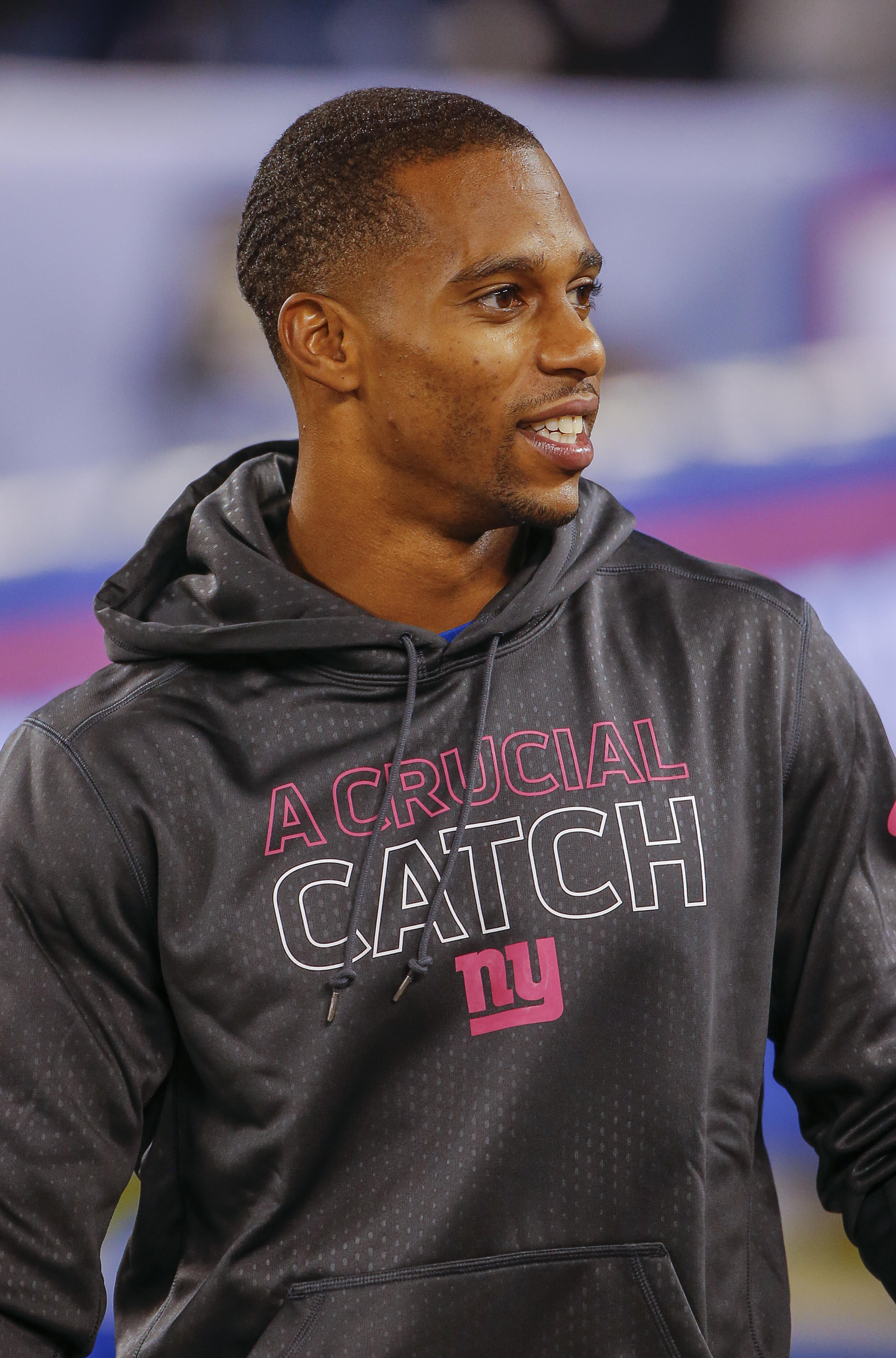 What will the Giants do with Victor Cruz? Just two short years ago, Cruz was the darling of New York and the focal point of their passing attack. Now, Beckham Jr. is the team’s ace wide receiver of the future and Cruz has not seen the field since October 12th, 2014.
Cruz was working his way back from a torn patellar tendon that forced him to miss most of 2014 season when, during his recovery, he injured his calf. In November 2015, he was placed on IR before his season could even get started. Cruz is currently set to count $9.9MM against the Giants’ cap in 2016 and none of his remaining $24MM over the next three years is guaranteed, so he’s unlikely to continue on his current contract. However, there’s no reason why the two sides couldn’t agree to a reworked deal that includes a pay cut.
Last year, the Giants were dealt an absolute gut punch when offensive tackle Will Beatty was ruled out for the entire 2015 campaign due to pectoral and rotator cuff injuries. The Giants also badly missed the services of offensive guard Geoff Schwartz. Both players were set to return in 2016 at considerable salaries, but just days ago, Big Blue opted to release both of the linemen.
Schwartz, 29, started 11 games for the Giants in 2015, but his seasons was cut short when he fractured a bone in his left leg in late November, forcing the team to place him on injured reserve. By releasing him, the Giants will avoid paying him $3.925MM annual salaries this year and next year, taking on a hit of about $1.917MM in dead money for 2016. The move creates nearly $3MM in cap savings for the club, while Schwartz – like his brother Mitchell Schwartz – figures to be on the lookout for a new home. Releasing Beatty, meanwhile, will leave $5MM in dead money on the Giants’ 2015 cap, but the move will also clear $4.175MM in space.
The Giants also said adios to linebacker Jon Beason, who announced his retirement. Beason said that he wanted to continue playing, but after consulting with numerous doctors, those experts unanimously recommending that he retire because of his injured knee. Beason would have been owed a $1MM roster bonus if he were still on the Giants’ roster on the fifth day of the 2016 league year. Instead, the Giants’ will clear that bonus, $1.2MM in per-game roster bonuses, a $100K workout bonus, and his $2.8MM base salary from their cap, creating a total of $5.1MM in cap savings. Taking into account the Beason, Schwartz, and Beatty moves, the Giants created more than $12.2MM in cap savings.
Positions Of Need:
Just like last offseason, the safety position stands as one of the Giants’ biggest needs. Last year, the Giants aimed high when they tried to bring Devin McCourty back to New Jersey. When the Rutgers alum returned to the Patriots, the Giants were left scrambling and could not come up with a high-impact solution.
If the Giants want to aim high once again, they could make a run at Chiefs free agent Eric Berry. The two sides are said to be working on an extension, and he’s a candidate for the franchise tag, but Berry would be a phenomenal fit for the Giants if he reaches the open market. Appearing in all 16 games for Kansas City in 2015, Berry logged 61 tackles to go along with a pair of interceptions and 10 passes defended. Pro Football Focus ranked the Tennessee product sixth among 88 qualified safeties. The standout season earned Berry his fourth Pro Bowl berth, along with a spot on the NFL’s All-Pro first team.
The Giants will also have to bolster their defensive line, particularly on the bookends if JPP and/or Ayers are not retained. In theory, Owa Odighizuwa could be elevated to a more significant role, but the club will have to improve its depth in that regard at the very least. The best Giants teams in recent years have relied on strong play from their defensive ends and it’s not like Justin Tuck is walking back through that door (though, technically, he will be back on a one-day deal before retiring).
On the interior of the defensive line, the Giants will have to find some outside help, particularly if Cullen Jenkins leaves in free agency or retires. The club was expecting a big leap forward from Jay Bromley in his second year, but the rising junior probably can’t be counted upon as a starter. A Syracuse product, Bromley started four games for the Giants this season and appeared in all 16, making 19 total tackles.
The Giants and Cruz will likely discuss a re-worked contract at a reduced salary, but that probably won’t end the club’s search for a secondary wide receiver. Entering his third season, ODB figures to draw double coverage from every opposing team unless the Giants can find a credible threat to line up on the opposite side of the field.
Extension Candidates/Contract Issues:
There aren’t a lot of strong veteran candidates for extensions on the Giants’ roster, but there are a pair of players from the 2013 draft class who could get consideration for new contracts.
Guard/tackle Justin Pugh is now one of the key members’ of the team’s offensive line, following the releases of Schwartz and Beatty, so the club could look into extending his rookie contract, though he has a fifth-year option for 2017.
Defensive tackle Johnathan Hankins, who was placed on IR in November, could be a buy-low candidate if the Giants want to lock him down for future seasons.
Overall Outlook:
The Giants have tons of cap space and flexibility to make major changes, but they’re far from the only team with spending room this spring. The Giants will have to play it smart in free agency and, more importantly, get it right in the draft. Overall, GM Jerry Reese doesn’t have the best track record when it comes to picking college prospects.
“The last couple of drafts have been much more productive. But we had a few in there where we just haven’t seen the production. Your core players are your third, fourth, fifth-year players. If you look back at those draft classes, there’s not a lot of them that are playing right now,” co-owner John Mara said in January.
This year, the Giants hold the No. 10 overall pick, two spots higher than where they landed Beckham Jr. in 2014. They appear to be in prime position to land a promising defensive lineman like Oklahoma St. DE Emmanuel Ogbah, but they’ll have to nail their picks in the later rounds as well in order to put themselves in a better position going forward.
Information from Over The Cap was used in the creation of this post. Photos courtesy of USA Today Sports Images.
Offseason Outlook: Chicago Bears
Pending free agents:
- Sam Acho, OLB
- Alan Ball, CB
- Nick Becton, T (RFA)
- Josh Bellamy, WR (ERFA)
- Vlad Ducasse, G
- Matt Forte, RB
- Rob Housler, TE
- Alshon Jeffery, WR
- Jarvis Jenkins, DE
- Marc Mariani, WR
- Sherrod Martin, S
- Shea McClellin, ILB
- Sherrick McManis, CB
- Zach Miller, TE
- Will Montgomery, C
- Ryan Mundy, S
- Patrick Omameh, G (RFA)
- Tracy Porter, CB
- Chris Prosinski, S
- LaRoy Reynolds, ILB (RFA)
- Jacquizz Rodgers, RB
- Deonte Thompson, WR (RFA)
- Mitch Unrein, DT
Top 15 cap hits for 2016:
- Jay Cutler, QB: $17,000,000
- Jermon Bushrod, T: $8,700,000
- Pernell McPhee, OLB: $7,675,000
- Lamarr Houston, OLB: $6,990,000
- Martellus Bennett, TE: $6,310,000
- Eddie Royal, WR: $4,500,000
- Robbie Gould, K: $4,100,000
- Kevin White, WR: $3,764,329
- Matt Slauson, G: $3,405,000
- Willie Young, OLB: $3,166,668
- Antrel Rolle, S: $2,718,750
- Kyle Fuller, CB: $2,641,909
- Kyle Long, T: $2,641,212
- Tim Jennings, CB: $1,500,000 (dead money)
- Eddie Goldman, DT: $1,292,344
Notable coaching/front office changes:
- Offensive coordinator: Promoted QBs coach Dowell Loggains to replace Adam Gase, who left to become Dolphins’ HC.
- Quarterbacks coach: Hired Dave Ragone to replace Dowell Loggains.
Draft:
- No. 11 overall pick
- Acquired sixth-round pick from Patriots in deal for LB Jon Bostic.
- Acquired conditional sixth-round pick from Panthers in deal for DE Jared Allen.
- Conditions aren’t known, but likely were met.
Other:
- Current projected cap room (via Over the Cap): $51.6MM
- Must exercise or decline fifth-year option for 2017 for T Kyle Long.
Overview:
2015 was largely billed as a rebuilding year for the Bears, and while a 6-10 record is certainly indicative of such a process, you’d be hard-pressed to find Chicago fans who weren’t — at the least — encouraged by last season’s outcome (and are now more enthused about the future). And a large chunk of that excitement, undoubtedly, is due to the successful ’15 campaign of quarterback Jay Cutler.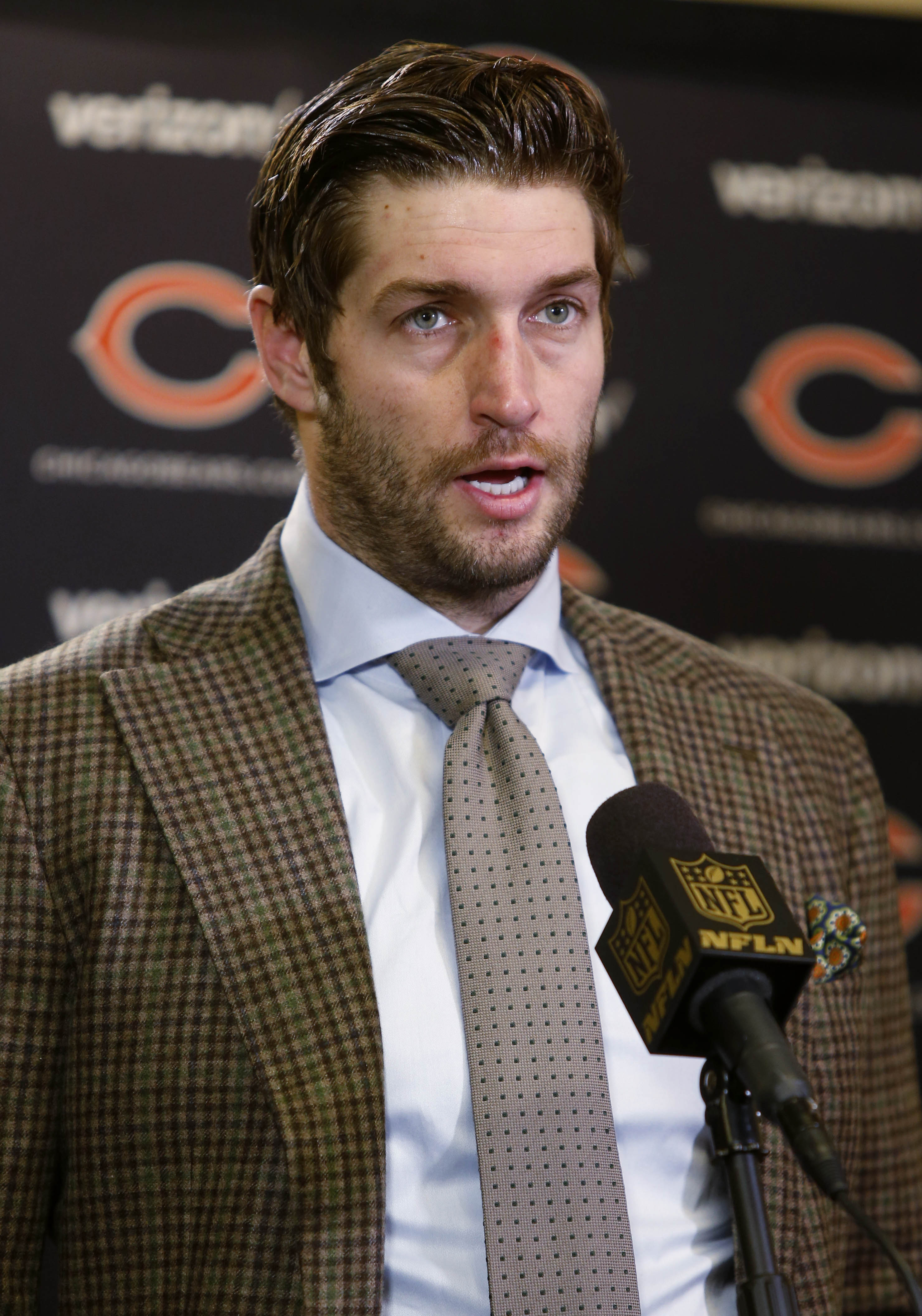
If you’ll think back to last season, Cutler’s fate with the Bears seemed to be sealed — he was benched by the previous Chicago regime at the end of the 2014 season, and subsequently, was anything but endorsed by new head coach John Fox and new general manager Ryan Pace. Speaking at last year’s combine, neither decision-maker fully committed to Cutler, and he was widely reported to be on the trade block.
But with the help of new offensive coordinator Adam Gase, Cutler rebounded, posting the lowest full-season interception total of his career, tossing 21 touchdowns, and finishing as a top-10 quarterback in Football Outsiders’ DYAR metric. Gase has since departed to become the Dolphins head coach, but with Cutler confidant Dowell Loggains having been promoted to play-caller, the quarterback position in Chicago seems to be set, at least for the time being.
On the other side of the ball, the Bears defense finished 14th in yards, 20th in scoring, but 31st in DVOA (they were 28th in weighted DVOA — which places more emphasis on the team’s most recent games — meaning the unit got slightly better as the year progressed). The numbers aren’t great, but given that Chicago is somewhat devoid of talent of talent on defense, they actually speak pretty well of defensive coordinator Vic Fangio.
It’s an important offseason for Pace and the rest of the Bears front office, so let’s take a look at what lies in store for Chicago over the next several months.
Key Free Agents:
Topping the list of Chicago’s free agents is receiver Alshon Jeffery, who despite missing seven games with nagging injuries, still managed to have a very productive season (at least on a rate basis). He caught four touchdowns in his starts, and managed nearly 90 yards receiving per game, good for eighth in the league. Jeffery will turn just 26 years old on Valentine’s Day, and as the best receiver available on the open market — and the No. 2 overall free agent in our most recent power rankings — he’s certainly set up for a big payday.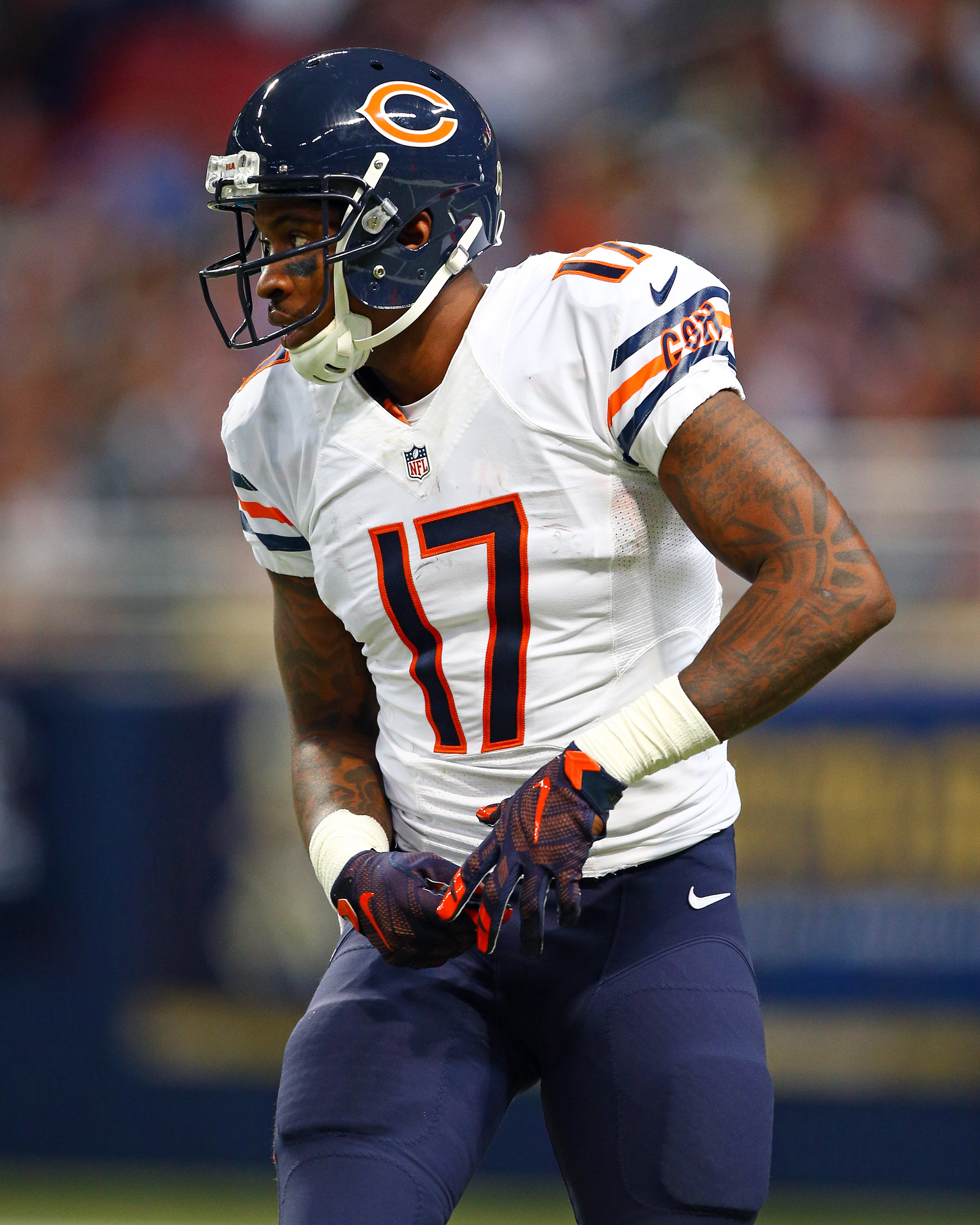
Threatening that contract potential, of course, is the Bears’ option to tender Jeffery the franchise tag, and retain him on a one-year deal at a cost of $14MM+. The incentives for a extension are obvious for both parties — financial security for Jeffery, retaining its best offensive weapon/lower initial cap charges for Chicago — but it’s not a certainty that a deal gets done. For their part, the Bears sound amenable to a long-term contract, but speaking last month, Jeffery didn’t sound quite as enthusiastic about such a pact.
Comps are available whether Jeffery seeks a five-year deal (like Demaryius Thomas, Dez Bryant, and Julio Jones) or a four-year contract (like A.J. Green). Green, at $15MM annually, received a higher AAV than did the five-year deal cadre, but garnered a much lower guarantee. His $26.75MM in guarantees pales in comparison the five-year trio, each of whom received at least $30MM in guaranteed money. Personally, I’d guess that Jeffery would push for the longer contract and thus the higher guarantee — with his injury history, he should probably secure as much money as he can immediately.
Staying among the offensive skill positions, we come to running back Matt Forte, the longest-tenured Bear on the roster with the exception of kicker Robbie Gould. Forte, who turned 30 in December, failed to top 1,000 yards rushing for the first time since 2011, and as he announced earlier today, he won’t be returning to Chicago for a ninth season.
“Despite my wishes, my days as a member of the Chicago Bears have sadly come to an end,” Forte said in an Instagram post. “I was informed earlier this week from the GM that they will not be attempting to re-sign me in free agency. I will remain forever grateful for my time spent in Chicago and being able to play for an organization with such a rich history.
It makes sense that the Bears want to get younger on offense, and the duo of Jeremy Langford and Ka’Deem Carey will likely handle the load in 2016. It could be good news for Forte, as well, as he can seek to latch on with a surefire contender — he’ll probably find a short-term deal with a new club, and the Patriots look like one early suitor.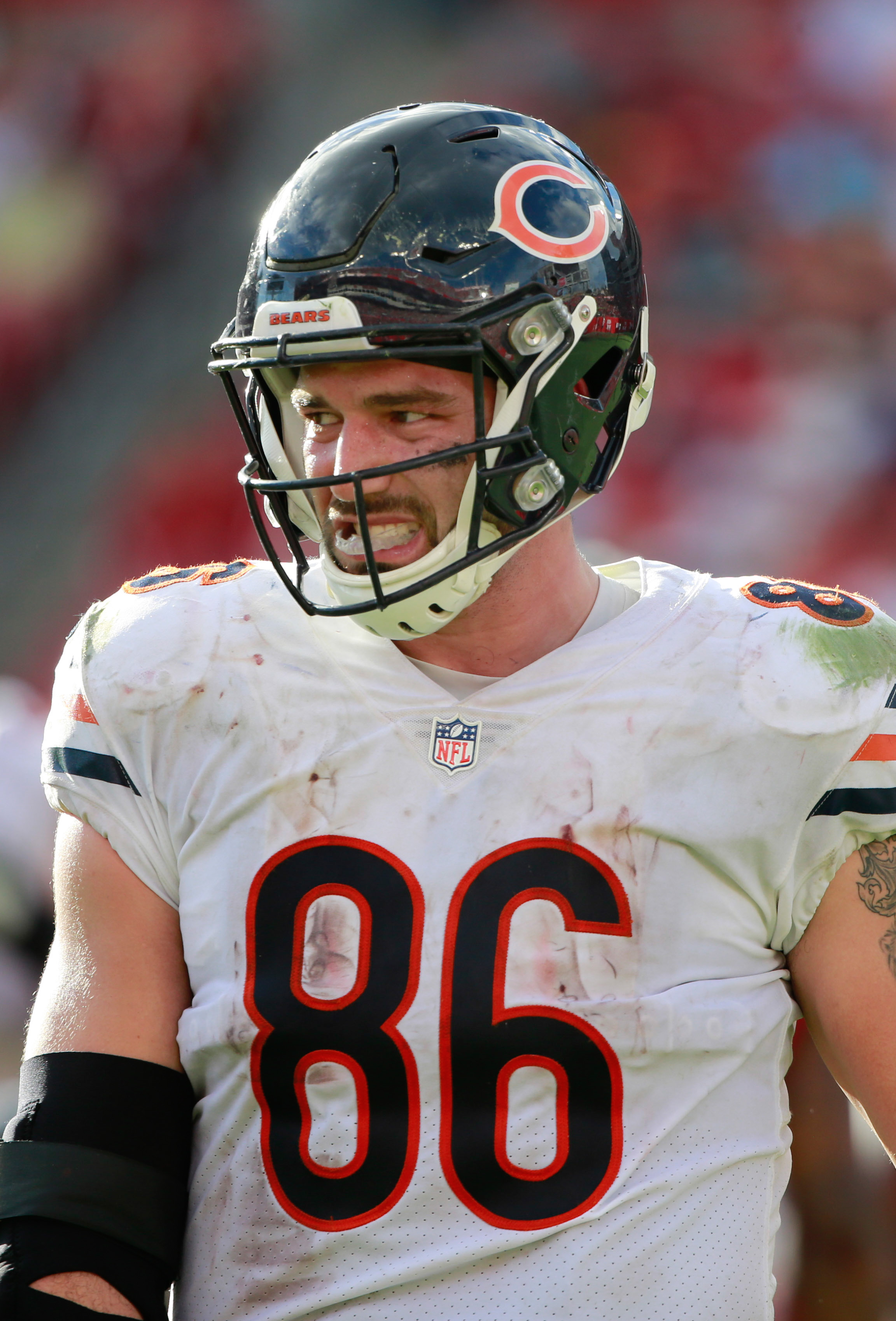
Elsewhere on offense, tight end Zach Miller is said to be targeting a $5MM average annual value after a breakout campaign that saw him post career-highs in receptions, yards, and touchdowns. But as PFR’s Luke Adams wrote in that linked post, $5MM could be a tough sell — the Browns’ Gary Barnidge, for example, had better numbers and failed to reach that mark. More likely, the 31-year-old Miller will settle for a lower salary, whether it be with the Bears or another club.
Receiver Marc Mariani — largely a return man to this point in his career — saw his largest role in an offense since 2011, playing on almost 50% of Chicago’s offensive snaps. He’s still a viable special-teamer, but a strong offensive unit probably doesn’t use someone of Mariani’s caliber quite as often. Along the line, Vlad Ducasse started 11 games, and was predictably disappointing, grading as the league’s No. 47 guard, according to Pro Football Focus — the Bears should seek an upgrade.
Let’s move to the defense, where, as noted above, coordinator Vic Fangio didn’t really have the horses, but still coaxed a somewhat respectable performance. Along the defensive line, two ends who saw significant playing time — Jarvis Jenkins and Mitch Unrein — are heading for free agency. Neither was spectacular, and given that I expect the Bears to target line help via either free agency or the draft, I wouldn’t anticipate either being retained as anything more than depth pieces on the veteran’s minimum.
Former first-round pick Shea McClellin has bounced around to several positions along the front seven during his career, but despite all the positional changes, he never seems to find success. He graded out as the league’s No. 88 linebacker among 97 qualifiers, per PFF, and despite McLellin expressing interest in re-signing, it’s time for the Bears to move on. Conversely, Chicago should look to re-sign Sam Acho, who was not only a valuable contributor on special teams, but saw action on 43% of the club’s defensive snaps. He’s always been a personal favorite of mine, and the Bears can once again keep him around via the minimum salary benefit, they should jump at the opportunity.
In the secondary, Tracy Porter spent the entire season as a starting corner opposite Kyle Fuller, but wasn’t overly effective, and the Bears should definitely look for an upgrade. Alan Ball, Chris Prosinski, and Sherrod Martin (the latter of whom was recently singled out by Jeff Dickerson of ESPN.com) can all be replaced by younger, cheaper options. Meanwhile, Dickerson did advocate for Chicago to re-sign cornerback Sherrick McManis, who is a special teams ace.
Possible Cap Casualties:
Fresh off the beast season of his career in 2014, tight end Martellus Bennett disappointed in 2015 for a number of reasons. He was never fully healthy, and he missed five games while posting his lowest yards per reception since 2010. Additionally, there were reports that Bennett was unhappy not only with his contract, but with his role in the Bears’ offense (claims that his agent and GM Ryan Pace have since denied).
Assuming that Alshon Jeffery is retained and Matt Forte is not, Bennett figures to be the second-best weapon on the Chicago offense, and his 2016 cap charge of $6.31MM is more than reasonable. So his status really comes down to his relationship with the club, something that’s hard for us to judge. Jeff Dickerson of ESPN.com recently argued for the Bears to trade Bennett, and if the reports of the rift are accurate, and another club is willing to part with draft compensation, I suppose that’s an option. Releasing Bennett would save Chicago $5.185MM against the cap, and if that happens, it would be clear the relationship had soured.
Left tackle Jermon Bushrod will almost certainly be released after a 2015 campaign that saw him lose his starting job to former seventh-round pick Charles Leno. Designating Bushrod as a post-June 1 cut would make some sense, as that move would spread his dead money out over two seasons ($2.2MM in both ’16 and ’17). But given that the Bears are flush with cap space, I’d expect them to bite the bullet and take the full $4.4MM hit immediately.
Having played in only seven games due to injury issues, 33-year-old safety Antrel Rolle would make sense a release candidate. However, Rolle’s contract was structured in such a way that his cap numbers for both 2016 and 2017 are quite low (~$2.71MM next season). The deal has no dead money remaining, so Chicago would clear his entire cap hit, but the secondary is so devoid of talent that I’d expect the club to take another chance with Rolle, a former first-round pick and Pro Bowler. Larry Meyer of ChicagoBears.com last month profiled Rolle and his determination to rebound in 2016.
Defensive end/linebacker Lamarr Houston was rumored to be on the trade block last season, and I wonder if that thought could cross the Bears’ decision-makers’ minds once again. Houston wasn’t great in his transition from 4-3 defensive end to 3-4 outside linebacker, so a switch back to a 4-3 scheme might do him good. A trade (or a pre-June 1 cut) would give the Bears more than $4MM in cap savings, so it’s a move they’ll probably consider.
Positions Of Need:
The Bears enter the 2016 offseason with $51.6MM in projected cap space, good for fourth in the NFL (for now), and I expect the team to be active in free agency. General manager Ryan Pace has said as much, noting that his club will need to use free agency to augment their roster due to team needs. However, Pace has also said that he doesn’t expect Chicago to use its excess cap room to pursue a high-profile free agent, preferring to spread the wealth and bring in several players at reasonable values.
Most every area of need in Chicago comes on the defensive side of the ball, so let’s go ahead and get the offense out of the way. Presuming Alshon Jeffery and Martellus Bennett are retained and 2015 first-rounder Kevin White comes back healthy, the Bears should be mostly set on offense. They will need to replace Vlad Ducasse at left guard, but I don’t expect them to spend at the top of the market to do so. If Alex Boone‘s price comes down, I could see him landing in Chicago, and the recently-released Geoff Schwartz could also make some sense.
The most pressing needs are on defense, starting with linebacker. The most obvious candidate to help at that spot is Broncos free agent Danny Trevathan, who has already stated he expects interest from the Bears based on his relationship and familiarity with John Fox. Fellow Denver linebacker Brandon Marshall is also a free agent, albeit one of the restricted variety. The Broncos will likely place a first- or second-round tender on Marshall, making Trevathan the preferred option.
Trevathan alone probably won’t cut it, as Chicago could use two new starting inside linebackers. It’s a cheap position, so if the Bears want to use free agency for both replacements instead of using a draft pick, they can. Veteran Joe Mays shouldn’t cost much on a one-year deal (and like Trevathan, has a history with Fox), while the Browns’ Craig Robertson or the Titans’ Zach Brown — each of whom excels in pass coverage — could also be targeted.
Adding another edge defender also wouldn’t hurt, and while the dream scenario is luring Super Bowl MVP Von Miller to Chicago, that simply is not going to happen, as Miller will either re-sign with Denver or get the franchise tag. The Bears could take a flyer on someone like Nick Perry or Courtney Upshaw, each of whom were relatively high draft picks who have failed to live up to their billing. The draft could also aid here, as Matt Miller of Bleacher Report has the Bears selecting Georgia’s Leonard Floyd in the first round of his most recent mock draft.
Along the defensive line, Chicago is probably set at nose tackle with Eddie Goldman, though the 49ers’ Ian Williams has a history with defensive coordinator Vic Fangio. Williams could conceivably shift to end in the Bears’ scheme, but he’ll be expensive, as he’s just 26 years old and is coming off a ver solid season.
At end, Muhammad Wilkerson will likely be franchised, and while he’s thought to be a trade candidate, I don’t think the Bears would (or should) give up their first-round pick – and pony up the extension money – for Wilkerson, who is coming off a broken leg. Instead, I expect Chicago to target Malik Jackson based on his history with Fox. Jackson won’t be cheap, and given the recent extensions inked by 3-4 defensive ends, he’s surely targeting a $11MM yearly value.
Ideally, the Bears would use the majority of their cap space on improving their front seven, and then use the draft and/or the second and third waves of free agency to solidify the back end. Chicago can make do with Kyle Fuller, Tracy Porter (if re-signed), Antrel Rolle, and Adrian Amos in the secondary, but adding another piece at either corner or safety wouldn’t be a bad idea. Josh Robinson could be intriguing at corner, while Rashad Johnson could be a target at safety.
Extension Candidates/Contract Issues:
Kyle Long has been named to the Pro Bowl in each of his three seasons in the league, and having transitioned from guard to tackle prior to the 2015 campaign, he’s now been to the all-star game at two positions. His 2017 fifth-year option will be exercised, and the Bears can begin working towards an extension immediately.
Long’s extension case is an interesting one given his recent positional change, but there is a recent example that is somewhat similar to Long’s situation — Eagles tackle Lane Johnson. Johnson, of course, has spent the entirety of his career on the right side, but his new five-year, $56.26MM contract was clearly negotiated with the assumption that he’ll replace Jason Peters at left tackle in due time.
It’s not clear if the Bears plan to move Long to the left side at some point, but as John Mullin of CSNChicago.com wrote last week, Long is set up for a big payday regardless. He should be able to surpass every other right tackle besides Johnson in terms of yearly value and guarantee, and if the plan is to eventually move Long to the blind side (and that plan is communicated to Long’s representation), he could match – or surpass – Johnson’s extension.
Overall Outlook:
The Bears can’t afford regression from their offense, as their defense – barring a complete turnaround – figures to once again be a weak point. Retaining Alshon Jeffery and investing more in the offensive line will only buoy Jay Cutler‘s production, and if the defense can finish as, say, a top 20 unit by DVOA, Chicago probably won’t go 6-10 again. The NFC North is a tough division, and Green Bay and Minnesota once again look like the favorites, but pending a solid offseason, it’s not out of the question that the Bears could compete for a Wild Card spot.
Information from Over The Cap was used in the creation of this post. Photos courtesy of USA Today Sports Images.
Offseason Outlook: Baltimore Ravens
Pending free agents:
- Kamar Aiken, WR (RFA)
- Daniel Brown, G (ERFA)
- Marlon Brown, WR (RFA)
- Jeremy Butler, WR (ERFA)
- Chris Carter, OLB
- Jimmy Clausen, QB
- Morgan Cox, LS
- Chase Ford, TE (RFA)
- Chris Givens, WR
- Ryan Jensen, C (ERFA)
- Terrence Magee, RB (ERFA)
- Chris Matthews, WR (ERFA)
- Albert McClellan, OLB
- Kelechi Osemele, G
- Sheldon Price, CB (ERFA)
- Allen Reisner, TE
- Konrad Reuland, TE (ERFA)
- Jumal Rolle, CB (ERFA)
- Matt Schaub, QB
- Brynden Trawick, S (RFA)
- Justin Tucker, K
- Courtney Upshaw, OLB
- De’Ondre Wesley, T (ERFA)
- Terrance West, RB (ERFA)
- Jermaine Whitehead, S (ERFA)
- Shareece Wright, CB
Top 15 cap hits for 2016:
- Joe Flacco, QB: $28,550,000
- Jimmy Smith, CB: $9,600,000
- Lardarius Webb, CB: $9,500,000
- Eugene Monroe, T: $8,700,000
- Marshal Yanda, G: $7,985,882
- Terrell Suggs, OLB: $7,450,000
- Elvis Dumervil, OLB: $7,375,000
- Dennis Pitta, TE: $7,200,000
- Jeremy Zuttah, C: $4,607,206
- Will Hill, S: $4,590,000
- Daryl Smith, ILB: $4,375,000
- Steve Smith, WR: $4,166,668
- Justin Forsett, RB: $3,700,000
- Sam Koch, P: $3,100,000
- Chris Canty, DE: $2,915,000
Notable coaching/front office changes:
- Defensive staff: Lost OLBs coach Ted Monachino to Colts, who hired him as defensive coordinator.
Draft:
- No. 6 overall pick
- Acquired fourth-round pick from Broncos in deal for C Gino Gradkowski.
- Owe fifth-round pick to Broncos in deal for C Gino Gradkowski.
- Owe seventh-round pick to Dolphins in deal for CB Will Davis.
Other:
- Current projected cap room (via Over the Cap): $1.31MM
- Must exercise or decline fifth-year option for 2017 for S Matt Elam.
Overview:
Coming into the 2015 season, the Ravens had never finished below .500 in a season during John Harbaugh‘s tenure with the franchise, and had earned a playoff spot in six of the previous seven seasons. There was no reason not to expect Baltimore to be in contention for the AFC North crown again in ’15.
Instead, the club saw season-ending injuries sideline veteran leaders on offense and defense, as wide receiver Steve Smith and outside linebacker Terrell Suggs each suffered a torn Achilles. Without Smith and Suggs, among others, the Ravens had their worst season since Brian Billick coached the team, finishing with a 5-11 record. A pair of wins against the division-rival Steelers represented virtually the only bright spots in a dismal year for Baltimore.
Unlike many teams that finished near the Ravens in the overall NFL standings, Baltimore isn’t a franchise that’s inclined to make sweeping changes after one bad year. The duo of Harbaugh and GM Ozzie Newsome is one of the longest-tenured leadership groups in football, and they’ll be tasked with righting the ship in 2016.
For a Ravens team that builds through the draft and rarely makes big splashes in free agency, that likely means staying the course, for the most part. Still, there are areas that need to be addressed and upgraded, and a rare top-10 draft pick could help the club bounce back next season.
Key Free Agents:
The list of pending Ravens free agents above features 26 names, which is essentially half of the 53-man roster that finished the season in Baltimore. However, 11 of those players are exclusive rights free agents, making them FAs in name only. In actuality, if those players want to play in 2016, and the Ravens want to keep them, they’ll have no choice but to accept the minimum-salary offer tendered to them by the team. Our focus in this section will instead be on the unrestricted and restricted free agents, players who have a real chance of moving on this offseason.
The Ravens, of course, have no qualms about letting certain players walk in free agency, even if those players have been key contributors in recent years. By mostly sitting out free agency themselves and allowing some of their own free agents to sign lucrative deals with new teams, the Ravens perennially rack up compensatory draft picks, which are handed out to teams who lose impact players in free agency. Since the program began in 1994, Baltimore has been awarded 44 compensatory picks — no other team has landed more than 35.
A player like offensive lineman Kelechi Osemele is a prime candidate to sign with another team, and would almost certainly earn the Ravens a 2017 comp pick if he does. Osemele has been a very solid performer at guard – and occasionally tackle – for the Ravens, but the team already invested heavily in one guard recently, when Marshal Yanda was locked up to a multiyear extension. Unless Baltimore views Osemele as its left tackle of the future, the club will likely be outbid by another Osemele suitor in free agency, perhaps one willing to pay him like a left tackle.
Similarly, even though the Ravens aren’t particularly deep at cornerback, it wouldn’t be a surprise if they don’t make a strong effort to re-sign Shareece Wright. After being signed in October by Baltimore, Wright was pretty solid in the secondary, but if he can parlay that success into a decent contract elsewhere, the Ravens would happily let him go, replacing him with a younger, cheaper alternative.
Quarterbacks Matt Schaub and Jimmy Clausen also seem unlikely to return to the Ravens in 2016, with Ryan Mallett likely getting the first shot to back up Joe Flacco. Mallett’s NFL résumé isn’t extensive enough that Baltimore should be totally confident in him as its No. 2 QB, but the structure of his contract suggests the team will probably give it a try.
Despite the Ravens’ aversion to re-signing some free agents, there are at least a couple players eligible for free agency who have a good chance to continue wearing purple and black in 2016. One is kicker Justin Tucker, who said in January that negotiations between the club and his agent have been going on “for a better part of a year, year and a half.” If Tucker and the Ravens don’t work out a long-term deal in the coming weeks, the 26-year-old – who has made 87.8% of his career field goals and never missed an extra point – is a strong candidate to receive the franchise tag, since the franchise price is fairly modest for kickers.
Another free-agent-to-be unlikely to go anywhere is wide receiver Kamar Aiken, who enjoyed a breakout season in 2015. Coming off a campaign in which he caught 75 balls for 944 yards, Aiken is eligible for restricted free agency and looks like a candidate to receive at least a second-round RFA tender. That tender (likely worth about $2.5MM) ensures that any team interested in signing Aiken to an offer sheet would have to give up a second-round pick to snatch him away from the Ravens.
If the Ravens believe Aiken still has the potential to improve, there’s a chance the team could even consider a first-round tender, which would mean committing an extra $1MM or so. As a point of comparison, the Seahawks used the second-round RFA tender on Jermaine Kearse a year ago even though his career highs of 38 receptions and 537 yards weren’t overly impressive, so a first-round tender isn’t out of the question for Aiken.
Possible Cap Casualties:
Depending on where the salary cap lands for 2016, the Ravens could be right up against it, based on their current commitments. However, there are several candidates to be released to give the team a little breathing room, and none are more obvious than tight end Dennis Pitta.
 If Pitta could get – and stay – healthy, the Ravens would likely do everything they could to keep him around, albeit probably at a reduced salary. But ongoing hip issues have sidelined him since September 2014, and may prematurely end his career. For the first time in 2016, Pitta’s base salary is non-guaranteed, so Baltimore can release him a clear a little cap room. Still, unless he’s designated as a post-June 1 cut, the savings would be marginal ($600K).
The next tier of potential cap casualties for the Ravens might not offer significant savings either, but players like Eugene Monroe, Kyle Arrington, Matt Elam, and Arthur Brown could be on the chopping block. Monroe, like Pitta, has been unable to stay healthy in recent years, while Arrington struggled in 2015 and saw his role reduced as the season went on. Elam and Brown aren’t particularly expensive, but neither player has lived up to expectations since coming off the board in the first two rounds of the 2013 draft. Cutting all four players would create about $5.75MM in total cap savings for Baltimore for 2016, with no dead money beyond this year.
Moving further down the list, releasing players like cornerback Lardarius Webb and running back Justin Forsett would save $4MM and $2.3MM in 2016 cap room, respectively. However, Webb was a release candidate last year, and Baltimore opted to rework his contract instead. His 2015 performance wasn’t exactly elite, but it wasn’t bad either, so it would be somewhat surprising if the Ravens decide to cut ties with him now.
As for Forsett, even before his season was cut short by a broken arm, he wasn’t producing at the same level that he did in his first season with the Ravens in 2014. Baltimore could decide that using a mid-round pick on a running back and pairing that rookie with inexpensive youngster Javorius Allen would be a better use of resources than hanging onto Forsett and his $3.7MM cap hit.
Of course, the simplest way for the Ravens to clear a significant chunk of cap room would be to restructure Joe Flacco‘s deal, perhaps extending him in the process. But we’ll get to that possibility a little later.
Positions Of Need:
As noted earlier, the Ravens typically aren’t the sort of team to splash around in free agency when the new league year opens, preferring instead to fill their holes in the draft. But the team doesn’t mind signing free agents that have been released by their previous teams, rather than having their contracts expire.
Those players don’t count toward the compensatory pick formula, and that group is generally where teams can find lower-risk, bounce-back candidates. For instance, the offensive line is one area that the Ravens figure to focus on this offseason, and veteran linemen like Jahri Evans, Will Beatty, and Geoff Schwartz have already hit the open market this week. When considering potential free agent targets for Baltimore, that’s one factor we have to take into account.
Although the offensive line is a potential area of concern for the team, the center and guard spots look reasonably promising. Marshal Yanda, Ryan Jensen, and Jeremy Zuttah are a solid trio on the interior if they’re all healthy to begin the 2016 season. But if Kelechi Osemele departs in free agency and Eugene Monroe becomes a cap casualty, the two tackle spots will be major question marks. That’s one position the Ravens could address with the No. 6 overall pick — ESPN’s Todd McShay and Mel Kiper both have the team selecting Notre Dame tackle Ronnie Stanley in their latest mock drafts.
Elsewhere on offense, wide receiver is a a position that could be upgraded — Kamar Aiken and Jeremy Butler had good years in 2015, but they’d combined for just 24 total receptions (all Aiken’s) before that. Breshad Perriman missed his entire rookie season, and Steve Smith is coming off a torn Achilles. If all of those receivers are healthy and productive in 2016, it looks like a terrific group, but there are plenty of question marks, so the Ravens may want to add an insurance policy or two just in case.
On defense, the secondary has been a concern for the Ravens in recent years, and should be addressed in some form this offseason. At cornerback, Jimmy Smith wasn’t as effective as he has been in past seasons, Lardarius Webb is a candidate for a full-time move to safety, Shareece Wright is a free-agent-to-be, and Kyle Arrington probably shouldn’t be a starter. Adding a corner in free agency and/or during the first two days of the draft should be a priority for Baltimore.
Up the middle, Will Hill is a fine player at strong safety, but it’s not clear if Kendrick Lewis is the answer for the Ravens at free safety. Unless the team trusts Lewis or Webb to handle that role in 2016, it’s another area to consider for the offseason to-do list. Michael Griffin, cut this week by the Titans, is one veteran that could appeal to Baltimore.
Finally, with Terrell Suggs coming off a major injury and Elvis Dumervil having just turned 32, adding another pass rusher to the mix would make a lot of sense for the Ravens. The team has had some success in the past turning mid- or late-round draft picks into very effective situational pass rushers — former second-rounder Paul Kruger and fifth-rounder Pernell McPhee both parlayed strong part-time performances with the Ravens into big-time free agent contracts with other teams, for example.
If Baltimore can strike gold again with a mid-round pick this year, or if a young player like Za’Darius Smith can take a nice step forward, it would take a lot of pressure off a pair of outside linebackers nearing their mid-30s in Suggs and Dumervil.
Extension Candidates/Contract Issues: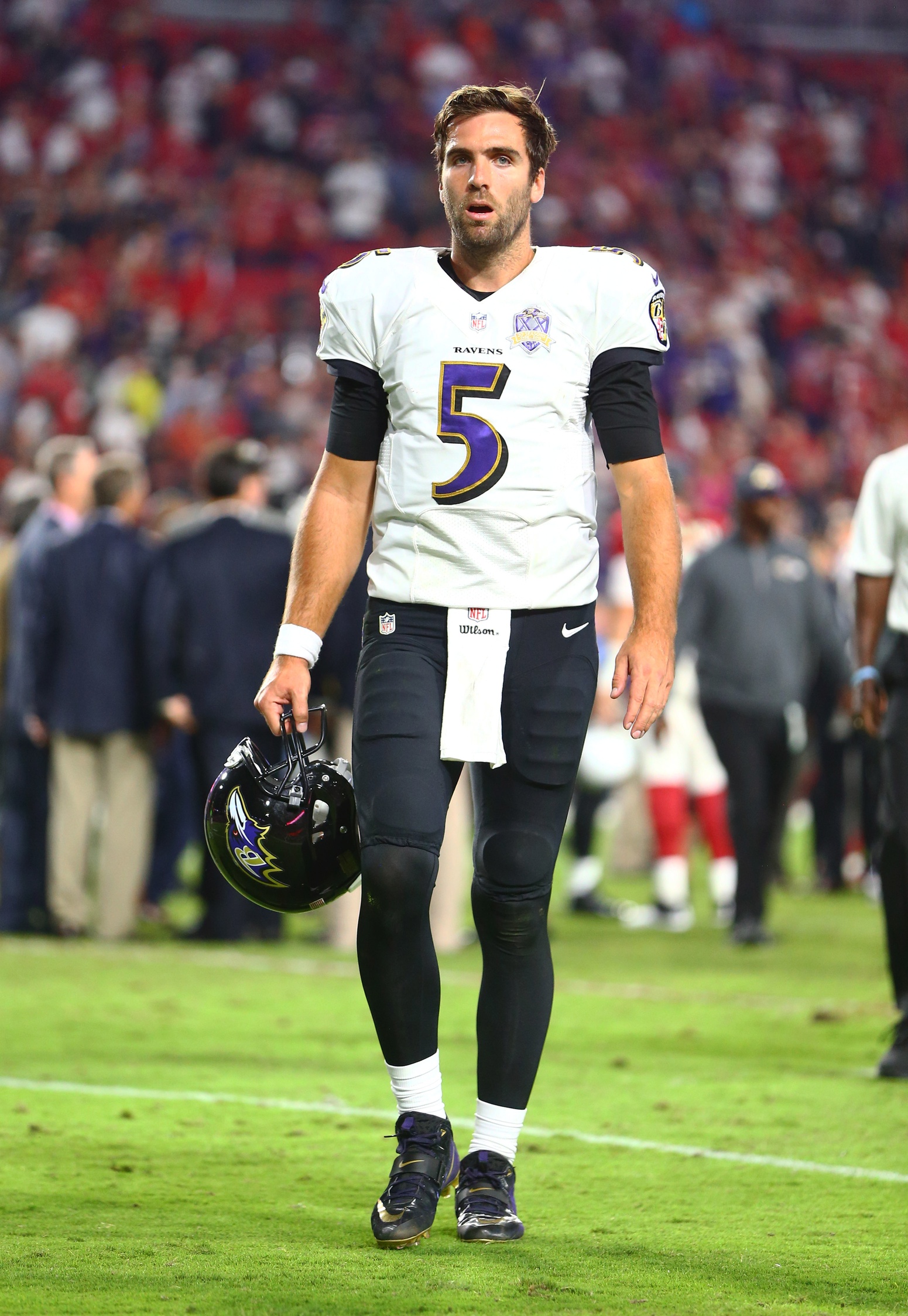
When the Ravens and Joe Flacco agreed to a six-year, $120MM+ contract following the team’s Super Bowl win three years ago, both sides knew that they’d be back at the negotiating table in 2016. The structure of Flacco’s deal ensured that the cap hit for the first three years (2013-15) averaged about $12MM. For the next three years (2016-18), that average skyrockets to $28MM+, including a $28.55MM cap number for 2016.
The Ravens have said they have a plan to put together their roster for 2016 without touching Flacco’s contract, but as we noted above when we discussed potential cap casualties, it won’t be easy for Baltimore to create significant cap space without doing something with Flacco’s cap charge.
The most obvious solution would be for the Ravens to further extend their quarterback’s contract, beyond 2018. Adding at least two more years to the deal would allow the club to spread a new signing bonus out across five seasons. That would allow the team to give Flacco a significant bonus up front while simultaneously reducing his salary for 2016 and minimizing the effect on the cap in the short term. It may create some issues down the road, but in one fell swoop, a major restructure for Flacco would give the Ravens the flexibility to conduct business in ’16. I expect the two sides to get something done in the coming weeks.
Elsewhere, Jimmy Smith and Terrell Suggs are candidates to have their contracts restructured, though the team would be better off not touching those deals. Some of the potential release candidates mentioned above could also be asked to take pay cuts, which would help out with the cap. But no moves would have the same impact as a Flacco extension.
Speaking of extensions, members of the 2013 draft class are now eligible to have their rookie contracts extended, but that wasn’t a banner year for the Ravens’ scouting department, and I don’t expect the team to be in any rush to lock up Matt Elam or Arthur Brown.
Nonetheless, third-round defensive tackle Brandon Williams is one player the Ravens should explore locking up. Pro Football Focus ranked Williams 21st out of 123 interior defenders in 2015, right behind standouts like Malik Jackson, Marcell Dareus, and Cameron Heyward. If the price is right, the club would be wise to get Williams under contract for a few years beyond 2016.
Will Hill, whose contract also expires after the 2016 season, is another player the Ravens ought to explore a longer-team deal with, assuming the team is confident that his off-field problems won’t resurface. Hill has been suspended three times for violating the NFL’s drug policies.
Overall Outlook:
The Ravens may not have as much talent as they did a few years ago, and they’re certainly no lock to return to the postseason in 2016, but they’re also not as bad as their 5-11 record suggests. Injuries sidelined a handful of the team’s top contributors, and only two of those 11 losses came by more than a single score.
Baltimore’s decision-makers recognize that bad luck played a part in the club’s disastrous 2015 campaign, and while some savvy roster moves will be required to get back above .500 next season, it’s definitely not out of the question. Sorting out their cap situation – including Flacco’s contract – and making the most of a rare top-six draft pick will be keys for the Ravens this offseason as they look to bounce back in 2016.
Information from Over The Cap was used in the creation of this post. Photos courtesy of USA Today Sports Images.
Offseason Outlook: San Francisco 49ers
Pending free agents:
- Ray-Ray Armstrong, OLB (RFA)
- Anquan Boldin, WR
- Alex Boone, G
- Reggie Bush, RB
- Garrett Celek, TE
- Phil Dawson, K
- Jordan Devey, G (ERFA)
- Shaun Draughn, RB (RFA)
- Tony Jerod-Eddie, DL (RFA)
- Andrew Turzilli, WR (ERFA)
- Michael Wilhoite, ILB (RFA)
- Ian Williams, DT
Top 15 cap hits for 2016:
- Colin Kaepernick, QB: $15,890,753
- Ahmad Brooks, OLB: $9,605,000
- NaVorro Bowman, ILB: $9,554,000
- Joe Staley, T: $8,300,000
- Torrey Smith, WR: $7,600,000
- Antoine Bethea, S: $6,025,000
- Tramaine Brock, CB: $3,880,000
- Anthony Davis, T: $3,000,000 (dead money)
- Glenn Dorsey, DL: $2,766,668
- Eric Reid, S: $2,698,422
- Erik Pears, T: $2,350,000
- Blaine Gabbert, QB: $2,250,000
- Arik Armstead, DL: $2,236,961
- Jimmie Ward, S: $1,939,781
- Bruce Miller, FB: $1,896,500
Notable coaching/front office changes:
- Head coach: Hired former Eagles HC Chip Kelly to replace Jim Tomsula.
- Offensive coordinator: Hired Lions RBs coach Curtis Modkins to replace Geep Chryst.
- Defensive coordinator: Hired former Browns OC Jim O’Neil to replace Eric Mangini.
- Special teams coordinator: Hired Bears ST assistant Derius Swinton to replace Thomas McGaughey.
Draft:
- No. 7 overall pick
- Acquired fifth-round pick from Chargers in deal for RB Melvin Gordon.
- Acquired sixth-round pick from Broncos in deal for TE Vernon Davis.
- Acquired sixth-round pick from Cowboys in deal for TE Geoff Swaim.
- Owe sixth-round pick to Vikings in deal for LB Gerald Hodges.
- Owe seventh-round pick to Broncos in deal for TE Vernon Davis.
Other:
- Current projected cap room (via Over the Cap): $52.58MM
- Must exercise or decline fifth-year option for 2017 for S Eric Reid.
- Signed CFL WR Eric Rogers.
- Al Guido assuming Paraag Marathe‘s front-office duties (business operations).
Overview:
To say that things did not go as planned for the Niners in 2015 would be a severe understatement. Last offseason, the 49ers parted ways with Jim Harbaugh and opted to promote from within, elevating Jim Tomsula from defensive line coach to head coach. While Tomsula cannot be solely blamed for the team’s struggles last season, he clearly did not have the attention of his team and shortly after New Year’s, he was let go. Harbaugh’s reign included a 44-19-1 regular-season record and three playoff appearances in four years. The Tomsula-led Niners finished the 2015-16 campaign 5-11 (the franchise’s worst mark since 2007) and suffered nine losses by double-digit deficits.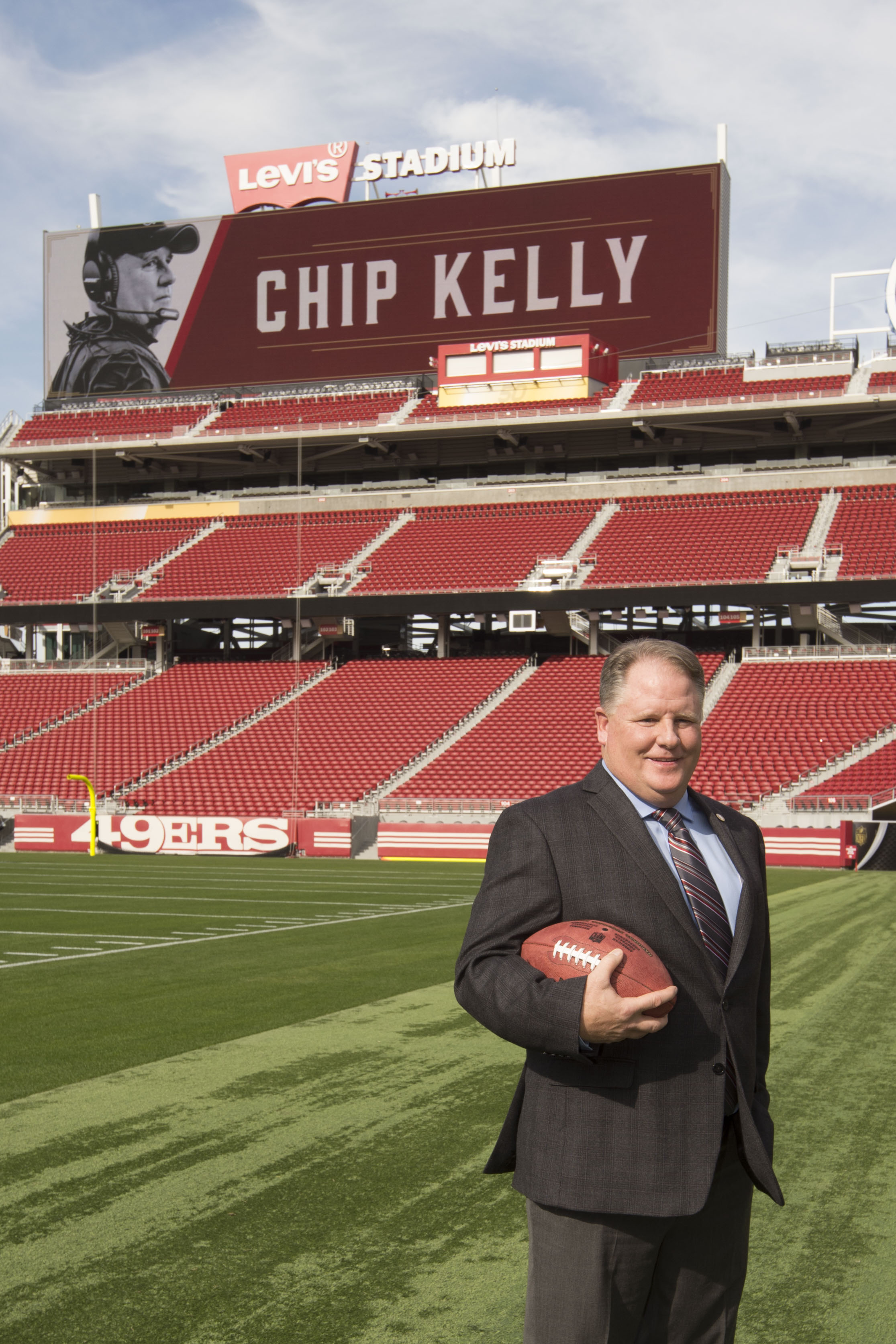
This time, the 49ers went out-of-house to find their next head coach when they tapped Chip Kelly. The boisterous Kelly enjoyed full personnel control in Philly, but he will have to comfortably co-exist with general manager Trent Baalke and CEO Jed York in San Francisco. Of course, Kelly’s departure from Philadelphia stemmed in part from him wearing out his welcome within the organization, having been at odds with former Eagles GM Howie Roseman.
Kelly was fired last year at the end of his third season coaching the Eagles. During his three seasons as Eagles head coach, Kelly had a solid 26-21 record. However, after consecutive 10-6 seasons, the wheels came off a little in 2015 as the new-look roster, which was supposedly tailored to Kelly’s vision, struggled to produce on the field. Although Kelly only took over final say of Philadelphia’s roster moves from Roseman a year ago, he influenced the team’s moves before then as well, and many talented players left town after not always seeing eye to eye with the head coach. DeSean Jackson, LeSean McCoy, Jeremy Maclin, and Evan Mathis are a few of the players that departed Philadelphia within the last couple years.
The 49ers are hopeful that Kelly can turn things around, but he and Baalke have something of a mountain to climb after the way things turned out last season. San Francisco struggled in every facet of the game, but most notably, the team watched its franchise quarterback go from hero to zero practically overnight. Not long after signing a hefty $114MM extension, Colin Kaepernick struggled mightily and looked nothing like his former self. Eventually, Kaepernick’s struggles led to backup Blaine Gabbert taking over the starting job and, for the most part, playing decently.
The Niners now have to figure out exactly what it is that they have in Kaepernick and whether he’s the right fit for the new regime. While in Philadelphia, Kelly was often connected to Kaepernick and many believed that Kelly saw him as an ideal QB for his offense. However, it appears that may not be the case. Kelly has reportedly only spoken with the QB once since he was hired, and that could be an indication that the coach does not see him as being a part of the team’s future. If Kaepernick is not part of the team’s plans, he would reportedly like to join the Jets, though there are conflicting reports as to whether that interest is being reciprocated by Gang Green.
What can the 49ers do to regain their position as one of the NFC’s most dominant teams? Here’s a look at San Francisco’s offseason needs and potential options.
Key Free Agents:
Nose tackle Ian Williams is last in alphabetical order, but No. 1 on the 49ers’ free agent list this spring. Luckily for the Niners, Williams hasn’t been shy about his desire to sign a new deal in San Francisco. When asked if he wants to re-sign with the 49ers, Williams said, “I would love to. This is where I’ve been. This is where I know guys on the team. This is where I’m comfortable at. I’d love to be back.”
Of course, a new contract for Williams isn’t going to come cheap. The veteran defender enjoyed his best season yet in 2015, racking up 65 total tackles, one forced fumble, one fumble recovery, and a sack across 16 games (all starts). Prior to 2015, Williams had a combined 15 games on the gridiron from 2011-2014. Back in January, Jason Fitzgerald of OTC projected that the Niners would lock up the 26-year-old (27 in August) to a three-year deal before the start of free agency. As of this writing, however, the Niners have not gotten that deal done.
 Offensive guard Alex Boone stands as another of the 49ers’ top priorities in terms of their own free agents. However, he isn’t coming off of a strong platform year. Boone, who was placed on IR in late December, graded out as a rather average starting guard according to Pro Football Focus. Ironically, Boone was critical of Harbaugh as a coach, but seemed to take a step back under Tomsula.
“I think he just pushed guys too far,” Boone said of Harbaugh back in April 2015. “He wanted too much, demanded too much, expected too much. You know, ‘We gotta go out and do this. We gotta go out and do this. We gotta go out and do this.’’And you’d be like, ‘This guy might be clinically insane. He’s crazy.‘ I think that if you’re stuck in your ways enough, eventually people are just going to say, ‘Listen, we just can’t work with this.'”
The Ohio State product was a second-team All-Pro selection in 2012, but he didn’t look the part in 2015. Still Boone should see a raise over the $3.4MM he earned in 2015. Boone fought tooth and nail for a reworked contract that would prevent the 49ers from using the franchise tag on him but, as it turns out, he did not have the kind of year that would warrant such consideration anyway. We don’t expect Boone to command top-five money for his position, but he should still be in line for a decent payday, whether it comes from San Francisco or another club.
Running back Reggie Bush stands as the biggest household name on the 49ers’ list of free agents, but he is not the highest priority thanks to his age and an injury-shortened 2015. Bush played only five games for the Niners before tearing his left ACL on the concrete at the Edwards Jones Dome in St. Louis. The 31-year-old, who sued the St. Louis Regional Convention and Stadium Authority over his injury in January, rushed for just 28 yards before his season was brought to a premature end. During Super Bowl weekend, Bush told reporters that he plans to continue playing in 2016.
49ers kicker Phil Dawson will turn 41 next month, which would make him one of the NFL’s oldest players, but the 17-year veteran wants to sign a new contract and continue his career next season. Dawson also believes he can still handle kickoff duties, a role the Niners handed over to rookie punter Bradley Pinion this season.
“I miss [kicking off],” Dawson said in December 2015. “I’ve always enjoyed that aspect of the game, and I still feel like I can do it. But Bradley has done a tremendous job, and he’s helped the team. So (there’s) no problem here on that front.”
As of late December, Dawson said he hasn’t spoken to the 49ers about signing an extension with the club. However, he indicated that he wanted to stay in San Francisco.
Veteran wide receiver Anquan Boldin is also expected to hit the open market, as his contract will void this spring. Boldin, 36 in October, looked like a shell of his former self in 2015, posting his lowest yardage total (789) since 2007. Boldin’s next deal will probably be his last, so he may choose to link up with a contender.
Possible Cap Casualties: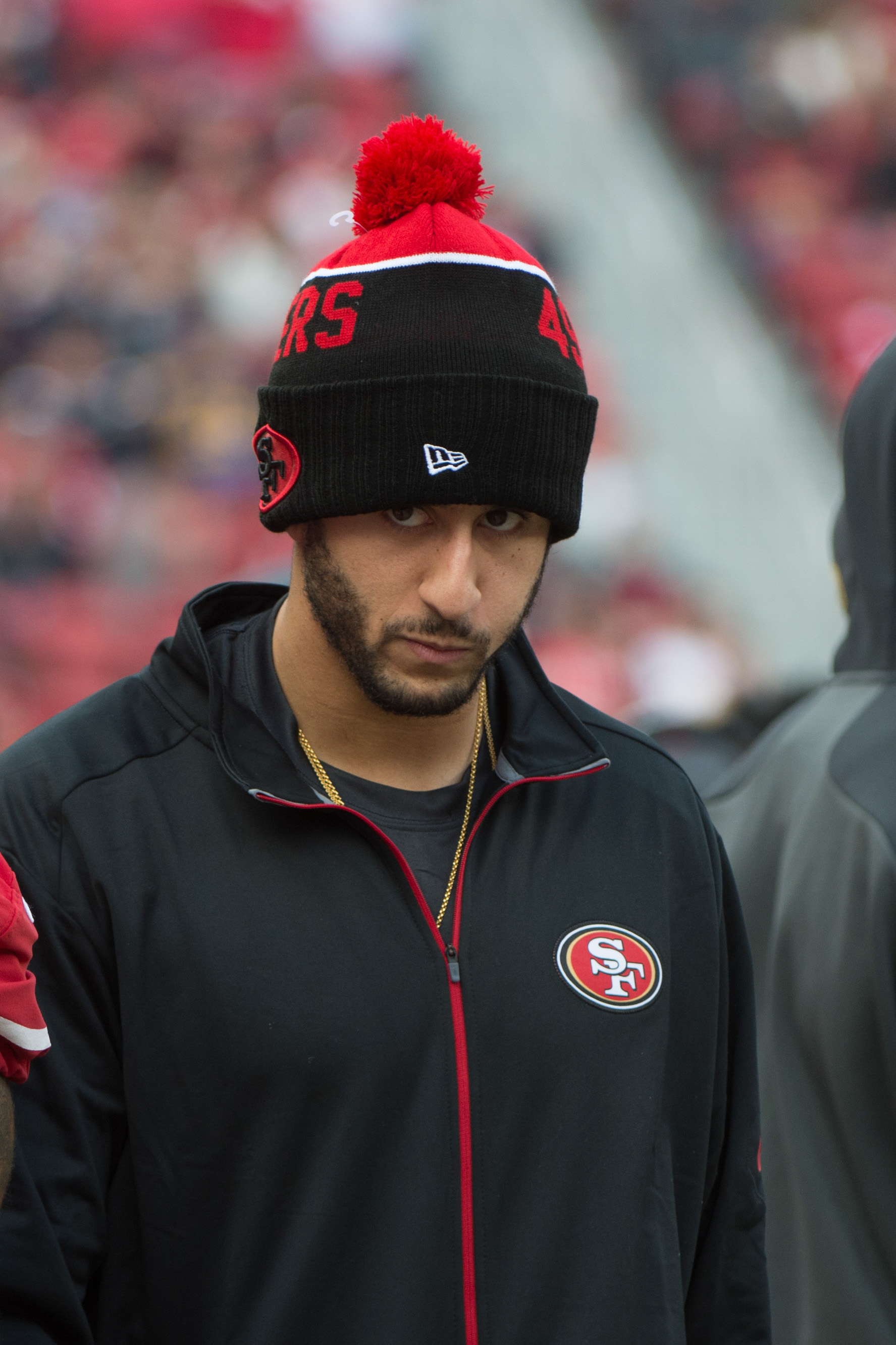
Of course, this list starts with Kaepernick and his ~$15.9MM cap hit for 2016. After a disastrous 2015, the 49ers are expected to consider all options involving Kaepernick, including dropping him outright and starting from scratch at the position. Kaepernick’s massive contract gives the Niners a great deal of flexibility with rolling salary guarantees that aren’t due until April 1st of each year. Dropping No. 7 could create nearly $8.5MM in cap savings. Alternatively, the 49ers could trade him and try to get something of value in return, even if it’s only a mid- or late-round draft pick.
On the other side of the ball, the 49ers could part ways with linebacker Ahmad Brooks. Brooks, 32 in March, earned a Pro Bowl selection in 2013 but he hasn’t looked like the same guy in the last couple of seasons. In 2015, Brooks had 42 tackles and 6.5 sacks, which is nothing to sneeze at, but the overall production just wasn’t there. Cutting Brooks would save the Niners roughly $6MM, and they’re widely expected to make some sort of move there.
Defensive back Antoine Bethea currently stands as the 49ers’ sixth-highest cap hit at just over $6MM. Like Brooks, Bethea is an ex-Pro Bowler who is no longer justifying his salary. The Niners may want him back for 2016, but it probably won’t be at that price.
Positions Of Need:
The 49ers need to quickly determine whether or not they Kaepernick can get back to his old form. If they’re pessimistic, then the Niners have a number of potential options, though none are slam dunks. If Sam Bradford isn’t retained by the Eagles, one has to imagine that Kelly could push for a reunion with him in San Francisco. Veteran quarterback Ryan Fitzpatrick could serve as a solid transitional option for the 49ers, though he is widely expected to reach agreement on a new deal with the Jets prior to the start of free agency.
In the draft, the 49ers could have a crack at a pair of impressive young QBs in Jared Goff (California) and Carson Wentz (North Dakota State). However, there are multiple teams that are looking for their next franchise QB and the Niners may have to move up from No. 7 if they want a shot at either player.
Beyond QB, the 49ers will have to address their offensive line. Obviously, if Boone goes elsewhere, the need becomes that much greater. If Boone stays and Anthony Davis opts to return from retirement, then the need to bolster the O-Line becomes much less severe. Of course, with so much time away from the game, it’s not a certainty that Davis will be able to pick up where he left off. The 49ers should also get a boost from having Daniel Kilgore at the starting center position rather than Marcus Martin, who had a rough year by just about any metric.
Boldin could be heading elsewhere this spring and even if he stays in San Francisco, he’s not the needle-mover that he once was. The 49ers signed Torrey Smith to a five-year, $40MM deal last March with $22MM guaranteed and, so far, that deal looks like a mistake. One has to imagine that the Niners will be seeking help at wide receiver. With major cap room to work with, could the 49ers get in the mix for expected free agent Alshon Jeffery? Ole Miss standout Laquon Treadwell is expected to be on the board when the 49ers pick at No. 7, so he could also be an option.
The 49ers also have some serious question marks on the defensive line. Defensive end Arik Armstead did not impress in his rookie season and defensive tackle Glenn Dorsey is recovering from a torn ACL. And, as discussed earlier, Ian Williams is slated to hit the open market.
Extension Candidates/Contract Issues:
Safety Eric Reid is an extension candidate for the 49ers, but the club also holds a fifth-year option on his deal, so San Francisco doesn’t necessarily have to get a deal done this offseason. As it stands, Reid carries just a ~$2.7MM cap hit for the 2016 season and the Niners could give him a significant pay bump while also keeping him under contract at a potentially under-market price. In 2015, Reid started all 16 games, racking up 66 tackles and 7 pass deflections.
The Niners could also explore an extension with quarterback Blaine Gabbert. Even if Gabbert isn’t used as the Niners’ starting quarterback, he does hold value as a strong backup if he continues to perform like he did in 2015.
Overall Outlook:
Armed with a boatload of cap space, the 49ers have an opportunity to give coach Chip Kelly a completely revamped roster in 2016. However, they need to spend their money more wisely than they did in 2015 if they hope to make an impact in the NFC West.
Information from Over The Cap was used in the creation of this post. Photos courtesy of USA Today Sports Images.
Offseason Outlook: Jacksonville Jaguars
Pending free agents:
- Bryan Anger, P
- Andre Branch, DE
- Ryan Davis, DE (RFA)
- Clay Harbor, TE
- Chad Henne, QB
- Nic Jacobs, TE (ERFA)
- Abry Jones, DT (RFA)
- Marcedes Lewis, TE
- Bernard Pierce, RB
- Stefen Wisniewski, C
- Sam Young, T
Top 15 cap hits for 2016:
- Jared Odrick, DE: $8,000,000
- Julius Thomas, TE: $7,300,000
- Luke Joeckel, T: $6,745,963
- Jermey Parnell, T: $6,500,000
- Davon House, CB: $6,000,000
- Blake Bortles, QB: $5,633,128
- Zane Beadles, G: $5,500,000
- Dante Fowler Jr., DE: $5,338,691
- Sen’Derrick Marks, DT: $4,675,000
- Paul Posluszny, LB: $4,604,166
- Chris Clemons, DE: $4,000,000
- Roy Miller, DT: $3,975,000
- Dan Skuta, ILB: $3,600,000
- Toby Gerhart, RB: $3,500,000
- Tyson Alualu, DL: $3,000,000
Notable coaching/front office changes:
- Head coach: Extended Gus Bradley‘s contract through 2017.
- Defensive coordinator: Promoted DL coach Todd Wash to replace Bob Babich.
Draft:
- No. 5 overall pick
- Acquired sixth-round pick from Steelers in deal for K Josh Scobee.
Other:
- Current projected cap room (via Over the Cap): $76.63MM
- Must exercise or decline fifth-year option for 2017 for T Luke Joeckel.
- WR Justin Blackmon remains indefinitely suspended and isn’t expected to return.
Overview:
During a season in which it seemed like no AFC South team wanted to win the division, the Jaguars hung around for most of the year — with three weeks left in the 2015 campaign, Jacksonville was 5-8, just a single game behind the 6-7 Texans and Colts. Houston won its final three contests, while the Jags lost their final three, so the final AFC South standings show 11 losses and another third-place finish for Jacksonville. However, the team took some promising steps forward.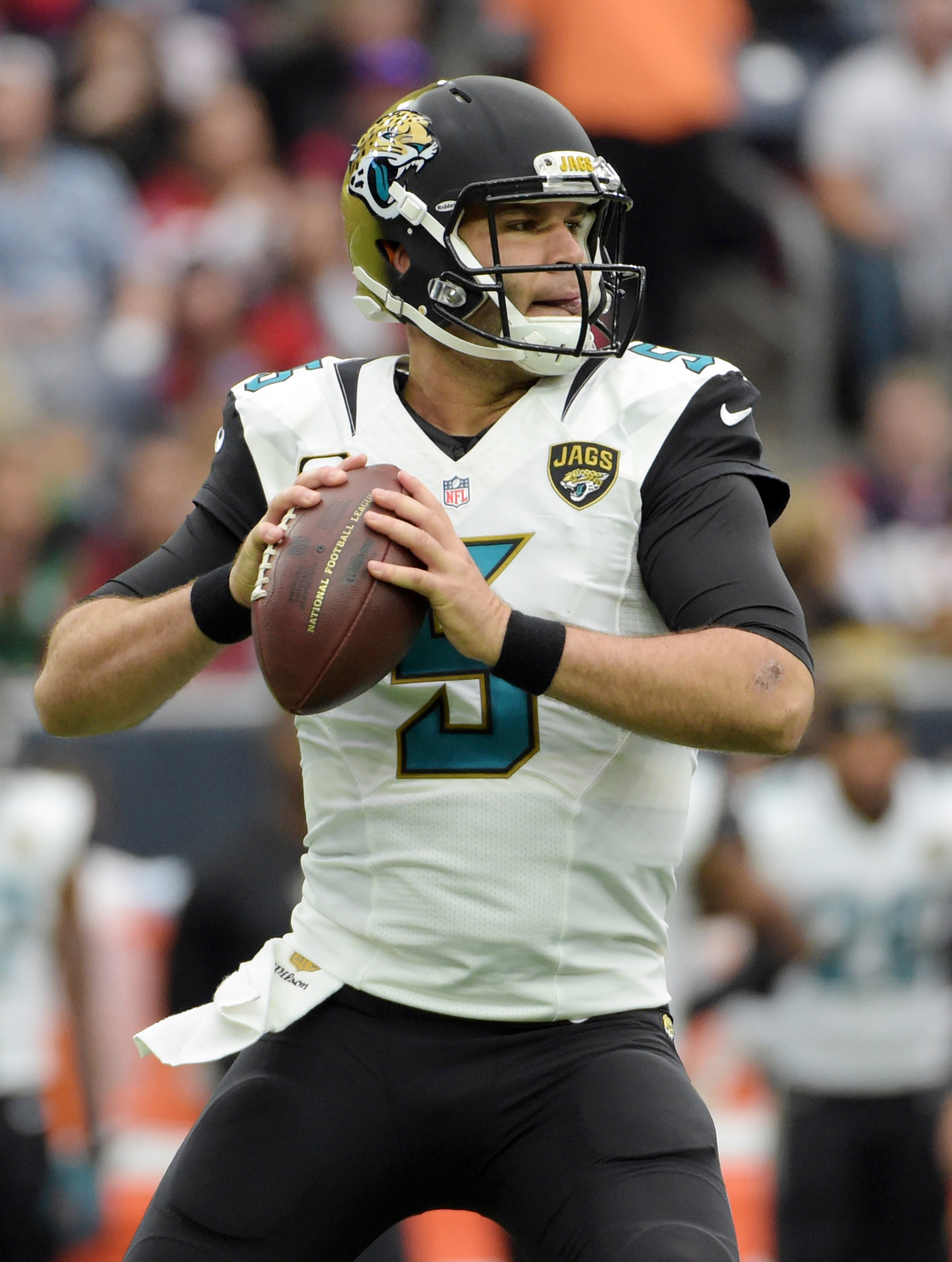
On the offensive side of the ball, 2014 first-rounder Blake Bortles showed that he may just be capable of being the Jaguars’ long-time answer at quarterback. In his sophomore year, Bortles racked up 4,428 yards and 35 touchdowns. Of course, he also led the NFL in interceptions and sacks, so it’s probably a little early to be penciling him into the Hall of Fame, but there’s some reason for optimism for the former third overall pick going forward.
While the Jaguars made strides on offense, the defense continued to struggle. 2015 first-rounder Dante Fowler Jr. didn’t play a single snap in the preseason or regular season during his rookie year, having torn his ACL on the first day of rookie minicamp. With Fowler on the way back, and the Jags expected to make additional moves this offseason to shore up the defense, head coach Gus Bradley earned another shot to turn around the club’s fortunes in 2016.
Although the Jags extended Bradley’s contract through 2017, that was mostly a ceremonial move, meant to avoid having him enter a lame-duck season. If he’s unable to get the team into playoff contention, or at least to .500, Caldwell likely won’t finish out that contract in ’17. So it’s a crucial offseason for general manager Dave Caldwell, who will also be on the hot seat if the Jaguars don’t make further progress on the field this fall.
Key Free Agents:
Fortunately for the Jaguars, none of the team’s key players are eligible for free agency. In fact, there are no free-agents-to-be that would leave the club with a huge hole if they departed this winter. Jacksonville heads into March with such a huge chunk of cap room that the team shouldn’t have a problem re-signing anyone it wants to though, even if it has to overpay by $1MM or $2MM to make it happen.
Veteran center Stefen Wisniewski is one player the Jaguars figure to explore bringing back if the price is right. Wisniewski was the full-time starting center in Jacksonville in 2015 and was adequate, particularly as a pass blocker. Considering Bortles has been sacked more than 100 times in his first two NFL seasons, the Jaguars ought to be aiming for more than “adequate” along the offensive line this offseason, but if the team can’t bring aboard an impact center, there’s nothing wrong with re-signing Wisniewski, who is at least familiar with the system now.
Marcedes Lewis took a pay cut last year to remain with the Jaguars, and even though he led the team’s tight ends in offensive snaps in 2015, his role in the offense continued to diminish. Despite not missing a game, Lewis grabbed just 16 balls for 226 yards and a touchdown, making it his least productive season since his rookie year. Unless the Jaguars highly value Lewis’ blocking abilities and he’s willing to further decrease his salary, the two sides could go their separate ways this offseason, with the Jags seeking out a blocking specialist to complement Julius Thomas.
Many teams wouldn’t consider a punter one of their top free agent priorities of the winter, but considering Jacksonville used a third-round pick on Bryan Anger back in 2012, the team will likely try to get him locked up to a new deal. Veteran quarterback Chad Henne could also be re-signed, if he’s comfortable continuing to back up Bortles. Assuming the Jaguars like the work Henne has done as a veteran mentor for Bortles in his first two years, they’ll probably be willing to continue paying him like one of the league’s top No. 2 QBs.
The Jaguars’ restricted free agents, Ryan Davis and Abry Jones, will likely continue to be part-time players on the defensive line, so assigning them low-end RFA tenders makes sense, especially since those salaries aren’t fully guaranteed.
Possible Cap Casualties:
As one of two NFL teams below the spending floor heading into the 2016 season, the Jaguars don’t really need to cut any players, particularly given their incredible amount of cap room. However, that doesn’t mean the team should simply hang onto well-compensated players who won’t necessarily earn those salaries.
Running back Toby Gerhart has carried the ball just 121 times since signing with the Jaguars as a free agent two years ago, and with T.J. Yeldon and Denard Robinson solidly in the mix, Gerhart likely won’t have much of a role going forward. The team could clear his entire $3.5MM cap charge from its books by cutting him this offseason.
On the defensive side of the ball, Chris Clemons and Dan Skuta are in a similar boat to Gerhart — neither player has any dead money left on his deal, so the Jaguars could create $4MM and $3.6MM in respective cap savings by releasing them. Clemons will turn 35 in October and wasn’t productive in 2015. His three sacks were his lowest total since he became a starter in 2010, and Pro Football Focus ranked him dead last among 110 qualified edge defenders.
As for Skuta, he was a little more effective, especially against the run, and it wouldn’t surprise me to see the Jaguars hang onto him, since $3.6MM isn’t an exorbitant cap hit, particularly for a team with so much flexibility. But he didn’t play a ton of snaps in his first year in Jacksonville, and if the club adds linebacker depth that further marginalizes Skuta, he could become a cap casualty.
Positions Of Need:
Bortles had plenty of weapons at his disposal in 2015, with Allen Robinson and Allen Hurns both racking up 1,000-yard seasons, while Thomas and Yeldon caught their share of balls as well. The club could use a blocking tight end, and it wouldn’t be a bad idea to add a receiving back — Yeldon did well as a pass-catcher out of the backfield in his rookie season, but a dedicated third-down back capable of bailing out Bortles would be a nice addition. Lance Dunbar might be a good fit in free agency.
The majority of the Jaguars’ offensive upgrades should happen along the offensive line rather than at the skill positions. On paper, the offensive line doesn’t look bad. At tackle, Luke Joeckel was the second overall pick in the 2013 draft, and Jermey Parnell was a significant free agent investment a year ago. At guard, A.J. Cann was a day-two pick in 2015, and Zane Beadles was the team’s big free agent addition on the line two years ago. Wisniewski, who is facing free agency, was solid, if not spectacular, during his first season with the Jags.
Still, Beadles and Parnell haven’t played quite as well as the Jaguars were hoping for when they rewarded them with nice paydays. Joeckel, meanwhile, isn’t the kind of stalwart left tackle you’d expect to land with a top-two pick. Even if the Jags plan to keep their 2015 starters around, the club should look to bring in at least one or two more viable options to challenge those incumbent starters.
One option, with Wisniewski a few weeks away from reaching the open market, could be Browns center Alex Mack. Though he’s technically not a free agent yet, Mack can opt out of his contract, a fact that the Jaguars know very well — it was Jacksonville that included that opt-out clause in the offer sheet Mack signed with the club two years ago. If he opts out, Mack will be an unrestricted free agent, so the Browns won’t have the option of matching Jacksonville’s offer this time around.
Another potential target in free agency could be Seahawks left tackle Russell Okung. Before becoming the head coach in Jacksonville, Gus Bradley saw first-hand as an assistant in Seattle what Okung was capable of, and the veteran lineman – who is representing himself – appears interested in testing the open market, having emailed all 32 teams recently about his potential availability.
Although the Jaguars could look to shore up their offensive line, most of their work in free agency and the draft figures to focus on the defensive side of the ball. Fowler’s debut will help improve the pass rush, but that’s still an area the club should look to improve. One free agent that should be of particular interest to the Jags is Seahawks linebacker Bruce Irvin, who was a first-round pick in 2012, Bradley’s final year as Seattle’s defensive coordinator. Irvin recorded eight sacks in his rookie year under Bradley, a number he hasn’t matched or exceeded since, and would be a nice fit in Jacksonville.
In the secondary, the Jaguars added Davon House a year ago, but still lack any real impact defensive backs, making the position group a top priority this winter. Armed with a ton of cap space and a pressing need in the secondary, the Jaguars can afford to be significant players on the top defensive backs available.
At cornerback, that means perhaps targeting players like Sean Smith and Janoris Jenkins, assuming Josh Norman is franchised or re-signed by the Panthers. If the Jags feel like going after another ex-Packer, Casey Hayward is another worthwhile option. At safety, Eric Weddle, Tashaun Gipson, Rodney McLeod, Walter Thurmond, and others might be among Jacksonville’s targets.
Considering the team potentially needs to add two or three starting defensive backs, it would make sense to use the fifth overall pick on cornerback Jalen Ramsey, if he’s available. ESPN’s Mel Kiper and Todd McShay both have Ramsey going to the Jags in their latest mock drafts, citing his athleticism and his ability to play either cornerback or safety as reasons why he’s worthy of being a top-five pick this spring. Heading into the 2016 season with Fowler rushing the passer and Ramsey roaming the secondary wouldn’t entirely fix Jacksonville’s defense, but it would be a great start.
Extension Candidates/Contract Issues:
While the Jaguars will have to spend some money within the next 12 months or so to reach the 89% floor for NFL teams, that doesn’t mean the team has to go crazy in free agency this year. Teams don’t have to reach that spending floor until March 2017, so extensions for players like Bortles and Robinson could factor into the equation. Of course, as members of the 2014 draft class, those players aren’t eligible for new contracts until next winter, so the Jags won’t be focusing on those extensions quite yet.
The Jaguars’ 2013 draftees are eligible for extensions immediately, but that year’s draft class wasn’t exactly a strong one for the team. Joeckel probably hasn’t earned a big-money deal, and second-round safety Johnathan Cyprien ranked as Pro Football Focus’ second-worst safety out of 88 qualified players this past season. A mid-round pick like Denard Robinson could sign an extension this winter, but as a part-time running back, he’d be in line for a pretty modest second contract.
As for contracts that could be restructured, Zane Beadles‘ deal jumps out as an obvious candidate. His performance in his first two seasons in Jacksonville has been underwhelming, and now that he has no dead money left on his contract, the Jags have some leverage to ask him to take a pay cut in exchange for keeping his roster spot and getting some guaranteed money up front. If he refuses, the Jaguars have the cap flexibility to cut him and simply add guard to the list of positions they’ll be looking to upgrade in free agency.
The Jaguars’ huge amount of cap space and lack of immediate extension candidates really puts the team in a strong position heading into the 2016 offseason. Obviously, the club doesn’t want to hand out a bunch of extravagant contracts this winter and put itself in a position where it can’t afford to pay players like Bortles, Robinson, Hurns, and Fowler down the line. However, those players are still so far away from breaking the bank that the Jaguars can afford to roll the dice on several free agents this winter, structuring those contracts in such a way that by the time Bortles and others start getting expensive, this winter’s signees can be cut or restructured at a minimal cost, if necessary.
It’s what we saw the team do last year with players like House, Skuta, and Parnell, and while none of those players really had the sort of breakout season the Jags were hoping for, the team still has so much flexibility that it could try its luck on another round of potential impact players this year.
Overall Outlook:
The Jaguars haven’t made the postseason since 2007, and their 14 combined wins over the last four years were fewer than the 2015 Panthers put up in one year. Still, this looks like it could be a team on the rise. With Bortles continuing to develop, another top-five pick debuting along with Fowler this season, and a truckload of cap room for the Jags to make a splash or two in free agency, fans in Jacksonville can start to glimpse the light at the end of the tunnel. If they can make a few savvy moves this offseason, there’s no reason to think that the Jags can’t be a potential dark-horse playoff contender in 2016.
Information from Over The Cap was used in the creation of this post. Photo courtesy of USA Today Sports Images.
Offseason Outlook: Miami Dolphins
Pending free agents:
- Louis Delmas, S
- Shamiel Gary, S (ERFA)
- Matt Hazel, WR (ERFA)
- Ulrick John, T (ERFA)
- Rishard Matthews, WR
- Jacques McClendon, G
- Lamar Miller, RB
- Matt Moore, QB
- Tyler Patmon, CB (ERFA)
- Spencer Paysinger, LB
- Derrick Shelby, DE
- Kelvin Sheppard, ILB
- Shelley Smith, G
- Jake Stoneburner, TE (ERFA)
- Michael Thomas, S (ERFA)
- Robert Thomas, DT (ERFA)
- Olivier Vernon, DE
- Brandon Williams, TE (RFA)
Top 15 cap hits for 2016:
- Ndamukong Suh, DT: $28,600,000
- Ryan Tannehill, QB: $11,640,000
- Branden Albert, T: $10,150,000
- Mike Pouncey, C: $10,025,000
- Cameron Wake, DE: $9,800,000
- Jordan Cameron, TE: $9,500,000
- Brent Grimes, CB: $9,500,000
- Reshad Jones, S: $8,202,942
- Quinton Coples, DE: $7,751,000
- Dion Jordan, DE: $6,202,377
- Greg Jennings, WR: $5,500,000
- Koa Misi, LB: $4,878,000
- Earl Mitchell, DT: $3,500,000
- Brice McCain, CB: $3,500,000
- Philip Wheeler, ILB: $2,800,000 (dead money)
Notable coaching/front office changes:
- General manager: Promoted college scouting director Chris Grier to replace Dennis Hickey.
- Head coach: Hired Bears OC Adam Gase to replace Dan Campbell, who left to become Saints’ assistant HC and TEs coach.
- Offensive coordinator: Hired Colts QBs coach Clyde Christensen to replace Zac Taylor.
- Offensive staff: Hired Bears offensive assistant Bo Hardegree as QBs coach.
- Defensive coordinator: Hired Bengals DBs coach Vance Joseph to replace Lou Anarumo, who returned to DBs coach role.
Draft:
- No. 8 overall pick
- Acquired seventh-round pick from Ravens in deal for CB Will Davis.
Other:
- Current projected cap room (via Over the Cap): $2.69MM over projected cap
- DE Dion Jordan remains suspended due to repeated substance-abuse violations.
- Signed German League MVP Tyler Davis.
Overview:
The Dolphins entered the 2015 season with playoff aspirations, but they ultimately went through two different head coaches, Joe Philbin and Dan Campbell, en route to another bitterly disappointing campaign. Miami finished last in the AFC East at 6-10, its worst record since 2011, and extended its playoff drought to seven years. The Dolphins have also failed to register a season above .500 during that span.
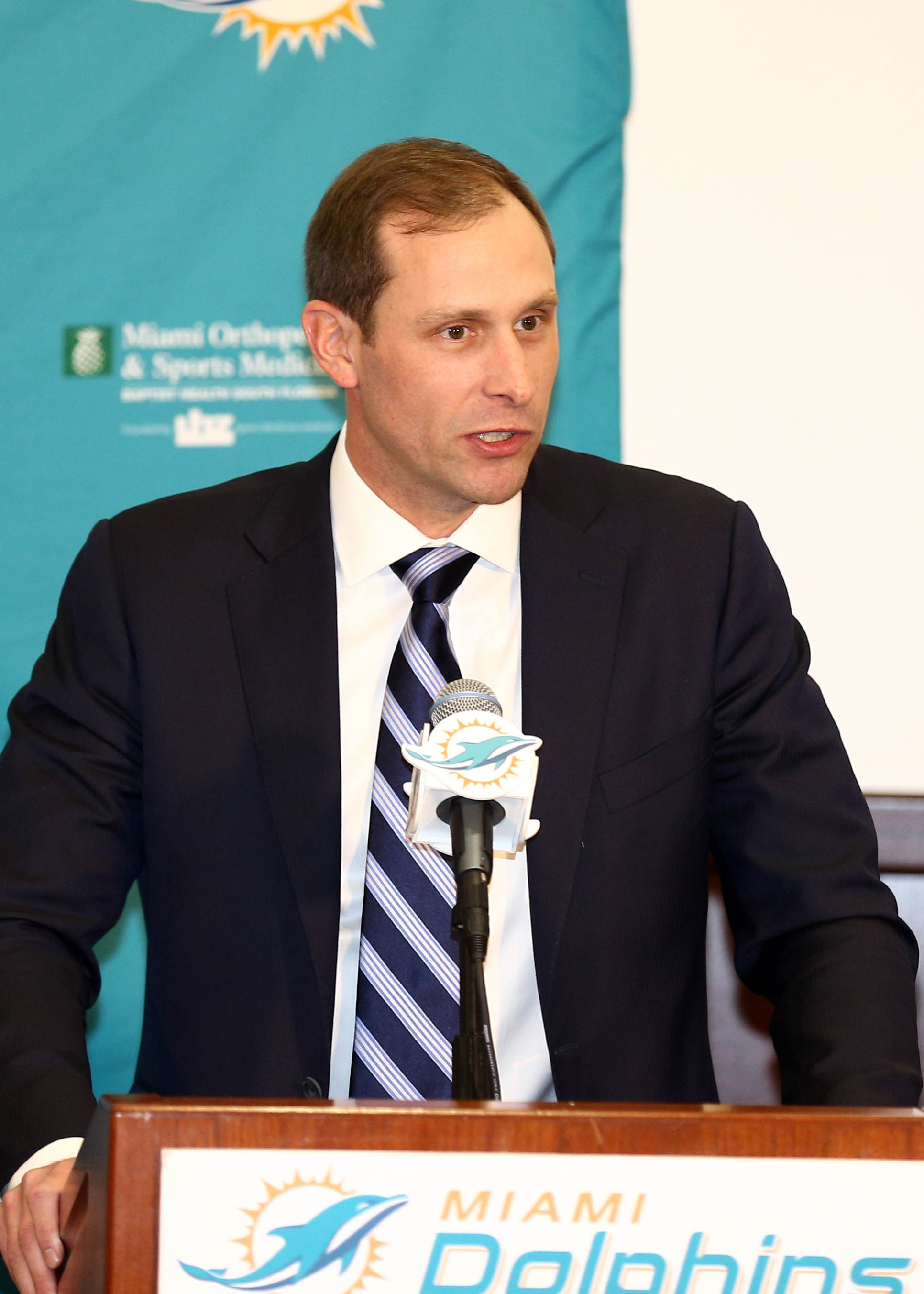 Naturally, then, major changes are needed, and those changes began last month with the ouster of general manager Dennis Hickey, the promotion of Chris Grier from director of college scouting to GM, and the hiring of Campbell’s replacement, first-time head coach Adam Gase. Grier and Gase will work in unison with the rest of the Dolphins’ hierarchy, led by executive vice president of football operations Mike Tannenbaum, as they try to restore glory to a franchise with just one playoff berth since 2002.
The organization is optimistic that the 37-year-old Gase, the NFL’s youngest head coach, is the right fit to get the most out of big-money quarterback Ryan Tannehill and his teammates. Prior to serving as the Bears’ offensive coordinator last season, Gase held the same position with the Broncos from 2013-14, during which time Peyton Manning piled up 94 touchdown passes. In Chicago, Gase helped maligned quarterback Jay Cutler to one of the most efficient seasons of his career — Cutler completed better than 64 percent of his passes and threw only 11 interceptions in 15 games.
In addition to having full control over the Dolphins’ 53-man roster, Gase will call their offensive plays, giving him an unusually high amount of responsibility for a neophyte head coach. He’ll have assistance on the offensive side from coordinator Clyde Christensen, formerly the quarterbacks coach in Indianapolis. Vance Joseph, who previously coached the Bengals’ defensive backs, will run a Dolphins defense that placed 25th overall in ’15-16 and looks poised to undergo a drastic overhaul in the approaching months.
Key Free Agents:
The Dolphins’ most noteworthy pending free agent is defensive end Olivier Vernon, who hasn’t missed a game since they spent a third-round pick on him in 2012. Vernon has paired durability with productivity, having racked up 29 sacks in four years (25.5 over the last three seasons). Vernon took down enemy QBs 7.5 times this past season and ranked third out of 91 qualifying edge defenders in overall performance by Pro Football Focus’ standards (subscription required), trailing only superstars Khalil Mack and Von Miller. When you consider all of the above, not to mention his age (26 in October), it’s clear Vernon is on the cusp of a significant payday. Vernon is aware of that, and he indicated in early January that the Dolphins won’t have an easy time keeping him.
 “I only get one shot [at free agency], so I’m not [doing] a hometown discount,” he told Barry Jackson of the Miami Herald.
Given their lack of long-term certainty at defensive end (Cameron Wake is 34 and recovering from a torn Achilles, Dion Jordan‘s career has been a disaster on and off the field, and Derrick Shelby joins Vernon as a free agent-to-be), the Dolphins should do everything within reason to retain Vernon. It’s estimated the franchise tag for DEs in 2016 will be just under $15MM, which looks too rich for a team that has work to do to get under the cap. It’s possible the Dolphins will tag Vernon in order to keep him under their control as they try to work out a long-term accord, though. Otherwise, he’s an obvious risk to go to the open market and sign with the highest bidder. James Walker of ESPN.com wrote that a contract worth upward of $9MM annually for Vernon could take the Dolphins out of the race to sign him. Considering all that he brings to the table, that type of annual value seems fair for Vernon, who could end up with a deal in the neighborhood of the five-year, $47.25MM pact fellow 4-3 edge rusher Vinny Curry recently signed with the Eagles.
It’s conceivable Vernon’s fate will determine Shelby’s, as the Dolphins might have trouble re-signing both. Shelby, who has missed only one game in four years, played over 72% of Miami’s defensive snaps in 2015-16 and totaled a career-high 3.5 sacks. He also ranked as PFF’s 23rd-best edge defender. Shelby, 27 in March, is seemingly in line for a raise over his expiring $2.36MM salary. If the Dolphins work something out with Vernon, Shelby will probably get his pay increase someplace else. Should Vernon walk, perhaps the Dolphins will look to Shelby as a cheaper, albeit less effective, replacement. A defense that finished 25th in sacks can’t afford to lose both Vernon and Shelby, so the likelihood is that at least one of them will stay in the fold.
Aside from Vernon and Shelby, the Dolphins have other defenders primed for free agency in middle linebacker Kelvin Sheppard, who started 14 games last season, and safeties Michael Thomas and Louis Delmas.
Sheppard has been underwhelming throughout his five-year career, last season included, and doesn’t seem likely to return to Miami – not as a starter, anyway.
As an exclusive rights free agent, Thomas can’t negotiate with other teams. That means he should be a Dolphin again. Thomas started 12 games last season and earned a respectable assessment from PFF (41st-ranked safety out of 88). He’s also a standout on special teams.
Delmas has been solid when on the field during his career, but health has long been an issue. The 28-year-old sat out all of ’15-16 with a torn ACL (his second in a nine-month span) and has missed 33 of a possible 112 regular-season games since entering the league in 2009. If the Dolphins elect to bring him back, expect a short-term, inexpensive deal with possible incentives.
On the offensive side, the Dolphins’ control over running back Lamar Miller is set to end. Miller has put up a tremendous 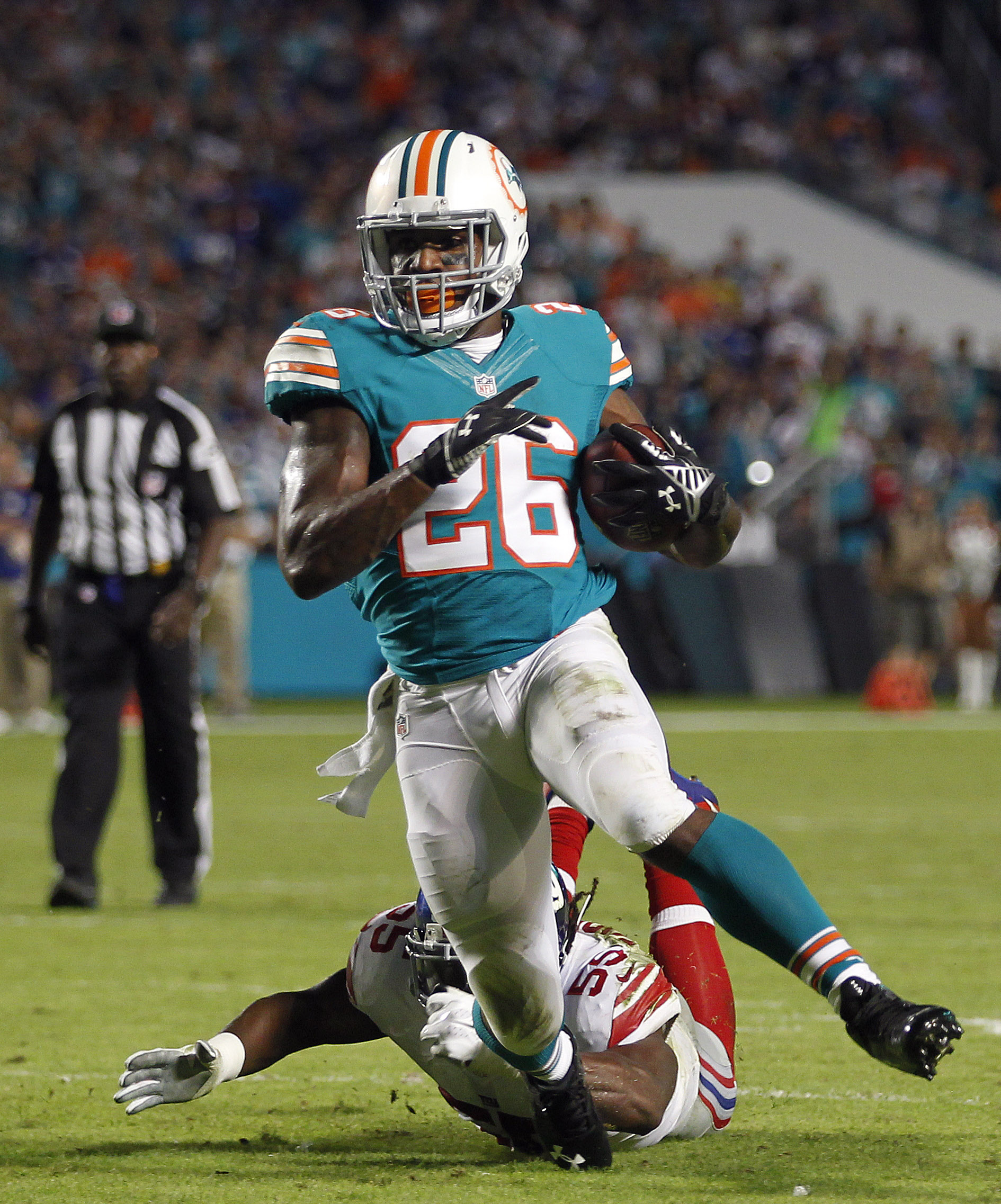 4.6 yards-per-carry average during his four-year career, but the Dolphins haven’t leaned on him enough. The 24-year-old accrued only the 18th-most carries in the league last season (194), though he made them count with 872 yards and eight touchdowns, also adding 47 receptions and two more scores. Miller closed the season poorly, however, rushing for 103 yards on 43 attempts over the final three weeks. He also had seven games with 10 carries or fewer, which is more an indictment of the prior coaching staff than him.
Gase puts much heavier emphasis on the run than previous Dolphins regimes, as Fox Sports’ Cameron DaSilva wrote last month. Gase’s offenses ranked in the league’s top 12 in rushing attempts the last three years (sixth in ’15), while the Dolphins were 29th, 22nd and 32nd, respectively. There’s a chance Gase believes in Miller and will make a push for the front office to re-sign him, but Miller’s future “depends on the economics,” a club official told Jackson last month. Miller is ostensibly a good bet to test the market, which would make him a good bet to find a contract richer than the one Miami will presumably offer.
Receiver Rishard Matthews joins Miller as a notable Dolphins weapon scheduled to explore free agency. Matthews’ departure seems likelier than Miller’s considering the Dolphins already have three capable wideouts in Jarvis Landry, Kenny Stills and 2015 first-rounder DeVante Parker. After catching a paltry four passes through Nov. 22, Parker broke out during the final six games of his rookie season and became an explosive part of Miami’s offense. That was especially evident in the 13-catch, 286-yard tear he went on over the season’s closing three weeks. Thanks to Parker’s emergence, the Dolphins are in fine shape at the position and will presumably let Matthews walk.
Matthews appeared in 11 games last season and caught 43 passes for 662 yards (a prolific 15.4 YPC) and four TDs. Before Matthews’ season ended in late November on account of broken ribs, Adam H. Beasley of the Miami Herald reported that the 26-year-old was in line for a deal worth $4MM to $6MM annually. The expectation is that Matthews will have to get that money from another team.
Possible Cap Casualties/Contract Issues:
The Dolphins are over the cap right now, but they’ll free up a sizable chunk of room by releasing a slew of players. The most obvious of the bunch is edge defender Quinton Coples, whom the Dolphins claimed off waivers from the Jets in November. Coples didn’t make a single tackle for the Dolphins and certainly won’t be on their books next season at the $7.75MM for which he’s presently slated.
Similarly, releasing 35-catch tight end Jordan Cameron would save Miami a large amount ($7.5MM). There’s also receiver Greg Jennings, who was a non-factor last season and whose release would make $4MM of space. Defensive tackle Earl Mitchell and cornerback Brice McCain are both pink slip possibilities, which would open up another $5MM ($2.5MM apiece).
The same is possible for linebacker Koa Misi, who has been with the Dolphins since they took him in the second round of the 2010 draft. Although he earned above-average ’15-16 marks from PFF (21st-ranked LB out of 97 qualifiers), Miami would save $4.3MM by designating Misi a post-June 1 cut ($3.72MM beforehand). That could seal his fate, according to Armando Salguero of the Miami Herald.
 In addition to getting rid of players, the Dolphins could look to create cap space by restructuring a handful of contracts. Defensive tackle Ndamukong Suh, cornerback Brent Grimes, Wake, Cameron, and Jordan are candidates to have lesser cap hits next season. If none are open to that, all except Suh may end up on the chopping block.
In Suh’s case, it’s worth noting that Jason Fitzgerald of Over the Cap has warned against restructuring his contract because of the negative ramifications it would bring over the long haul. Nevertheless, in an effort to decrease Suh’s $28.6MM cap number this year, the Dolphins are considering altering the mammoth deal he signed last offseason, a move which wouldn’t require the former Lion’s approval.
Wake has 70 sacks in seven years with the Dolphins – seven of which came in only seven games last season. But it’s hard to imagine the team being content with an aging player coming off a serious injury taking up $9.8MM of its cap. Worst-case scenario: Miami can release Wake and recoup $8.4MM of breathing room. If that happens, it could help the Dolphins retain both Vernon and Shelby.
Grimes will eat into $9.5MM of the cap, $6.5MM of which can be saved by parting with him before June 1. By designating Grimes as a post-June 1 cut, the team would create $8MM in cap savings. However, given Grimes’ track record and their dearth of quality corners, bringing the nine-year veteran back at a lower amount would seem more beneficial for the Dolphins.
Finally, there’s Jordan, who had to sit out this past season after the league suspended him for violating its substance abuse policy. If the league reinstates Jordan in the spring, he’ll go back to factoring into the Dolphins’ cap. His hit for next season exceeds $6.2MM, an unpalatable total for a player who has amassed three sacks and 22 games missed because of suspensions since Miami drafted him third overall in 2013. While cutting Jordan outright would save the Dolphins upward of $3.21MM this year, they’re open to giving him another chance, according to Jackson.
Positions Of Need:
Even without taking the nebulous statuses of its all-important edge rushers into account, most of Miami’s offseason focus will lie with a defense that struggled against both the run and pass, and didn’t generate much pressure or force many turnovers last season.
With Sheppard’s contract up and Misi a release candidate, the team could search for two new starting linebackers this offseason to join the young and inexpensive Jelani Jenkins, per Salguero. The Dolphins might be better served continuing on with Misi instead of creating another hole, though. Keeping Misi would mean the Dolphins would only have to land one starting-caliber LB. That player could come via the draft, where UCLA’s Myles Jack, Alabama’s Reggie Ragland and Notre Dame’s Jaylon Smith are all potential fits for the Dolphins at eighth overall.
Miami’s defensive backfield, which largely aided in allowing 31 touchdown passes and an opposing QB rating of over 97.0 in ’15-16, also requires fixing. Even if Grimes isn’t released, the unit is devoid of impact players outside of him and star strong safety Reshad Jones. With Joseph now in charge of the defense, Jackson thinks the Dolphins will consider cornerback Adam Jones and free safety Reggie Nelson. Both played under Joseph in Cincinnati and are presently without contracts.
Jackson also lists the Rams’ Trumaine Johnson and Janoris Jenkins, ex-Dolphin Sean Smith (Chiefs), Casey Hayward (Packers) and Prince Amukamara (Giants) as some established corners Miami could turn to in free agency. If the Dolphins want to go for a high-ceiling CB in the draft, a couple of in-state collegians – Jalen Ramsey (Florida State) and Vernon Hargreaves III (Florida) – are prospective top 10 picks. Another local product, the Miami Hurricanes’ Artie Burns, could be a second-round target, along with William Jackson (Houston) and Eli Apple (Ohio State).
As for safety, after intercepting a career-high eight passes and ranking as PFF’s 10th-best player at his position last season, Nelson will be on plenty of teams’ radars — not just the Dolphins’. The same is true regarding the Chargers’ Eric Weddle, a three-time Pro Bowler who “would welcome” an offer from Miami, Jackson wrote in January. The Browns’ Tashaun Gipson also looks like a player who could garner interest from the Dolphins. At 26, the one-time Pro Bowler would be more of a long-term solution than Nelson or Weddle.
Offensively, the Dolphins’ concerns begin along the line. With Branden Albert and Ja’Wuan James manning the tackle positions and Mike Pouncey at center, most of their starting five is a strength. Guards Dallas Thomas and Billy Turner are in over their heads, however. The Dolphins agree, per Jackson, and will search for more suitable starters.
If true, that should put the club in contention for in-their-prime free agents like the Ravens’ Kelechi Osemele, the 49ers’ Alex Boone and the Texans’ Brandon Brooks. Osemele would upgrade left guard substantially and bring experience at left tackle, where he’d be able to sub for Albert in the event of an injury (Albert hasn’t played a 16-game season since 2011). Boone has played both guard spots and has a connection to Miami’s new offensive line coach, Chris Foerster, who oversaw Boone and the rest of San Francisco’s O-line last season.
Other options include Denver’s Evan Mathis, whom the Dolphins courted last summer, and Atlanta’s Chris Chester. Both are among the adept veteran Band-Aid types who are likely to sign low-term, mid-tier-money contracts. They should be appealing to the Dolphins if they’re unable to reel in the younger choices, as should adding depth to the position later in the draft.
With Miller’s contract up, Jay Ajayi is the in-house starter at running back. After combining for 89 yards on 11 carries in his first two appearances, the fifth-round rookie fell to earth, accumulating 98 yards on 38 attempts the rest of the season. With that in mind, it would be overly optimistic of the Dolphins to hand the reins to Ajayi in the wake of Miller’s possible departure. They could instead pair with him with a free agent, perhaps the Bears’ Matt Forte – who totaled 1,200-plus yards and seven TDs under Gase last season – or Washington’s Alfred Morris. Gase also has familiarity with the Broncos’ Ronnie Hillman, who is set to hit the market off a career year and won’t turn 25 until September.
As is the case with running back, how Miami will handle tight end is unclear. Whether the team brings in a prominent outsider will depend on what happens with Cameron, who, as mentioned earlier, is unlikely to return at his current cap hit. If he agrees to come back at a lower cost, the Dolphins will get by with him and Dion Sims for at least another year. Otherwise, they might have to venture into free agency for another unremarkable veteran of Cameron’s ilk to helm the position until someone better comes along.
Overall Outlook:
The Dolphins will have plenty to do in the coming months as they try to ascend from the cellar of the AFC East, a division which they went 1-5 against last season, to playoff contention. Not only will Gase have to prove himself as the correct coaching hire, but the front office must make numerous shrewd roster moves to boost a club that had the league’s eighth-worst record and fifth-worst point differential during the 2015-16 campaign. Tannehill is the Dolphins’ most scrutinized player, but any possible progress he makes next season will probably go for naught if the front office doesn’t adequately address the team’s abundance of glaring issues through free agency and the draft.
Information from Over The Cap was used in the creation of this post. Photo courtesy of USA Today Sports Images.
Offseason Outlook: Cleveland Browns
Pending free agents:
- Johnson Bademosi, S
- Travis Benjamin, WR
- Tank Carder, ILB
- Travis Coons, K (ERFA)
- Pat Devlin, QB (ERFA)
- Tashaun Gipson, S
- Darius Jennings, WR (ERFA)
- Kaleb Johnson, G (ERFA)
- Don Jones, S (RFA)
- Jamie Meder, DE (ERFA)
- Darrian Miller, G (ERFA)
- Raheem Mostert, RB (ERFA)
- Austin Pasztor, T (RFA)
- Terrelle Pryor, WR (RFA)
- Craig Robertson, LB
- Mitchell Schwartz, T
- Scott Solomon, OLB (RFA)
Top 15 cap hits for 2016:
- Joe Haden, CB: $13,400,000
- Joe Thomas, T: $9,500,000
- Donte Whitner, S: $8,450,000
- Dwayne Bowe, WR: $8,000,000
- Alex Mack, C: $8,000,000
- Paul Kruger, OLB: $7,700,000
- Desmond Bryant, DE: $7,000,000
- Tramon Williams, CB: $6,981,250
- Karlos Dansby, ILB: $6,500,000
- Barkevious Mingo, OLB: $5,201,319
- Josh McCown, QB: $5,041,666
- Brian Hartline, WR: $3,750,000
- Randy Starks, DT: $3,625,000
- Justin Gilbert, CB: $3,500,046
- John Greco, G: $2,925,000
Notable coaching/front office changes:
- Front office: Fired general manager Ray Farmer, VP of player personnel Morocco Brown, and executive chief of staff Bill Kuharich.
- Front office: Promoted Sashi Brown to VP of football operations, hired MLB executive Paul DePodesta as chief strategy officer, and hired Colts pro scouting coordinator Andrew Berry as VP of player personnel.
- Head coach: Hired Bengals OC Hue Jackson to replace Mike Pettine.
- Offensive staff: Will go without OC after firing John DeFilippo. Hired Al Saunders as senior offensive assistant, Pep Hamilton as assistant head coach/offense, and Kirby Wilson as running game coordinator.
- Defensive coordinator: Hired Titans DC Ray Horton to replace Jim O’Neil.
Draft:
- No. 2 overall pick
- No traded picks
Other:
- Current projected cap room (via Over the Cap): $33.22MM
- Must exercise or decline fifth-year option for 2017 for OLB Barkevious Mingo.
- WR Josh Gordon has filed for reinstatement from his suspension.
- C Alex Mack can opt out of his contract to become a free agent.
Overview:
In 2014, the Browns finished out the year with a 7-9 mark and at least showed glimpses of competitiveness. In 2015, there wasn’t much to write home about after a 3-13 campaign. Naysayers around the league whispered about Johnny Manziel‘s off-the-field issues, and the party-loving quarterback proved them all right. Of course, the Browns’ issues ran much deeper than the quarterback position, but their poor play under center has been an issue for decades now and it’s unlikely that they will get back on track until they finally find a solution there.
Throughout 2014, Browns fans wondered whether it would be Brian Hoyer or Manziel starting at QB for Cleveland in 2015. As it turns out, it was neither. Instead, that mantle was given to offseason acquisition Josh McCown. The 6’4″, 213-pounder spent the 2014 campaign in Tampa Bay and performed poorly in 11 games for a Buccaneers team that finished with the NFL’s worst record. Thanks to a string of injuries, things didn’t go much better for him in 2015. McCown suffered a concussion in Week 1, a shoulder injury in Week 8, a rib injury in Week 9, and a season-ending collarbone injury in Week 12.
As for Johnny Football? The injuries opened up the door for him to show his skills and, for a brief moment, he did. He wound up squandering that opportunity at mid-season, however, after he was caught on video partying and lied to the team about it. There were numerous off-the-field transgressions for Manziel in 2015 and the most recent run-in will probably bring an end to his time in Cleveland.
“We’ve been clear about expectations for our players on and off the field,” executive VP of football operations Sashi Brown said in early February. “Johnny’s continual involvement in incidents that run counter to those expectations undermines the hard work of his teammates and the reputation of our organization. His status with our team will be addressed when permitted by league rules. We will have no further comment at this time.”
Assuming they don’t designate him as a post-June 1 cut, the Browns will take on a ’16 cap hit of about $4.33MM if they release Manziel on or after March 9. Of course, the team could remove that entire figure from its cap if the 23-year-old is claimed on waivers, but that seems extremely unlikely. A first-round pick in 2014, Manziel started eight games during his two years in Cleveland, completing 57% of his passes and throwing seven touchdowns to seven interceptions, for a QB rating of 74.4. While his on-field performance was unspectacular, it was off-field behavior that will cost him his roster spot.
What follows is a detailed look at what lies ahead for the Browns — not just at quarterback, but everywhere else on the field.
Key Free Agents:
Wide receiver Travis Benjamin broke out in 2015, hauling in 68 catches (125 targets) for 966 yards and five touchdowns. Of course, this wasn’t the easiest year for the Browns, but Benjamin has been generally positive when asked about making a future in Cleveland and in December, he said he was 75-80% on the way to reaching a new deal with the Browns.
 “I’m not looking for (free agency),” he said in October. “Me and the Browns have a great relationship. I love them, they love me and I love the community so if we get a deal done that’ll be great for me…I love it here, my wife loves it here and we’re just happy to be here.”
Safety Tashaun Gipson was the league’s final restricted free agent on the market last offseason and only re-signed with the Browns in June of 2015. The team assigned Gipson a second-round tender worth $2.356MM earlier in the offseason and, despite his protests, he ultimately signed it in order to join his team in training camp. While Gipson wasn’t happy with the RFA tender he received from the Browns, it’s not a huge surprise that he eventually relented and signed it, given his lack of leverage.
This past season, Gipson played in (and started) 13 games, racking up 60 tackles, two pass deflections, and two interceptions. The former UDFA could, theoretically, sign a deal with the Browns before the start of free agency, but he has stated in the past that he wants to test the open market to assess his value.
It has been speculated for some time that Browns right tackle Mitchell Schwartz could be in for a big payday this offseason. For his part, Schwartz recently said he’d like to re-sign with Cleveland. The 26-year-old is a four-year starter at the right tackle position and Pro Football Focus is wild about him, having named him to its “All Third-Year Team” for the 2015 season. The Browns have the money to retain him, but it’s not clear if they’re willing to make him the kind of offer that will convince him to bypass the open market, or if his stated preference to stay in Cleveland is genuine.
Possible Cap Casualties:
As noted above, Dwayne Bowe currently stands as the Browns’ fourth-highest cap hit with an $8MM figure in 2016. And, of course, you’ve seen the math on how much money Bowe has been paid per reception and the end result is not pretty. Bowe’s contract is not just the worst in Cleveland – it’s arguably one of the worst in the entire NFL. Cleveland gave Bowe $9MM in guaranteed money in March of 2015. In September, it was already rumored that coaches were displeased with his work ethic and performance. Bowe, 32 in September, is not wanted back in Cleveland and it would not be a surprise to see him let go.
Outside of Bowe, there are a handful of notable players that would make at least some sense as possible cap casualties. Wide receiver Brian Hartline might not have a major role going forward, but he’s also not too expensive with a cap number of $3.75MM in 2016. He also produced with 46 catches (77 targets) for 523 yards and two touchdowns across 12 games.
Barkevious Mingo would be a possible release candidate if his salary weren’t fully guaranteed. Paul Kruger and Desmond Bryant carry high cap numbers ($7.7MM and $7MM, respectively), but they gave Cleveland some decent production last year. Donte Whitner also gets honorable mention in this section, though he doesn’t seem like a strong candidate given his production.
The Browns also shouldn’t be too strapped for space as they will be carrying over ~$20MM in unused cap room from last year.
Positions Of Need:
Obviously, the quarterback position is the No. 1 priority with a bullet for the Browns. Armed with the No. 2 overall pick in the draft, the Browns could try their luck again with a rookie QB. The latest word is that Cleveland prefers Carson Wentz to Jared Goff, but they’ll be evaluating all quarterback options over the next few months. If the Browns look to the free agent market for a quarterback, they’re not likely to find any real slam dunk options. Someone like Ryan Fitzpatrick, who seems likely to re-sign with the Jets anyway, would serve only as a transitional option, and that’s something Cleveland already has with McCown.
The Browns will continue to discuss a new deal with Benjamin and the outcome of those talks will largely dictate what they do at wide receiver. If the 26-year-old cannot be retained, the team would have even more room to go out and try to hit a home run at the position. If the Browns are thinking big, they could potentially make a move for Bears free agent wide receiver Alshon Jeffery. The soon-to-be 26-year-old is primed to cash in soon, be it with the Bears, Browns, or someone else, having accumulated 228 receptions, 3,000+ yards, and 21 touchdowns over the last three years (41 games). Of course, the Browns already have one of the game’s most talented wide receivers in-house: Josh Gordon (more on him later).
Cleveland threw some money at its defense last offseason, but it sure didn’t show. The Browns’ pass defense finished outside of the lower third in the league with 250.8 yards surrendered per game, but that’s partly because teams decided to just run them over instead — opponents averaged 128.4 yards per game against Cleveland, putting the club in a virtual tie for the NFL’s second-worst run defense.
Specifically, the Browns badly need an edge rusher to put pressure on opposing quarterbacks. Von Miller stands as the most desired free agent player at the outside linebacker position, but few expect him to actually reach the open market since the Broncos reserve the right to use the franchise tag on him. However, Seahawks free agent Bruce Irvin could be available for the Browns, if they’re interested, and he’d cost less than Miller on a long-term deal too. How much exactly? That’s hard to say, but it has been suggested that Vinny Curry‘s recent five-year, $47.25MM ($23MM guaranteed) deal with the Eagles could be a reasonable starting point for talks. Meanwhile, Joey Bosa could be a consideration for them with their top pick.
Inside linebacker will have to be addressed, particularly with Karlos Dansby getting up there in age. A strong second cornerback opposite Joe Haden would also give the Browns’ secondary a much-needed boost — 2014 first-rounder Justin Gilbert hasn’t been that player so far.
Extension Candidates/Contract Issues:
 The Browns have some serious decisions to make when it comes to wide receiver Josh Gordon. Gordon was suspended for the 2015 season but just a few weeks ago, he applied for reinstatement. Since his entry into the league in 2012, Gordon’s NFL career has been tumultuous to say the least. He missed the first two games of the 2013 season following a drug suspension, but then went on to lead the NFL in receiving yards, finishing with 87 receptions for 1,646 yards and nine touchdowns.
Hopes were high for the 2014 season, but Gordon’s off-the-field issues resurfaced, as he was first arrested for DUI, and then suspended for one year after again violating the league’s substance-abuse policy. He was eventually reinstated after only 10 games as part of the NFL and the players’ union agreeing to a new drug policy, which reduced the sentences for some players-in-limbo. The Browns subsequently suspended Gordon for the final contest of the season after he reportedly violated team rules, and then a failed alcohol test resulted in the wideout’s ban of at least a year last February.
Will the Browns hang on to Gordon? The old regime was vocal about wanting to build a future with the 6’4″ receiver. However, that will now be up to a group that includes head coach Hue Jackson, lead decision maker Sashi Brown, and (for some reason) former MLB executive Paul DePodesta.
The Browns’ offensive line could look drastically different in 2016 depending on how things play out. While Cleveland’s starting right tackle is a potential free agent, left tackle Joe Thomas said he was considering asking about a way out of the organization before the team hired its new coach and top decision maker. After Hue Jackson and Sashi Brown were chosen, Thomas indicated that he was unlikely to ask for a trade. Still, given that a potential deal that would have sent Thomas to the Broncos for a bevy of draft picks reportedly fell through at last year’s trade deadline, it was fair to wonder if the club might attempt to deal Thomas again.
At last check, Browns center Alex Mack said that he has yet to make a final decision on whether he’ll opt out of his contract this winter. The offensive lineman says he’ll start seriously considering his options after the Super Bowl, with a decision to follow within the next month or so. Ultimately, it stands to reason that Mack will opt out. Even if he wants to remain in Cleveland, he can easily best his current pact which calls for $8MM annual salaries for the next three seasons, with only his 2016 salary guaranteed.
Overall Outlook:
The Browns have already done some major remodeling by showing coach Mike Pettine and GM Ray Farmer the door. Now, they’ll have to do even more work to the roster if they hope to compete in 2016. Odds are ’16 will be yet another rebuilding year for the Browns, but they can set themselves up nicely for the future if they make good use of their high draft picks and significant cap space.
Information from Over The Cap was used in the creation of this post. Photo courtesy of USA Today Sports Images.
Offseason Outlook: San Diego Chargers
Pending free agents:
- Jahleel Addae, S (RFA)
- Joe Barksdale, T
- Kellen Clemens, QB
- Malcom Floyd, WR
- Antonio Gates, TE
- Ladarius Green, TE
- Chris Hairston, T
- Dontrelle Inman, WR (ERFA)
- David Johnson, TE
- Cordarro Law, OLB (ERFA)
- Jeff Linkenbach, G
- Ricardo Mathews, DE
- Joe Mays, ILB
- John Phillips, TE
- Kendall Reyes, DE
- Patrick Robinson, CB
- Brandian Ross, CB (RFA)
- Damion Square, DE (RFA)
- Johnnie Troutman, G (RFA)
- Cassius Vaughn, CB
- J.D. Walton, C
- Eric Weddle, S
- Kenny Wiggins, T (ERFA)
Top 15 cap hits for 2016:
- Philip Rivers, QB: $21,000,000
- Corey Liuget, DE: $10,000,000
- Brandon Flowers, CB: $9,750,000
- Donald Butler, ILB: $9,280,000
- Melvin Ingram, OLB: $7,751,000
- Orlando Franklin, G: $7,200,000
- King Dunlap, T: $6,343,750
- Mike Scifres, P: $4,162,500
- Steve Johnson, WR: $3,900,000
- D.J. Fluker, T: $3,628,067
- Donald Brown, RB: $3,500,000
- Danny Woodhead, RB: $3,000,000
- Melvin Gordon, RB: $2,424,946
- Trevor Robinson, C: $2,375,000
- Jason Verrett, CB: $2,151,546
Notable coaching/front office changes:
- Head coach: Extended Mike McCoy‘s contract through 2017.
- Offensive coordinator: Hired former Titans HC Ken Whisenhunt to replace Frank Reich.
Draft:
- No. 3 overall pick
- Owe fifth-round pick to 49ers in deal for RB Melvin Gordon.
- Acquired sixth-round pick from Vikings in deal for T Jeremiah Sirles.
Other:
- Current projected cap room (via Over the Cap): $27.75MM
- Must exercise or decline fifth-year option for 2017 for T D.J. Fluker.
- Chargers will play in San Diego in 2016, but hold option to move to Los Angeles for 2017.
Overview:
After narrowly missing a playoff berth in 2014, with a 9-7 record, the Chargers came into the 2015 season determined to take a step forward and become a postseason contender. Instead, the team headed in the other direction.
Plagued by injuries, particularly on the offensive line, the Chargers’ offense struggled to put points on the board. The defense, an area of weakness in past seasons, didn’t improve at all, and the end result was a disappointing 4-12 season.
While the team’s on-the-field performance was a letdown, Chargers fans were preoccupied all season with concerns about the franchise’s long-term future in San Diego. Team owner Dean Spanos filed for relocation and was approved by his fellow NFL owners, who deemed San Diego’s stadium proposal as insufficient.
However, since those other team owners approved Stan Kroenke‘s Inglewood project, rather than the Carson plan put forth by the Chargers and Raiders, Spanos had the option of partnering with Kroenke in Los Angeles or returning to San Diego for another year. The Chargers opted for the latter scenario, meaning the team and the city – armed with an extra $100MM from the NFL – have another 12 months to try to improve their plan for a San Diego stadium. If those efforts fall short, 2016 may very well be the Chargers’ final year in San Diego.
The Chargers’ uncertain long-term future looms large over the offseason, but while Spanos and his closest confidantes work to solve that issue, the club’s top personnel decision-makers, including general manager Tom Telesco, must focus on improving the product on the field after an unsatisfactory 2015 showing.
Key Free Agents:
By working out a new contract with quarterback Philip Rivers last August, the Chargers ensured that their most noteworthy potential free agent won’t reach the open market this winter. However, the team’s list of free-agents-to-be still includes a handful of big names.
We’ll start with one longtime Charger who almost certainly be back with the team in 2016: Eric Weddle. The veteran safety, who failed to record an interception last season for the first time in his career, was still fairly effective on the field, but his relationship with the team seemed to grow more and more acrimonious as the year went on.
After refusing to discuss a potential extension in the summer, to the chagrin of Weddle and his agent, the Chargers placed the former second-round pick on injured reserve heading into Week 17, even though he felt he could play. Reports also indicated that the team fined Weddle $10K for remaining on the field during halftime to watch his daughter perform during a dance ceremony, and said there would be no room for him to travel on the team plane to the regular season finale in Denver. Several days after that game, Weddle publicly stated that he doesn’t think re-signing with the Chargers is a realistic possibility.
 While Weddle spent nine years in San Diego, tight end Antonio Gates has been with the franchise even longer, having made his Chargers debut way back in 2003. He’s also eligible for free agency this offseason, and so is his understudy at the position, Ladarius Green. Gates has said he’d like to play for at least one more season, and the Chargers appear to reciprocate that interest, but it will be interesting to see what that means for Green.
Long viewed as Gates’ eventual replacement, Green has seen the veteran continue to get the majority of the targets at the position over the last few seasons. When Gates missed the first four weeks of the 2015 season due to a suspension, it looked like Green was poised to break out. However, after catching 26 balls in his first six contests, Green didn’t have more than two receptions in any game the rest of the way. Unless the Chargers are willing to give him a nice raise, it wouldn’t be a surprise for the 25-year-old to explore his options on the open market and potentially find a spot where he could get out of Gates’ shadow.
The Chargers’ offensive line was a mess in 2015, but one constant was offensive tackle Joe Barksdale. Not only was he the only lineman to start all 16 games for San Diego, but he was by far the team’s most reliable player up front, ranking 22nd among 81 qualified tackles, according to Pro Football Focus’ grades. Given the number of question marks facing the Chargers on the offensive line heading into 2016 in terms of both performance and health, it would make sense for the team to make a strong effort to bring Barksdale back into the fold.
The Chargers’ other free agent offensive linemen – including Chris Hairston, Jeff Linkenbach, and J.D. Walton – are more expendable, though it wouldn’t be a surprise to see one or two of them re-signed for continuity’s sake.
While none of the rest of the Chargers’ unrestricted free agents are must-sign players, cornerback Patrick Robinson was a nice complementary piece to Jason Verrett and Brandon Flowers in the secondary, and should be affordable enough to bring back. Restricted free agents Jahleel Addae, Johnnie Troutman, and Damion Square are also decent bets to receive low-end tenders.
Possible Cap Casualties:
Linebacker Donald Butler has a complicated contract that includes a $12MM option bonus in 2017. The Chargers must make their decision on that option this offseason, and given Butler’s underwhelming performance on the field, it seems obvious that San Diego will move on from him. Doing so would create more than $2.5MM in cap savings in 2016, and would remove his contract from the books entirely for the following four seasons.
The contract signed two years ago by Donald Brown raised some eyebrows at the time, and the running back hasn’t done a whole lot since then to justify the Chargers’ investment. Brown’s paltry 3.1 yards per carry average on his 144 attempts in San Diego can be attributed partially to the team’s ineffective offensive line, but it would still be a surprise if he’s on the roster by September. The Chargers could create $3.5MM in cap room by cutting him.
Other candidates to be cut include center Trevor Robinson and punter Mike Scifres. Robinson stayed relatively healthy compared to the rest of the Chargers’ offensive line in 2015, but PFF ranked him 37th out of 39 qualified centers, so the team could potentially replicate – or improve – his production at a lower cost.
As for Scifres, like Gates, he has been with the Chargers since 2003, so the club may prefer not to release him. But he ranked in the bottom half of the league in both total yards and net yards per punt last season, and his cap number ($4.163MM) is high for a punter. Depending on how aggressive San Diego is in free agency, the team may not need that extra cap room.
Positions Of Need:
As noted above, the Chargers’ offensive line was extremely shaky in 2015. Pro Football Focus ranked the group dead last in the NFL overall, placing it in the bottom five in terms of pass blocking, run blocking, and penalties taken, writing that the Chargers “just haven’t got it right on the line and it shows each and every game.”
Health issues are partly to blame for the offensive line’s ineffectiveness, but even when they were healthy, big-money investments like King Dunlap and Orlando Franklin were far from dominant in 2015, and D.J. Fluker has yet to play like an 11th overall pick. Even if Barksdale returns, the Chargers will have to assess nearly every spot on the line, deciding whether they want to continue to rely on the current group, or whether it’s time to make some significant changes.
It might make sense for the Chargers to take an approach to the 2016 draft that the Bengals did in 2015 — Cincinnati’s first two picks were offensive tackles, despite the fact that the team didn’t expect them to play right away. If the Chargers were to use the third overall pick on Ole Miss tackle Laremy Tunsil, it would give the club an immediate starter, one who would likely be a cog on the offensive line for years to come.
After the free agent market produced mixed results for the Chargers a year ago, adding some young offensive line talent to the current group could create a strong insurance policy in the event that Dunlap, Franklin, and/or Fluker don’t play like San Diego believes they’re capable of playing. If the team does decide to revisit free agency for offensive line solutions, Byron Bell, who played for offensive coordinator Ken Whisenhunt in Tennessee, could be a player worth watching.
While some of the Chargers’ skill position players struggled in 2015, improved offensive line play would likely create a domino effect and allow some of those players to have bounce-back seasons in 2016 — Melvin Gordon, for instance, could be in line for a nice increase in production if the line creates some holes for him. The return of Whisenhunt as offensive coordinator also bodes well for the offense. As such, it makes sense for the Chargers to devote most of the rest of their resources to the defensive side of the ball.
San Diego should be fairly solid on the outside in 2016 — the cornerback group is a good one, particularly if Robinson returns, and outside linebackers Melvin Ingram and Jeremiah Attaochu played well in 2015. However, that still leaves a number of spots on the middle for the Chargers to address.
Corey Liuget is a nice piece on the club’s defensive line, but he didn’t get much help up front, making me wonder if the Chargers might take a long look at a veteran nose tackle in free agency. With Damon Harrison, Ian Williams, B.J. Raji, and Letroy Guion among the players whose contracts are expiring, there will be no shortage of potential options.
At inside linebacker, 2015 second-round pick Denzel Perryman took over Butler’s starting role in the second half of last season, and I’d expect him to run with that job next year. But he only has nine career starts to his name, and fellow starter Manti Te’o has had major issues against the run, so the Chargers might want to fortify this group with another veteran. Spending a day two or three draft pick on the position might not be a bad idea either, since top inside linebackers typically don’t come off the board right away.
Finally, with Weddle on his way out, the Chargers will be in the market for a new free safety. Reggie Nelson, Tashaun Gipson, Rodney McLeod, and Isa Abdul-Quddus are among the free agents at the position that could appeal to San Diego. And while the division-rival Chiefs are a good bet to lock up Eric Berry, the Chargers may want to take a look at his backup, Husain Abdullah, who played well as a full-time starter in 2014 and is also eligible for free agency.
Extension Candidates/Contract Issues:
Although the Chargers had a disappointing year on the whole in 2015, outside linebacker Melvin Ingram enjoyed his best season as a pro, establishing new career highs with 65 tackles, 10.5 sacks, and three forced fumbles. He’s under contract for one more year, since San Diego exercised his fifth-year option for 2016 last spring. Still, it wouldn’t be a surprise to see the Chargers seriously explore a contract extension for their best pass rusher before the season begins.
Outside linebackers who can rack up double-digit sacks don’t come cheap, so if the Chargers intend to extend Ingram, it will almost certainly require an annual salary north of $7MM, and perhaps one much higher than that. A logical point of comparison if and when the two sides enter negotiations could be Bills pass rusher Jerry Hughes, whose 2014 numbers were very similar to the ones Ingram posted in 2015. Hughes, who had a slightly more extensive track record than Ingram, signed a five-year, $45MM contract that included nearly $18MM in fully guaranteed money.
Like Ingram, wide receiver Keenan Allen will be entering a contract year, and you could make the case that he’s the most important player on San Diego’s offense, outside of Philip Rivers. With 62 receptions in his first seven games, Allen was on pace to challenge the record for most catches in a season before a lacerated kidney in his eighth game prematurely ended his season.
Because Allen’s breakout season was cut short, his reps and the Chargers may have a hard time agreeing on his value this offseason. I’d expect Allen’s agent to aim for a T.Y. Hilton-type deal ($13MM per year), while San Diego may prefer something in the Randall Cobb range ($10MM per year). If the two sides can agree on the numbers, the Chargers will want to get something done as soon as possible, to ensure the 23-year-old remains under contract for years to come.
Overall Outlook:
As long as the Chargers still hold an option to move to Los Angeles in 2017, fans in San Diego will be apprehensive about getting too attached to the roster on the field. There’s some reason for optimism from a football standpoint though — if the Chargers can stay a little healthier in 2016 and fortify two or three key positions, there’s enough talent here for the team to bounce back to respectability.
The Chargers’ ability to take a major step forward and return to postseason contention will hinge on whether the team can put together an offensive line capable of keeping Rivers upright and creating holes for Gordon, and whether the club can add some defensive playmakers at up-the-middle positions. Those figure to be the areas GM Tom Telesco prioritizes as he makes his roster decisions this winter and spring.
Information from Over The Cap was used in the creation of this post. Photo courtesy of USA Today Sports Images.