
Tuesday Signings: Seahawks, Bucs, Bears
A handful of NFL teams signed players to contracts today, according to the league’s transactions log. Because these are modest reserve/futures contracts and not significant deals like DeAngelo Hall‘s, we’ll round them up in a single post, right here:
- The Seahawks have signed wide receiver Chris Matthews, tweets Brian McIntyre. Matthews, who was said to be deciding between two NFL teams, had a standout 2012 season for the CFL’s Winnipeg Blue Bombers, racking up nearly 1200 yards on 81 catches, but was sidelined for most of the 2013 season due to various injuries.
- Linebacker Damaso Munoz has signed with the Buccaneers, according to McIntyre (via Twitter). Like Matthews, Munoz has spent multiple seasons playing in the CFL, having played for the Edmonton Eskimos in each of the last three years. Munoz’s 2012 and 2013 campaigns were virtually identical from a statistical perspective — in both seasons, he notched 88 tackles and three sacks.
- The Bears have signed cornerback Derricus Purdy, says Aaron Wilson of the Baltimore Sun (via Twitter). The former Texas Southern DB went undrafted in 2013 before reportedly drawing some interest from the Packers and Bills.
Colts Cut Tashard Choice, Jake McDonough
The Colts have cut two players, waiving defensive lineman Jake McDonough and releasing running back Tashard Choice, according to Brian McIntyre (via Twitter). McDonough must past through waivers before becoming a free agent, while Choice is immediately eligible for unrestricted free agency.
Choice, 29, joined the Colts after spending most of the 2013 season with the Bills. The ex-Cowboy had 46 combined carries for the two teams last season, totaling 170 yards on the ground. He figures to catch on with an NFL team searching for backfield depth.
As for McDonough, he signed in 2013 with the Jets and then the Colts as an undrafted free agent, but never saw action in an NFL game. If another team takes a flier on the defensive end for 2014, he’ll likely be hard-pressed to earn a roster spot.
Draft Notes: Browns, Rams, Manziel, Ravens
On a conference call with reporters today, draft expert Mike Mayock of NFL Network said 2014’s draft class is the deepest in the last 10 years, adding that having a top-20 pick this year is the equivalent of having a top-10 pick in 2013 (Twitter link via Rich Campbell of the Chicago Tribune). Teams searching for receiving help are in especially good position, since this looks like the best WR class in years, according to Mayock (Twitter link via Adam Beasley of the Miami Herald). Here are a few more draft-related links, as the 2014 combine nears:
- While Mayock has discussed several specific players and their stocks during his conference call, one of his more interesting comments was about the depth in the draft at offensive tackle and cornerback. As Jeff Howe of the Boston Herald tweets, Mayock believes there will be quality tackles and cornerbacks available in the third or fourth rounds, perhaps even players who could start for NFL teams.
- Jason Fitzgerald of OverTheCap.com has published his initial estimates for the rookie pool amounts available to all 32 NFL teams this May. The Browns and Rams, each armed with an extra first-round pick, lead the way with over $9MM+ in projected first-year bonus money.
- Having met extensively with top prospect Johnny Manziel, John McClain of the Houston Chronicle came away extremely impressed with the Texas A&M quarterback, and believes Manziel would be the Texans’ best choice for the first overall pick.
- The Ravens will be eyeing running backs in the draft, and Clifton Brown of CSNBaltimore.com suggests a few names that should be on the club’s radar.
- The NFL has released the schedule detailing when many of the league’s head coaches and general managers will be speaking to the media this weekend at the combine. You can find the specifics right here.
Franchise/Transition Tags
Yesterday marked the first day that teams can apply the franchise tag to free-agents-to-be for 2014. While no clubs have designated franchise players yet, there will likely at least a handful of players receiving the tag before the March 3 deadline, so it’s worth taking an in-depth look at what exactly it means to be designated as a franchise player.
Essentially, the franchise tag is a tool that a team can use to keep one of its free agents from freely negotiating with rival suitors on the open market. Designating a franchise player means tendering that player a one-year contract offer. The amount of that offer varies from year to year and from position to position, and also differs slightly depending on what sort of specific tag the team employs. Here’s a breakdown of the three types of franchise/transition tags:
Exclusive franchise tag:
- The amount of the one-year offer is either the average of the top five highest-paid players at the player’s position in the current league year or 120% of the player’s previous salary, whichever is greater. The top five highest-paid players at the position are determined once the free agent signing period ends in May, so the exact amount isn’t known until then.
- The player isn’t allowed to negotiate with other teams.
- The player and his team have until July 15 (or the first business day thereafter) to work out a multiyear agreement. After that date, the player can only sign a one-year contract.
- The exclusive tag is generally only used for extremely valuable free agents, such as franchise quarterbacks.
Non-exclusive franchise tag:
- The amount of the one-year offer is determined by a formula that includes the salary cap figures and the non-exclusive franchise salaries at the player’s position for the previous five years. Alternately, the amount of the one-year offer can be 120% of the player’s previous salary, if that amount is greater.
- The player is free to negotiate with other teams. If he signs an offer sheet with another team, his current team has five days to match the offer.
- If the offer is not matched, the player’s previous team will receive two first-round draft picks as compensation from the signing team.
- As is the case with the exclusive franchise tag, July 15 (or the first business day thereafter) represents the deadline for a multiyear agreement.
- Due to the attached compensatory picks, the non-exclusive franchise tag is generally sufficient for free agents — few rival suitors are willing to give up multiple first-rounders in order to sign a free agent to a lucrative deal, so there’s not much risk for a team to give up exclusive negotiating rights.
Transition tag:
- The amount of the one-year offer is either the average of the top 10 highest-paid players at the player’s position in the previous league year or 120% of the player’s previous salary, whichever is greater.
- The player is free to negotiate with other teams. If he signs an offer sheet with another team, his current team has five days to match the offer.
- If the offer is not matched, the player’s previous team does not receive any compensatory draft picks.
- Because it does not include any draft compensation or exclusive negotiation rights, and is only slightly more affordable, the transition tag is rarely used.
The exact amounts of these tags won’t be known until the salary cap number for 2014 is announced, and even then, the exclusive franchise tag amount won’t be established immediately. However, Joel Corry of CBSSports.com has a breakdown of the projected non-exclusive figures, ranging from around $3.4MM for a punter or kicker all the way up to $16MM+ for a quarterback. No quarterbacks will be franchised in 2014 now that Jay Cutler has signed a long-term contract, but plenty of those other projections will be relevant — Jimmy Graham (TE/WR, Saints), Greg Hardy (DE, Panthers), T.J. Ward (S, Browns), Brian Orakpo (OLB, Redskins) are among the candidates to receive the franchise tag.
As we’ve discussed several times on PFR, positions for players like Graham and Dennis Pitta figure to be a point of contention this offseason. Both players lined up as receivers more frequently than they played at tight end in 2013, and the CBA clearly states that the franchise salary shall be determined by the position at which the player “participated in the most plays during the prior league year.” The difference between the tight end and wide receiver franchise salaries is expected to be between $4-5MM, so it’s an important distinction for players like Graham and Pitta.
Here are a few other relevant details on franchise tags:
- Each year, the period for teams to designate franchise players runs from the 22nd day before the new league year begins, right up until the eighth day before that new year. In 2014, that means February 17 to March 3, with the 2014 league year set to start on March 11.
- A team can withdraw a franchise or transition tag at any time once when the free agent period begins, but it would immediately make the player an unrestricted free agent, allowing him to sign with any team.
- If a player is designated a franchise player for a third time, the amount of his one-year offer is equal to the exclusive franchise salary for the highest-paid position (QB), 120% of the five largest prior-year salaries at his position, or 144% of his previous salary. That’s why, for instance, the 49ers won’t franchise Phil Dawson this offseason — it would be his third franchise tag, so he’d be eligible for the QB franchise salary.
- Teams are allowed to designated one franchise player and one transition player per offseason. A team can also designate two transition players if it doesn’t designate a franchise player, but can’t designate two franchise players.
- Restricted free agents can be designated as franchise players.
- If a player chooses to sign the one-year franchise tender, his salary is essentially guaranteed. The CBA notes that if a team releases the player due to a failure “to establish or maintain his excellent physical condition,” the team may recoup his salary. However, a franchise player released due to poor performance, injury, or cap maneuvering will receive his full salary.
Note: This is a PFR Glossary entry. Our glossary posts will explain specific rules relating to free agency, trades, or other aspects of the NFL’s Collective Bargaining Agreement. Information from Joel Corry and OverTheCap.com was used in the creation of this post.
Free Agent Rumors: Decker, Graham, Bell
Appearing on Sirius XM Radio today, Eric Decker discussed his free agency and didn’t rule out the possibility of a return to the Broncos. However, the wide receiver’s comments suggested that Denver will likely just be one of the many options he’ll consider — Decker indicated that he’d “welcome a call” from the Broncos, but said he’ll need to make the decision that’s best for his family (Twitter link). The free-agent-to-be added that it’s not all about the money, and that he’ll be looking for a spot where he’ll have fun and enjoy going to work every day (Twitter link).
Here are a few more updates on free agents around the league:
- While there has been no real progress in contract talks between Jimmy Graham and the Saints, expect Graham to immediately file a grievance to be considered a receiver if and when the team designates him as its franchise player, tweets Ian Rapoport of NFL.com.
- In a piece for CBSSports.com, Joel Corry examines the free agents who could be designated as franchise players for each of the league’s 32 teams, and also touches on Graham’s looming positional battle.
- As both Corry and Robert Mays of Grantland point out, there’s a precedent for a positional grievance related to the franchise tag. In 2008, Terrell Suggs challenged his designation as a linebacker, contending that he spent more time at defensive end. Suggs and the Ravens ultimately compromised on the average of the two positions’ salaries. If Graham and the Saints were to reach a similar agreement, it would have to be considered a win for New Orleans, since Graham will likely be seeking top-five wide receiver money, according to Corry.
- Justin Rogers of MLive.com attempts to project the cost of a long-term deal for Lions running back Joique Bell, who will be eligible for restricted free agency next month. Rogers concludes that a four-year contract that starts at around $3-3.5MM per year could make sense for both sides.
East Notes: Allen, Redskins, Eagles, Dolphins
Five of the eight teams are covered in this morning’s look at the AFC and NFC East divisions, so let’s dive right in and check out Tuesday’s East links….
- Jets safety Antonio Allen has switched agents and will now be represented by Joel Segal of Lagardere Unlimited, tweets Brian Costello of the New York Post. The 2012 seventh-round pick remains under contract through 2015.
- In a piece for the Washington Post, Mike Jones explores whether or not the Redskins ought to re-sign outside linebackers Rob Jackson and Darryl Tapp. In Jones’ view, it could make sense for the club to bring back Jackson, but re-signing Tapp won’t be a priority.
- The Eagles need to add depth at running back behind LeSean McCoy, writes ESPN.com’s Phil Sheridan. While Sheridan tosses out the names of a few free agent options, he expects the team to draft a running back rather than sign one.
- Offensive tackle will be a major area of focus for the Dolphins this offseason, and Omar Kelly of the South Florida Sun Sentinel suggests there are multiple ways the team could address the position.
- If he were running the Giants, Mike Tanier of Sports on Earth would extend Eli Manning‘s contract and roll the dice on bringing in potentially high-reward offensive playmakers.
Ravens Rumors: Pitta, Monroe, Oher, Ngata
We passed along word last night that the Ravens and tight end Dennis Pitta remain “far apart” in contract negotiations, but that isn’t the only noteworthy tidbit from Aaron Wilson of the Baltimore Sun. The Ravens insider provided several more rumors in his latest piece, so let’s round up the highlights:
- Ravens GM Ozzie Newsome said during Monday’s presser to announce Terrell Suggs‘ new contract that the team has entered negotiations with many of its own free agents: “We’ve engaged in discussions with several of our players. With the combine coming up, the majority of the agents will be there and we will be there. I’m sure we’ll have some more talks, but we’ve engaged in several conversations with several players.”
- A source predicts to Wilson that the Ravens will designate Pitta as their franchise player, which will likely be followed by Pitta filing a grievance in an effort to be designated as a wide receiver rather than a tight end. Like Jimmy Graham of the Saints, Pitta lined up as a receiver for more than half of his 2013 snaps.
- The Ravens are prioritizing re-signing offensive tackle Eugene Monroe and have begun negotiations with his camp, says Wilson. If the team is able to lock up Monroe, fellow free agent tackle Michael Oher is unlikely to be retained.
- Baltimore would also like to bring back middle linebacker Daryl Smith, though no deal is imminent.
- Defensive lineman Arthur Jones is expected to draw “heavy interest” on the open market, and the Ravens may not have the cap flexibility to re-sign him, according to Wilson.
- The Ravens explored the possibility of lowering Haloti Ngata‘s cap number, but have been unable to reach a “realistic” financial compromise, a source tells Wilson. Cutting the defensive tackle isn’t viewed as a viable option for the team.
Active Market Expected For Riley Cooper
Coming off a breakout 2013 season, Riley Cooper is poised to hit unrestricted free agency next month, and the wide receiver is expected to draw significant interest if and when he hits the open market, a league source tells Mike Florio of Pro Football Talk. While Eagles GM Howie Roseman has referred to the team’s receiving situation as “complicated,” the team would like to bring back Cooper, according to Florio.
Cooper, 26, became a full-time starter for the Eagles in 2013 in the absence of the injured Jeremy Maclin, and notched career-highs in virtually every category. Cooper finished the year with 47 receptions, 835 yards, and eight touchdowns. Still, with Maclin headed to free agency as well, the club may not have the cap flexibility to re-sign both players. There’s a belief among Eagles beat writers that the team will try to re-sign one of the two, then draft a receiver, though there’s no consensus on which veteran will return.
Zach Berman of the Philadelphia Inquirer expects Maclin to be a priority for the Eagles, while suggesting that Cooper could earn in the neighborhood of $5MM per year on the open market. ESPN.com’s Phil Sheridan, meanwhile, is skeptical of Cooper’s free agent value, predicting that the club is more likely to re-sign Cooper than Maclin. Sheil Kapadia of PhillyMag.com also weighed in this morning, writing that if the market for Cooper is as active as Florio suggests it will be, the Eagles would be wise to move on and focus on Maclin.
There’s a good chance that the Eagles will meet with reps for both free agent receivers at this week’s scouting combine.
Minimum Salary
The NFL salary cap is expected to exceed $126MM in the 2014 season, and while that figure gives teams a good deal of spending flexibility, each and every club will still have to fill out the back of its roster with players earning minimum salaries. The amount of that minimum salary varies from player to player, depending on service time. A veteran with 10 or more years of NFL experience is eligible for a minimum salary that more than doubles a rookie’s minimum salary.
For the 2014 season, the minimum base salary for a rookie will be worth $420K, while a veteran of 10+ years will earn $955K on a minimum salary. However, those figures are on the rise with each passing year, increasing annually by $15K. Here’s a breakdown of what the NFL’s minimum salaries will look like from the 2013 season through 2020 (dollar amounts in thousands):
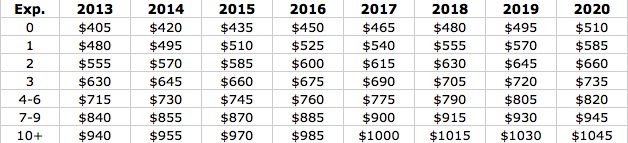
Hypothetically, let’s suppose that when free agency opens next month, a player with three years of experience signs a two-year contract worth the minimum salary, with no signing bonus. His salary for the first year of the deal would be $645K, the 2014 amount for a player with three years of experience. The second year would check in at $745K, the 2015 figure for a player with four years of experience.
Players on minimum base salaries can still receive various kinds of bonuses, but those will count toward the player’s cap number, so teams are generally reluctant to include significant signing bonuses on minimum salary contracts.
As for that cap number, a team can avoid having a veteran player’s full minimum salary count against the cap by signing him to a qualifying contract. The league’s Minimum Salary Benefit Rule ensures that, for a player with four or more years of experience, his cap hit on a minimum salary contract will only be equal to the cap number for a minimum-salary player with two years of experience — for 2014, that figure is $570K. To qualify for this reduced cap number, the contract must be for no more than one year, and the bonus money cannot exceed $65K (this maximum bonus increases by $15K every three years).
In other words, let’s say a player with nine years of experience signs a one-year, minimum-salary contract with the Cowboys for the 2014 season. The deal also includes a signing bonus of $30K. While that player would earn a total salary of $885K (a base minimum of $855K plus the $30K bonus), the cap hit for Dallas would only be $600K — the $570K minimum, plus the $30K bonus. This rule ensures that teams won’t necessarily opt to sign young players over veterans in an effort to minimize cap charges.
While a player can sign a contract with a team and spend a full season with the franchise, that doesn’t necessarily earn him a credited season for minimum salary purposes. A player must be on a club’s 53-man roster for at least three weeks in order to earn a credited season. So if a rookie spends three games on a team’s 53-man roster, and then is cut, he’ll be considered to have one year of experience the following season, even if he didn’t appear in a single game. However, if a player spends two games on a team’s 53-man roster, then is placed on injured reserve, that’s not a credited season.
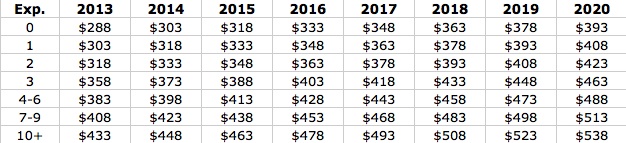
Players on injured reserve may also not earn their full minimum salaries. The contracts for many young players and veterans with injury histories include what is known as a split salary, so that if the player is placed on injured reserve, his salary is reduced to an IR minimum. Here’s the breakdown of what those minimum salary figures look like for the next several years:
While there are plenty of rules and guidelines surrounding minimum salary contracts, the NFL’s Collective Bargaining Agreement doesn’t include a limit on what a player can earn a season. A team must fit its full roster under the salary cap, which is why we typically don’t see annual salaries larger than $20-25MM. But with no defined maximum salary in place, an NFL team could, in theory at least, pay a player for double or triple that amount, assuming that player was surrounded by a few dozen teammates on minimum salaries.
Note: This is a PFR Glossary entry. Our glossary posts will explain specific rules relating to free agency, trades, or other aspects of the NFL’s Collective Bargaining Agreement. Information from OverTheCap.com was used in the creation of this post.
AFC Notes: Martin, Bonuses, Colts, Kolb
In the wake of the publication of the Ted Wells report, Jonathan Martin’s agent Kenny Zuckerman reiterated to several reporters today, including ESPN.com’s Adam Schefter (Twitter link), that his client fully intends to continue his NFL career in 2014. Jim Harbaugh, Martin’s former coach at Stanford, believes that the offensive tackle should fare better in another team’s locker room, as Matt Barrows of the Sacramento Bee details. Meanwhile, Mike Garafalo of FOX Sports tweets that Martin’s camp will meet with the Dolphins as soon as next week at the scouting combine.
Richie Incognito‘s lawyer has publicly suggested that the Wells report is “replete with errors,” while Armando Salguero of the Miami Herald hears from a Dolphins source that offensive line coach Jim Turner is almost certainly done in Miami (Twitter link). There may still be more twists and turns coming in this story, but for now we’ll focus on a few other non-Dolphins items around the AFC:
- While it won’t affect teams’ salary cap figures, plenty of clubs are set to pay out deferred bonus money this weekend. The Patriots will pay Tom Brady $5MM of his signing bonus, according to Field Yates of ESPN.com. Brian McIntyre reports (via Twitter) that the Chiefs and Dolphins will also pay out bonus money on Saturday, including $6MM to Tamba Hali and $5MM to Dwayne Bowe for Kansas City.
- With Trent Richardson and Vick Ballard set to return to the Colts’ backfield, it wouldn’t be surprising to see prospective free agent Donald Brown land elsewhere, writes Stephen Holder of the Indianapolis Star.
- A history of concussions has placed Kevin Kolb‘s NFL future in doubt, and Bills coach Doug Marrone told WGR 550 today that he still isn’t sure if Kolb is planning to return to the team. ESPN.com’s Mike Rodak has the details. With a $1MM roster bonus owed to the quarterback next month, the Bills may end up releasing Kolb or restructuring his deal.
- Within his latest look around the NFL, Bleacher Report’s Dan Pompei revisits the Browns‘ front office situation, providing details about Ray Farmer‘s GM candidacy with the Dolphins, Cleveland’s head coaching search, and Joe Banner‘s future job prospects.
- The Titans should try to re-sign cornerback Alterraun Verner, safety Bernard Pollard, and defensive end Ropati Pitoitua, but should be content to let wide receiver Kenny Britt and a few other free agents walk, suggests Jim Wyatt of the Tennessean.