
Free Agent Stock Watch: Dwight Freeney
Using the 2015 franchise tag figures as a gauge, it’s evident that edge defenders are considered, and compensated as, one of the most important position on the field, second only to quarterbacks. While the QB franchise number for the upcoming season is set at $18.544MM, the figure for pass rushers (which I determined by averaging the franchise salaries for defensive ends and li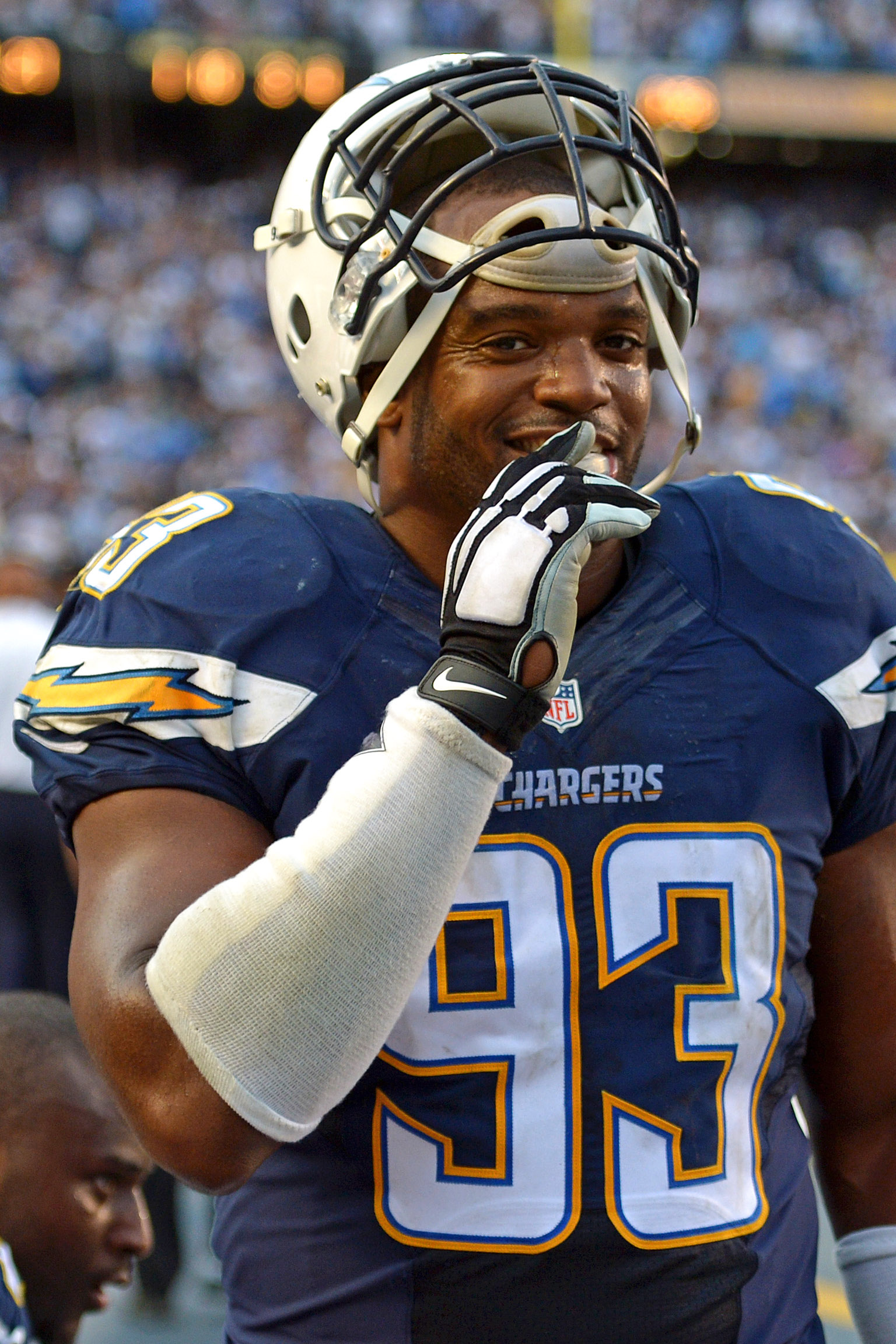 nebackers) will be $13.854MM.
The need for high-quality edge defenders was borne out in free agency, where the best available rushers garnered top-end contracts. Jerry Hughes signed a five-year, $45MM pact to stay with the Bills, the Bears handed Pernell McPhee $38.75MM to lure him away from Baltimore, and Brandon Graham was retain by the Eagles on a four-year, $26MM deal. The market for rushers (and defenders as a whole) is mostly picked over now that we’re a month removed from the beginning of free agency, but there are a few options still remaining, one of whom is veteran LB/DE Dwight Freeney.
Entering his age-35 season, Freeney obviously isn’t the player he once was during his prime when the Colts, with whom he averaged 10 sacks per year from 2002-12 (including a league-leading 16 in 2004). But the Syracuse alum still has a lot to offer on the football field, including the ability to stand up and play outside linebacker, the position he manned during the past two seasons in San Diego. Freeney didn’t rack up the same gaudy sacks totals with the Chargers that he did with Indianapolis — he posted just four total sacks from 2013-14 — but a deeper look his statistics shows that he’s still capable of affecting an opposing club’s passing attack.
Freeney played on approximately 55% of San Diego’s defensive snaps last year, rushing the passer or defending the run on nearly every play (he saw just 14 coverage snaps). While he accrued just 3.5 sacks, he placed third among qualifying 3-4 OLBs with 40 quarterback hurries, and 14th with nine QB hits — as such, he graded as the sixth-best at his position in terms of pass-rush productivity, an all-encompassing metric from Pro Football Focus (subscription required) that seeks to measure a defender’s total pressure output. Subscribing to Josh Norris of Rotoworld’s theory that “disruption is production” — in other words, sack totals aren’t the only way to judge a pass rusher — it’s clear that Freeney has quite a bit left to offer.
Unlike the other edge rushers mentioned above, Freeney shouldn’t require a multi-year deal or any significant amount of guaranteed money. That might seem like an odd statement given his production last season, but given his advanced age, and the fact that he’s yet to draw any known interest since announcing his intention to play this season on March 2, it seems like Freeney will have to end up accepting a one-year deal with minimal risk attached for the team.
Freeney, a three-time All Pro, is coming off a contract that paid him nearly $4.5MM annually (though he eventually accepted a pay cut from the Chargers), but he probably won’t be able to match that figure again. Fellow OLB Sean Weatherspoon recently signed a one-year, $3.875MM pact with the Cardinals, and while Weatherspoon does have a lengthy injury history to account for, he’s also eight years younger than Freeney. As such, I’d guess that something like $3MM over one year, perhaps with some incentives available, would be a fair deal for Freeney.
There a quite a few teams that could use a situational rusher like Freeney, and because he has experience both with his hand in the ground and standing up, I wouldn’t think he’d be limited to one scheme. That versatility could prove handy, especially for clubs that like to mix up their defensive fronts. One such team, the Patriots, always seem to be able to coax out the last bit of production from veteran players, so Freeney could be a fit in New England. Elsewhere, the Falcons, Packers, Bengals, Bears, and Chiefs all finished among the bottom-10 in adjusted sack rate, and might be interested in adding edge talent. For his part, Peter King of TheMMQB.com opined last month that the Buccaneers could also be a possible fit, while I recently suggested another NFC South club, the Panthers, could find a bargain in Freeney.
One club that won’t be signing Freeney is the Chargers, as general manager Tom Telesco told Freeney in March that San Diego wouldn’t be retaining him. Personally, I find that a bit surprising, as San Diego’s pass rush was nothing special last season — the team finished 29th in sacks and 20th in adjusted sack rate. Following the retirement of Jarret Johnson, the Chargers don’t have much depth at outside linebacker, so unless they’re especially high on 2013 sixth-round pick Tourek Williams (the projected starter at LOLB), I’m confused as to why San Diego wouldn’t welcome Freeney back.
One reason that could help explain why Freeney remains unsigned is that free agent contracts are still tied compensatory draft picks for another month. In the past, the cutoff date for draft pick compensation was June 1, but the league recently moved that deadline up to May 12. Based on Zack Moore of Over the Cap’s calculations, Miles Austin‘s $2.3MM deal with the Browns is currently the least-expensive contract tied to a compensatory pick. So if Freeney is asking for the ~$3MM that I estimated for him, interested clubs might be wary of possibly forfeiting the chance at a comp pick to sign him (even if that pick will only be a sixth- or seventh-rounder). As such, we’ll probably have to wait until after that May 12 date so see Freeney (and other veterans like him) find new homes.
Like I noted when I profiled fellow free agent Brandon Spikes, I think NFL teams are wise to focus on what a player can do, instead of what he can’t do. Spikes is out of his element in pass coverage, but he’s an effective run defender when given the chance. Freeney is 35 years old and needs to have his playing time monitored, but as a part-time pass rusher who sees 35 snaps per game, he can still be highly productive. A club could do much worse than to hand Freeney $3MM or so and insert him into it’s edge defender rotation.
Free Agent Stock Watch: Brandon Spikes
Last March, coming off a five-year stretch with the Patriots, inside linebacker Brandon Spikes had to settle for a one-year deal with the division-rival Bills that netted him just $3.25MM. That contract, while likely below Spikes’ salary target, was signed within days of the start of the free agent period. This year, however, we’re nearly a month separated from the beginning of free ag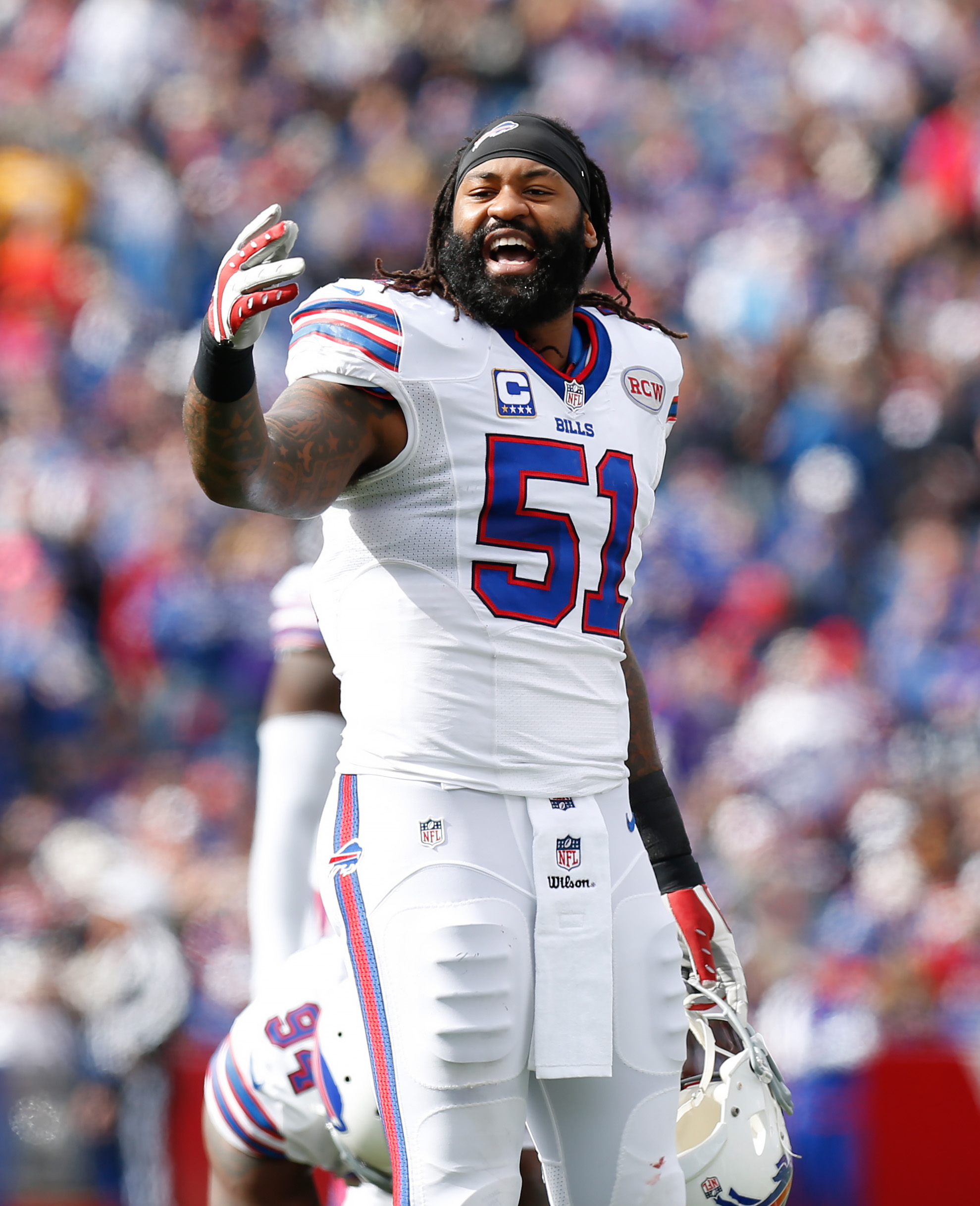 ency, and Spikes is still unsigned.
There are a myriad of reasons that could help explain why Spikes is still on the market, but chief among them is probably the devaluation of the inside linebacker position. Not only are ILBs not (for the most part) getting paid in free agency, but two-down run-stopping specialists, such as Spikes, are rapidly falling out of favor in today’s NFL.
The advanced metrics provided by Pro Football Focus (subscription required) actually paint a relatively positive picture of Spikes’ pass-coverage abilities, as he ranked fourth-best at his position in yards per coverage snap and coverage snaps per reception. Each of those statistics, however, are dependent on a player’s total coverage snaps, of which Spikes had few. The 27-year-old saw just 222 snaps in coverage, the 16th-fewest among qualifying inside linebackers. Small sample size is obviously an issue here, as the consensus among most observers is that Spikes isn’t cut out for three-down duty.
But for a club looking for a force against the run, there are certainly worse options than Spikes. Overall, he graded as PFF’s 13th-best inside linebacker in the league last season, and his total ranking was buoyed in large part by his run-stopping acumen, as he placed ninth in that department. Spikes’ 2014 run-defense numbers are no fluke, as he ranked No. 1 against the run in both 2012 and 2013.
Of course, Spikes’ on-the-field limitations and/or strengths might not be the only factors playing into his current availability. Clubs also take into account soft factors, and Spikes has a history of (relatively minor) off-the-field incidents. He’s been called a “headhunter” by other players (and has been fined heavily for certain hits), posted offensive material on social media, and been lambasted by former teammates. Perhaps most seriously, Spikes was suspended for four games in 2010 for violating the league’s substance abuse policy. On their own, none of the above episodes are overly consequential, but taken together, they paint Spikes as a player who could be more of a distraction than he’s worth.
But yet, as Steve Palazzolo noted on a recent PFF Podcast, in a league where 31-year-old David Harris is worth $21.5MM over three years, it’s possible that Spikes is being undervalued. Yes, two-down linebackers are increasingly less important, but as Palazzolo added, a team could sign Spikes, draft a coverage linebacker, and replicate the production of a Harris-type linebacker for half the cost.
One potential path for Spikes could be returning to Buffalo, which still had interest in re-signing its free agent linebacker as recently as March 27. Back in February, however, Bills general manager Doug Whaley said that Spikes would only return as a two-down linebacker, adding that if Spikes wanted a larger role he would have to look elsewhere. Of course, at this point, an early-down role looks like the only route for Spikes, regardless of team, but overall, Buffalo doesn’t seem overly invested in retaining Spikes.
Other clubs have expressed their interest in Spikes, including the 49ers (reeling from the loss of Patrick Willis and Chris Borland) and the Vikings. Minnesota, though, proceeded to sign fellow ILB Casey Matthews, which reportedly signaled the end of the team’s interest in Spikes. The Dolphins were also mentioned as a potential suitor, but it sounds like Koa Misi will man the middle in Miami.
So now that the dust has settled on free agency, where could Spikes fit? I’d think the Browns could make a play for him, as he’d act as a good complement to Craig Robertson, who is a solid coverage linebacker. Elsewhere, the Titans, Cardinals, Packers, Chiefs and Texans all currently list at least one inexperienced player atop their inside linebacker depth charts, so Spikes could add something of a veteran presence to each of those 3-4 schemes. Among clubs who play a 4-3 front, the Falcons could look for an upgrade over the smallish Paul Worrilow, and Spikes (at 6’2″, 255 pounds) could be an improvement.
Spikes will probably have to settle for another one-year deal, and because he’s still unsigned into April, he might have to take even less than he received in 2014. A.J. Hawk, by any measure a less-talented linebacker, will earn a $1.625MM AAV with the Bengals, a figure that should act as a floor for Spikes. Nate Irving, a good comparison for Spikes, will garner a shade less than $2.5MM per year per his deal with the Colts, so I’d guess that Spikes will earn something in that range. A team willing to play to Spikes’ strengths, and perhaps pair him with a coverage-centric linebacker, could end up finding a bargain.
Free Agent Stock Watch: Joe Barksdale
As we head into April, there are just four remaining unsigned free agents that were listed among Pro Football Rumors’ Top 50 FAs. Our 29th overall free agent, receiver Michael Crabtree, had a down year in 2014, and PFR’s Rory Parks look at w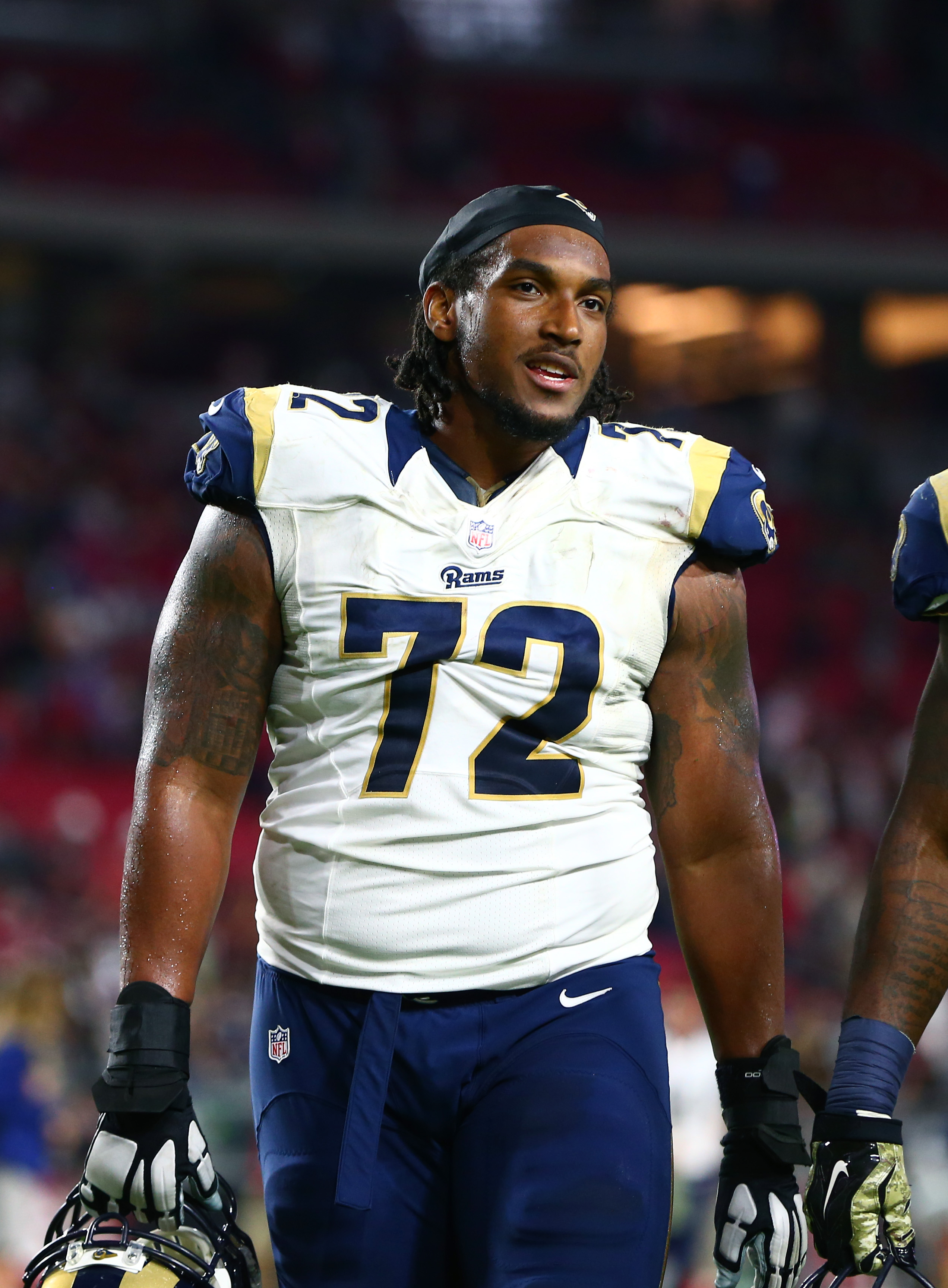 hy he remains on the open market. Linebacker Rolando McClain, our No. 35 FA, has already retired twice during his young career, and is facing a fine after failing a third drug test, as documented by PFR’s Luke Adams. And our 39th-ranked free agent, center Stefen Wisniewski, is recovering from offseason shoulder injury, which could explain his lack of a market.
But perhaps the most puzzling member of the unsigned free agents club is offensive tackle Joe Barksdale, who ranked 36th on our Top 50 list. The 27-year-old Barksdale has spent the past three seasons with the Rams, and has started 29 games over the past two years. Without a strong crop of right tackles available in free agency, Barksdale seemingly should have been in line for a multi-year pact that paid him in the neighborhood of $6MM annually, comparable to the deals signed by Andre Smith and Anthony Collins in recent years.
The few free agent right tackles who did hit the market were handsomely rewarded, making it even more confusing that Barksdale hasn’t been able to find a home. The top RT available, Bryan Bulaga, re-signed with the Packers for almost $34MM, and while he’ll average just $6.75MM per year, it’s assumed that he took less money to stay in Green Bay. Jermey Parnell, largely unproven after starting just seven games over three seasons for the Cowboys, secured a five-year, $32.5MM deal from the Jaguars, while Doug Free will earn a $5MM AAV after re-signing with Dallas.
A glance at Pro Football Focus’ (subscription required) offensive tackle grades could offer some explanation as to why Barskdale remains available — while Bulaga, Parnell, and Free all ranked within the top 21 tackles, Barksdale placed just 48th. His run-blocking grade (arguably the more important mark for a right tackle) was impressive, however, as he ranked as the league’s 11th-best T in the run game. Still, based on PFF’s ratings, Barksdale might not be in the same class as those top three tackles, so if he’s asking for $5-6MM per year, clubs could be looking elsewhere.
Indeed, Barksdale hasn’t drawn much known interest from around the league, as he’s only been linked to the Rams and the Titans. Tennessee’s interest seems to be lukewarm, as reports indicated that the club would “consider” Barksdale after losing Michael Roos and Michael Oher earlier this year. Based on reports, it appears that a reunion between Barskdale and St. Louis is the most likely scenario — the Rams initially thought that the tackle was overestimating his market, and now that that seems to have been the case, head Jeff Fisher confirmed the two sides were talking.
Even after a dreadful season, Oher was able to garner a $3.5MM AAV from the Panthers, and I’d be very surprised if Barksdale has to settle for less than that. Something in the $4-4.5MM range (at the level of Zach Strief and Breno Giacomini) would make sense for both Barksdale and the Rams. For its part, St. Louis can use all the help it can get along the offensive line, where Greg Robinson and Rodger Saffold are the only returning starters. With only about $2.6MM needed to sign its draft class, the Rams have approximately $6.4MM in effective cap space, so they should easily be able to fit a Barksdale-level contract on their books.
Free Agent Stock Watch: Rolando McClain
Less than a year ago, on April 22, 2014, linebacker Rolando McClain retired from the NFL. After being reinstated by the Ravens and working out for the team, McClain had such a poor showing at that workout that he decided to give up his comeback attempt and end his NFL career.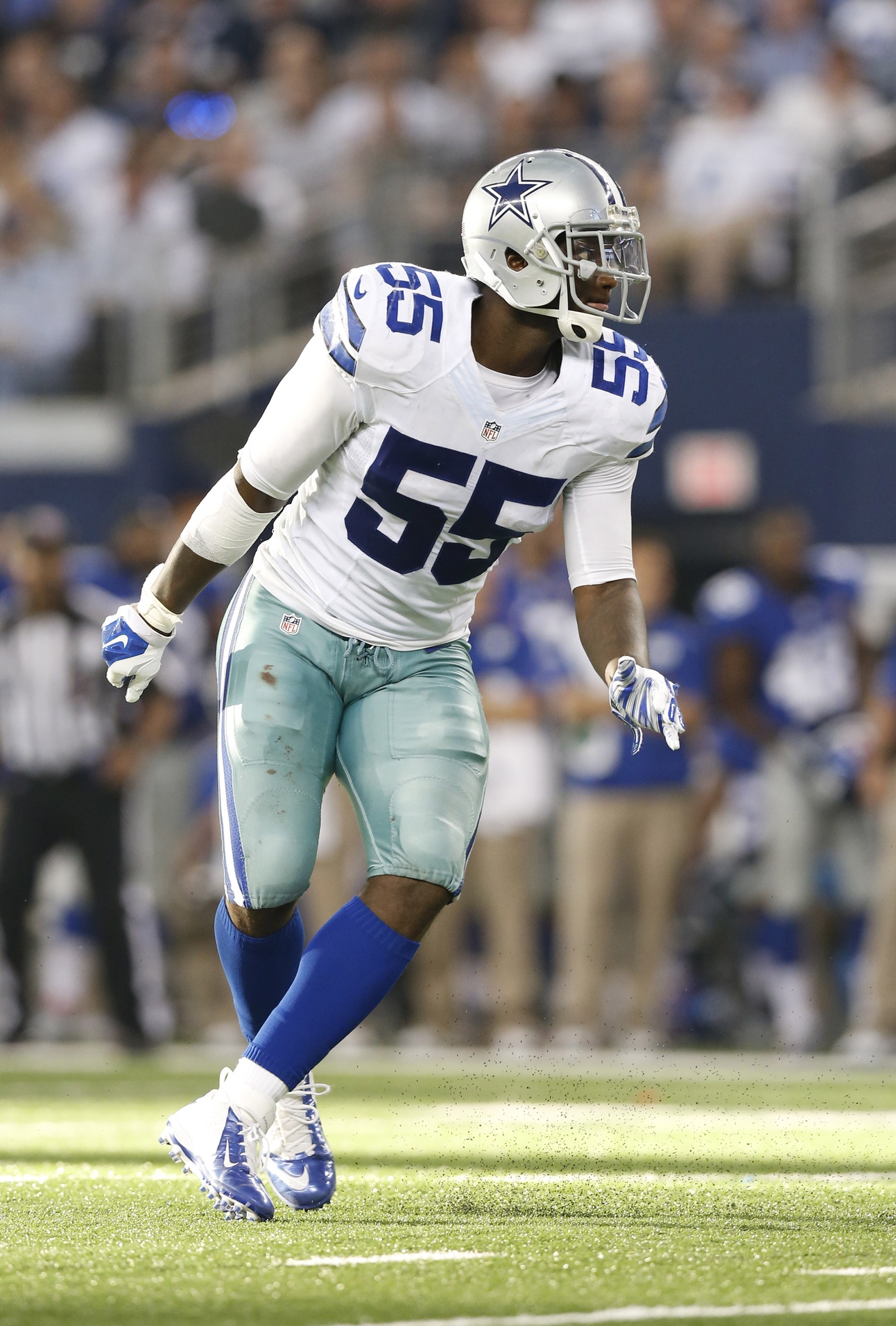
“I’m done,” McClain said at the time in a text message to Seth Wickersham of ESPN.com. “If football made me complete I would play. But whenever I think of it my heart pulls me away [for] whatever reason.”
About two and a half months later, the Cowboys unexpectedly swung a deal for McClain, sending a late-round draft pick to Baltimore to acquire the former eighth overall pick. Apparently, the veteran linebacker, who has been plagued by off-field troubles since entering the NFL, wasn’t quite as retired as he had suggested back in April. Still, it seemed unlikely that he’d contribute much for the Cowboys after having not appeared in a regular season game since 2012, and having announced his retirement twice in the interim.
As such, McClain’s performance in 2014 was one of the most surprising storylines of the year. In 13 games for Dallas, McClain racked up 87 tackles and a sack to go along with two interceptions. Pro Football Focus (subscription required) ranked McClain eighth out of 60 qualified inside linebackers, and he excelled in every aspect of the game — PFF’s grades placed him eighth as a pass rusher, seventh as a cover man, and 11th as a run defender, among inside linebackers.
Based on that impressive performance, and his pedigree as a former top-10 draft pick, I ranked McClain as the 35th-best free agent available this offseason. However, it’s becoming increasingly clear that teams around the league aren’t necessarily on board with that assessment. Of our top 50 free agents, only four remain unsigned, and only one (Michael Crabtree) ranked higher on our list than McClain.
That wariness is certainly justified. After all, less than 12 months ago, McClain was talking about his heart pulling away from football, which could very well make any team reluctant to offer him a multiyear contract. Additionally, the former Raider failed a third drug test earlier this year — the league’s new substance abuse policy simply calls for a fine for a third failed test, but a fourth violation of the policy would result in an automatic four-game suspension. Potential suitors for McClain may try to alleviate the risk of a possible suspension by include significant per-game roster bonuses in their contract offers, like the Cowboys did with Greg Hardy.
Those off-field concerns surrounding McClain may limit his market, or result in short-term offers, which could help to explain why he remains available. From McClain’s perspective, some long-term security would be preferable, but if he signs a one-year deal and stays healthy, productive, and out of trouble in 2015, it could increase teams’ willingness to commit to him on a longer-term contract a year from now.
As far as potential fits go, Dallas was clearly a good one for McClain, and it certainly wouldn’t hurt the team to bring him back for 2015. Linebackers Justin Durant and Bruce Carter, who were regular contributors in 2014, have signed elsewhere this month, replaced by incoming free agents Jasper Brinkley and Andrew Gachkar. With the linebacking corps undergoing an overhaul this offseason, re-signing McClain to anchor the unit in the middle would at least provide some stability and continuity.
If McClain doesn’t return to Dallas, teams like the Saints, Dolphins, Vikings are among the clubs who run a 4-3 scheme and could use some help at the middle linebacker position. Of course, New Orleans may not be an ideal match for McClain, given his history with former Raiders head coach Dennis Allen, who is now a defensive assistant for the Saints. Free agent players often end up reconnecting with former coaches on new teams, but in the case of McClain and Allen, the relationship in Oakland was somewhat strained.
As far as other former coaches go, McClain could explore the idea of rejoining Tom Cable in Seattle, or Hue Jackson in Cincinnati, though neither of those teams look like the fit that Dallas, Miami, or Minnesota would be.
Ultimately, McClain may be forced to settle for the sort of short-term, prove-it contract that notable free agents like Nick Fairley and Terrance Knighton signed. An impressive 2014 season in Dallas helped to partially rebuild McClain’s value, but it doesn’t appear that any team is ready to spend big on him, particularly since he plays a position where huge free agent deals are somewhat rare. A one-year agreement heavy on incentives and per-game roster bonuses wouldn’t be a surprise.
Photo courtesy of USA Today Sports Images.
Free Agent Stock Watch: Michael Crabtree
Two weeks ago, we compiled our top 50 free agent list. Since that time, almost all of the players on that list have either signed with a new club, re-signed with their original team, or retired. The most intriguing name remaining is Michael Crabtree, who checked in at No. 29 and who is still looking for a new home.
Last July, our Luke Adams examined Crabtree as an extension candidate. In that piece, Adams described Crabtree’s breakout 2012 campaign, in which he established career highs in receptions (85), receiving yards (1,105), and touchdowns (9). Crabtree was just as dynamic in the postseason that year, compiling 285 yards and three touchdowns through the air and helping San Francisco reach the Super Bowl, where he nearly hauled in a game-winning touchdown on the team’s final drive.
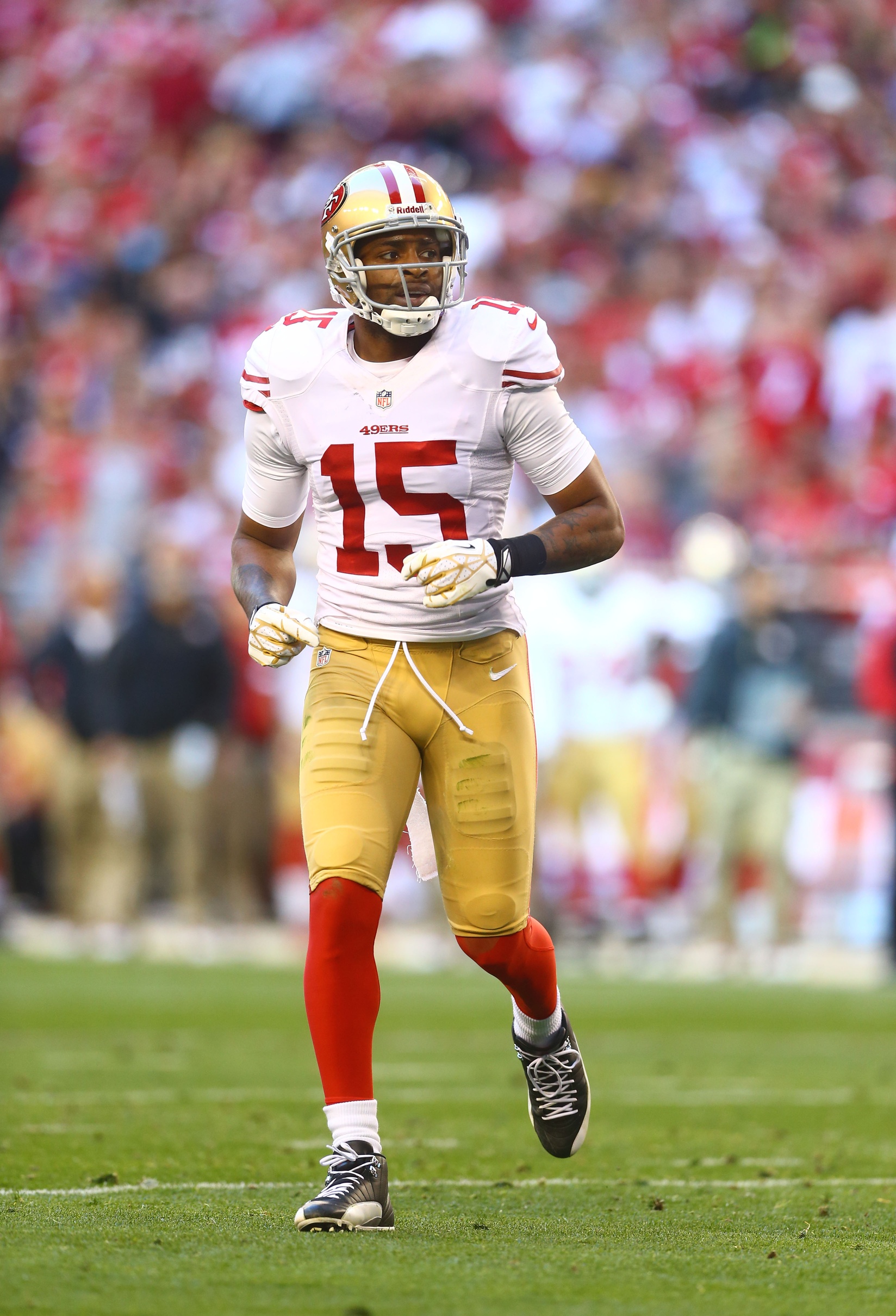
But it has all been downhill from there for Crabtree. In the spring of 2013, the former Texas Tech star–who famously held out until October of his rookie season, thereby becoming the longest rookie holdout in 49ers history–underwent surgery to repair a torn Achilles tendon, and he did not get back on the field until December. He ultimately played just five games in the 2013 season, catching 19 balls for 284 yards and a score.
2014 was a season that most 49ers fans and players would sooner forget, and Crabtree is no exception. He managed to stay on the field for all 16 games, but he caught just 68 passes for 698 yards and four touchdowns. Those are not especially poor numbers, especially in an offense that largely struggled, but they are not the sort of statistics befitting someone of Crabtree’s talents.
As a result, Crabtree, like a number of his fellow veteran wide receivers, has had difficulty generating much interest on the open market this offseason. He visited the Dolphins several days ago, and the Chargers and Washington have also been rumored as potential landing spots. The Dolphins, who recently traded Mike Wallace and who released Brian Hartline earlier this year, would appear to be a strong fit. At this point, though, it does not appear that anything is imminent.
Age, at least, is on Crabtree’s side. He just turned 27 in December, and he has proven that he can be a capable downfield threat when healthy. But it could be that teams simply do not believe Crabtree can ever be healthy enough to replicate his 2012 form. Tony Grossi of ESPNCleveland.com opined (via Twitter) this morning that Crabtree is a descending wideout since the Achilles injury. Although that may be something of a harsh assessment, it is not a stretch to say that Crabtree was just as much a cause of the 49ers’ anemic offense last year as he was a victim of it.
As a result, he may have to settle for a one-year deal to prove himself. A team with an established quarterback and another quality receiving option or two may provide the ideal platform for Crabtree to showcase his talents, but at this point, it is uncertain whether a suitor like that is out there. So Crabtree, like Hakeem Nicks, will continue to hope for an opportunity to show that he has put his injury history behind him and can be the dynamic player of a few seasons ago.
Photo courtesy of USA Today Sports Images
Free Agent Stock Watch: Julius Thomas
One of the more rapid rising stars in the game, Julius Thomas presents an interesting case in his first foray into free agency. The two-year starting tight end made next to no impact in his first and second seasons, hampered by lingering ankle maladies. But his ensuing two slates create a robust market for the athletic, yet frequently unavailable target.
Does Thomas’ value lie in being an athletic tight end with elite ball skills, a package the Broncos haven’t unleashed since Shannon Sharpe, who played under then-offensive coordinator Gary Kubiak for most of the latter half of his career? Or is he an injury-prone Peyton Manning product? Since the 26-year-old Thomas morphed into a red zone dynamo, with 12 touchdown receptions in each of the past two seasons, and has positioned himself as this market’s top tight end, teams will bid big to find out.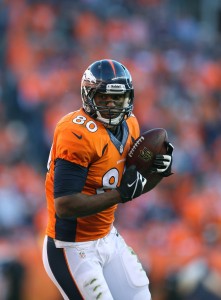
But the best offer for the 2011 fourth-round pick might not come from the Broncos. Now transitioning back to Kubiak’s offense, which relies heavily on tight ends blocking and not splitting out wide as much, with multiple other dominant free agents to take care of — including Demaryius Thomas and Terrance Knighton — Denver may not be able to afford Julius Thomas’ services. He may not even be in large font on the Broncos’ offseason itinerary considering the scheme change and the numerous ancillary free agents from their 2011 draft class, which is easily the best under fifth-year GM John Elway‘s watch.
Undrafted Pro Bowl cornerback Chris Harris re-upped for 5 years and $42.5MM, and first-rounder Von Miller will play out his fifth-year option on a $9.7MM cap number next season from that class. But Thomas, left guard Orlando Franklin and free safety Rahim Moore (second round), middle linebacker Nate Irving (third) and in-line tight end Virgil Green (sixth) are all free agents who played key roles last season.
Thomas, who played for just $645K last year, has understandably been lukewarm to the idea of a hometown discount, something to which Demaryius Thomas and Knighton have been receptive. With Demaryius Thomas likely to be slapped with the franchise tag, as we discussed Tuesday, the Broncos will need to reach a long-term contract with Julius Thomas to keep him around. Even though Elway reiterated his desire to keep Julius Thomas in Denver in January, per Nicki Jhabvala of the Post, the former Big Sky basketball standout already turned down a deal that would’ve made him one of the league’s top four highest-paid tight ends, a source told Kils in October. With a projected $26MM+ in cap space and more than a third of their starters unsigned, the Broncos likely won’t bring back all of their top three free agents and may be stuck with just one after franchising Demaryius Thomas, should Knighton also receive a strong offer considering his career metamorphosis the past two years.
The case for the Broncos bringing back Julius Thomas depends on which version of Manning they think they’re getting back. The future Hall of Fame quarterback has inflated the numbers for plenty of pass-catchers over the past 18 years, but assuming he returns for his age-39 season — this probably will be the case after the QB iterated his desire to return Friday night — he will need as much firepower as possible to keep the Broncos on their current course. Thomas’ reputation as a bigger wide receiver who is ill-equipped for Kubiak’s system may not be entirely accurate, either. The 6-foot-4, 251-pound Division I-FCS product improved from 2013 when Pro Football Focus (subscription required) tabbed him as the NFL’s second-worst run-blocking tight end to last season when the site gave Thomas a positive grade and slotted him at No. 33 in the category — just two spots behind Rob Gronkowski.
Former Broncos head coach John Fox and OC Adam Gase in a way validated Thomas’ market value by orchestrating a dramatic overhaul of the offense — to a C.J. Anderson-heavy ground approach — the week after Thomas encountered ankle turmoil for the fourth straight season. Not that there weren’t additional factors in Manning’s decline in the season’s second half, but the Broncos’ offense didn’t look the same without its top touchdown target. Without Thomas at full strength, a level he didn’t return to after his latest injury, Manning had just two games with a quarterback rating over 86 — against the Dolphins and Chargers, respectively. This precipitous fall came after Manning (22 TD passes and just three interceptions in the Broncos’ first seven games) charted just one game under 110 in a stretch that wasn’t a bad imitation of his 2013 MVP effort. Thomas had nine TD grabs during Denver’s peak span and three multi-score showings.
The case against re-signing Thomas hinges on what the Broncos do with Knighton, how much they want to invest in the aforementioned 2011 draft class, how much money they allocate to reshape their offensive line and, perhaps most importantly, whether they feel the tight end’s availability justifies his likely high re-up price. As TheMMQB’s Peter King summarized last year, Thomas considered giving up football after a persistent ankle injury he sustained in 2011 dogged him throughout his first two seasons. Overall, ankle problems forced him to miss 28 games in four years. But teams with shaky tight end outlooks — the Raiders, Cardinals and Browns, to name a few — likely won’t have as much of an issue with Thomas’ negatives, considering a player with these numbers rarely reaches free agency.
If Jared Cook and Kyle Rudolph could ink $7MM-per-year deals within the last couple years — Cook as a free agent with production nowhere near Thomas’ — Thomas has a good chance to earn top-five money at the position. That top five currently ends with Rudolph and starts with Jimmy Graham‘s $10MM-per-year contract signed last year, per OverTheCap.com.
Re-signing Green ($645K in his fourth season last year) or someone like Dolphins free agent Charles Clay makes sense if the Broncos don’t want to meet Thomas’ salary wishes, but for a team whose title window depends heavily on the success of an aging quarterback with fading arm strength, it might be prudent to keep his main weapons around — especially the one who is Manning’s preferred option to finish off drives. The cap math adds up better for the Broncos if Manning renegotiates his salary — something we learned on Friday he could be willing to do — which is set for $19MM and a $21.5MM cap hit.
Photo courtesy of USA Today Sports Images
2015 Free Agent Stock Watch Series
2015’s NFL free agent period is just a few weeks away, as this year’s free-agents-to-be will be eligible to speak to other teams starting on March 7, and can sign contracts with rival suitors as of March 10 at 3:00pm central time.
Over the next few weeks, Pro Football Rumors will be heavily focused on free agency, and that means taking a closer look at several of the higher-profile players who could hit the open market next month. Our Free Agent Stock Watch pieces will explore what a player brings to a club, what sort of earnings he can expect on his next contract, teams that could be in the market for the player, and where the player might want to end up, along with any other relevant factors.
The list of players we’ve profiled so far is below, and will grow exponentially over the next several weeks. This post, which can be found on the right sidebar under “PFR Features,” will be updated each time we publish a new Free Agent Stock Watch piece, so be sure to check back to read up on the latest additions. The players below are listed in alphabetical order.
- Joe Barksdale, OT (Rams)
- Bryan Bulaga, OT (Packers): Re-signed with Packers.
- Michael Crabtree, WR (49ers): Signed with Raiders.
- Nick Fairley, DT (Lions): Signed with Rams.
- Dwight Freeney, DE/LB (Chargers)
- Greg Jennings, WR (Vikings)
- Rolando McClain, LB (Cowboys): Re-signed with Cowboys.
- Hakeem Nicks, WR (Colts)
- Jason Pierre-Paul, DE (Giants): Franchised by Giants.
- Mark Sanchez, QB (Eagles): Re-signed with Eagles.
- Brandon Spikes, LB (Bills)
- Julius Thomas, TE (Broncos): Signed with Jaguars.
Free Agent Stock Watch: Bryan Bulaga
After missing all of 2013 due to an ACL tear, Bryan Bulaga turned in a fine performance in 2014, the final year of his rookie contract. The former first-round pick out of the University of Iowa, a veritable factory of quality offensive linemen, graded out as the 16th best tackle, and 4th best right tackle, in the league per Pro Football Focus’ advanced metrics (subscription required). He received especially high marks for his pass blocking performance in support of league MVP Aaron Rodgers, yielding just four sacks–two of which came in one game–and two other quarterback hits over the course of the season.

In addition to his strong 2014 campaign, which culminated in a heartbreaking defeat to Seattle in the NFC Championship Game, Bulaga brings a few other noteworthy accomplishments to the table. He was named to the league’s all-rookie team in 2010, and he was the youngest player to ever start in a Super Bowl when the Packers bested the Steelers in Super Bowl XLV. PFF also ranked him as the 7th best tackle in football in 2011, just his second year in the league (subscription required).
However, he does come with an injury history. Even before the ACL tear that he suffered in August 2013, Bulaga suffered a hip injury nine games into the 2012 season that kept him sidelined for the rest of the year. As a result, he spent nearly two years on injured reserve, meaning that he needed a year like 2014 to not only prove that he was a top-flight tackle, but that he could stay healthy for a full season.
Despite missing Green Bay’s Week 2 matchup against the Jets this year, Bulaga largely managed to stay injury-free, which, combined with his strong play, puts him in excellent position for a big payday. Although there are a few other solid tackles eligible for free agency this year, most notably Doug Free, Michael Roos, and King Dunlap, Bulaga has one significant advantage over all of them: his age. At 26, Bulaga should still have a few prime years remaining, while those other free agent tackles will be at least 30 at some point in 2015.
Last year, Austin Howard scored the top deal among free agent right tackles, landing a five-year, $30MM contract with the Raiders, including $15MM in guaranteed money. Even Michael Oher, who was just released today, managed to snag a four-year, $20MM deal with Tennessee last season. Bulaga is more talented than both, and he will likely be paid accordingly. Although he has never played left tackle in his pro career–the Packers had planned to utilize him in that role before his ACL tear in 2013–he did play on the blind side while with Iowa, and he could at least represent an emergency solution at left tackle should the need arise. And, as the best overall tackle in free agency, he may end up getting paid like a second-tier left tackle, perhaps netting a deal in the five-year, $35MM range, which is what Jared Veldheer received from Arizona last year.
Green Bay would surely love to have Bulaga back. In late December, offensive line coach James Campen said of his right tackle, “He’s heavier than he’s ever been; he’s stronger…Remember, he was a young guy coming out of college, so he’s grown into his body and he has a clear understanding of the scheme, so he’s playing with total confidence. He knows exactly what’s going to happen, where it’s going to happen” (link via Rob Demovsky of ESPN.com). There is no reason to think that Bulaga himself would not like to continue his career where it began, though he was understandably in no state to discuss his future after Green Bay fell to the Seahawks several weeks ago.
But, if he does not re-sign with the Packers before free agency opens on March 10, he will likely be one of the first players to come off the board, and his presence should be a great comfort to whatever quarterback lines up behind him.
Photo courtesy of USA Today Sports Images
Free Agent Stock Watch: Nick Fairley
With the offseason around the corner, the Lions’ most pressing concern from a roster standpoint is undeniably the impending free agency of defensive tackle Ndamukong Suh, who topped the most recent edition of our 2015 Free Agent Power Rankings. Reports had indicated the Detroit would consider all the options at its disposal to retain Suh, and today Chris Mortensen of ESPN reported that the Lions are in a good position to re-sign the All-Pro. But because Suh is expected to receive a contract that rivals the $100MM pact between J.J. Watt and the Texans, the Lions probably won’t be able to keep its other talented defensive tackle, fourth-year player Nick Fairley.
Assuming a $140MM cap, the Lions will have approximately $15.4MM of 2015 cap space with which to work. Depending on how Suh’s potential extension is structured, much of that space could be already be spoken for. Mortensen’s report indicated that receiver Calvin Johnson could restructure his contract to create more financial flexibility for the club, allowing the Lions to re-sign Suh and add even more talent. Regardless, cap space in Detroit figures to be tight, leading Dave Birkett of the Detroit Free Press to tweet today that Fairley returning to the Motor City is a “long shot.”
Of course, the Lions could have had Fairley under team control for the 2015 season had they opted to exercise his fifth-year option last May. Because it selected Fairley in the first round of the 2011 draft, Detroit could have retained Fairley next season for a base salary in the neighborhood of $5.5MM. General manager Martin Mayhew & Co. opted to decline the option, and explained the decision as a motivational tactic, hoping to push Fairley into performing at high level in 2014. The maneuver created something of a Catch-22 — though Fairley did perform well last season, the Lions have now allowed him to hit free agency a year earlier than was needed.
Utilizing the fifth-year option decision as a strategy to motivate Fairley was an understandable move at the time, as the former 11th overall draft pick had failed to live up to expectations. The Auburn product started just 22 games during his first three seasons in the NFL, posting 12.5 sacks over that span. He had a nice season in 2012, grading as the fifth-best defensive tackle among 85 qualifiers per Pro Football Focus (subscription required). In ’13, however, Fairley slipped to to No. 31 per PFF, as his run defense grade slipped significantly.
In 2014, Fairley was playing at perhaps his highest level yet before suffering a sprained MCL and PCL in Week 8 — he didn’t play again the rest of the season. Despite his limited amounted of snaps (297), he still placed as the league’s 18th-best DT per PFF; his grade would have been better save for is -4.0 penalty mark. Fairley’s absence on the Detroit defense was tangible — though the unit ranked third in DVOA, it placed seventh in weighted DVOA, which more heavily factors more recent performance.
Fairley will be a part of a relatively strong free agent defensive tackle class, but assuming Suh remains in Detroit, Fairley would have a claim to the No. 1 spot at the position. He’s undoubtedly a top-five choice among DTs, with Terrance Knighton, Jared Odrick, and Dan Williams also intriguing FAs for clubs looking for interior defensive line help. Williams is a 3-4 nose tackle, so he probably won’t interest the same teams that look into Fairley; Knighton, as well, is more of a space-eater. Odrick is probably the most similar competitor among free agent tackles, and it’s notable that Fairley and Odrick produced the top two pass-rushing grades among FA defensive tackles, per PFF.
Given his uneven career performance and his recent injury history, Fairley certainly isn’t in line for a Watt/Suh/Gerald McCoy-type contract that averages more than $12MM per year. The Geno Atkins deal, with an AAV of roughly $10.7MM, is probably out of reach as well. Linval Joseph‘s five-year, $31.25MM pact with the Vikings, signed last offseason, is pretty clearly the floor for Fairley. Joseph was a bit younger than Fairley at the time he inked his contract, but Joseph had never played to the level that Fairely has demonstrated he’s capable of. As such, Fairley will probably be looking for a five-year deal with an AAV that pushes $7MM, with guarantees in the neighborhood of $13-14MM.
Fairley shouldn’t suffer from a lack of suitors, as clubs that perhaps had their eye on Suh can turn their attention to Fairley, provided Suh stays with the Lions. Teams such as the Raiders, Jaguars, Bengals, Broncos (should they lose Knighton), and Falcons (depending on scheme) all make sense for Fairley, who just turned 27 years old. He’s spent his career in a 4-3 defensive front, and given his pass-rushing acumen, it would likely serve him to stay in that scheme. But at 6’4″ and more than 300 pounds, he could conceivably play end in a 3-4 look, and interest clubs like the Chargers, Colts, and Titans, but again, his talents play up in a 4-3. Additionally, if former Lions head coach Jim Schwartz lands a role with a team, it will be interesting to see if he lobbies to bring in Fairley, his ex-pupil.
Fairley said back in August that he’d like to stay with the Lions, but given the massive contract that Suh will garner, it seems wholly unlikely Detroit can keep both its defensive tackles. The club was already spending the second-most on its defensive line in 2014, and that figure would surely rise with new contracts for both Suh and Fairley. Free agency now presents that most likely (and tantalizing) route for Fairely, who should do well on the open market.
Free Agent Stock Watch: Jason Pierre-Paul
In 2011, just his second year in the league, Jason Pierre-Paul displayed in grand fashion just what made him so appealing to the Giants, who selected him with the 15th overall pick of the 2010 draft. Using a rare and dynamic blend of size, speed, and athleticism, the man affectionately known as “JPP” racked up 16.5 sacks and was ranked by Pro Football Focus (subscription required) as the league’s sixth best 4-3 defensive end out of 67 eligible players. Pierre-Paul also led his position in total tackles, and he earned first-team All-Pro honors in recognition of his efforts as the most dangerous defensive player on the eventual Super Bowl champions.
It would have been difficult to top his outstanding 2011 campaign, but there seems to be a general belief, probably driven in large part by his lower sack totals, that Pierre-Paul has not even come close to replicating his performance from that season. Although he did amass only 6.5 sacks in 2012, PFF (subscription required) ranked him third among 62 qualified 4-3 defensive ends that year, and after an injury-shortened 2013, JPP is up to his old tricks this season, ranking as the fourth-best player at his position among 54 eligible players (subscription required). Although the Giants’ defense as a whole has been fairly pedestrian over the course of Pierre-Paul’s career (according to Football Outsiders’ metrics), Pierre-Paul seems to be holding up his end of the bargain.
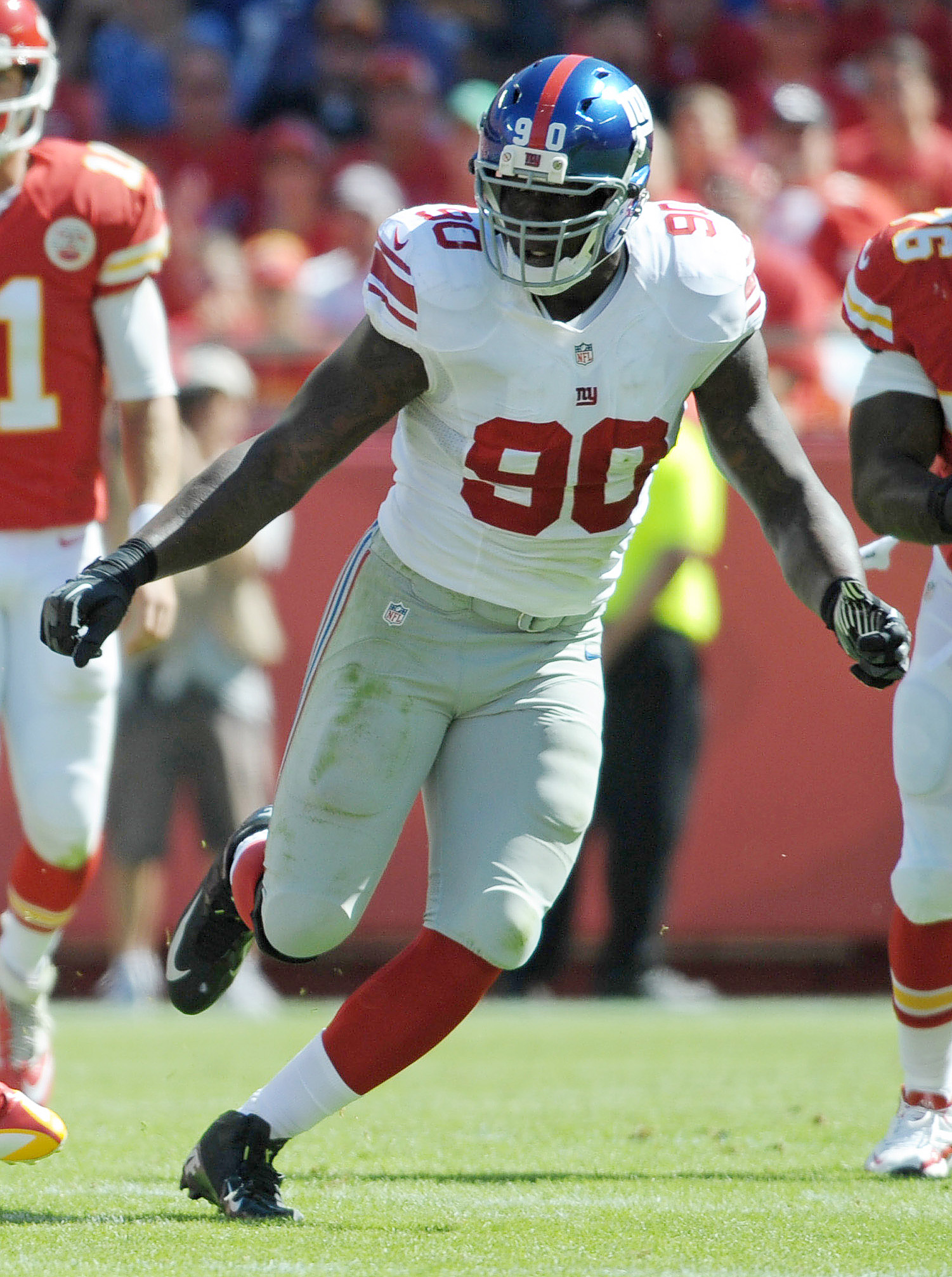
Nonetheless, the two sides appear headed for a parting of the ways after 2014. As PFR’s Rob DiRe wrote last month, Pierre-Paul appeared ambivalent about returning to the club in 2015, stating, “Hey, if I’m here, I’m here, if I’m not, I’m not.” JPP did deliver the usual platitudes while discussing how much he has enjoyed his time as a Giant, but for a struggling team that has a bevy of potentially franchise-altering questions to answer this offseason, a mega-deal for Pierre-Paul might not be the wisest investment, no matter how much cap room New York might have.
So what will a new contract look like for a player in the prime of his career who plays a premium position and who may hit double-digit sack totals for the second time in four full seasons in the league? Robert Quinn, a 4-3 defensive end who was drafted one year later than Pierre-Paul and who has put together three consecutive seasons of 10.5 or more sacks (including a whopping 19 in 2013), signed a four-year extension with St. Louis in September, a deal worth about $67MM.
That contract seems to be a fair benchmark for JPP, although he stands to make more on the open market than he would if he were to sign an extension with New York. Another reasonable comparison might be Justin Houston, a premier pass rusher from the outside linebacker position who expects to land a contract valued somewhere between Quinn’s deal and the extension recently signed by J.J. Watt, a six-year pact worth as much as $100MM (with $51.8MM guaranteed). A five-year deal worth $80MM would seem like a fair price for both Houston and JPP, and that is about what I would expect both players to make on the free agent market.
Of course, the franchise tag remains an option, but as Paul Schwartz of the New York Post pointed out in October, the nearly $15MM projected cost of the tag “is impractical and probably impossible for the Giants to handle.” Schwartz also notes that Pierre-Paul, who was just 21 when he was drafted, is hitting free agency at a younger age than most players, and his willingness and ability to stop the run is not only an underrated part of his game, but also an attribute often difficult to find among so-called pass-rush specialists.
The knocks on JPP, of course, are his injury history—he struggled with back and shoulder injuries in 2012 and 2013—his relatively modest sack total after 2011, and the fact that much of his success is based on his athleticism rather than his technique, which is still raw in many ways. But, as Schwartz wrote, and as Pro Football Focus evaluations indicate, the sack totals are not indicative of Pierre-Paul’s abilities, and if he can complete 2014 in good health, the injury concerns may begin to fade. So while JPP’s next contract will probably not match Watt’s, he could get surprisingly close—especially in this era of the ever-increasing salary cap—and his departure would leave a very big hole in Big Blue. The Giants will have to decide if mending that hole is worth the price.