By Sam Robinson |
at August 3, 2023 10:10 pm
The AFC’s No. 1 seed in 2021, the Titans took a step back after another injury-riddled season. As numerous starters moved from Tennessee’s two-deep to IR, ownership reversed course on an extension it had just authorized months earlier. Like the Cardinals, the Titans fired a GM (Jon Robinson) they had extended earlier in the year. Robinson’s decision to trade A.J. Brown also brought disastrous effects, and the Titans enter 2023 with their longtime offensive pillars — Derrick Henry and Ryan Tannehill — in contract years.
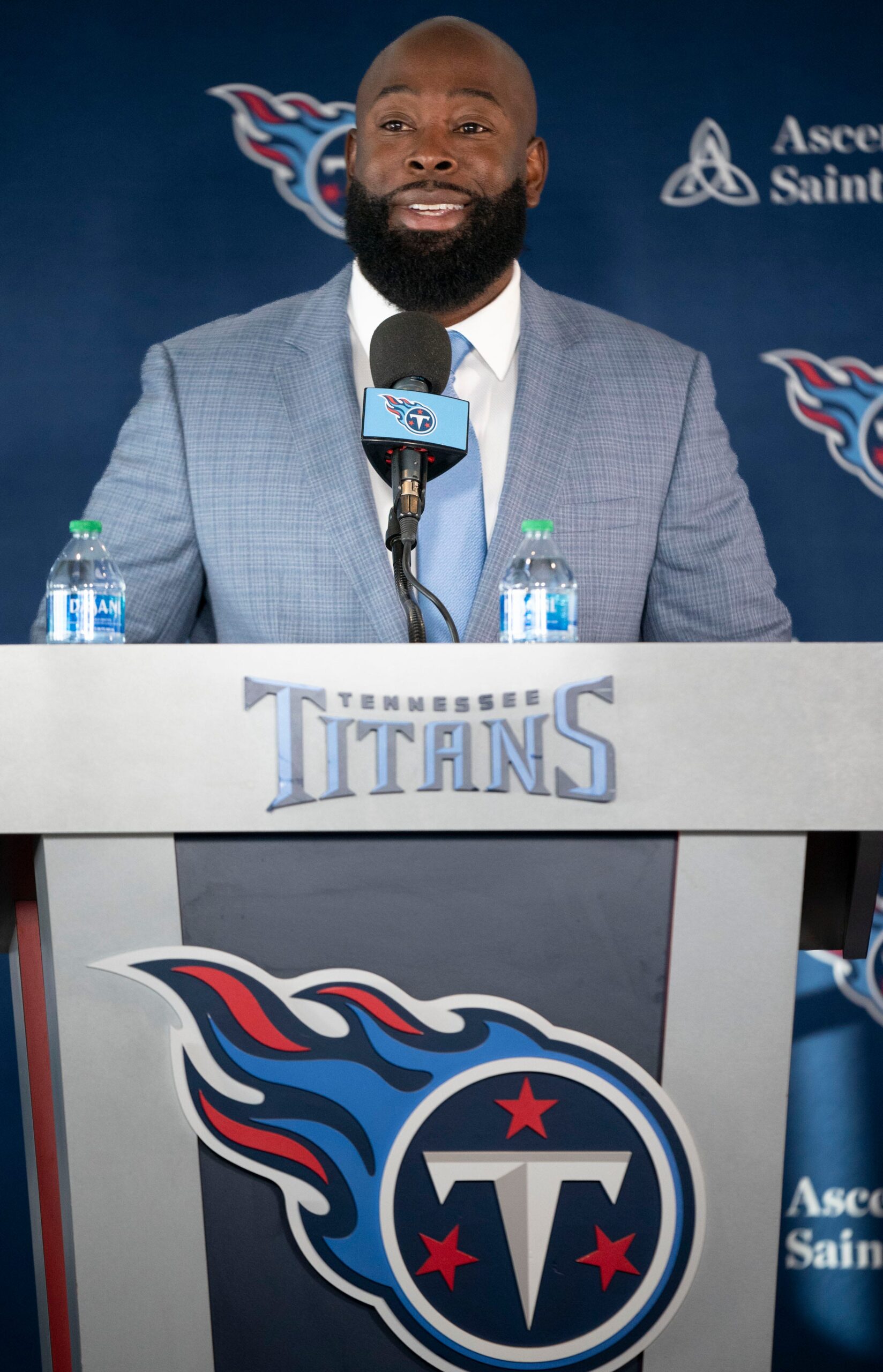
Rookie GM Ran Carthon made several lineup changes this offseason, and the Titans do play in what has been the AFC’s worst division for the better part of the past decade. Will the high floor Mike Vrabel has helped provide be there for this reconstructed team?
Extensions and restructures:
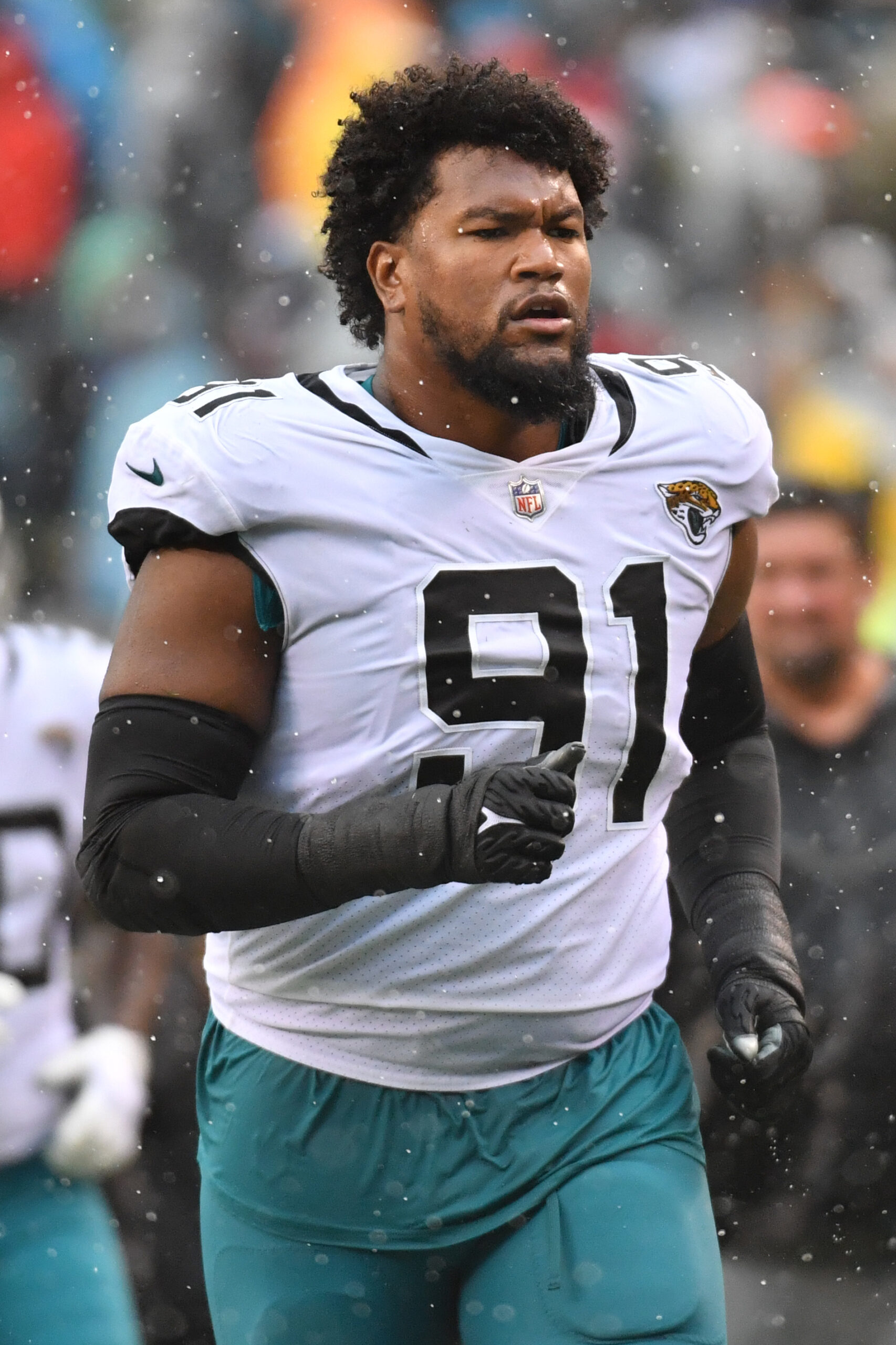
This Robinson bet on an injured prospect paid off for the Titans, who have one of the NFL’s best interior defensive linemen. And Simmons has been durable since debuting midway through his rookie season post-ACL tear. Notching back-to-back second-team All-Pro seasons, Simmons has totaled 16 sacks and 21 tackles for loss from 2021-22. His three sacks drove a ferocious pass rush that nearly dragged the Titans to a divisional-round win over the Bengals. The Titans now have the two anchors of that rush — Simmons and Harold Landry — signed long term.
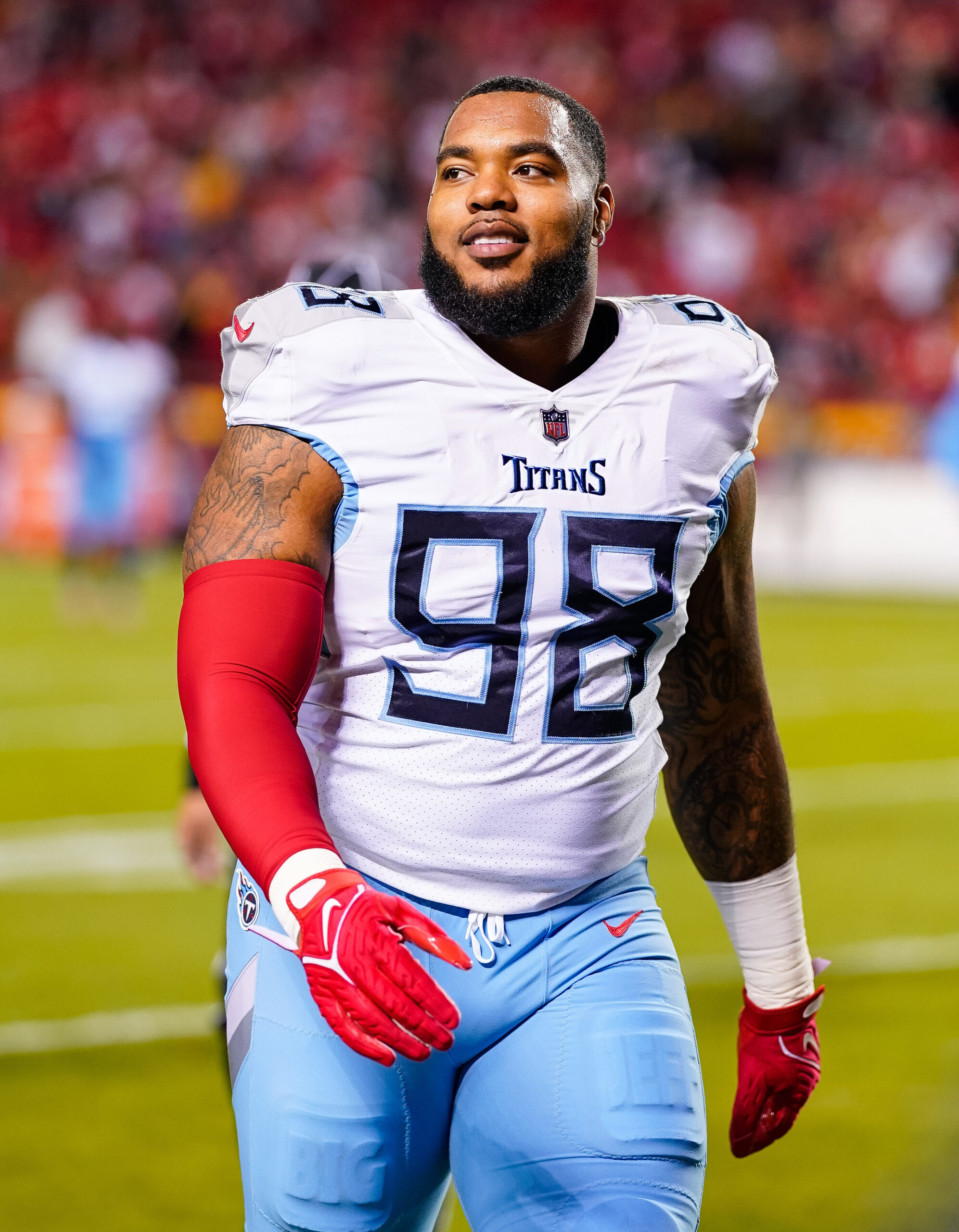
During an offseason in which the NFL’s top non-Aaron Donald tier of D-tackle contract became firmly established, Simmons exited with more guaranteed money than the Rams legend. Although Carthon did not draft Simmons, the former 49ers exec made a point to hammer out the deal before the offseason program began.
Simmons, 26, had staged a hold-in at the Titans’ 2022 minicamp, but with non-quarterback extensions for players with two years of control remaining still fairly rare, the DT-rich 2019 first round needed to wait. With the Commanders franchise-tagging 2018 first-rounder Daron Payne, it created a glut of D-tackles aiming to bridge the mammoth gap between Donald and the field.
In a league in which Patrick Mahomes‘ contract — which stood $10MM north of the second-highest NFL AAV when finalized — has been passed over many times, it is notable none of the 20-something D-tackles came especially close to Donald’s $31.7MM average salary. Simmons has a case to be labeled the league’s third-best inside D-lineman — behind Donald and Chris Jones — and his AAV landed at $23.5MM. Teams were not willing to go near the price the Rams set for their historically talented pass rusher, but Simmons securing the $47.8MM guarantee number obviously proved crucial for his camp. While the Jones-Chiefs talks have not produced a resolution, Simmons trails only Quinnen Williams in fully guaranteed money at the position.
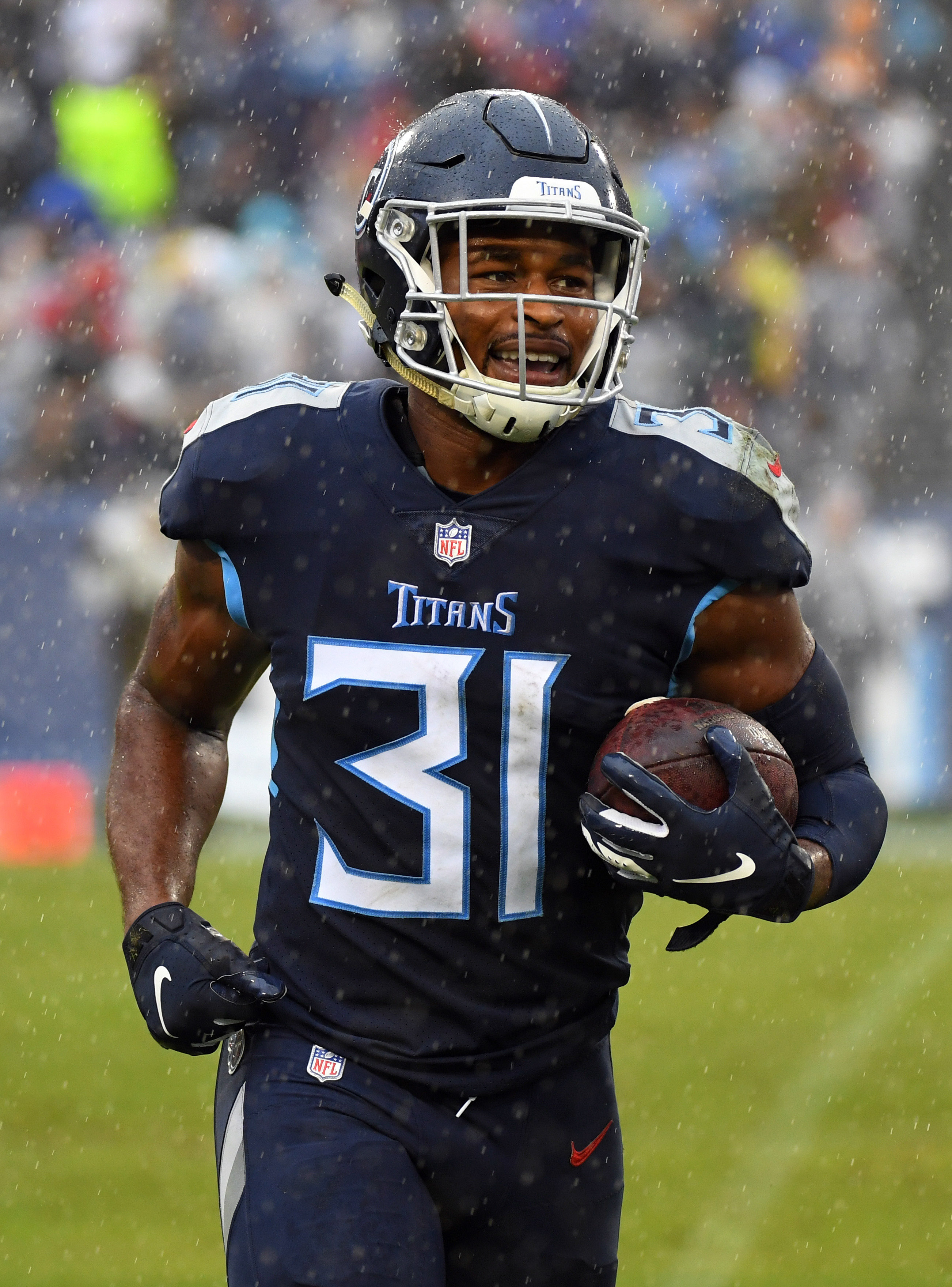
The Byard saga did produce an agreement, but the Carthon era has not started off ideally for the veteran safety. A reliable performer on one of the NFL’s most injury-prone teams, Byard is two seasons removed from a first-team All-Pro nod. The seven-year veteran has never missed a game, giving the Titans vital security as injury trouble has impacted the roster at key points. Pro Football Focus has also graded Byard as a top-10 safety in five of the past six seasons. Byard, who will turn 30 before the season, admitted he did not expect Carthon to hit him with a pay-cut request.
No trade drama ensued, but Carthon did trim money from Byard’s 2023 base salary. This is not a true restructure, as the transaction shaved nearly $3MM off Byard’s 2023 base salary. Incentives can move the number back to the $13.6MM place at which it previously stood, but the Titans also gave Byard $7MM in additional guarantees — on a contract that had seen its guarantees elapse — to agree to this. As a result, the team created more than $7MM in 2023 cap space with this adjustment. After two previous restructures, Byard’s cap number had ballooned to $19.6MM.
Free agency additions:
- Arden Key, OLB: Three years, $21MM ($13MM guaranteed)
- DeAndre Hopkins, WR: Two years, $26MM ($10.98MM guaranteed)
- Andre Dillard, T: Three years, $29MM ($10MM guaranteed)
- Azeez Al-Shaair, ILB: One year, $5MM ($4.25MM guaranteed)
- Sean Murphy-Bunting, CB: One year, $3.5MM ($3.5MM guaranteed)
- Daniel Brunskill, G: Two years, $5.5MM ($1.5MM guaranteed)
- Luke Gifford, ILB: Two years, $4MM ($1MM guaranteed)
- Chris Moore, WR: One year, $1.32MM ($1MM guaranteed)
- Chris Hubbard, OL: One year, $1.32MM ($75K guaranteed)
- Jaleel Johnson, DL: One year, $1.1MM
- Ben Niemann, LB: One year, $1.1MM
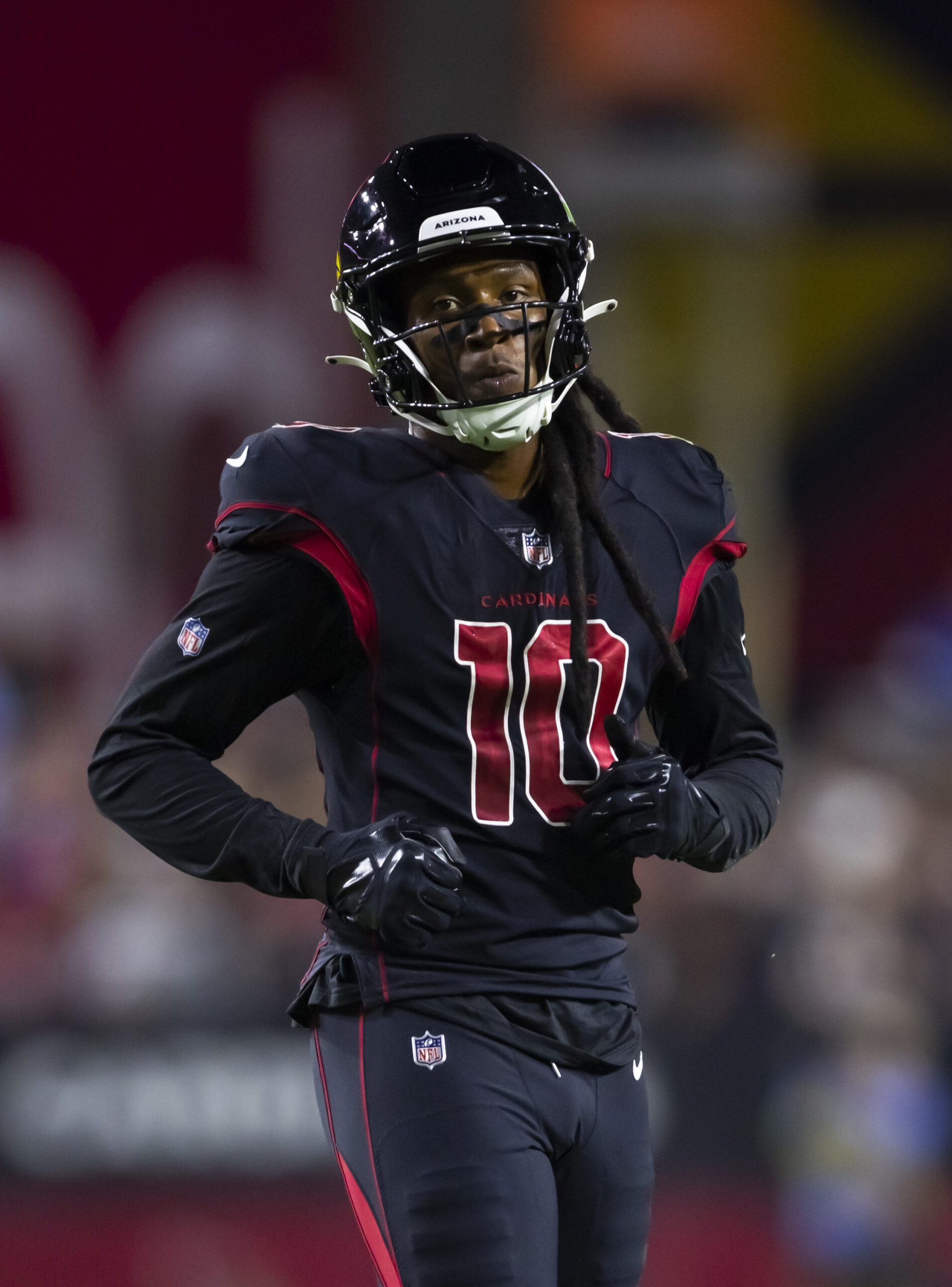
The Ravens’ Odell Beckham Jr. contract shook up Hopkins trade talks, eventually opening the door for the Titans. As Hopkins’ free agency played out, it seemed fitting the Titans ended up playing the Ravens role as they competed against true AFC contenders. Tennessee ended up outflanking other suitors — perhaps by a decent margin — to sign Hopkins. Considering the performance of the Titans’ receiving corps last season and the state this year’s group resided post-draft, Hopkins represented a vital upgrade.
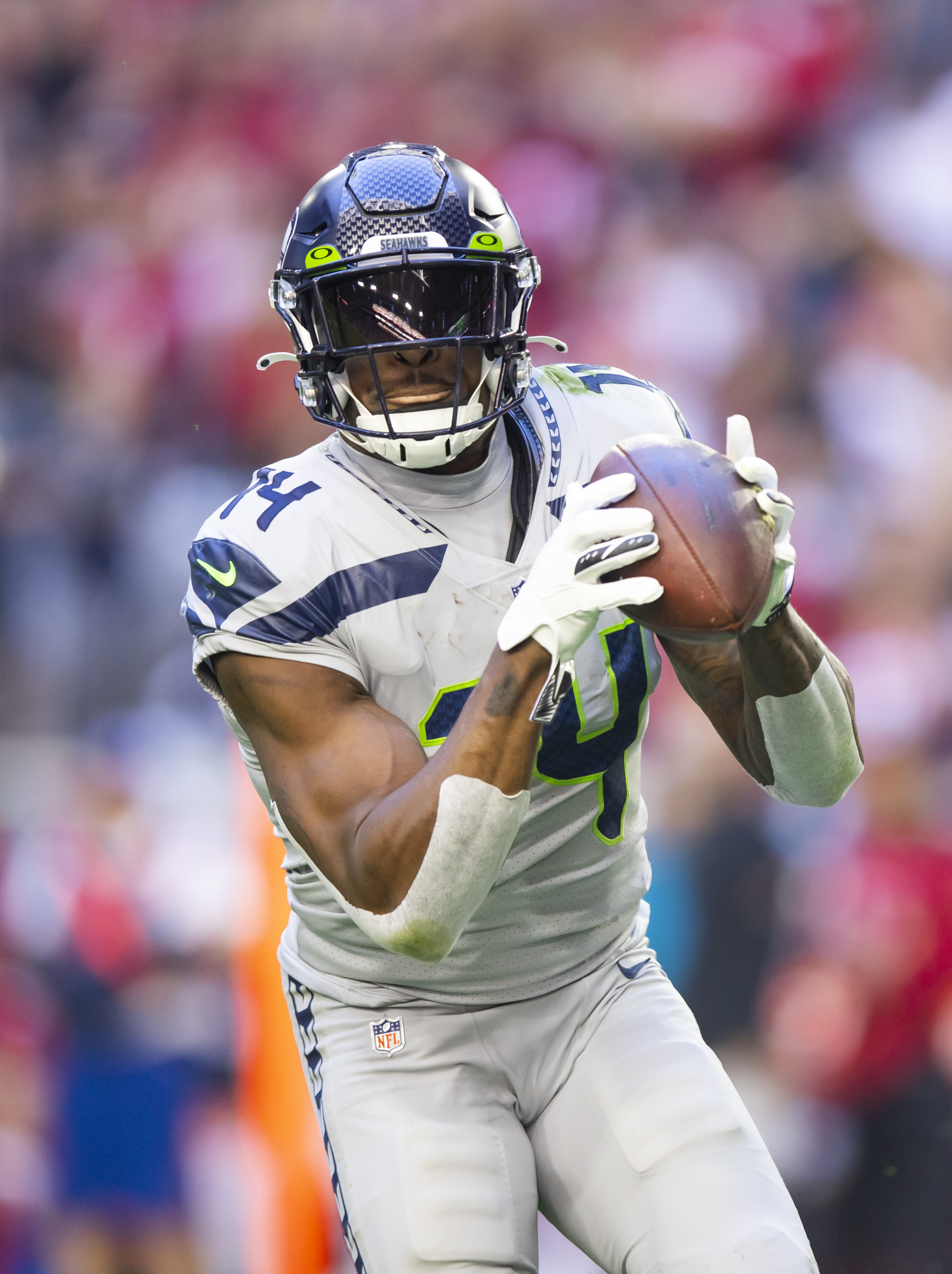
Dealing Brown immediately burned the Titans, who may have misread the market. Although the Ravens traded Marquise Brown, the other four teams with decisions on 2019 receiver draftees — the Commanders (Terry McLaurin), Seahawks (D.K. Metcalf), 49ers (Deebo Samuel) and Steelers (Diontae Johnson) — reached extension agreements, with the pacts being based on the one the Eagles gave Brown. While first-rounder Treylon Burks — effectively Brown’s replacement — showed flashes, Tennessee’s receiving corps produced just one 500-yard showing. And that came from a declining Robert Woods, who totaled 527 yards as this passing attack cratered.
Hopkins, 31, is not where he was when traded from the Texans to the Cardinals, but of the suitors, no team needed him more. The contract the Titans shelled out reflected that. Had the Ravens’ similar receiver need not driven them to give Beckham $15MM guaranteed, the long-rumored Bills-Chiefs bidding war might have taken place on the trade market.
Hopkins was apparently ready to accept a reduction to facilitate a trade away from the rebuilding Cards, but once OBJ (zero first-team All-Pro nods) landed the Baltimore deal after not playing in 2022, Hopkins naturally did not believe he needed to make a big sacrifice ahead of his 11th season. Rather than becoming a major chip in the arms race taking place atop the AFC, Hopkins will take some pressure off Burks in Nashville.
This move does remind of Tennessee’s Julio Jones pickup two years ago. Jones was also a three-time first-team All-Pro coming off an injury-limited season in his early 30s. But the Titans needed to fork over a second-round pick for the ex-Falcon great. The Hopkins contract details reveal an easy out after one year. The Titans designating Hopkins as a post-June 1 cut next year would come with just $1.96MM in dead money (and $14MM-plus in savings). Hopkins is due a $4.1MM roster bonus on Day 5 of the 2024 league year, providing an early decision date — unlike this offseason.
Bailing on another accomplished wideout with a post-June 1 release designation would not be optimal for Tennessee, which still has $8.4MM in Jones dead money on its 2023 cap sheet. But even though it looked like the team needed to offer several million more than Kansas City or New England did in guarantees, thus topping the incentive-laden deals each proposed, the Titans are not pot-committed for 2024.
In Hopkins’ last full season, he totaled a career-high 115 receptions for 1,407 receiving yards and six touchdowns. Hamstring issues and a torn MCL halted Hopkins’ momentum in 2021, bringing about the first injury-plagued stretch of the former first-round pick’s career. A PED ban and a minor knee issue emerged last year. Hopkins has missed 15 games over the past two seasons. But he has a history with Vrabel and new OC Tim Kelly, who were each in Houston during part of his seven-season stay.
Read more
The six-time 1,000-yard receiver will have another chance as a WR1. Potentially on the Hall of Fame borderline, Hopkins may be able to use this Titans tenure to cement his Canton candidacy. Will a player who has already pocketed $111MM regret not insisting on playing with Patrick Mahomes?
Making big changes on their offensive line, the Titans added Brunskill — a 49ers UDFA during Carthon’s San Francisco period — and will give Dillard a second chance. Dillard was unable to become the Jason Peters heir apparent the Eagles wanted when they traded up for him in the 2019 first round, but the Washington State alum drew trade interest before the 2021 and ’22 deadlines. Dillard, 27, has only made nine career starts, making this an interesting gamble by the Titans. Pro Football Focus did view Dillard’s five-game starter stretch in 2021 favorably, and he has fared better as a left tackle in his career.
Brunskill, 29, played a key role in the 49ers’ trips to the past two NFC championship games. He worked as San Francisco’s right guard starter from 2020-21, and although rookie Spencer Burford beat him out last year, Brunskill still rotated in and played 519 offensive snaps. No rotation appears planned by the Titans, who entered the offseason with two guard needs.
The 49ers extending Dre Greenlaw last year turned Al-Shaiir’s 2022 into an audition, and Carthon brought another San Francisco UDFA find to Tennessee with him. A 2021 Greenlaw injury gave Al-Shaair an extended run as a three-down Fred Warner sidekick, and PFF graded him as a top-30 off-ball linebacker that year and in 2022. Greenlaw’s return restored Al-Shaair to a part-timer last season, but for a Titans team that released Zach Cunningham and let David Long sign with the Dolphins, a three-down role is on tap for the soon-to-be 26-year-old talent. The Titans were able to land Al-Shaair on the cheap as well, as the ILB market produced just two deals (for Tremaine Edmunds and Bobby Okereke) north of $7.5MM per year.
Carthon continued to find former 49ers in free agency, signing Key to a deal that brought the young pass rusher more in guarantees than the summer Leonard Floyd or Frank Clark deals ended up requiring. The 49ers found some value in Key, scooping up the Raiders cut in 2021 and seeing him collect 6.5 sacks as one of Nick Bosa‘s wingmen. Key, 27, operated as a rotational rusher in San Francisco and Jacksonville. Tennessee will give him a chance to be a regular starter opposite Harold Landry. Jon Robinson struggled for years to staff that position, whiffing on Cameron Wake, Vic Beasley, Jadeveon Clowney and Bud Dupree. Carthon will continue this effort with a familiar face.
Robinson also saw his efforts to build at cornerback largely fall flat. Betting on Caleb Farley to shake off an injury-laden college tenure has not worked, and slot man Elijah Molden missed most of last season. Murphy-Bunting will pair with homegrown talents Molden, Kristian Fulton and Roger McCreary. The former Buccaneer did not see the type of market ex-teammates Carlton Davis ($14.8MM per year) and Jamel Dean ($13MM AAV) did in free agency. This came despite a 2022 season in which he set career-best marks for passer rating against (59.6), completion percentage allowed (51.2) and yards per target (4.5). These each ranked near the top of the league, but the Bucs gave Murphy-Bunting a career-low 53% snap rate. The former second-round pick, who made a big impact with three playoff INTs during the Bucs’ Super Bowl LV run, will try to boost his stock in Tennessee.
Re-signings:
- Aaron Brewer, OL: One year, $4MM ($4MM guaranteed)
- Teair Tart, DL: One year, $4MM ($4MM guaranteed)
- Morgan Cox, LS: One year, $1.32MM ($1MM guaranteed)
- Nick Westbrook-Ikhine, WR: One year, $1.26MM ($400K guaranteed)
- Corey Levin, OL: One year, $1.1MM
After winning Tennessee’s left guard job in training camp last year, Brewer is shifting to center. The 17-game 2022 starter will be the only returning starter on the Titans’ O-line in Week 1. A fellow ex-UDFA, Tart has been a Titans regular over the past two seasons. He joins Simmons and the versatile Denico Autry on a solid defensive front.
While the Titans have kept attempting to minimize Westrbook-Ikhine’s role via high draft choices and veteran additions, the former Indiana UDFA has remained a regular auxiliary piece. Barring injuries to Tennessee’s top two receivers, Westbrook-Ikhine profiles as the team’s WR3 in his age-26 season. But Hopkins and Burks missed time last year. NWI has helped Tennessee navigate the various maladies its pass catchers have suffered over the past two seasons, totaling 873 receiving yards and seven touchdowns in that span. The 215-pound target, whom the Titans circled back to after nontendering as an RFA, will aim to create a decent free agent market for himself this season.
Notable losses:
- Andrew Adams, S
- Tarell Basham, OLB
- C.J. Board, WR
- Randy Bullock, K (released)
- Trenton Cannon, RB
- Le’Raven Clark, OL
- Dylan Cole, LB
- Chris Conley, WR
- Zach Cunningham, ILB (released)
- Dennis Daley, OL
- Nate Davis, G
- Joshua Dobbs, QB
- Bud Dupree, OLB (released)
- Mario Edwards, DL
- Davontae Harris, CB
- Dontrell Hilliard, RB
- Austin Hooper, TE
- Lonnie Johnson, DB
- Ben Jones, C (released)
- Jamarco Jones, OL (released)
- Joseph Jones, LB
- Taylor Lewan, LT (released)
- David Long, ILB
- Greg Mabin, CB
- Terrance Mitchell, CB
- A.J. Moore, DB
- Andre Smith, ILB
- Kevin Strong, DL
- Geoff Swaim, TE
- DeMarcus Walker, DL
- Robert Woods, WR (released)
Carthon made four cap-casualty moves in one afternoon, cutting Bullock, Cunningham, Lewan and Woods on Feb. 22. The releases of Jones and Dupree followed. The moves took six starters’ contracts off the books, creating just more than $50MM in cap space. This helped move Tennessee well under the cap, but the team did not stop there. Davis, Walker and Edwards further stripped away Robinson-era pieces from the Titans’ lines, with Long’s Miami exit representing more turnover at inside linebacker as well.
Jones (108) and Lewan (100) combined to start 208 games as Titans — fifth and sixth, respectively, in the franchise’s Tennessee era — but finished last season on IR. Lewan ran into extensive knee trouble, with the issue recurring last season and leading to 15 missed games. The former first-round pick missed 29 games during the 2020s, with the excessive knee trouble leading him to a lawsuit over a surgery he underwent in 2020. The Titans still received Pro Bowl-caliber play from Lewan during most of his healthy stretches, and he played a vital role in Henry’s dominance. But the 32-year-old blocker/podcast host appears headed toward retirement.
A former Texans draftee, Jones became better known for his Titans work. He signed three contracts with the team, initially joining during Robinson’s first offseason as GM. The Titans gave their interior O-line anchor a two-year, $14MM accord in 2022, but concussion issues intervened and halted the durable performer. Jones, 34, had only missed one game over his first 10 seasons. He missed five last year, suffering two concussions. That obviously brings about concern for Jones, who was briefly linked to the Jets in free agency. No team has signed him. While this franchise has trotted out the likes of Bruce Matthews and Mike Munchak, no player in Oilers/Titans history has started more games at center than Jones, who also played an essential part in Henry’s ascent.
The Titans also figure to miss Davis, who grew from third-round pick to four-year right guard starter. As Lewan missed time, Davis joined Jones in being constants for the team during its three-year playoff streak. As the Titans have struggled to find right tackle consistency post-Jack Conklin, they were able to depend on Jones and Davis inside. Moving on from Lewan and both interior staples will make for one of the bigger transitions any team has made up front in recent years.
Hooper’s one-and-done will leave intriguing Chig Okonkwo atop the tight end depth chart. Okonkwo totaled 450 yards as a rookie, but Next Gen Stats’ yards after catch per reception metric slotted him second (8.1) to only Deebo Samuel across the NFL. With the Titans still short on receiver dependability, Okonkwo will be an important piece in his second season.
For a stretch during the 2010s, the Titans enjoyed inside linebacker continuity. Since the Wesley Woodyard–Avery Williamson duo splintered, the team has let a number of notable ILBs walk. Zach Brown, Jayon Brown, Rashaan Evans and now Long have moved on as free agents.
Long battled injuries, to the point Vrabel brought it up at his season-ending press conference. Hamstring trouble, in particular, has interfered with Long’s ascent. Long’s 12 absences over the past two seasons likely contributed to his being available for two years and $11MM (Dolphins). PFF, however, graded Long as a top-20 off-ball ‘backer in 2021 and ’22, slotting him fifth in run defense at the position. The Titans could not rely on Cunningham, a 2021 waiver claim. While the former Texans second-rounder immediately moved from castoff on a rebuilding team to starter for the AFC’s No. 1 seed, he made two trips to IR last season.
Draft:
- Round 1, No. 11: Peter Skoronski, OL (Northwestern) (signed)
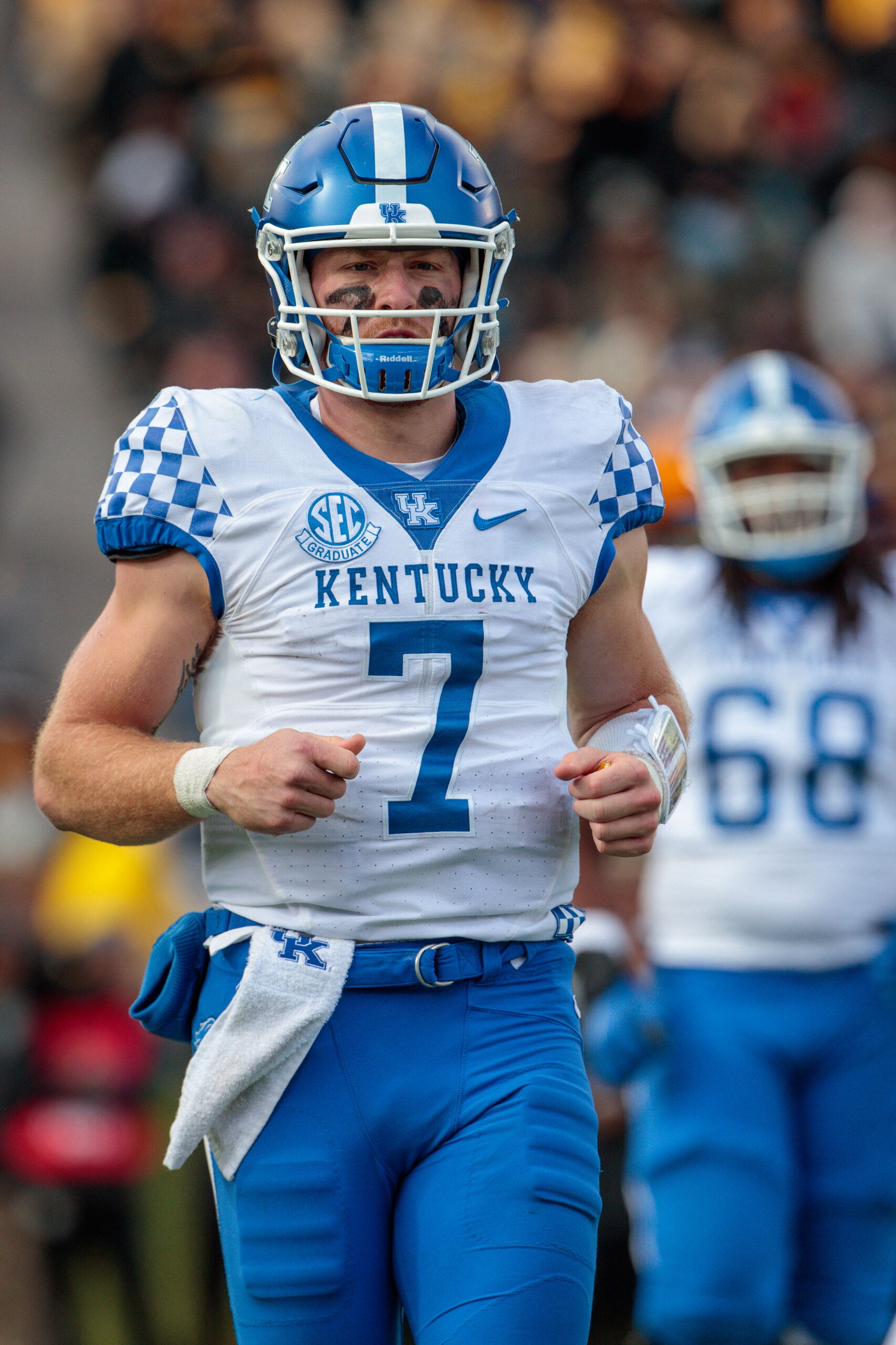
- Round 2, No. 33 (from Cardinals): Will Levis, QB (Kentucky)
- Round 3, No. 81 (from Lions through Cardinals): Tyjae Spears, RB (Tulane) (signed)
- Round 5, No. 147: Josh Whyle, TE (Cincinnati) (signed)
- Round 6, No. 186 (from Falcons): Jaelyn Duncan, T (Maryland) (signed)
- Round 7, No. 228: Colton Dowell, WR (Tennessee-Martin) (signed)
Connections tied the Titans to interest in trading up for a first-round quarterback, but it is quite possible one of their division rivals blocked the path to the player they wanted. The steady attachments forming between the Titans and a first-round trade-up from No. 11 into the quarterback range may have centered on C.J. Stroud, as the Titans dropped out of the running for such a move — which would have been with the Cardinals — after the Texans chose Stroud at 2.
As Tennessee regrouped, filling a need up front made sense given the losses sustained in March. Skoronski played only tackle at Northwestern, but most scouts agreed guard would be his NFL job. After giving the decorated blocker a look at tackle during their offseason program, the Titans have stationed him at guard in training camp. The grandson of former Vince Lombardi-era Packers left tackle Bob Skoronski, Peter paved a clear path toward first-round status by earning first-team All-Big Ten acclaim as a sophomore and junior. Despite Nicholas Petit-Frere‘s situation, the Titans added Hubbard, who vying for the RT job with Duncan. Rather than disrupt Skoronski’s development by giving him the temporary assignment of replacing Petit-Frere, Vrabel and Co. look to be allowing him to learn guard full-time.
The Titans did explore moving back into Round 1, but Levis fell out of the first round. Following the likes of Geno Smith, Drew Lock and Malik Willis, the Kentucky alum remained available after steady first-round rumors. The Colts, who had been low-key enamored with Anthony Richardson, had been consistently linked to Levis. Instead, the Titans will make the bet on the Penn State transfer-turned-multiyear SEC starter. Moving from No. 41 to 33 cost the Titans a 2024 third-rounder. That will be an afterthought if Levis becomes a legitimate Tannehill successor.
Levis, who fared better under OC Liam Coen as a junior in Lexington, will challenge Willis for the Titans’ backup job. After being rumored to be a potential top-10 pick, Willis fell to 86 last year and looked overmatched when summoned to replace Tannehill. This situation reached a definitive conclusion when Vrabel called upon Joshua Dobbs, plucked off the Lions’ practice squad days earlier, to start the team’s final two games. It would seem premature to bail on Willis after one season, but with a new front office in place, that should not be considered a shocking development. Levis now sits as the preferred developmental option behind Tannehill, who joins Kirk Cousins in being due for free agency in 2024.
Since DeMarco Murray‘s 2018 exit unleashed Henry, the Titans have tried and largely failed to acquire a capable backup. The team released Dion Lewis after one season of a four-year deal, and third-rounder Darrynton Evans did not pan out. Jeremy McNichols and a shopworn Adrian Peterson could not replace Henry in 2021; only in-season practice squad pickup D’Onta Foreman ended up being a viable fill-in. Foreman left in free agency last year. A 2022 fourth-round pick, Hassan Haskins was arrested on an aggravated assault by strangulation charge this offseason.
Spears will be the latest attempt at a Henry RB2. The Tulane product shined as a senior, zooming for 1,837 scrimmage yards and 21 touchdowns — four of those in Cotton Bowl victory over USC. Considering Henry’s high mileage (1,877 career touches), Spears’ status will be worth monitoring this season. A draft-weekend report indicated Spears does not have an ACL in his one of his knees, after two tears, and had battled arthritis. The rookie brushed off health concerns upon being drafted.
Other:
The Titans attempted to interview both of John Lynch‘s top lieutenants, but assistant 49ers GM Adam Peters declined the meeting. Carthon joined Peters in working as a 49ers staffer since Lynch’s 2017 arrival, and he will team with Vrabel. While the NFL’s progress with minority HCs has slowed, the hiring of Carthon — who beat out Bears assistant GM Ian Cunningham for the job — gives the league eight minority GMs.
After a short career as a running back, Carthon, 42, worked his way up from a pro scout over the past 15 years, finishing his San Francisco tenure as director of player personnel. The 49ers have built one of the NFL’s best rosters, advancing to three of the past four NFC title games despite middling-at-best quarterback play. Carthon will attempt to carry that success to Tennessee, where he steps into the unusual situation of taking over a team that has made the playoffs in three of the past four years.
This will be an interesting partnership, as Vrabel — who joined Robinson in signing a 2022 extension — is entrenched and will have considerable say in personnel matters. While new GMs often join a team in need of a head coach or create an HC vacancy by firing the incumbent sideline boss within a year, Carthon will likely be working with Vrabel for the foreseeable future.
Robinson lieutenants Cowden, who closed last season as the Titans’ interim GM, and Monti Ossenfort — now the Cardinals’ GM — are out. Brinker, named the Titans’ assistant GM/strategy, spent 12 years working under Ted Thompson and then Brian Gutekunst in Green Bay. Like Brinker, Robinson stayed on with his former team — the Falcons — after a GM change. The Thomas Dimitroff hire spent two years under Terry Fontenot, finishing as Atlanta’s college scouting director. He carries the title of assistant GM/personnel.
Todd Downing lost his Raiders OC gig after one season and saw a DUI arrest key a downfall with the Titans, whose offense talent lessened during his second season. Internal and NFL investigations ensued, with Downing’s arrest coming in Tennessee shortly after the Titans concluded a Thursday trip to Green Bay, but the ousted OC is now with the Jets.
Like Downing and Arthur Smith before him, Kelly, 36, earned the Tennessee OC job via promotion. The former Texans OC joined the Titans as pass-game coordinator in 2022, coming over after an eight-year stay in Houston. The longtime Bill O’Brien right-hand man called plays for the Texans during the 2020 and ’21 seasons. Kelly, who is the older brother of ex-Titans tackle Dennis Kelly, spent three seasons as Houston’s OC. The Texans finished 13th in total offense in each of Kelly’s first two seasons, but after the Deshaun Watson fiasco led to the team parking the embattled Pro Bowler as a healthy scratch, the team’s offense predictably sank to the NFL’s basement in 2021. After that last-place offensive ranking, the Texans fired Kelly and HC David Culley.
The Titans’ depth chart points to Petit-Frere getting his job back once the suspension ends. Unlike a handful of players found to have bet on NFL games, Petit-Frere was popped for making a bet on another sport while on team grounds. That will allow the 2022 third-round pick to salvage his second season. Hubbard, who has not been a regular starter in four years, could provide swing depth once Petit-Frere (16 starts as a rookie) returns. The player Petit-Frere beat out for the RT job last year, 2021 second-rounder Dillon Radunz, remains on Tennessee’s active/PUP list after suffering a late-December ACL tear.
Top 10 cap charges for 2023:
- Ryan Tannehill, QB: $36.6MM
- Harold Landry, OLB: $18.8MM
- Derrick Henry, RB: $16.37MM
- Kevin Byard, S: $11.27MM
- Denico Autry, DL: $9.1MM
- Amani Hooker, S: $8.87MM
- Jeffery Simmons, DL: $6.35MM
- Aaron Brewer, OL: $4.3MM
- Teair Tart, DL: $4.3MM
- Caleb Farley, CB: $3.68MM
Tennessee’s payroll figures to look much different in 2024, with Tannehill likely — barring another contract agreement ahead of his age-36 season — coming off the books. The former injury-prone Dolphins castoff resurrected his career as a Titan and should generate a market next year. For 2023, however, the Titans need the veteran QB.
Barring Levis showing immediate readiness, Tannehill should have the reins for most, if not all, of the upcoming season. It would probably take Levis displaying considerable progress, the Titans stumbling out of the blocks and a contract restructure — to lower Tannehill’s big paragraph 5 number ($27MM) — for a QB trade to become realistic.
After toppling a wounded Titans team, the Jaguars are favored to stay atop the AFC South. In Vrabel’s five years at the controls, the Titans have only finished under .500 once. Even as the team jettisoned several veterans, it is difficult to see a decline from last year’s 7-10 place coming. This could mark the end of an era, given Tannehill and Henry’s contract situations, but the Titans still have prime-years talent left over from the 12-5 2021 squad. The presences of that nucleus, which returns Landry after a full-season absence, should keep the Titans competitive with the Jags this season.
By Sam Robinson |
at July 30, 2023 9:40 pm
The Joe Schoen regime’s first offseason did not feature splash moves, with cap issues limiting the GM last year. After a surprise voyage to the NFC’s divisional round, the Giants became far more active this year in making moves that will shape their long-term future. For the most part, the team’s core players are now locked down. Though, more headlines came the team’s way because of the pillar that exited the offseason without an extension.
Re-signings:
- Daniel Jones, QB: Four years, $160MM ($81MM guaranteed)
- Saquon Barkley, RB: One year, $10.1MM ($10.1MM guaranteed)
- Darius Slayton, WR: Two years, $12MM ($4.9MM guaranteed)
- Jamie Gillan, P: Two years, $4MM ($1MM guaranteed)
- Jihad Ward, OLB: One year, $1.5MM ($500K guaranteed)
- Matt Breida, RB: One year, $1.4MM ($500K guaranteed)
- Casey Kreiter, LS: One year, $1.32MM ($353K guaranteed)
- Oshane Ximines, OLB: One year, $1.18MM ($200K guaranteed)
- Sterling Shepard, WR: One year, $1.32MM
- Jarrad Davis, LB: One year, $1.18MM
- Isaiah Hodgins, WR (RFA tender)
Faced with one of the more fascinating decisions in the franchise tag era, the Giants made no secret of their stance adjustment on Jones. Schoen passed on the Dave Gettleman-era draftee’s $22.4MM fifth-year option in 2022. Picking that up would have brought an easier route for the Giants, but the former No. 6 overall pick was coming off an injury-limited season and had not justified such an investment at that point. With Jones becoming the first quarterback to re-sign with a team that had declined his fifth-year option, he exerted the leverage the March franchise tag deadline gave him. At the end of that journey: a payday that would have been unimaginable a year ago.
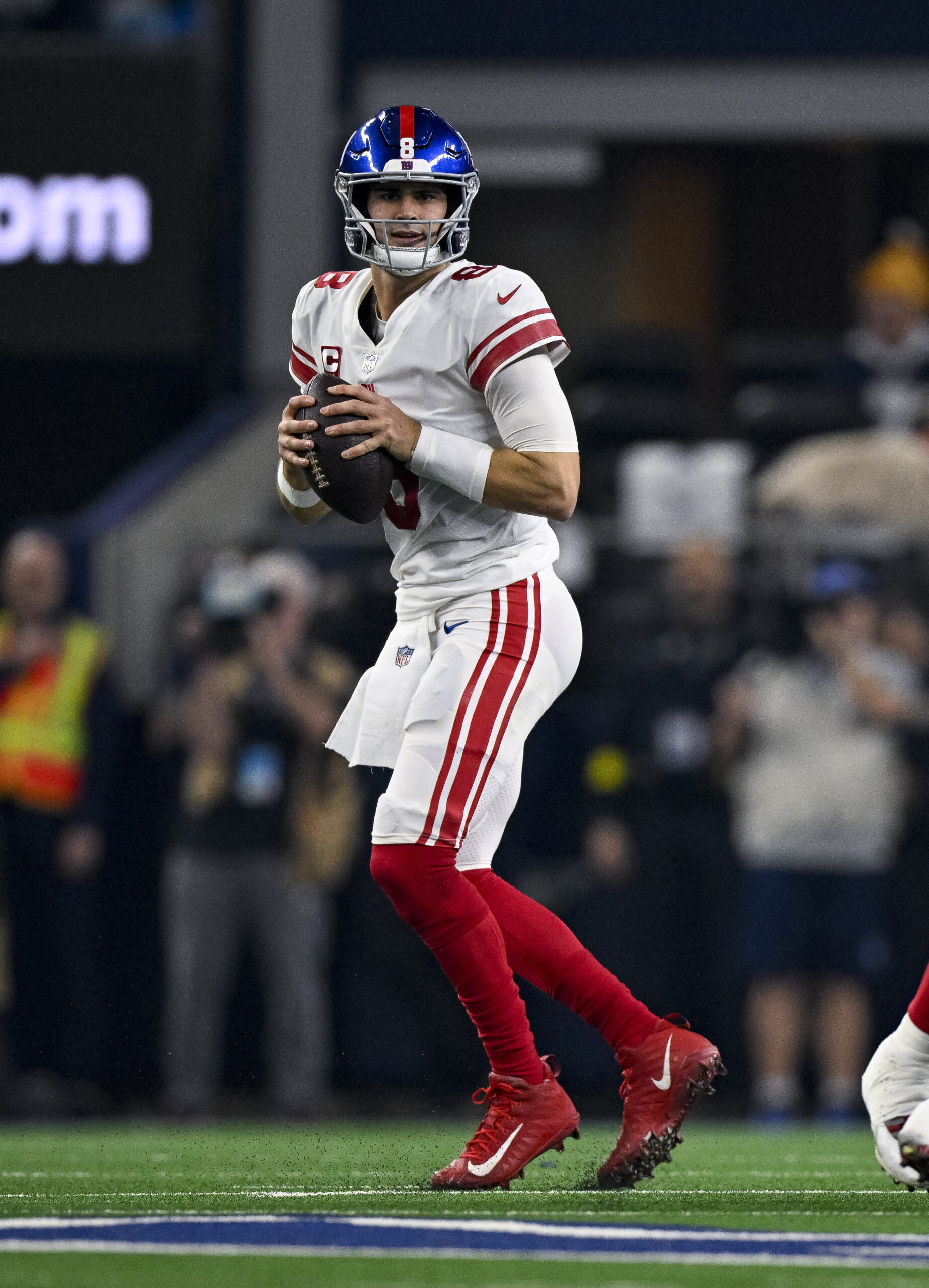
By not picking up Jones’ option and letting Barkley play out his, the Giants entered March with both unsigned. They ended up navigating this scenario in the same way the 2020 Titans did, re-signing the quarterback and tagging the running back. But the Ryan Tannehill–Derrick Henry situation did not produce half the headlines the Giants’ Jones-Barkley proceedings did.
In the fall, the team first identified Barkley as an extension candidate, beginning bye-week negotiations and offering an extension worth more than $12MM per year. No Jones negotiations took place at that point, with the new Big Blue regime wanting to see more. After Jones piloted a Giants offense stripped of non-Barkley skill-position talent to the franchise’s first playoff win since Super Bowl XLVI, Schoen and Co. changed course. Jones became the priority and was set to receive an expensive franchise tag ($32.4MM). Barkley’s superior talent notwithstanding, the two-time Pro Bowl running back’s positional value dropped him in the team’s queue. This set up a high-stakes stretch leading up to the March 7 deadline to tag players.
Rumored to be aiming for a deal south of $40MM per year, the Giants saw their quarterback change agents and come in with a $47MM-AAV ask once talks heated up in the winter. After a lack of progress in the days leading up to the deadline, the Giants talked Jones down to $40MM per year. Beating the deadline buzzer on this extension allowed them to tag Barkley, completing step one of a seminal offseason itinerary. While that set off another high-profile negotiation that would play out in the coming months, Jones successfully negotiated the same contract parameters Matthew Stafford and Dak Prescott received and did so coming off a season in which he threw only 15 touchdown passes.
The Eli Manning heir apparent transforming his value to this degree made for one of the most interesting contractual sagas in recent memory. Jones, 26, had shown promise as a rookie under Pat Shurmur. His 24 TD passes — in a 12-start season — still rank fifth for a rookie. But Joe Judge‘s tenure, which largely placed Jason Garrett at the controls on offense, ended up setting Jones back. The Duke product combined for 21 TD passes in 25 starts from 2020-21, and his midseason neck injury in the latter season led to one of the worst stretches in Giants history. Although the team’s 9-7-1 response to that benefited Jones more than anyone, the Giants are making a reasonable bet on a player they were seemingly ready to discard at this time last year.
Factoring in rushing impact, QBR viewed Jones as having made tremendous strides under Brian Daboll. Despite increasing receiver limitations and a basement-level tight end situation, Jones ranked sixth in that metric. His 708 rushing yards boosted a team in need of viable non-Barkley help moving the chains, and it will be interesting to see how Jones performs in Daboll’s offense with an improved pass-catching corps.
This contract also gives the Giants a reasonable out after two years. They would be on the hook for barely $9MM in dead money if they designated Jones a post-June 1 cut in 2025. And the subsequent deals for Jalen Hurts, Lamar Jackson and Justin Herbert did bump the Jones contract down to 11th at the position. Still, Jones is a bit on this deal is a different than having him on rookie money. While it would have been interesting to see if another team would have been willing to give him $40MM per year on the open market, the Giants did not wish to chance that.
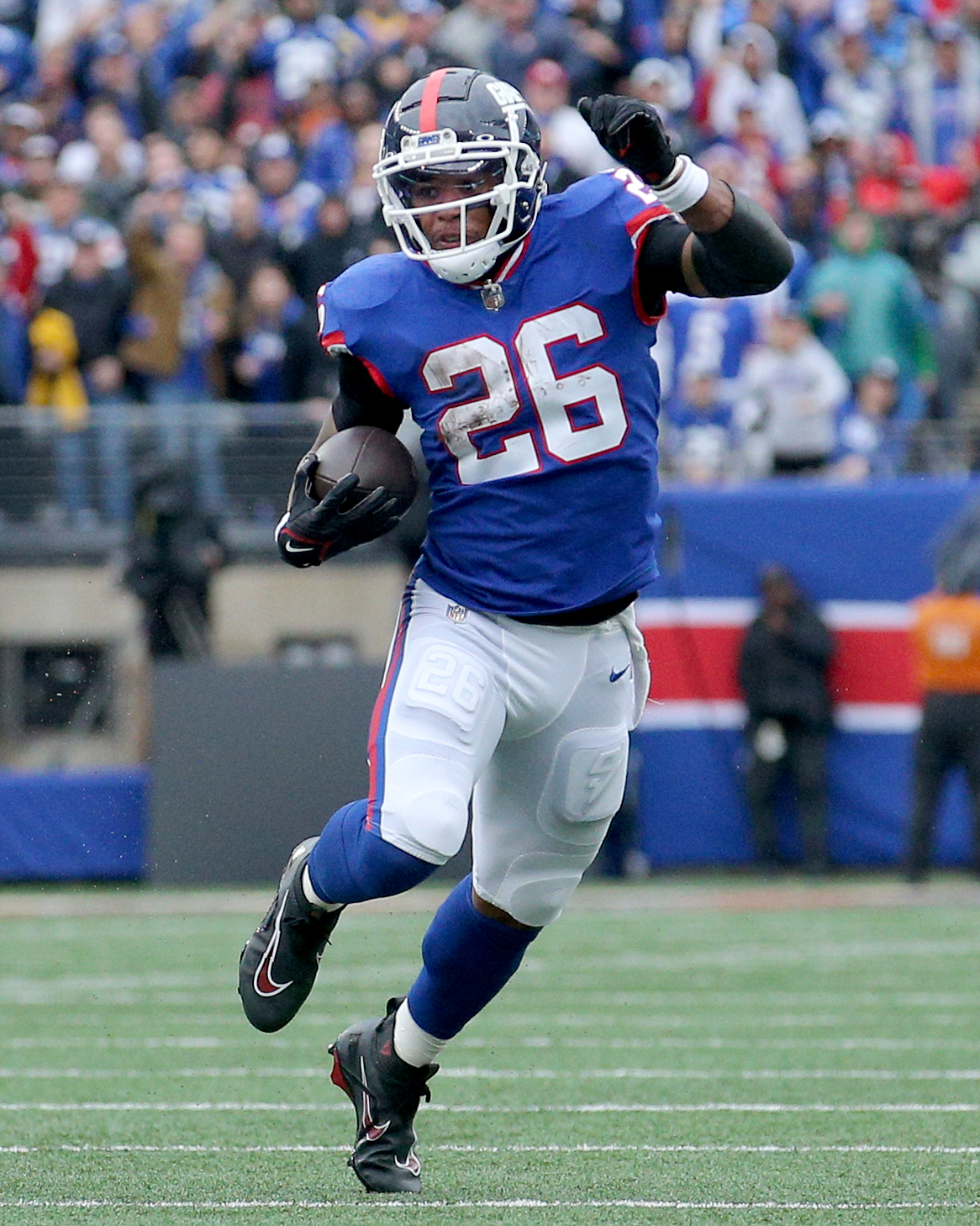
Barkley’s tag became one of many events in a crushing offseason for the running back position. The throughline from Mike Shanahan‘s brigade of post-Terrell Davis 1,000-yard backs to the gridlock atop the market following Christian McCaffrey‘s 2020 agreement has led to an overdue spotlight shining on this position’s place in the modern game. At the end of 2023’s carnage, the RB position is at maybe its most unstable point in history.
The Giants not coming to an agreement with Barkley certainly puts this relationship at risk of falling apart after 2023. But the team will have a chance to use the most talented back in its near-100-year history for at least one more season. The Giants will have a chance to tag Barkley again, at barely $12MM, in 2024. Will the 26-year-old RB remain in the picture by that point?
After shaking off a three-year stretch of injuries, Barkley provided great value on a $7.22MM fifth-year option salary by powering the Giants to the playoffs. While the Giants have not been able to utilize Barkley’s pass-game talents on the level his rookie year brought, he gained a career-high 1,312 rushing yards and was by far the most talented Giants skill player. Barkley stayed healthy throughout the season, but after the fall talks did not come close to producing a deal, the Giants ended up pulling their second offer — worth roughly $13MM per year — after tagging him. Four months later, Barkley will play the season for the $10.1MM tag salary (feat. a small incentive package with lofty benchmarks).
Barkley blasted the Giants for leaks that made him look greedy, when the fall and winter offers included low guarantees. Once the team finally moved up to the $22MM guarantee level that represented the cost of two franchise tags, the backfield staple was annoyed that increase came with an AAV decrease south of $12MM. Despite the parties being close to a deal, the Giants making the late move to reduce the AAV led to Barkley passing. Barkley’s No. 2 overall draft slot and fifth-year option money moved his career earnings past $38MM, which would have given him interesting leverage to use a Le’Veon Bell-like absence as evidence — on a Giants team still bereft of dependable skill players elsewhere — of RB value while preserving his body for what could be a last-chance free agency run in 2024. Barkley’s bluff on this front did not translate to even a training camp holdout, illustrating the power the tag gave the Giants.
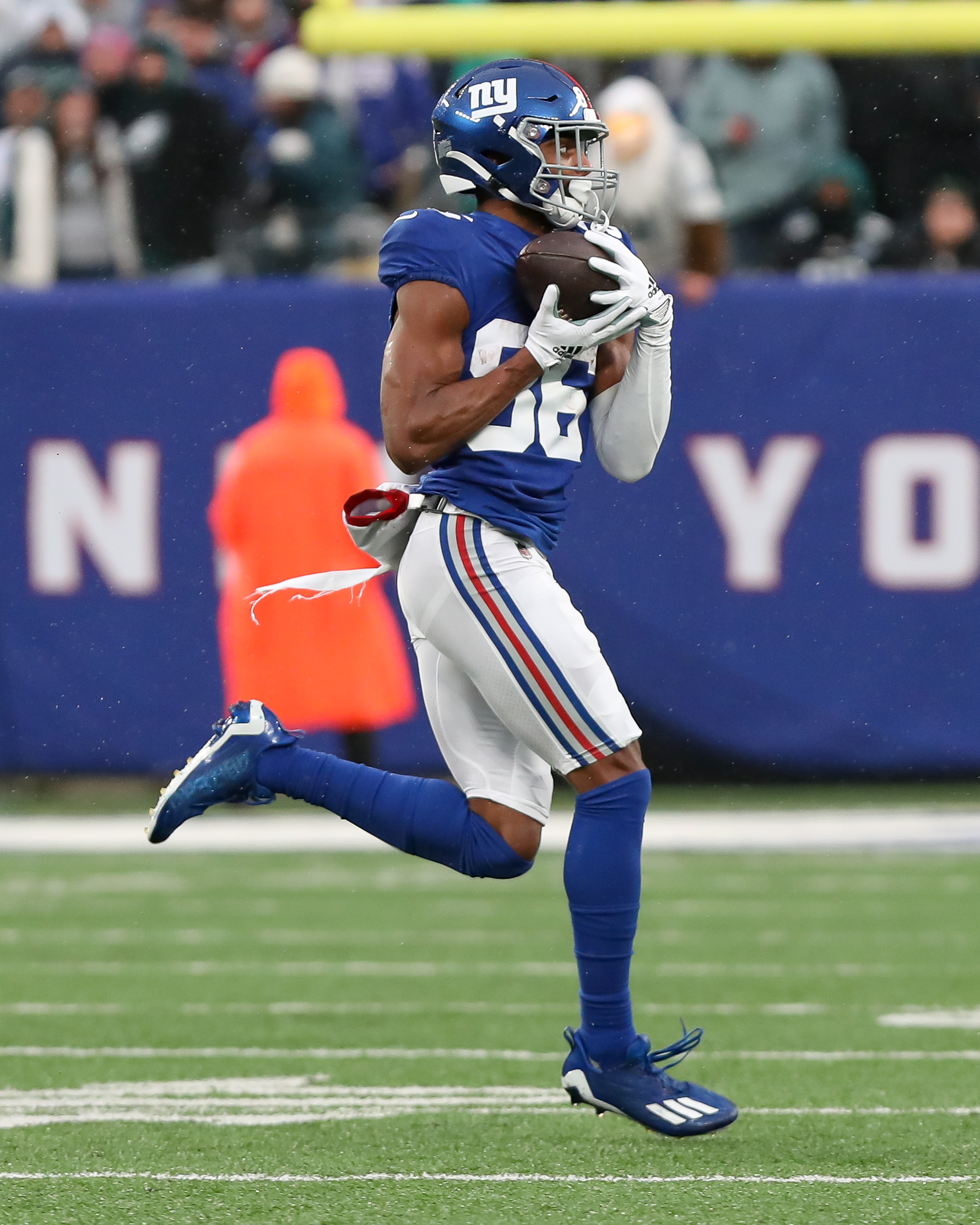
With the Giants free to use Barkley as they please, this tag season could tank his stock — through either an injury or a third 350-plus-touch year — and leave him in a tough spot on what looks like another crowded free agent market. That is, if the Giants let Barkley reach free agency in 2024. With Miles Sanders receiving $13MM guaranteed from the Panthers, Barkley will bet on himself this year in hopes a reasonable guarantee figure will await him on the market in 2024.
Shepard is the Giants’ longest-tenured player, but his injury history and having re-signed for no guaranteed money makes the Slayton transaction more pertinent for the 2023 Giants. Although Jones and Barkley zoomed into this regime’s good graces after down 2021 offerings, Slayton’s turnaround with the organization may have been more surprising.
The Giants buried Slayton on their depth chart going into his contract year and then slashed his pay, stripping away the proven performance escalator money he earned, before the season. But the slew of issues to affect the team’s receiver cadre — Shepard and Wan’Dale Robinson‘s ACL tears, Kadarius Toney‘s repeat injuries and then a give-up trade, and Kenny Golladay cementing himself as a historic free agency bust — led to Slayton climbing back into a starting role and leading the team in receiving (724 yards). The Giants are deeper at wide receiver this year, but with Robinson not a lock to begin the season on time, Slayton (three 700-yard years) could still find himself opening the season as Jones’ top wideout.
Trades:
In betting Jones will grow with better pass catchers, the Giants are wagering Waller will shake off the injury trouble that plagued him in Las Vegas. Waller, who will turn 31 in September, missed 14 games over the past two years. The Pro Bowl tight end’s injuries eventually caused the Raiders to cut bait. For a Giants team that has not employed a difference-making tight end in maybe 16 years (Jeremy Shockey?), this is a bet worth making. The pick obtained for Toney is a reasonable price to pay for a dynamic player like Waller.
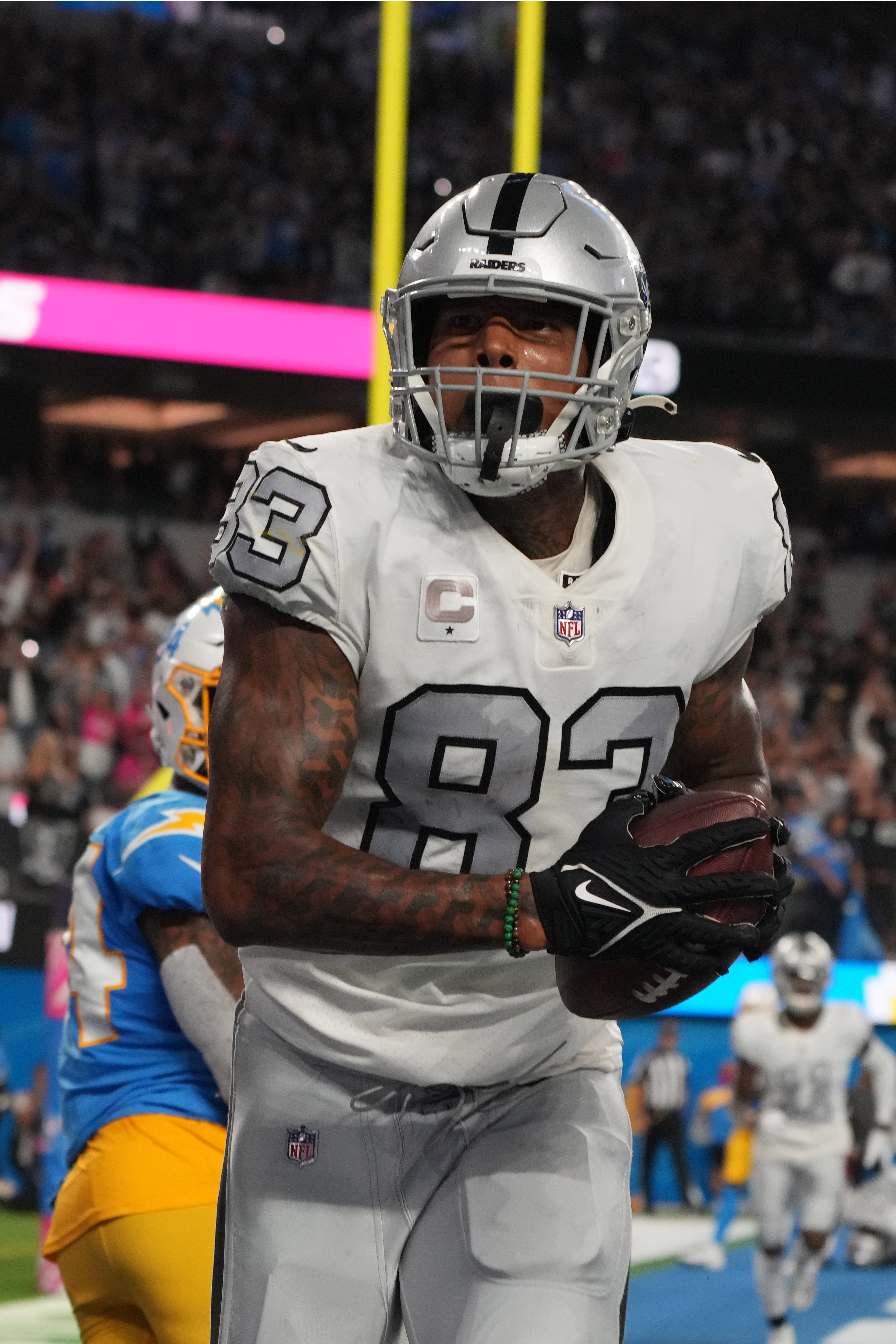
Unlike Shockey, Waller has delivered a 1,000-yard season. In fact, the ex-Ravens wide receiver is one of just eight tight ends with two 1,100-yard years. Waller saved the Raiders when their Antonio Brown trade preceded a spectacular combustion, going from Jon Gruden-era flier to cornerstone piece in Derek Carr‘s final stretch with the franchise. In his most recent healthy season, Waller ripped off 107-catch, 1,196-yard, nine-TD performance.
Of course, that came three years ago. Since, Waller has dealt with ankle, IT band and hamstring problems. Waller missing eight games due to a hamstring issue — weeks after the Raiders made him the NFL’s highest-paid tight end, at $17MM per year — last year frustrated some in the organization. But he has a clear opportunity in New York. The Raiders had transitioned to a Davante Adams-centered aerial attack. While the Giants took a quantity-based approach at receiver, no No. 1-type wideout — at least, no known commodity — exists on this depth chart. Waller will enter the year as the most likely passing-game centerpiece.
Waller’s 2022 extension did not feature lofty guarantees, which gave the Raiders an easy out. The Giants will only be tagged with $2.5MM in dead money if they designate Waller a post-June 1 cut in 2024. This is a relatively low-risk proposition for Big Blue. Waller did show flashes after coming back from his hamstring issue in December; when healthy, he presents the capability to give the Giants a weapon that would accelerate Jones’ development.
Extensions and restructures:
In an offseason that has placed Barkley in a late-’90s George Costanza-like position, when the Susan Ross Foundation continued to unveil other financial plans regarding her estate, Thomas and Lawrence have joined Jones in receiving windfalls. How the Giants proceeded this year doubles as a decent encapsulation for positional value in the NFL. Beyond the reality of the Giants taking care of higher-value players and letting their running back stay on the tag, two more Gettleman-years breakthrough players are under contract for at least five more seasons. Thomas’ deal, in particular, could age very well for the team.
Read more
Zack Martin‘s Cowboys holdout shows the risk of standout players agreeing to lengthy contracts, but Thomas has given the Giants seven years of control. It took a tackle-record guarantee for the former No. 4 overall pick to do so, but the Giants now have their left tackle signed through his age-30 season. Considering the growth Thomas has shown since a rocky rookie year, this might be a significant value play for the team as the salary cap makes a climb toward $300MM over the course of this contract.
Thomas, 24, finished last season as a second-team All-Pro. Pro Football Focus slotted the Georgia alum third among tackles; both PFF and ESPN’s win rate metric charted him as an elite pass blocker. After the Giants whiffed on big-ticket moves to staff this all-important position — the Ereck Flowers top-10 pick, the Nate Solder record-setting contract — in Manning’s twilight years, they have a potential anchor for Jones.
Of the 318 players chosen in Round 1 in the fifth-year option era (2011-present), Thomas is just the 28th to sign an extension before his fourth season. Teams do not make a habit of extending non-QBs with two years left on their rookie deals. The Giants had this on their radar, however. Showing early faith in Thomas illustrates their confidence in the prior regime’s investment. With the Giants not having another O-lineman signed to an upper-echelon contract, an early window for a Thomas play was open.
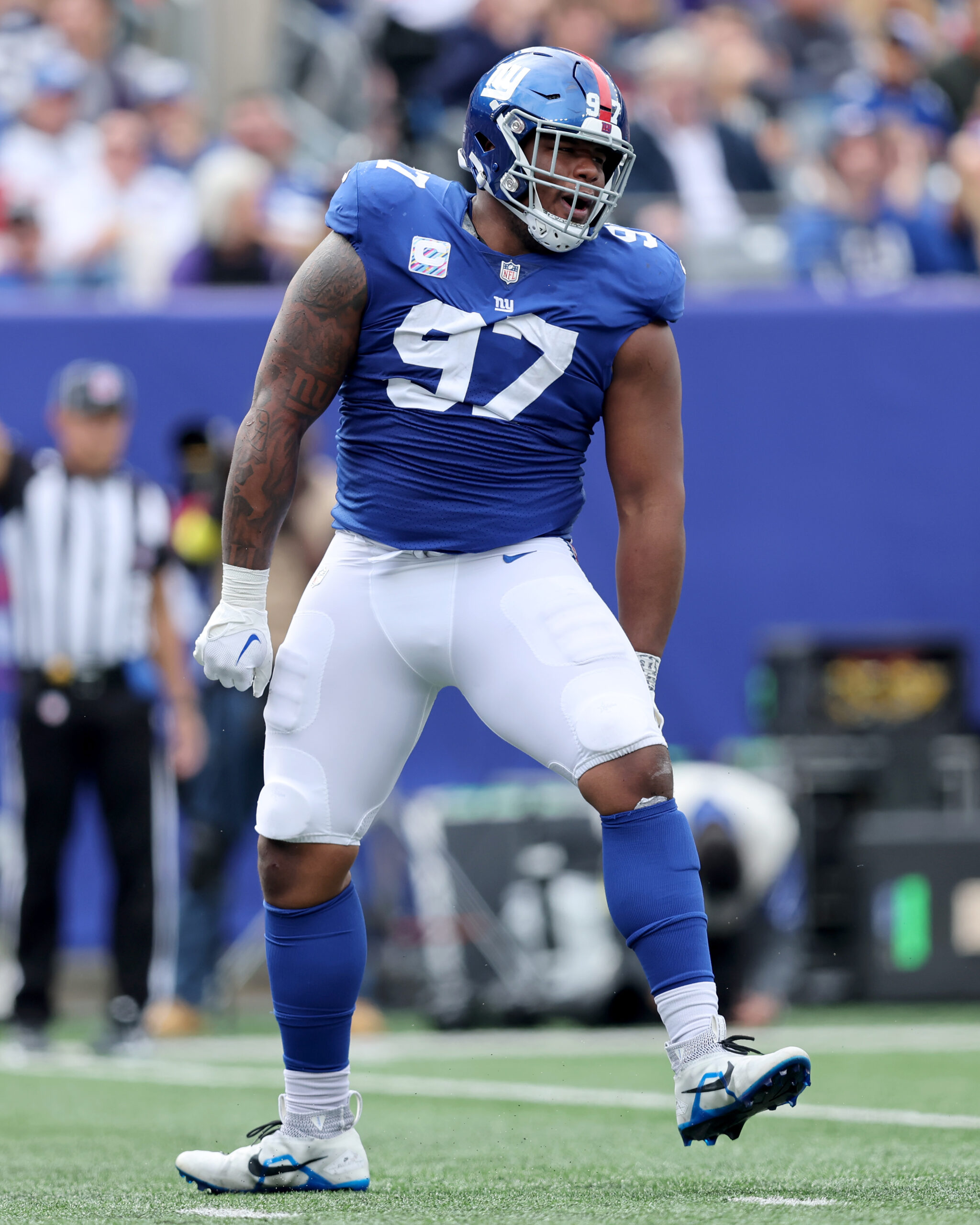
Lawrence signed a more traditional extension, doing so as a clear-cut second tier formed at defensive tackle this offseason. Lawrence joined Daron Payne, Jeffery Simmons and Quinnen Williams in signing extensions worth between $22.5-$24MM AAV this year. Payne’s re-up started off that formation, and the Giants matched the Commanders’ terms two months later. The non-Aaron Donald market at the position is set, though Chris Jones is seeking a payday much closer to the Rams all-time great than this new tier that now exists, and the Giants will enter a season as the only team paying two DTs — Lawrence and Leonard Williams — more than $20MM per year.
The last piece remaining in either New York or Cleveland from the 2019 Odell Beckham Jr. trade, Lawrence has grown into one of the league’s top inside D-linemen. Both PFF and ESPN’s pass rush win rate metric rated Lawrence as a top-five D-tackle last season. The Clemson product controlled the line of scrimmage against Garrett Bradbury in the Giants’ wild-card win in Minnesota, finalizing his case for a top-non-Donald-level re-up. Lawrence, 25, moved from 11 QB hits in 2021 to a staggering 28 — with 7.5 sacks — last season. Leonard Williams’ $21MM-AAV contract expires at season’s end, making Lawrence the Giants’ cornerstone D-lineman.
Gettleman’s tenure did not go well, and the Golladay move will reside in free agency infamy. But the criticized GM’s top investments comprise the Giants’ long-term core. It will be on the likes of Kayvon Thibodeaux, Evan Neal and Deonte Banks to join them, but this offseason showed Schoen was plenty willing to reward players he did not have a hand in acquiring.
Free agency additions:
- Bobby Okereke, LB: Four years, $40MM ($21.8MM guaranteed)
- Rakeem Nunez-Roches, DL: Three years, $12MM ($5.47MM guaranteed)
- A’Shawn Robinson, DL: One year, $5MM ($4MM guaranteed)
- Parris Campbell, WR: One year, $4.7MM ($2.9MM guaranteed)
- Bobby McCain, S: One year, $1.32MM ($653K guaranteed)
- Cole Beasley, WR: One year, $1.17MM
- J.C. Hassenauer, OL: One year, $1.01MM ($200K guaranteed)
- Amani Oruwariye, CB: One year, $1.23MM ($53K guaranteed)
- Jamison Crowder, WR: One year, $1.32MM ($28K guaranteed)
- James Robinson, RB: One year, $1MM
Similar to the running back market, a low ceiling set in for most of the off-ball linebackers aiming to cash in. But the Bears and Giants made exceptions. Despite Schoen, Daboll and ILBs coach John Egorugwu having a history with Tremaine Edmunds in Buffalo, Chicago landed the top ILB on this year’s market. The Bears also signed ex-Eagle T.J. Edwards, a rumored Giants target. But the Giants handed out the second-most lucrative deal. No other ILB free agent collected more than $10.2MM guaranteed, making New York’s Okereke deal stand out. But the Giants had battled steady issues at inside linebacker for a bit.
It seemed Blake Martinez had solved the Giants’ ILB issue, but a 2021 ACL tear led to the Giants moving on in 2022 (and led Martinez into a flourishing career selling Pokemon cards). Tae Crowder‘s rise from Mr. Irrelevant to Giants starter ended abruptly, via a midseason cut. Okereke, who moved out of Shaquille Leonard‘s shadow after the latter’s 2022 injury trouble, is now the team’s ace at this position.
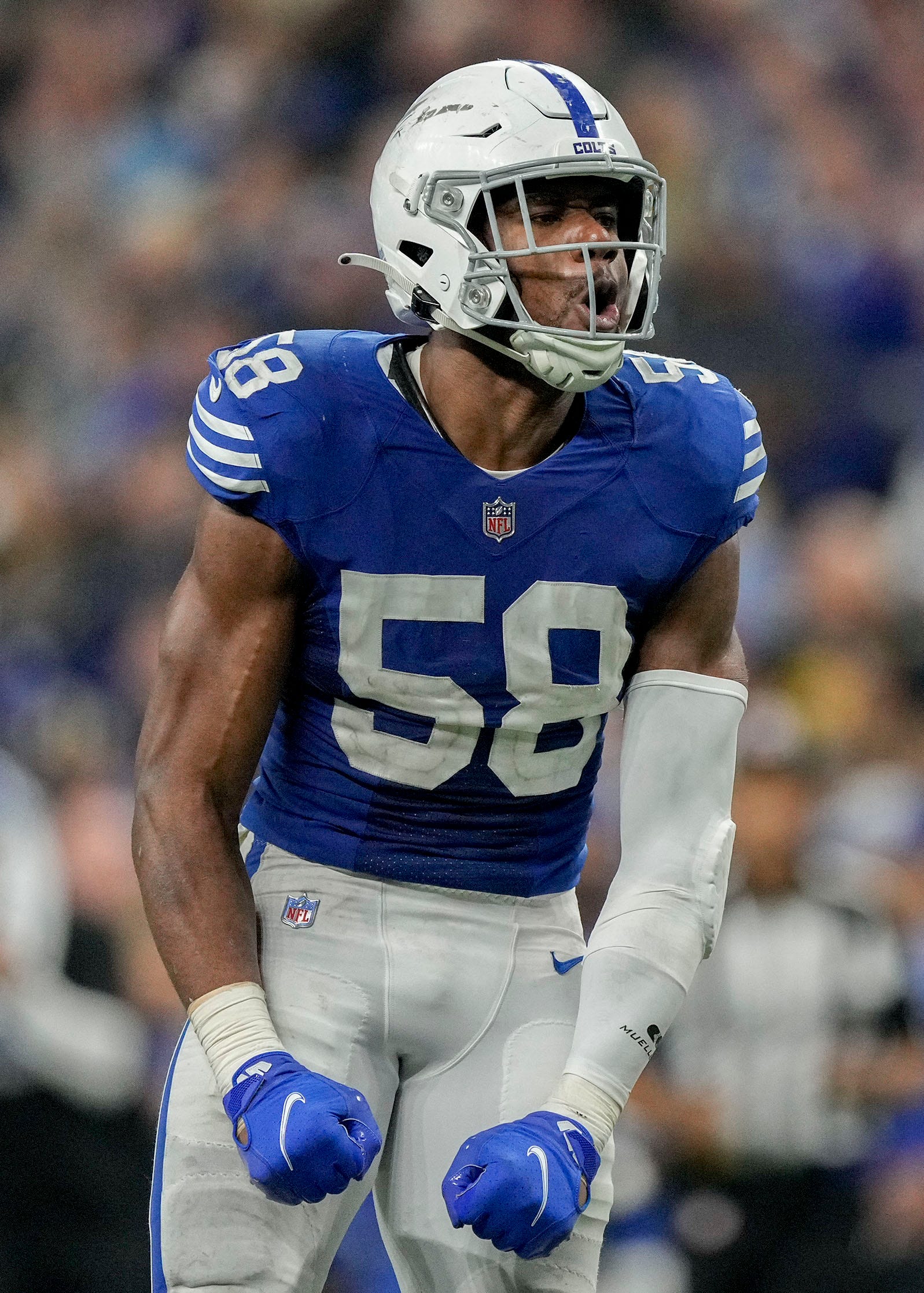
Unleashed after the Colts did not re-sign Anthony Walker in 2021, Okereke combined for 283 tackles over the past two seasons — ninth-most in that span — and forced two fumbles last year. Considering Martinez received $10MM per year in 2020, this might represent a bit of value for the Giants, even though the crowded ILB market settled in below this point.
The contracts given to Campbell and Jamison Crowder show modest confidence, and taken in with Beasley’s deal along with the Shepard re-signing and Robinson draft choice, this Giants regime certainly has a type at receiver. Jokes about Big Blue’s slot receiver hoarding aside, Campbell’s injury trouble from 2019-21 led to this small guarantee.
The ex-Ohio State speedster was a non-factor over his first three NFL years, but as eyes fixated elsewhere during a disastrous 2022 Colts campaign, he played 17 games and posted 623 receiving yards. Campbell, 26, seems a safe bet to make the team, while Crowder (30) is more a flier. A decent slot contributor in Washington and with the Jets (three 700-yard seasons), Crowder is coming off a season in which a fractured ankle limited him to four games with the Bills.
Even with Williams and Lawrence entrenched up front, the Giants ranked 27th against the run last season. They brought in Robinson and Nunez-Roches to help the cause. PFF rated Robinson as a top-30 run defender among D-tackles last year, and the ex-Lions draftee started for a Super Bowl-winning Rams outfit a season prior. Nunez-Roches (30) and Robinson (28) should have promising opportunities alongside the Giants’ big two up front. If nothing else, each provides some stability after the Giants lacked depth here last year.
Notable losses:
- Landon Collins, S/LB
- Justin Ellis, DT
- Jon Feliciano, C
- Nick Gates, OL
- Kenny Golladay, WR (released)
- Richie James, WR
- Tony Jefferson, S (retired)
- Marcus Johnson, WR
- Julian Love, S
- Fabian Moreau, CB
- Jaylon Smith, LB
- Nick Williams, DL
Not using the post-June 1 designation on Golladay, the Giants are taking the entire $14.7MM dead-cap penalty in 2023. Responsible for two 1,000-yard seasons in Detroit, the slow-footed target quickly showed in New York he would not come close to replicating that production. Daboll banished Golladay from the Giants’ receiver rotation last season, going with Slayton and low-end additions Richie James and Isaiah Hodgins as his primary wideouts. James (561 yards last season, easily a career-high total) signed with the Chiefs this offseason, but it is not exactly like the Giants are hurting for slot receiver types.
Love may have joined C.J. Gardner-Johnson in misreading the market. As the Eagles safety ended up taking a one-year deal worth $6.5MM with the Lions, Love joined the Seahawks for two years and $12MM. But the Giants expected to re-sign the improving safety. Their offseason offer was believed to be worth more than what the Seahawks proposed, but after the market opened, it appears likely the Giants — after paying Okereke, Nunez-Roches and Slayton — were moving in a different direction. Love signed with Seattle five days into free agency. He joined a team that already had the most money allocated to safeties, thanks to the top-five Jamal Adams pact and Quandre Diggs‘ quality third contract.
Former Jets draftee Jason Pinnock, who made five starts for the Giants last season, joins McCain, 2022 fourth-rounder Dane Belton and converted cornerback Nick McCloud in competition to start alongside Xavier McKinney. Pinnock worked as McKinney’s primary fill-in when the latter sustained injuries in an ATV accident. The Giants let two safeties (Logan Ryan, Jabrill Peppers) go last year, moving to Love, who delivered a 124-tackle slate in being used across the formation under Martindale. Love will not be easy to replace, but the Giants have an array of options they are considering.
Rumored to be on the Giants’ extension radar, Gates and Feliciano are now in Washington and San Francisco, respectively. Gates’ exit has introduced a guard competition, one that primarily involves Ben Bredeson and 2022 third-rounder Joshua Ezeudu.
Draft:
- Round 1, No. 24 (from Jaguars): Deonte Banks, CB (Maryland) (signed)
- Round 2, No. 57: John Michael Schmitz, C (Minnesota) (signed)
- Round 3, No. 73 (from Browns through Texans and Rams): Jalin Hyatt, WR (Tennessee) (signed)
- Round 5, No. 172: Eric Gray, RB (Oklahoma) (signed)
- Round 6, No. 209 (from Chiefs): Tre Hawkins, CB (Old Dominion) (signed)
- Round 7, No. 243: Jordon Riley, DT (Oregon) (signed)
- Round 7, No. 254: Gervarrius Owens, S (Houston) (signed)
No team was more closely connected to this year’s batch of first-round receivers than the Giants, who both met with the top four (Jaxon Smith-Njigba, Quentin Johnston, Zay Flowers, Jordan Addison) around their pro days and brought them in for “30” visits. The Giants, who had pursued Odell Beckham Jr. before surprising Ravens offer won that race over both New York teams, also explored trade-up avenues — with Flowers being the reported target. But no path emerged, leaving the team to address another need in Round 1.
With answers beyond Adoree’ Jackson scarce at corner, whom the team is not preparing to extend before this season, the Giants chose Banks. The Giants lost Jackson to an MCL sprain and spent most of last season without their planned CB2 — Aaron Robinson. With question marks at corner, the team will need to count on Banks, a multiyear Maryland starter who enhanced his value after an early-season shoulder sprain kiboshed his junior year, to start immediately. As a senior in 2022, the 6-foot cover man held his own in a matchup with high-end Ohio State receiver prospect Marvin Harrison Jr. and finished with eight pass breakups.
The Giants showed early interest in Schmitz and made him this draft’s first pure center pick. Big Blue’s second-round choice came down to a Schmitz-or-Hyatt decision, and with the Biletnikoff winner falling out of Round 2, Schoen pulled the trigger on a 16-spot trade-up. Schmitz will be expected to start before Hyatt, as the Giants let Feliciano — their 2022 center starter — walk in free agency.
This pick comes nine years after the Weston Richburg second-round investment. Since Richburg’s 2018 free agency exit, the Giants have deployed a different primary center (Spencer Pulley, Jon Halapio, Nick Gates, Billy Price, Feliciano) in each season. They will call on Schmitz, who earned second-team All-Big Ten honors as a junior and first-team acclaim as a COVID-year senior, to stop the carousel.
The receiver investment the Giants circled back to, Hyatt brings a different dimension to a slot-heavy Giants receiving corps. He of a five-touchdown performance in Tennessee’s win over Alabama last season, Hyatt broke out after two off-grid years in Knoxville. That junior-season showing prompted the Giants to meet with him pre-draft and then take him at 73. Hyatt’s 4.40-second Combine 40-yard dash clocking surprised some, illustrating the speed profile the 6-footer had created, but a hamstring ailment had bothered him at that point. With the Giants lacking a long-term outside presence, Hyatt should be given an opportunity to commandeer this role in Daboll’s offense.
Other:
Last year’s surprising work on offense garnered Kafka and Tierney looks, and despite a 29th-place DVOA finish (albeit with a host of starters missing time with injuries), the Giants’ defensive performance led to Martindale returning to the HC carousel for the first time since the Giants interviewed him in 2020. Martindale, 60, is tied to a three-year contract. If Jones takes another step, Kafka — the team’s play-caller — will be a tough candidate to ignore come 2024. A closer Tierney OC look will probably follow as well.
The Giants hired Jeff Nixon to replace Smith. This marks an interesting addition, with Nixon having been a Matt Rhule assistant — at Baylor and with the Panthers — for the past six years. Nixon spent time in the NFL prior to his Rhule ties, though.
Top 10 cap charges for 2023:
- Leonard Williams, DT: $32.26MM
- Daniel Jones, QB: $21.75MM
- Adoree’ Jackson, CB: $19.08MM
- Saquon Barkley, RB: $10.09MM
- Andrew Thomas, LT: $9.29MM
- Mark Glowinski, G: $8.35MM
- Kayvon Thibodeaux, OLB: $7.12MM
- Tyrod Taylor, QB: $6.9MM
- Dexter Lawrence, DT: $6.65MM
- Evan Neal, RT: $5.58MM
An extension brought down Lawrence’s 2023 cap number, but the Giants have not discussed a second re-up with Williams just yet. The 29-year-old D-tackle carries the largest 2023 cap hit for any defender. It will be tougher for the Giants to carry two big-ticket D-line contracts in 2024, when Jones’ cap number — barring a restructure — will spike to $45MM. Thomas’ $23.7MM 2024 cap figure and Lawrence’s $21.9MM number further complicate Williams’ Big Apple future.
As for this year’s team, expectations are higher compared to 2022. The Giants do face five 2022 playoff teams in their first six games, with a date with the now-Aaron Rodgers-fronted Jets in Week 8. Even in a shallower NFC, the team will be challenged to stay afloat early. Potential Barkley disharmony will be a storyline to monitor, considering the other payments the Giants handed out and running backs now holding meetings to discuss their depressed market. Barkley’s 2023 workload also ties directly to an ability to score what could be a last-chance free agency payday, making his carry count a potential plotline as well.
Jones’ progress after a 2022 step forward will still be the biggest factor in determining whether the Giants can sustain their momentum. Development from the highly drafted Schoen players to go along with the established Gettleman-era bastions will aid Jones, but the scrutiny — as many are naturally viewing the middling QB’s payment as out of step given the Barkley saga’s 2023 conclusion — does not figure to let up anytime soon. The fifth-year QB should be in better position this year, however, positioning the Giants to see if they made the right call.
By Sam Robinson |
at July 26, 2023 9:50 pm
Like Doug Pederson, Nick Sirianni led the Eagles to a Super Bowl in his sophomore HC effort. The endings proved different, as Philadelphia’s defense could not stop Patrick Mahomes in a shootout, but the Eagles went from 9-8 in 2021 to the NFC’s best team. While this represents considerable progress after the team did not tumble onto the rebuilding tier — as many expected — in 2021, this offseason featured defections from both starters and staffers.
Two new coordinators and five new defensive starters will be in place this season. The Eagles, however, hover as the NFC favorites. Their roster blueprint has also changed. The quarterback they once drafted as Carson Wentz insurance is now signed to a monster extension.
Extensions and restructures:
Hurts has completed one of the most remarkable ascents in modern quarterback history. Eagles brass was split on the ex-Alabama and Oklahoma passer, with some in the organization wanting the team to take safety Jeremy Chinn in the 2020 second round. The Eagles defied traditional roster-building measures by selecting Hurts in Round 2, doing so less than a year after giving Wentz a $32MM-per-year extension. They took on a then-record dead-money hit ($33.8MM) by trading Wentz in 2021, but even after Hurts spent a full season as a starter, Philly was not fully committed to him.
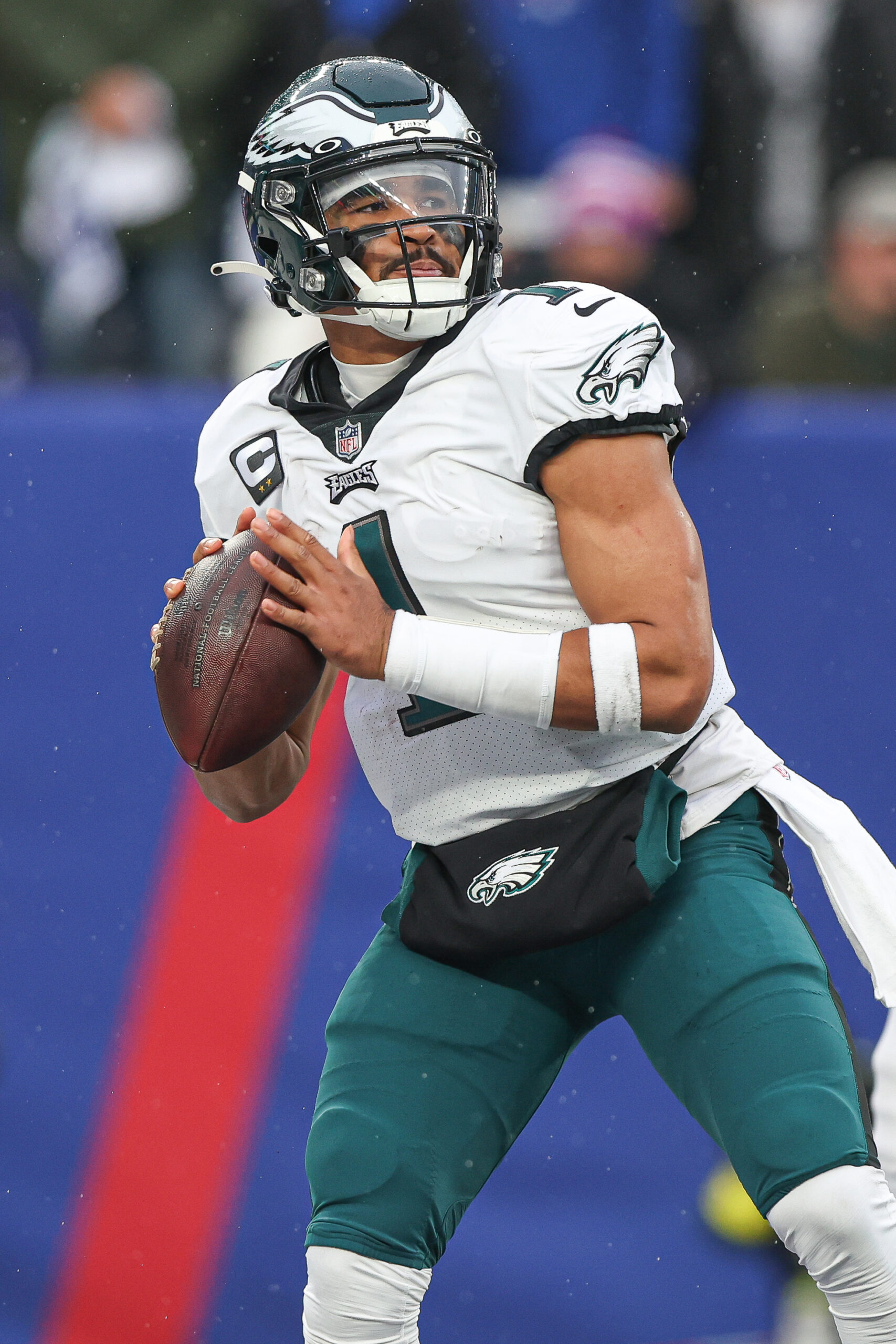
Jeffrey Lurie expressed hope the Eagles would not bring in a quarterback to compete with Hurts in 2021, but during the season, the owner was still believed to be higher on the then-accuracy-challenged QB than Howie Roseman. In turn, the Eagles looked into higher-profile trade options in 2022. But neither Russell Wilson nor Deshaun Watson would waive their respective no-trade clauses to join the Eagles. Philly did not end up a finalist for Watson. Although the Eagles had wanted Wilson in the 2012 draft and were prepared to make a substantial trade offer to the Seahawks 10 years later, the perennial Pro Bowler steered his way to the Broncos. Wilson’s no-trade clause now looms as a significant Eagles “what if?” scenario, as Hurts removed much of the doubt about his future last season.
The Eagles went 16-2 in games Hurts started last year, and the stout quarterback went toe-to-toe with Mahomes in Super Bowl LVII. Hurts’ completion rate (66.5%), yards per attempt (8.0), passer rating (101.5) and QBR (66.4 — fourth overall) took substantial leaps last season. Philadelphia’s decision to trade for A.J. Brown paid off in more ways than one, with the ex-Titans wideout breaking the Eagles’ single-season receiving record and aiding Hurts in the process. Philly’s years-long commitment to beefing up its offensive line boosted Hurts as well, as his nearly unstoppable QB sneak — which the NFL considered outlawing before standing down this offseason — became a tremendous drive-extending or drive-finishing tactic that benefited the Eagles (and fantasy GMs) in key spots.
Hurts going from an uncertain piece in the Eagles’ big-picture puzzle to surefire extension candidate could have made talks complicated, especially with the Eagles having a 2024 franchise tag at their disposal. But the soon-to-be 25-year-old QB signed in April. Just as they had done in 2019 with Wentz, the Eagles went first on a QB extension. This paved the way for the Ravens to end their years-long impasse with Lamar Jackson, which led to the Chargers’ Justin Herbert deal and will set up Joe Burrow to finish this round of market reshaping.
Hurts did not flirt with Watson-like guarantees, with the deals for he, Jackson and Herbert successfully pegging the Browns contract as an outlier. The Eagles gave Hurts $110MM guaranteed — a cool $120MM south of Watson’s monstrous figure — and used a startling seven void years to spread out the cap hit. As a result, Hurts will not even count $40MM on the Eagles’ cap until 2027. By then, the salary cap could be close to $300MM. Of course, Hurts will need to continue on the path he started in 2022 to justify this expense. The Eagles were not shy about recommitting to a quarterback, despite Wentz rapidly fading from franchise centerpiece to supplanted starter. And while the team let a number of key defenders walk in free agency, most of the same pieces remain in place for Hurts to succeed going forward.
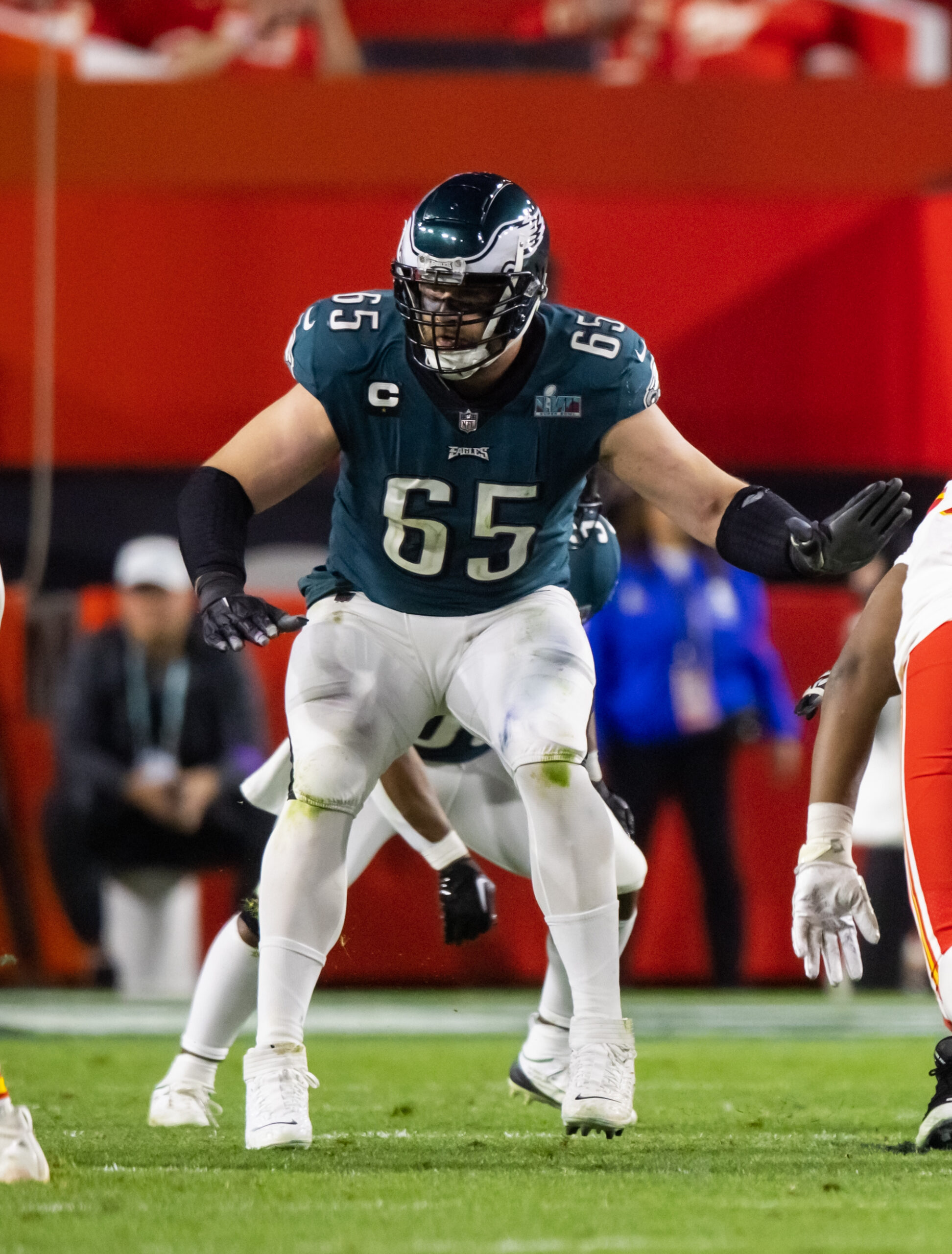
One of those is Johnson, who has been the Eagles’ right tackle since Michael Vick‘s final season with the team. This is the former No. 4 overall pick’s fourth contract with the Eagles, who previously extended him in 2016 and 2019. This contract only tacked on a year to Johnson’s deal but rewarded the cornerstone lineman with $30MM in additional guarantees. Johnson played through an adductor tear in the playoffs, putting off surgery. If Johnson plays out this contract, he could pass Tra Thomas for the most starts by a tackle in Eagles history. As of now, Johnson (127 starts) sits fourth on that list. But he has been an indispensable cog for the Eagles.
On the Hall of Fame radar as a three-time All-Pro, Johnson aided LeSean McCoy to a rushing title and helped the Eagles lead the league in rushing in 2021. Wentz and Hurts have benefited tremendously from the 10-year veteran, and while the Eagles have a replacement for Jason Kelce in place, they have not made plans to succeed Johnson just yet. This will be Johnson’s age-33 season; Pro Football Focus has ranked the Wisconsin product as a top-10 tackle during each of Hurts’ full seasons as a starter. The extension, which includes three void years, dropped Johnson’s 2023 cap hit by more than $9MM.
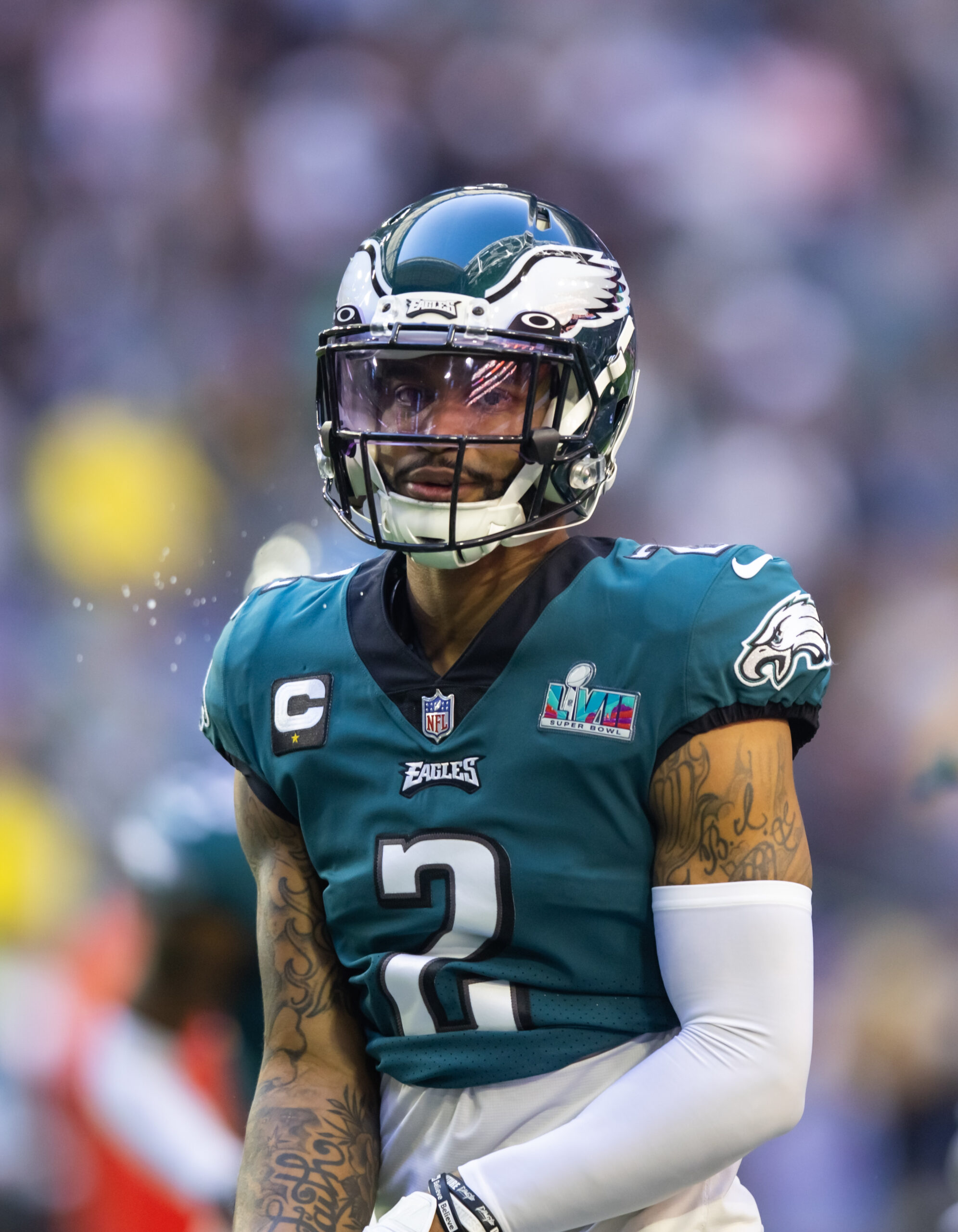
Johnson’s status with the Eagles was not in question, but Slay’s was during an eventful March span. In less than a week’s time, the decorated cornerback went from discussing an Eagles extension to being granted permission to seek a trade to moving close to a post-June 1 cut designation to making it back to the extension radar and finalizing a deal. The Eagles had talked terms with Slay, who was going into the final season of a three-year, $50MM contract. After those discussions — which may or may not have included a pay-cut request — did not progress, the Eagles allowed him to talk trades. The Ravens and even the Cowboys came up as suitors, but the Eagles and Slay found a resolution.
This did make for an interesting turn of events, as Slay turned 32 in January. Yet the Eagles will guarantee him $23MM — not bad for a player who has now signed three extensions and already pocketed nearly $87MM during a 10-year career. The Eagles made a modest bet on Slay in 2020, prying him from the Lions for third- and fifth-round picks. The former third-rounder has provided considerable ROI, making two Pro Bowls as an Eagle. PFF slotted Slay as a top-25 corner in both years, and while teams do not make a habit of giving 30-something corners big-money deals, this pact will keep Slay’s cap hits below $12MM in 2023 and ’24.
This deal will keep Darius Slay–Darius Slayton matchups coming for at least another year, thanks to the latter’s Giants re-signing, and because of the four void years attached, Slay would bring at least $9MM in dead money if cut at any point before 2026.
Trades:
Swiftly becoming expendable after the Lions chose multipurpose back Jahmyr Gibbs at No. 12, the former Detroit second-round pick generated interest from multiple teams. The oft-RB-inquiring Dolphins emerged on the radar, but the Eagles pulled the trigger on a deal. A much brighter future could exist for Swift in Philadelphia. Being phased out in Detroit, the Georgia product has a chance to start for a team that just booked a Super Bowl berth.
Injuries have impeded Swift for much of his NFL career, but the pass-catching back has never missed more than three games in a season. Swift totaled 25 touchdowns in Detroit, amassing 2,878 scrimmage yards over his first three seasons. Swift has never taken more than 151 handoffs in a season. His 364 career carries certainly could appeal to the Eagles, who let Miles Sanders (739 career totes) walk in free agency.
The Eagles are open to a Swift extension, but it will likely depend on how he performs in a contract year. This is not a good time for RB value, but Swift’s receiving prowess could help him. That said, the Eagles have not been big on involving their backs in the passing game since Hurts’ debut. Sanders totaled 20 catches for 78 yards last season, while Kenneth Gainwell led Philly backs with 169 receiving yards. It is possible the Eagles will explore this dimension further with a better receiving RB, but early returns with Hurts do not bode well for the 24-year-old’s aerial skills to be utilized properly.
Re-signings:
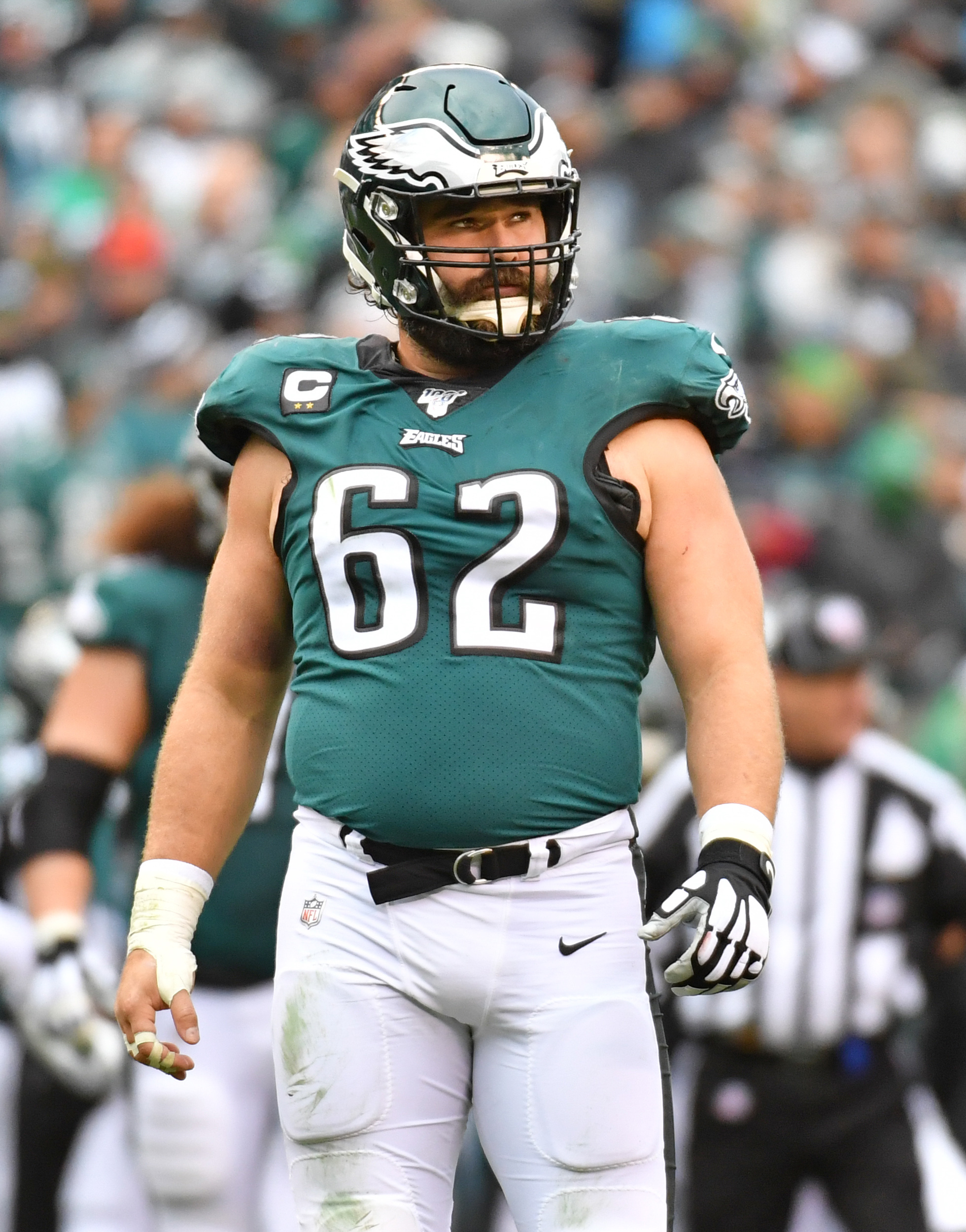
Three of the Eagles’ core four along their lines played on expiring deals last season. Despite each player having at least 11 years’ experience, the batch of 30-somethings is back for at least one more go-round. Kelce again considered retirement, but the All-Pro center/podcast host/SNL special guest re-signed for a 13th season. The longest-tenured Eagle, Graham is back for a 14th year. Although Philly has now drafted defensive tackles from Georgia in each of the past two years, Cox remains in the team’s plans ahead of his 12th season. Graham, Kelce and Cox all arrived during Roseman’s first three years as GM; they join Johnson as part of a storied quartet in Eagles history.
Read more
Kelce’s return is probably the most important here, as he anchored the Super Bowl LII-winning O-line and has delivered top-shelf work since. The rare player to use his 30s as his central Hall of Fame case, Kelce almost definitely will be Canton-bound because of the past six seasons. Since his age-30 campaign in 2017, Kelce has snagged five of the six first-team All-Pro slots at center. This includes each of the past two. The gregarious blocker serves as a linchpin for the Eagles’ offense, which has successfully broken in Hurts and Wentz (and enabled strong Nick Foles work when similar form has eluded the Super Bowl MVP everywhere else).
The Eagles keep drafting Day 2 interior O-linemen, but the organization still does not need its Kelce heir apparent to start. Kelce has not missed a game since the 2014 season. And yes, void years are present in Kelce’s contract, along with the Cox and Graham pacts. The Eagles also have dummy years in place for 2024 for the trio, making each eligible for post-June 1 cut designations next year. Though, only two such moves are allowed per offseason. And given the value the organization places on these veterans, it should not be ruled out more one-year contracts could transpire.
After seven straight seasons as a starter, Graham stepped into a reserve role and thrived. Helping the Eagles (70 sacks) push for the 1984 Bears’ single-season record (72), Graham collected a career-high 11 and forced two fumbles. This was Graham’s first double-digit sack season, and he will return to play a complementary role alongside Haason Reddick and Josh Sweat. Graham, 35, said other teams pursued him as well. The Eagles have not re-signed Robert Quinn, but Derek Barnett — who suffered a Week 1 ACL tear — is still with the club.
As highly drafted pieces keep entering the equation, Cox remains stationed as a veteran presence on the Eagles’ interior D-line. Cox’s seven sacks were his most since 2018. While the 2012 first-rounder no longer has a claim to being the best non-Aaron Donald D-tackle, Cox has missed all of two games over the past five seasons. PFF assigned Cox a career-worst grade, slotting him outside the top 65 among interior D-linemen last season. The Eagles also signed both Linval Joseph and Ndamukong Suh to help Cox hold down the fort during Jordan Davis‘ injury absence. With both unsigned and Javon Hargrave in San Francisco, Cox should still be expected to be a regular presence. After a 2022 release/reconciliation sequence and Jalen Carter‘s April arrival, will this be it for Cox in Philly?
It looked like Bradberry would join Hargrave and Co. in pricing himself out of Philly, but the reigning NFC champs prioritized their outside defenders over just about everyone up the middle. Bradberry, who is going into his age-30 season, joined the rest of the secondary in benefiting from Philly’s dominant pass rush. But the former Panthers and Giants corner rebuilt his value after being a post-draft cap casualty last year.
The Giants were close to trading Bradberry to the Texans in 2022, but after Houston extension talks went nowhere, the former second-round pick ended up in free agency at a bad time. Bradberry signed a one-year, $7.25MM Eagles deal and worked as a full-time starter. Bradberry did not quite fetch as much as he did during the 2020 offseason, but this represents a nice payday for the veteran. PFF gave the veteran boundary corner a top-30 grade for his Eagles work. With this Bradberry re-up, the Eagles will be the only team preparing to trot out two 30-something outside corners this season. This against-the-grain strategy will leave the team in need of long-term help at the position
Free agency additions:
- Marcus Mariota, QB: One year, $5MM ($5MM guaranteed)
- Boston Scott, RB: One year, $2MM ($1.1MM guaranteed)
- Olamide Zaccheaus, WR: One year, $1.23MM ($650K guaranteed)
- Terrell Edmunds, S: One year, $2MM ($600K guaranteed)
- Greedy Williams, CB: One year, $1.35MM ($600K guaranteed)
- Rashaad Penny, RB: One year, $1.35MM ($600K guaranteed)
- Kentavius Street, DL: One year, $1.28MM ($500K guaranteed)
- Dan Arnold, TE: One year, $1.19MM ($50K guaranteed)
- Nicholas Morrow, LB: One year, $1.16MM
- Justin Evans, S: One year, $1.2MM
- Dennis Kelly, T
The Eagles devoted their dollars to in-house options this offseason, taking some free agency fliers to balance out the higher costs on their two-deep. Mariota, 29, will better match Hurts’ skillset compared to Gardner Minshew, and this is a nice bounce-back spot for the former No. 2 overall pick. Jacoby Brissett drew Eagles interest, but the Commanders gave him an $8MM guarantee.
After the Falcons benched Mariota, he essentially left the team and became an obvious cap casualty this offseason. The ex-Titans draftee started 13 games in 2022 and has eight seasons — both as a starter (74 career starts) and a backup — under his belt. The Eagles needed to give Minshew three starts due to Hurts injuries over the past two seasons, providing a good reason for the $5MM Mariota guarantee. This is a full-circle move of sorts for Mariota, whom Chip Kelly aimed to reunite with via a proposal to trade up in the 2015 draft. (Kelly’s year ahead of Roseman in the Eagles’ organizational hierarchy was wild.)
Edmunds, Morrow and Zaccheaus loom as potential low-cost starters. The Eagles waited until the end of training camp to acquire C.J. Gardner-Johnson last year, but even in the event of another trade at the position, it would seem Edmunds (75 starts in Pittsburgh) would have a good chance to be a post-CJGJ/Marcus Epps solution in Philly. That said, Reed Blankenship made four starts for the team last season. Either way, the Eagles will have two new primary safety starters in 2023.
A Philadelphia native, Zaccheaus will challenge Quez Watkins for the Eagles’ slot receiver job. The Falcons lost Julio Jones, Calvin Ridley and Russell Gage during Zaccheaus’ tenure, and the former UDFA has totaled 939 receiving yards over the past two years. At 6-foot, Watkins presents better size compared to the 5-8 Zaccheaus. But his yardage total slipped from 647 in 2021 to 354 last year. A.J. Brown‘s presence undoubtedly affected Watkins’ target share.
The Eagles are preparing to take the training wheels off Nakobe Dean, giving the ex-SEC Defensive Player of the Year a chance to start alongside some of his former teammates. Morrow, though, has the early lead to be the other Eagles ILB starter. Since ditching the Mychal Kendricks and Nigel Bradham contracts, the Eagles have gone with low-level contracts on their defensive second level. After letting Kyzir White rejoin Jonathan Gannon in Arizona, the Eagles are still leaning in this direction. Morrow, 28, rebounded from a full-season absence in 2021 to start 17 games for the Bears. The ex-Raider made a career-high 116 tackles (11 for loss) but found no market for his services.
Notable losses:
- Andre Dillard, T
- T.J. Edwards, LB
- Marcus Epps, S
- C.J. Gardner-Johnson, S
- Javon Hargrave, DT
- Brett Kern, P (retired)
- Linval Joseph, DT
- Zach Pascal, WR
- Robert Quinn, DE
- Miles Sanders, RB
- Isaac Seumalo, G
- Ndamukong Suh, DT
- Kyzir White, LB
Paying Hurts and finding more room for Slay and Bradberry’s latest contracts, the Eagles said goodbye to several defensive starters. Both the team’s top linebackers and safeties from last season are gone. Philly has not devoted many resources to filling these roles, either. Even with two new starters at linebacker and safety, a D-line loss represents the most noticeable change from last season.
Being the third wheel alongside Cameron Heyward and Stephon Tuitt in Pittsburgh, Hargrave still fetched a $13MM-per-year deal from the Eagles in 2020. Pennsylvania’s NFC team was proven correct in its assessment of the Steeler defender. Hargrave became one of the NFL’s best interior D-linemen while in Philly, notching 18 QB hits during a Pro Bowl 2021 season and posting his first double-digit sack season (11) to help the Eagles threaten that Buddy Ryan-era Bears mark.
Hargrave, 30, locked in a $21MM AAV with San Francisco; that contract makes more sense for a team that has Brock Purdy‘s seventh-round rookie deal on its books than it would on a Hurts-fronted payroll. Still, Hargrave’s production will be difficult to replace.
Dillard never caught on as a full-time starter, despite the Eagles trading up for him in the 2019 first round. But he came up in rumors before multiple trade deadlines, eventually fetching a three-year, $29MM deal from the Titans. Seumalo was part of both Eagles Super Bowl O-lines, serving as a 2017 backup before signing an Eagles extension in 2019. That deal led to multiple lengthy injury absences (2020 and ’21) before the former third-round pick put together a nice contract year. The Steelers gave Seumalo his third NFL deal — a three-year, $24MM accord — leaving Cam Jurgens as the frontrunner to replace him.
With more than half their starting defense hitting free agency or set to see their contracts void, the Eagles attempted to prioritize a Gardner-Johnson re-signing. The late-summer trade acquisition thrived as a safety, converting from the slot corner post he manned in New Orleans, tying for the 2022 INT lead (six) despite missing five games. But the brash DB viewed a multiyear Eagles offer as unsatisfactory. This led to a strange outcome in which CJGJ signed a one-year, $6.5MM Lions deal. This helped free up money for Bradberry. The fifth-year cover man’s Detroit tenure is off to a bad start, with an early-camp knee injury sidelining him.
In what turned out to be a crushing offseason for the running back position, the writing appeared on the wall for Sanders early. Sanders, 26, was interested in staying, but Roseman was not expected to devote much funding to running back. In a buyer’s free agent market at a position that has seen its value crater, other GMs felt the same. Sanders still did fairly well, leading this free agency class with a four-year, $25.4MM Panthers deal. His $13MM guarantee ended up outpacing franchise-tagged backs Saquon Barkley, Josh Jacobs and Tony Pollard.
The Hurts years moved Sanders to largely a one-dimensional role. But the former second-round pick delivered plus ground work last season, accumulating 1,269 yards and 11 touchdowns. Swift, Penny and Kenneth Gainwell bring a much cheaper succession plan.
Draft:
Round 1, No. 9 (from Bears): Jalen Carter, DT (Georgia) (signed)
Round 1, No. 30: Nolan Smith, LB (Georgia) (signed)
Round 3, No. 65 (from Texans): Tyler Steen, G (Alabama) (signed)
Round 3, No. 66 (from Cardinals): Sydney Brown, S (Illinois) (signed)
Round 4, No. 105 (Texans through Cardinals): Kelee Ringo, CB (Georgia) (signed)
Round 6, No. 188 (from Saints through Texans): Tanner McKee, QB (Stanford) (signed)
Round 7, No. 249 (from Chiefs through Lions): Moro Ojomo, DT (Texas) (signed)
If Carter did not face charges in connection with a street-racing accident that left two members of the Georgia program dead, the Eagles would not have been in position to draft the dominant defensive tackle prospect. The Seahawks, Lions, Raiders, Falcons and Bears were each connected to Carter and hosted him on a pre-draft visit. Seattle and Las Vegas chose other defensive players instead; Chicago traded down. The Bears’ move set up the Eagles, who will surround Carter with three of his former Bulldog defensive teammates (Smith, Dean, Jordan Davis) in an effort to move him toward a steady path.
Carter said the Eagles did not probe deeply into the January incident, which saw a plea deal reached but multiple civil complaints involving this draft’s top D-tackle prospect come out. Some teams viewed Carter as unapologetic, likely leading to the slight draft slide. ESPN’s Scouts Inc. slotted Carter as this year’s sixth-best prospect, but he played the lead role on both national championship-winning Georgia defenses. He also struggled through his pro day, inviting more questions. If the Eagles’ gamble pays off and Carter utilizes the power-quickness combo that made him a feared SEC presence, Hargrave’s exit may not sting much, and the formation of a Georgia-to-Philadelphia long-term DT combination will loom as a threat to the rest of the NFC.
NFL.com’s Daniel Jeremiah offered Haason Reddick as a Smith comp; the Eagles will deploy both soon. An undersized edge rusher, Smith did not post impressive numbers during Georgia’s championship campaigns. He finished with 7.5 sacks and 15 tackles for loss over the past two seasons. Though, a torn pec limited Smith to eight games in 2022. The Eagles were impressed with the young pass rusher, who clocked a 4.39-second 40-yard dash at the Combine. Smith’s quick-twitch rushing ability unveils an intriguing ceiling, with the Eagles’ Reddick investment doing plenty to blaze another trail to a Super Bowl. Once again, the Birds boast considerable edge-rushing depth, with Derek Barnett still in the mix alongside Reddick, Graham, Smith and Josh Sweat.
Although Jurgens is the favorite to take over for Seumalo, he has also been the Kelce heir apparent. If Steen cannot wrest the right guard job from Jurgens’ grasp this year, he will provide swing depth. If Kelce hangs up his cleats after this season, the Eagles’ 2024 O-line may well feature each of their recent three Day 2 picks — Jurgens, Steen, Landon Dickerson — on the interior. A Vanderbilt transfer who started at both left and right tackle for the Commodores, Steen spent last season as Alabama’s left tackle. That high-profile college spot will enhance the appeal of Philly’s upcoming RG competition.
Other:
Some impropriety on the Cardinals’ end led the Eagles improving their third-round draft slot, keying the Sydney Brown pick, and it also may have affected Vic Fangio‘s decision to leave for Miami and not transition from Philly consultant to defensive coordinator. The Dolphins were clearly prepared to put up a fight in this winter market, paying up — in the $4.5MM-per-year range — to add Fangio. The Eagles went with ex-Fangio Bears lieutenant Desai, whose 2021 Chicago DC work might be slept on a bit. Despite losing Khalil Mack midway through the season, the Bears ranked sixth in total defense during Desai’s lone year in charge. DVOA ranked that unit 13th.
Desai, 40, beat out Wilson for the position, leading the latter to Baltimore. While Vance Joseph was in the mix as well, Sean Payton enticed the former Broncos HC to come back as his DC.
Johnson, 36, profiled as a natural fit, having been Hurts’ position coach for the past two seasons. The former Florida OC, who unleashed Kyle Pitts in 2020, is expected to make a major level jump this season; Sirianni has indicated he is not planning to call plays. While Sirianni began his Eagles tenure as the team’s play-caller, he gave Steichen the gig midway through the 2021 slate. That decision opened the door to a No. 1 rushing ranking that year and Hurts making a seminal leap in 2022. Johnson, who also was QBs coach at Mississippi State during Dak Prescott‘s mid-2010s ascent, will attempt to keep this car in the fast lane.
Transitioning after Gannon, Wilson and Rallis left, the Eagles hired an experienced consultant of sorts in Patricia. Due both to Patricia’s success unfolding entirely under Bill Belichick — excluding his bizarre 2022 appointment as de facto Patriots OC — and past with Darius Slay, this is one of the NFL’s most interesting senior assistant-type hires in years. The Pro Bowl corner and then-Lions HC famously clashed, helping lead to Slay ending up in Pennsylvania via trade. The Eagles felt the need to clear the Patricia hire with their top corner before going through with it. Given Slay’s past animosity toward his former coach, the Eagles going in this direction made for an unexpected hire.
Top 10 cap charges for 2023:
- Lane Johnson, RT: $14.72MM
- Darius Slay, CB: $11.87MM
- Jason Kelce, C: $10.76MM
- Brandon Graham, DE: $10.1MM
- A.J. Brown, WR: $8.32MM
- Jordan Mailata, LT: $7.47MM
- Haason Reddick, OLB: $6.96MM
- Dallas Goedert, TE: $6.26MM
- Jalen Hurts, QB: $6.15MM
- Josh Sweat, DE: $5.86MM
Hurts’ post-Steichen trajectory will define this Eagles offseason, as he saved the Eagles after their last such commitment went bad fast. The Eagles entered their previous post-Super Bowl season as the favorite to repeat, but Wentz’s issues helped key a steady fade. Philly kept investing on its lines, which should help mitigate the losses of Seumalo and those at linebacker and safety. Once again, the defending NFC champions will walk into a season with high expectations.
The Eagles may have a friendlier road back to the Super Bowl compared to the Chiefs, with the NFC being potentially the far shallower conference. But the Chiefs have a Mahomes-provided fast pass to deep playoff destinations. Can Hurts supply his team with a similar gateway?
By Sam Robinson |
at July 17, 2023 9:50 pm
For the second time in franchise history, the Jaguars overcame a 2-6 start to make the playoffs. The last time the team did so (1996), a run of playoff appearances followed. This Jaguars nucleus has similar ingredients in place compared to the Mark Brunell-fronted teams of the late ’90s. At the center is Trevor Lawrence, the former No. 1 overall pick who shook off a rough rookie season to emerge as a factor in the QB-rich AFC. The Jags’ 27-point playoff rally past the Chargers and competitive effort against the eventual champion Chiefs would seemingly depict a clear team on the rise.
The organization proceeded accordingly this offseason, not doing much to tamper with the roster it assembled during the 2022 free agency period. The Jags enter the season as favorites in what appears to be the AFC’s weakest division. How much more of a level jump can the 2023 edition make?
Extensions and restructures:
The Jaguars look to have made several strong investments in 2022. While the rest of the A- and B-listers from that pricey lot received multiyear deals, Engram needed to prove his value after an inconsistent Giants run. The former first-round pick did that, establishing a new Jaguars single-season best for tight end receiving yardage (766) last season. Although the Jaguars also had right tackle Jawaan Taylor looming as a free agent, they slapped a less expensive franchise tag ($11.35MM) on Engram. After both sides expressed interest in a long-term partnership, an agreement emerged barely 24 hours before this year’s deadline for tagged players to sign extensions.
As the tight end position remains undervalued relative to its best players’ contributions, Engram and contract-year Vikings tight end T.J. Hockenson represented this year’s needle-movers on the financial front. But Engram is both going into his age-29 season and has not been a reliable pass catcher from a year-to-year perspective. As such, he and the Jags reached common ground short of the $17MM-per-year positional ceiling Darren Waller established in September 2022. At $13.75MM per year, Engram is now the NFL’s sixth-highest-paid tight end.
It is a bit surprising Engram could not clear the $14MM-AAV barrier, seeing as the salary cap is back on its steady rise after a 2021 reduction. Both Mark Andrews and Dallas Goedert signed $14MM-per-year deals in 2021, and Engram’s 2022 season featured better production than either of Waller’s past two slates. The Ole Miss alum became one of Lawrence’s go-to targets, adding 12 catches for 124 yards and a touchdown during Jacksonville’s two playoff games. In terms of guarantees, Engram did slightly better. The $24MM, which covers this year’s franchise tag and the tag amount had Engram been cuffed in 2024 as well, checks in fifth at the position.
While Travis Etienne is tied to a rookie contract, Lawrence’s top four pass catchers are all either tied to veteran deals or a fifth-year option (Calvin Ridley). Lawrence’s eventual extension will likely be a record-setting accord, but the Jaguars can backload that deal to make the cap numbers to best line up with those of Engram and Christian Kirk. Zay Jones‘ $8MM-per-year pact runs through 2024, while Ridley should be an extension candidate, provided he bounces back from 1 1/2-season absence.
Engram could not become a reliable difference-maker in New York, but he did surpass 700 receiving yards as a rookie (2017) and earn a Pro Bowl bid during a 2020 season in which alternates were not part of the equation (due to the game not actually being played). In his three other Giants years, the 6-foot-3 target underwhelmed. This included a 408-yard 2021 showing, but the Giants were not exactly giving their pass catchers much of an opportunity during this period, which bottomed out following Daniel Jones‘ neck injury in November 2021. Engram showed enough in Jacksonville last season, and a team that has struggled for years to generate notable work from the tight end position rewarded him.
After bouncing back from the Urban Meyer debacle, the Jaguars made a concerted effort to retain talent this offseason. This was particularly a point of emphasis along their defensive front. One year remained on Hamilton’s rookie contract, with Robertson-Harris’ three-year deal also running through 2023. The Jaguars drafted Hamilton in the 2020 third round, when former GM Dave Caldwell was still running the show, and added Robertson-Harris during Meyer’s short span in charge. GM Trent Baalke, however, was with the organization when both arrived. The Baalke-Doug Pederson regime prioritized both as D-line supporting-casters.
A part-timer on his rookie contract with the Bears, Robertson-Harris has now fetched two three-year deals from the Jags. His $14.4MM guarantee is nearly identical to the one that brought him to Duval County — $14MM — two years ago. Robertson-Harris is primed to continue his run as a starter. The former UDFA has started 30 games with the Jags — nearly triple his Bears first-string work — and is coming off his most productive season. In 2022, Robertson-Harris equaled his 2021 sack total (three) but offered career-best marks in tackles for loss (seven) and QB hits (12). Going into his age-30 season, Robertson-Harris opted to stay in Jacksonville rather than aim for a bigger deal in free agency next March.
Hamilton, 26, emerged as a full-time starter last year. Pro Football Focus rated the Ohio State alum as a top-30 interior D-lineman in 2022, giving the Jags an ascending player alongside veterans Fatukasi and Robertson-Harris up front. Playing a career-high 610 defensive snaps last season, Hamilton has helped the Jags compensate for missing on 2018 first-rounder Taven Bryan. Hamilton also looks to be an under-the-radar draft win for the Jags, who reached their franchise nadir in the first two years of this decade.
With Hamilton also bypassing a chance at a free agency payday in 2024, the team has an interesting trio complementing its pair of ex-top-10 draftees on the edge.
Free agency additions:
Last year, the Jags signed Kirk, Scherff, Oluokun, Engram, Fatukasi, Jones and Darious Williams; five of those contracts were worth at least eight figures per year. Baalke said this would be a quieter free agency, and the third-year Jags GM did not deviate from that plan. Johnson, Brewer and Wells profile as backups, while McManus’ latest contract is worth far less than his most recent Broncos agreement.
Working behind Nick Chubb and Kareem Hunt in Cleveland, Johnson did rise to the Browns’ RB2 when one of the stalwarts was hurt. This led to the former Alliance of American Football performer rushing for 534 yards in 2021. In Johnson’s three games as the Browns’ primary running back that year, he gained 146, 99 and 123 rushing yards. The South Florida alum is already 27, but he only has 141 career carries. The Jags, who are planning to reduce Etienne’s workload by a touch, figure to give their RB2 a change-of-pace workload to spell their clear-cut starter. Third-rounder Tank Bigsby will likely push Johnson for the backup role, but the free agency addition also has steady special teams experience to bring value as a third-string option.
McManus, 31, spent the past nine seasons as the Broncos’ kicker. Last year, which began eventfully via the Nathaniel Hackett-ordered 64-yard game-winning try in Week 1, was not the veteran’s best work. McManus made just 77.8% of his field goal tries — his worst accuracy rate since 2017 — but did connect on 8 of the 12 50-plus-yard tries he attempted after that bizarre Week 1 scene in Seattle.
The Broncos used the McManus post-June 1 cut money to add Frank Clark. As Sean Payton‘s team zeroed in on the veteran edge rusher, McManus contacted the Jaguars about a gig. The push worked, and the Jags will aim for kicker stability after years adrift at the position. Eight kickers had seen time in Jacksonville from 2020-22, with last year’s option — Riley Patterson — after training camp had concluded.
Re-signings:
- Andrew Wingard, S: Three years, $9.6MM ($4.1MM guaranteed)
- Tre Herndon, CB: One year, $2.58MM ($2.58MM guaranteed)
- C.J. Beathard, QB: Two years, $4.5MM ($2MM guaranteed)
- Adam Gotsis, DL: Two years, $2.88MM ($1.25MM guaranteed)
- JaMycal Hasty, RB: One year, $1.45MM ($300K guaranteed)
- Tevaughn Campbell, CB: One year, $1.23MM ($100K guaranteed)
Bigger money went to players on the Jags’ extension radar, but the team also retained multiple regulars on defense. Wingard made 24 starts over his rookie contract, including 15 during the dismal 2021 season. Last year, he settled in as a third safety behind starters Rayshawn Jenkins and Andre Cisco. PFF has viewed Wingard’s work well, ranking him as a top-35 safety during his 2021 starter year and slotting him in the top 10 — albeit on just 223 defensive snaps — last year. Wingard’s ability around the line of scrimmage and work on special teams has allowed him to become a UDFA success story out of Wyoming, and the Jags’ retention mission included a pay bump from rookie-deal money for the 26-year-old defender.
Read more
This is the third straight offseason in which Jacksonville kept Herndon via a one-year contract. Re-signing in March 2021 and ’22, Herndon has been in the Jags’ good graces regardless of the defensive system. Hip and back injuries sidelined Griffin last year, and the team plugged Herndon back into the slot to pair with Williams and Tyson Campbell. PFF and Pro-Football-Reference’s coverage metrics did not view Herndon’s age-26 season favorably, but the $2.58MM represents the ex-Jalen Ramsey/A.J. Bouye sidekick his largest guarantee with the team to date.
The Jags did add two sixth-round rookie corners this year, providing some competition for a position group that did not see any notable veteran additions. Still, in keeping Wingard and Herndon, the Jags will run it back with their entire starting 11 from 2022 and multiple key bench players in familiar roles. This will be both players’ first time in the same defensive system in consecutive offseasons since Todd Wash‘s final two years (2019-20) with the team.
DVOA ranked Mike Caldwell‘s first Jaguars defense 26th, while they ranked 12th (points) and 24th (yards) in terms of traditional numbers. Does the core the Jaguars have built on this side of the ball justify the inaction regarding outside investments?
Lawrence is 36-for-36 in starts as a pro, keeping Beathard parked on the bench. Beathard’s senior year at Iowa occurred during Baalke’s final year as 49ers GM (2016), and after the 49ers ended up drafting him in Round 3 post-Baalke, the backup quarterback found his way to Jacksonville weeks after Baalke’s appointment as GM. Beathard, 29, has attempted all of 13 passes with the Jags.
Notable losses:
No pure right tackle has been franchise-tagged since the Bengals cuffed Stacy Andrews back in 2008. All offensive linemen being grouped together on the tag makes it difficult for teams to tag right tackles, but Taylor’s free agent market helped bridge the divide between the blindside blockers and their less heralded bookend partners.
Despite Taylor being in a training camp competition with Walker Little last year, the Chiefs gave the former second-round pick a four-year, $80MM deal. At the time, it appeared Kansas City would move Taylor — primarily a right tackle at Florida — to the left side. But the defending champions’ post-draft Donovan Smith accord cleared that up; Taylor will stick at his usual position.
One of a few experienced right tackles hitting the market, Taylor scored big in the form of a $40MM guarantee. Offering a bit more pass-protecting security compared to Mike McGlinchey, who scored a $52.5MM practical guarantee from the Broncos, Taylor is now the NFL’s second-highest-paid right tackle (behind Lane Johnson‘s new Eagles extension). The 2019 draftee has never missed a game, and although PFF has never given him high marks, a bidding war ensued for the 25-year-old blocker’s services. The Jaguars have left tackle Cam Robinson signed long term. With the Jags letting Taylor walk, the Broncos are the only team with two tackles tied to top-10 AAVs at their respective positions.
Although his production fell short of his Lions best, Marvin Jones did deliver some memorable moments as a Jaguar. He scored fourth-quarter touchdowns in 2022 comeback wins over the Ravens and Cowboys and added another score in the playoff rally past the Chargers. But the Jags brought in Calvin Ridley, whose contract did not hit their books until his March 6 reinstatement. Barely three weeks later, Jones rejoined the Lions. Jones, 33, only signed a one-year, $3MM Detroit deal; the Jags will effectively replace him with Ridley.
It might be premature to suggest Smoot is a surefire Jags departure, as he remains unsigned. But the veteran edge defender has been a free agent for more than four months. A six-year Jaguar who became the team’s longest-tenured defender following Myles Jack‘s March 2022 exit, Smoot saw a December Achilles tear torpedo his free agency value. The former third-round pick worked well as a supplementary rusher for the Jags, collecting 22.5 sacks over the past four years. Following the quick breakup of its “Sackonville” D-line, the Jags relied on Smoot for steady production.
With the team not addressing the position until Round 5 this year, Smoot coming back on a value-reestablishing deal should not be ruled out. For now, though, the Jags are somewhat thin on rotational outside linebackers.
Also among the reasons Smoot — or another of the veteran edges still available — could be in the Jaguars’ plans: Key’s departure for the rival Titans. The former Raiders draftee-turned-49ers contributor registered 4.5 sacks, bringing his total to 11 over the past two seasons. He added 15 QB hits. The Titans gave Key $13MM guaranteed on a three-year, $21MM pact. Key wound up collecting more guaranteed than Clark or Leonard Floyd did in free agency.
Draft:
- Round 1, No. 27 (from Bills): Anton Harrison, T (Oklahoma) (signed)
- Round 2, No. 61 (from Panthers through 49ers and Bears): Brenton Strange, TE (Penn State) (signed)
- Round 3, No. 88: Tank Bigsby, RB (Auburn) (signed)
- Round 4, No. 121 (from Buccaneers): Ventrell Miller, LB (Florida) (signed)
- Round 4, No. 130 (from Bills): Tyler Lacy, DE (Oklahoma State) (signed)
- Round 5, No. 136 (from Bears): Yasir Abdullah, LB (Louisville) (signed)
- Round 5, No. 160 (from Giants): Antonio Johnson, S (Texas A&M) (signed)
- Round 6, No. 185 (from Jets): Parker Washington, WR (Penn State) (signed)
- Round 6, No. 202: Christian Braswell, CB (Rutgers) (signed)
- Round 6, No. 208 (from Eagles): Erick Hallett, DB (Pittsburgh) (signed)
- Round 7, No. 226 (from Panthers): Cooper Hodges, T (Appalachian State) (signed)
- Round 7, No. 227 (from Saints): Raymond Vohasek, DT (North Carolina) (signed)
- Round 7, No. 240 (from Giants through Ravens): Derek Parish, FB (Houston) (signed)
After four years of deploying Robinson and Taylor as their starting tackles, the Jags will begin this season with a new direction. With Robinson suspended and Taylor in Missouri, Harrison will likely to be needed from the jump. The Jags intend to keep Little at left tackle, where he finished last season in place of an injured Robinson, and begin Harrison on the right side. Seeing as right tackle serves as the long-term need in Jacksonville, stationing Harrison there makes sense.
How Jacksonville proceeded in Round 1 provides a good indicator of the team’s hopes for the Oklahoma product. Baalke made two trades down the draft board but made both his trade partners — the Giants and Bills — assure him they were not taking a tackle.
While NFL teams moving college left tackles to the right side is nothing new, Harrison does face a learning curve. He made 23 of his 24 college starts at left tackle. Only allowing one sack last season, the Sooner blind-sider earned first-team All-Big 12 acclaim. ESPN’s Scouts Inc. slotted Harrison 55th overall, but the Jags had identified him as a Taylor successor. The Jags had not taken a first-round tackle since selecting Luke Joeckel second overall in 2013, but the team did use Nos. 34 and 35 picks, respectively, on Robinson and Taylor. The Harrison move represents a similar investment.
Strange wrapped the second-round run on tight ends. Five went from No. 33 to No. 61. Now that Engram is signed through 2025, a TE2 ceiling is in place for Strange for the foreseeable future. The 253-pound pass catcher totaled 32 receptions for 362 yards and five touchdowns last season, earning third-team All-Big Ten honors for his senior-year work. While Engram’s skillset is closer to that of a wide receiver, Strange displayed effective blocking traits with the Nittany Lions. With Jacksonville’s receiving tight end spot locked down for a bit, blocking could be Strange’s niche as he begins his NFL foray.
Dissatisfied with his Combine 40-yard dash time (4.56 seconds), Bigsby trained to improve upon that clocking at Auburn’s pro day. The school event produced a 4.45 time, helping the three-year Tigers contributor lock in Day 2 value. Etienne’s rookie contract runs through 2024, with the fifth-year option in place in the event the Jags want to push it to 2025, so Bigsby could be a long-term backup. With only D’Ernest Johnson in his way right now, the 210-pound back will enter training camp with an opportunity. Bigsby exceeded 800 rushing yards in each of his three college seasons, topping out at 1,099 in 2021. Auburn did not use Bigsby much in the passing game.
Trades:
Other:
The first in what turned out to be a wave of gambling suspensions over the past year and change, Ridley’s officially ended in March. The Jags’ top 2023 addition happened in 2022, when the team bought low on the suspended Falcon. Pederson and Co. limited Ridley during the team’s offseason program, bringing the former first-rounder along slowly given his recent past. Ridley has not played since October 2021, when mental health issues prompted Atlanta’s then-No. 1 receiver to leave the team. The Falcons were close to trading Ridley to the Eagles before his suspension surfaced in March 2022, but the Jags will now be the team that bets on the ex-Matt Ryan weapon.
Ridley played alongside a healthy Julio Jones for his first two seasons, showing promise in back-to-back 800-plus-yard years. Jones’ chronically troublesome hamstring sidelined him for much of the 2020 season, and Ridley broke out. The Alabama alum totaled 90 receptions for 1,374 yards and nine touchdowns that year. Overall, the 6-1 receiver has 28 TD catches as a pro. Ridley also played through a significant foot injury in 2020, indicating he received a belated diagnosis of a broken foot — an issue that led to his 2021 hiatus. A healthy Ridley figures to enhance Lawrence’s capabilities, though this also represents a gamble by the Jags.
Jacksonville is taking on an $11.12MM fifth-year option salary for someone who has not played in consecutive games since Weeks 3 and 4 of the 2021 season. Ridley also turned 28 during his suspension; his contract tolling makes an extension more complicated. The Jaguars already paid the Falcons a 2023 fifth-round pick; if they re-sign Ridley before the 2024 draft, they owe Atlanta a ’24 second-rounder.
With Ridley turning 29 during this season, the Jags will have plenty to think about as the Fort Lauderdale, Fla., native begins his run with the team. But the prospect of Ridley, Kirk, Engram and Zay Jones as Lawrence’s top four weapons certainly supplies intrigue.
Lawrence protection will be another matter. Little has gone from backup to entrenched starter to open this season, and with Harrison inexperienced at right tackle, the team’s foundation suddenly looks faulty after the Robinson-Taylor tandem offered relative security during Lawrence’s first two years. Pre-draft talks with the Bengals on Jonah Williams did not appear to progress, leading to the team’s Harrison commitment. Previously unhappy about the Bengals moving him to right tackle, Williams appears to have accepted the change.
While Robinson’s PED ban will allow an extra month to ensure his meniscus tear is fully repaired, the Jags will face the Chiefs (Week 2) without their seventh-year tackle. PFF rated Little as last season’s 58th-best tackle. The suspension also voided the remaining guarantees on Robinson’s three-year, $52.75MM extension.
Cooter served as the Jaguars’ pass-game coordinator for one season. After his Indianapolis departure, Jacksonville will turn to 2022 UNLV offensive coordinator Nick Holz in this role. Holz had been a Raiders assistant from 2012-21, mostly working as a low-level staffer before finishing his tenure as the team’s assistant wide receivers coach. Pederson and OC Press Taylor will still run the show, but Holz will have some input.
Top 10 cap charges for 2023:
- Cam Robinson, LT: $18.24MM
- Darious Williams, CB: $12.5MM
- Christian Kirk, WR: $11.46MM
- Calvin Ridley, WR: $11.12MM
- Josh Allen, DE: $10.89MM
- Brandon Scherff, G: $10.13MM
- Trevor Lawrence, QB: $10.03MM
- Foyesade Oluokun, LB: $8.83MM
- Travon Walker, DE: $8.49MM
- Folorunso Fatukasi, DT: $6.81MM
An Allen extension still looms on the Jaguars’ radar, though scant buzz has circulated this offseason about a re-up for the Dave Caldwell/Tom Coughlin-era draftee. Struggling around the trade deadline, the Jags received interest on Allen. The organization’s decision to stand pat looks smart given the events that followed. And Allen (seven sacks, 22 QB hits last season) could be a key part of the team’s long-term future. The Jags have used their franchise tag in each of the past three years. No extension being reached this year would put that option on the table for Allen in 2024.
A depleted Titans team still pushed the Jaguars to the brink in Week 18, injecting some uncertainty regarding this nucleus’ 2023 viability. Lawrence taking another step forward would in turn elevate the Jags, who suddenly look to have a major advantage over their divisional rivals at quarterback. With the Texans still rebuilding and the Colts attempting to mix their Frank Reich-era veterans with a QB wild card (Anthony Richardson), another Jags-Titans divisional race appears on tap. With the Titans changing GMs and sending their cornerstone offensive pieces (Derrick Henry, Ryan Tannehill) into contract years, the organization appears less sold on its 2023 team’s prospects compared to the Jaguars.
How high can this Jags iteration climb in the AFC hierarchy following a 9-8 season? After a post-AFC championship game descent turned into a bottoming-out effort, the Jaguars (one 10-win season in the past 15 years) look to have recovered. But Lawrence is set to become extension-eligible in January. This looms as a big season on the franchise’s timeline.
By Sam Robinson |
at July 13, 2023 9:45 pm
The Texans’ rebuild continues, and it now involves a third head coach in three years. Following in the footsteps of the 1970s and 2010s 49ers in seeing back-to-back one-and-done coaching tenures transpire, the Texans have been the league’s most anonymous on-field operation during the 2020s. GM Nick Caserio generated scrutiny as the losses piled up, but he convinced one of this year’s hottest head coaching candidates to sign up.
DeMeco Ryans is now in charge of this lengthy ascent attempt. The Texans turned to their former linebacker — who presumably will receive more than the one season David Culley and Lovie Smith did in the HC chair — and this offseason at least brought some big swings from an organization that kept the car in neutral in 2021 and ’22. The C.J. Stroud–Will Anderson Jr. pairing will go a long way toward determining if Caserio’s rebuild will work.
Trades:
Even though Cooks’ production fell off in 2022, the NFL’s active trade kingpin had long been destined to get off the Texans’ long rebuild runway. It did look strange to see Cooks sign a two-year, $39.5MM Texans extension in April and then want out by midseason. Cooks’ NBA-esque about-face did not result in a midseason trade. Instead, the veteran deep threat languished on a 3-13-1 Houston team, finishing the season with a career-low 699 receiving yards.
Cooks effectively boycotted the Texans’ first post-trade deadline game but returned to action soon after. Interest came from nearly a fourth of the league, and the Texans listened to offers before the 2022 trading cessation. The team is believed to have sought a second-round pick, which was an unrealistic ask for a ninth-year player with an $18MM guarantee for 2023.
The actual trade price came in far below the 2017, ’18 and ’20 Cooks deals (which collectively involved two first-rounders and a second). After the Cowboys renegotiated Cooks’ deal, the former Saints, Rams and Patriots pass catcher is now part of an exclusive NFL club, being traded four times. Two of Cooks’ six 1,000-yard seasons — for four different clubs — came in Houston, which looks to be without an upper-echelon receiver after this deal.
Extensions and restructures:
Seemingly incongruent with the Texans’ timeline, Tunsil’s presence has offered high-end left tackle play and affected his position’s market. Few would label Tunsil (zero first- or second-team All-Pro nods) as the game’s best tackle, but he has managed his career well. This offseason marked the second time the Texans have made Tunsil the NFL’s highest-paid offensive lineman. The three-time Pro Bowler played a full season for the first time in his career last year, and while a Texans team that has shown no interest in contending (since at least 2020, that is) carrying a high-priced tackle has been a bit strange, checking off this key box has not been a problem thanks to a Bill O’Brien trade.
Months after trading two first-rounders and change to the Dolphins for Tunsil, O’Brien — during a short but eventful run wearing both HC and GM hats — signed off on a three-year, $66MM extension. That made Tunsil by far the NFL’s highest-paid O-lineman. Three years after Tunsil became the NFL’s first $20MM-per-year O-lineman, he is the only $25MM-AAV blocker.
The short-term contracts Tunsil has preferred have proven tremendously beneficial, as they have given him leverage of two contract years coming in his 20s. Tunsil also did not make any real guarantee concessions despite the medium-term deal; his $50MM guarantee figure trails only Ronnie Stanley‘s among tackles. After two seasons without a franchise quarterback to protect, Tunsil will be assigned to Stroud’s blind side. This extension also dropped Tunsil’s 2023 cap hit from $35MM to $26.6MM. Pro Football Focus has graded Tunsil as a top-30 tackle in each of his three non-injury-marred Texans seasons, with last year bringing a career-high placement (11th).
The Texans did authorize a $39MM-per-year Deshaun Watson extension in 2020, but beyond that and the disastrous Brock Osweiler deal they paid the Browns to take on, the franchise has kept QB costs low over the past 10 years. Building around Stroud’s will give the organization flexibility. With no big-ticket wideout, tight end or running back deal on the payroll, Caserio has invested up front. Mason is now signed through 2026 at $12MM per, and right tackle Tytus Howard — who may or may not be on the team’s extension radar — holds the team’s second-largest cap number ($13.98MM).
Mason, 29, joins Tunsil in signing a third contract. The Patriots gave the steady guard a five-year, $45MM deal in 2018, when Caserio remained Bill Belichick‘s right-hand man. Houston’s payroll now includes two eight-figure-AAV O-line deals. This brings a change from recent years, when the Texans opted to add bottom-tier or low-middle-class contracts around Tunsil’s.
In Mason, the Texans have one of the league’s most consistent players. PFF graded the former fourth-round find as a top-10 guard for six straight years (2016-21). After a Bucs one-off, which did feature 17 starts and a top-30 PFF grade, how long will Mason’s prime extend into his Texans years? He will be a key part of the team’s Stroud-years plan.
Caserio has inked numerous veterans to two-year deals during his time as Houston GM. Collins has now signed two of those. The former Cowboys draftee has signed a Texans contract in each of the past three years, coming over in 2021 (one year, $5MM), re-signing in 2022 (two years, $17MM) and now inking a player-friendly extension. Collins, 28, will shift back to a 4-3 scheme under Ryans, after playing two years in Smith’s system. Collins, who was a 4-3 D-tackle in Dallas and Las Vegas, totaled 18 tackles for loss over the past two seasons, representing one of the few Texans bright spots during this bleak period.
Free agency additions:
- Robert Woods, WR: Two years, $14MM ($10MM guaranteed)
- Jimmie Ward, S: Two years, $13MM ($8.5MM guaranteed)
- Sheldon Rankins, DT: One year, $9.75MM ($8.5MM guaranteed)
- Dalton Schultz, TE: One year, $9MM ($6MM guaranteed)
- Andrew Beck, FB/TE: Two years, $6.25MM ($4MM guaranteed)
- Case Keenum, QB: Two years, $6.25MM ($4MM guaranteed)
- Shaquill Griffin, CB: One year, $3.5MM ($3MM guaranteed)
- Hassan Ridgeway, DL: One year, $3.25MM ($3MM guaranteed)
- Devin Singletary, RB: One year, $2.75MM ($2.5MM guaranteed)
- Noah Brown, WR: One year, $2.6MM ($2.25MM guaranteed)
- Chase Winovich, DE: One year, $2MM ($1.75MM guaranteed)
- Jacob Martin, DE: One year, $2.5MM ($1MM guaranteed)
- Cory Littleton, ILB: One year, $2.4MM ($600K guaranteed)
- Denzel Perryman, ILB: One year, $2.6MM ($500K guaranteed)
- Steven Sims, WR: One year, $1.5MM ($500K guaranteed)
- Mike Boone, RB: Two years, $3.1MM ($300K guaranteed)
- Michael Deiter, OL: One year, $1.23MM ($125K guaranteed)
Caserio’s preferred genre of veteran contract appeared often on the transaction wire this year. Middling talent floods this section, though the team did cut down on its volume of two-year deals compared to 2022. Still, the Texans added a host of veteran role players, stocking Ryans’ defense with potential starters alongside cornerstones Anderson and Derek Stingley and giving new OC Bobby Slowik some skill-position talent.
This contract is not what Schultz envisioned during his year on the franchise tag. The Cowboys are believed to have made their former tight end starter a long-term offer, but the preference for a shorter-term agreement — not a Cowboys specialty — helped lead to Schultz playing on the tag. After missing early-season time due to injury, Schultz still resided as one of Dak Prescott‘s top targets. But his overall and per-game yardage totals were down compared to 2021.
Schultz, 27, will join fellow 2022 tight end tag recipient Mike Gesicki in attempting to boost his value on a one-year deal. The Texans have struggled for nearly a decade to find a reliable pass-catching tight end. No Texan tight end has surpassed 600 receiving yards in a season since Owen Daniels in 2012. Schultz has done that in two of the past three seasons and should be a go-to player on a team likely to be without a No. 1-caliber wide receiver.
Was Woods’ down 2022 a sign of a decline, or was the 527-yard year due to a woeful Titans pass offense and being a year out from an ACL tear? The Texans paid a fairly surprising amount — adding the Titans cap casualty before the market opened — to find out. Woods, 31, did play in all 17 Titans games last season, and he resided as a consistent player (three 900-yard seasons) in Sean McVay‘s attack. With Cooks gone, Houston needs a reliable veteran to foster Stroud’s development. With Nico Collins the team’s top returning receiver, Woods looks to be that player.
As the contracts for Mark Ingram, Rex Burkhead, Phillip Lindsay and Royce Freeman showed, Caserio has not shied away from veteran backs during his tenure. Singletary will be tasked with supplementing Dameon Pierce this season. The former Florida Atlantic star worked as the most prominent Bills back during Josh Allen‘s career, eclipsing 150 carries in each of his four Buffalo seasons and surpassing 750 rushing yards in three of his four rookie-contract years. The Texans did not possess much behind Pierce last season. Singletary, 25, has not offered much in the passing game, but he is a proven ball-carrier who should have some use as a 1-B option.
Undoubtedly placing a premium on Ward’s leadership and system intel, Ryans had spoken to the nine-year 49ers safety about following him to his next destination before last season ended. Ward, 32 next week, toggled between safety and cornerback during his San Francisco stay. The former first-rounder expressed disappointment in being moved back to the nickel role last season, but while Ryans was leading the 49ers’ defense at that point, the Texans are planning to move Ward back to the safety spot at which he is more comfortable. Ward has battled injuries throughout his career but has made 79 starts. He profiles as a mentor to emerging safety Jalen Pitre.
The Texans also beefed up their defense using one-year contracts, most notably the Rankins agreement. The Jets pushed to keep the former first-round pick, with it turning into a free agency battle between the 49ers’ past two DCs. Rankins’ fit in Robert Saleh‘s Jets defense certainly points to a useful cog for Ryans. The inside pass rusher has not replicated his eight-sack 2018, but at worst, the 29-year-old defender can assist as a rotational option. Ridgeway, 28, has been a 4-3 D-tackle for most of his career, including a 2022 stopover in San Francisco.
Read more
With Jerry Hughes still here and the likes of Littleton and Perryman coming in, most of the Texans’ defense consists of second- or third-contract players, which is atypical for a team in Houston’s position. Most of Houston’s defensive two-deep stands to consist of veteran-contract performers, which partially highlights the void that came from the lack of first- and second-round picks in 2020 and ’21.
Draft investment dictates Stroud will be the Texans’ starter early in the season — perhaps in Week 1 — but the team brought back Keenum as insurance against the Ohio State product needing more developmental time. Keenum, 35, never disproved 2017 — when he ranked first in QB DVOA while leading the Vikings to the NFC championship game — was an outlier. Keenum’s Denver and Washington seasons returned him to the QB2 level. But the former Texans UDFA, who made 10 of his 64 starts with the franchise, has remained one of the better backup options.
Keenum’s arrival and $4MM guarantee leaves Davis Mills without an obvious role. The 2021 third-round pick has started the bulk of Houston’s games over the past two seasons and took first-team reps during the team’s offseason program. A May report indicated the Texans were not shopping Mills, and Keenum could conceivably serve as an expensive mentor-only option — rather than a true bridge QB — should Mills outplay him in training camp. Still, two years remaining on Mills’ rookie contract would make him an intriguing commodity for a team eyeing a better backup or a spot starter.
Re-signings:
- M.J. Stewart, S: Two years, $6MM ($3MM guaranteed)
- Tavierre Thomas, DB: One year, $2.25MM ($2MM guaranteed)
- Scott Quessenberry, OL: One year, $2.1MM ($550K guaranteed)
- Neville Hewitt, LB: One year, $1.7MM ($300K guaranteed)
- Jon Weeks, LS: One year, $1.17MM ($153K guaranteed)
- Greg Little, T: One year, $1.18MM ($100K guaranteed)
Houston’s DBs room is crowded compared to 2022, with Ward and Griffin in place. Still, the team restructured Eric Murray‘s deal and reached agreements to retain Stewart and Thomas. Between these two and Murray, the Texans have three ex-Browns positioned as second-string secondary options. Stewart and Thomas served as two of the Texans’ special teams regulars last season. With the Texans retaining ST coordinator Frank Ross — an ex-Patriots scout during Caserio’s time in Foxborough — despite changing HCs once again, it is unsurprising continuity will be prioritized on these units. Ditto Hewitt, who has been an ST mainstay during his two Texans years.
On the subject of Texans mainstays, Weeks is the only player in team history to play 13 seasons with the franchise. The long snapper is now in position for Year 14. This niche position can offer extreme longevity, and teams almost never stray far from the league minimum to staff it. Weeks, 37, has never missed a game, having played 210. The only player active in each Texans playoff contest, Weeks will look to bury the franchise’s games-played record.
Notable losses:
- Mario Addison, OLB (released)
- Jordan Akins, TE
- Kyle Allen, QB
- Justin Britt, C (released)
- Rex Burkhead, RB
- A.J. Cann, G (released)
- Phillip Dorsett, WR
- Jeff Driskel, QB
- Royce Freeman, RB
- Rasheem Green, DL
- O.J. Howard, TE
- Justin McCray, G
- Chris Moore, WR
- Ogbonnia Okoronkwo, OLB
- Jonathan Owens, S
- Jalen Reeves-Maybin, LB (released)
- Kevin Pierre-Louis, LB
- Tremon Smith, CB
In place of Britt and Cann (16 starts last season), the Texans made bigger investments on their interior O-line this offseason. They also said goodbye to two more of their veteran running backs. After 122 carries in 2021, Burkhead saw his usage rate plummet last year. The departures of Okoronkwo (five sacks in the team’s final six games) and Green do leave some depth questions on the edge around Anderson, but Jonathan Greenard remains in the mix in a contract year. Addison, 35, recorded just one sack last season. While Hughes will turn 35 next month, he remains rostered after racking up nine sacks in 2022.
Draft:
- Round 1, No. 2: C.J. Stroud, QB (Ohio State)
- Round 1, No. 3 (from Cardinals): Will Anderson Jr., LB (Alabama) (signed)
- Round 2, No. 62: (from Eagles): Juice Scruggs, C (Penn State) (signed)
- Round 3, No. 69 (from Rams): Nathaniel Dell, WR (Houston) (signed)
- Round 4, No. 109 (from Raiders): Dylan Horton, DE (TCU) (signed)
- Round 5, No. 167 (from Rams): Henry To’oTo’o, LB (Alabama) (signed)
- Round 6, No. 201 (from Vikings): Jarrett Patterson, C (Notre Dame) (signed)
- Round 6, No. 205 (from Bills): Xavier Hutchinson, WR (Iowa State) (signed)
- Round 7, No. 248 (from Eagles): Brandon Hill, S (Pittsburgh) (signed)
For a few weeks, it seemed like the Texans were giving legitimate consideration to overlooking their quarterback need once again. Seeing as last year brought a down QB rookie class and the team trudged through a strange first year under Caserio — due to the Watson scandal/full-season deactivation — the Texans carried some cover for their previous delay. This year, they would not have been shielded from investment-based criticism.
The Texans were deep in talks with the Bears (and Panthers) about a deal that would have seen them move up a spot to No. 1, where Bryce Young awaited. Rumored to be iffy on this year’s non-Young QB crop, the Texans then became tied to taking Anderson or Tyree Wilson at No. 2 and then finding a way to add a passer through other avenues. It turned out to be the other way around, with Houston drafting Stroud and then moving up nine spots to acquire Anderson. Houston became the first team since Washington in 2000 to make two top-three selections in a draft.
It cost the Texans considerable capital to pry No. 3 from the Cardinals, however. The nine-spot vault required near-QB-level trade terms. The Texans sent No. 33 and 2024 first- and third-rounders to climb up for Anderson. It is surprising Caserio signed off on trading a 2024 first to make this leap. The past three Texans seasons have secured the team a top-three draft choice. Seeing as the AFC South team remains in rebuild mode in a stacked conference, the now-rebuilding Cardinals have a good chance of carrying two top-five choices into next year’s draft. This raises the stakes on the Anderson bet, and it could turn up the heat on Caserio, whose job security has come up on multiple occasions over the past several months. Caserio was loosely linked to leaving his current post after this draft, but he squashed that rumor quickly.
After backing out of talks with the Bears, the Texans will be tied to the Young-Stroud debate for a while. And considering how much buzz surfaced regarding Texans apathy toward Stroud, Anthony Richardson and Will Levis, it is worth wondering if ownership pushed for a quarterback. Cal McNair and Co. were believed to have more involvement in this year’s draft, though the second-generation owner denied having input in how the team proceeded at No. 2. A fairly decent Texans-Stroud smokescreen also may have occurred. Regardless of how the Texans ended up here, they now have a franchise-QB hopeful two years after their previous such investment both asked for a trade and disgraced his reputation as the subject of dozens of sexual assault/misconduct accusations.
The latest Ohio State-produced QB talent, Stroud graded as Scouts Inc.’s No. 5 overall prospect and shined in two seasons after Justin Fields‘ NFL exit. The Titans were viewed as Stroud suitors, via trade-up, and the Texans taking the 6-foot-3 signal-caller at 2 — rather than choosing Anderson there — prevented them from having to compete with Tennessee in terms of an offer for No. 3.
Stroud earned Big Ten Offensive Player of the Year acclaim in 2021 and 2022, totaling 8,123 yards and 85 touchdown passes in that span. His 348-yard, four-TD passing performance against Georgia in the semifinal round aged quite well, considering how a dominant Bulldogs defense fared in the championship game. Mills’ experience aside, it would be shocking if Stroud were not at the controls early in the season.
Texans-Anderson connections emerged in early April, and the team had not made a splashy move at edge rusher since Caserio’s arrival. Set to slide to defensive end in Ryans’ 4-3 scheme, Anderson will anchor Houston’s pass rush and serve as Ryans’ new Nick Bosa-like presence. A two-time recipient of the Nagurski award (given to the top Division I-FBS defender), the Alabama product hardly could have accomplished more in college. The Crimson Tide outside linebacker totaled 27.5 sacks and a whopping 48 tackles for loss from 2021-22. The Texans have more work to do in future offseasons to address their pass rush, but they made a big bet Anderson will be their cornerstone cog.
Considering the makeup of the Texans’ center position, it would surprise if Scruggs were not an early-season starter. A 2019 car accident nearly ended Scruggs’ career, but he recovered and grew into one of the top O-line prospects in this year’s draft. Scruggs has experience at both guard and center, finishing his career at the latter post. The Texans now have an O-line housing four first- or second-round picks and Mason, who has long outplayed his fourth-round slot.
A Texan for all of a day, Stroud lobbied for Dell, leading to a four-spot trade-up maneuver. Stroud worked with Dell at the Combine, and the ultra-productive Houston Cougars wideout will stay in town. Dell’s 5-8, 165-pound frame provides limitations, but he put together back-to-back 1,300-yard seasons in college and totaled 29 TD receptions from 2021-22. Dell should be expected to see most of his time in the slot; he also could offer his new Houston squad vertical and return-game capabilities.
Other:
Smith delivered a knockdown body shot on his way out, going for a final-minute two-point conversion — after a Hail Mary touchdown set it up — to beat the Colts and deny the Texans the No. 1 pick. Neither Smith nor Culley were part of other teams’ HC searches when hired. While neither 60-something HC was given much to work with, it always seemed as if they were placeholders until Caserio — who admittedly oversaw two strange coaching searches — found his long-term leader. As his six-year contract shows, Ryans will be expected to be that coach.
This doubles as a nice homecoming effort for Ryans, a 2006 second-round linebacker who made 86 starts in six seasons with the Texans. Ryans, 39 this month, finished his career with the Eagles and later sued the Texans because of NRG Stadium’s playing surface (a 2014 injury led to Ryans’ career ending). The sides moved past that, and despite widespread interest, Ryans limited his interviews to the Texans and Broncos. While Denver looked close to offering Ryans the job, he preferred the Texans. With Houston, Ryans will have the opportunity to lead a rebuild.
Succeeding Saleh as San Francisco’s DC, Ryans landed on the HC radar early during his second season in that job. The 49ers’ defense led the NFL in points, yards and DVOA. The Bosa-powered unit gave Kyle Shanahan‘s offense, which had gone through three starting QBs by season’s end, a sturdy safety net that produced another NFC championship game berth. Long viewed as a fast-rising assistant, Ryans went 2-for-2 in NFC title game appearances as a coordinator.
Slowik, 36, worked with Ryans for six years on Shanahan’s staff. The new Texans OC is a second-generation coach, as the son of veteran DC Bob Slowik. While the younger Slowik did not rise up the 49ers chain as swiftly as Ryans did, he had worked under longtime Shanahan assistants Mike McDaniel and Mike LaFleur. Once they departed, Shanahan made Slowik his right-hand man on offense. The 49ers staying afloat despite Jimmy Garoppolo‘s injury clearly helped Slowik, who will be a first-time play-caller in Houston.
The team does have some experience behind Slowik on offense. Lazor is a two-time NFL OC, with the Bengals and Bears, while Day is a two-time QBs coach with 15 years’ experience in the NFL. On defense, both Burke and Undlin are previous coordinators.
Burke, 47, served in that role for the Dolphins under Adam Gase from 2017-18 but has bounced around since. Last season, he served as the Cardinals’ defensive line coach, overseeing a J.J. Watt bounce-back effort and Zach Allen‘s breakout. Undlin has been in the NFL since 2004, serving as DBs coach on Super Bowl-bound Broncos (2013) and Eagles (2017) teams and being Matt Patricia‘s final Lions DC. Undlin spent the past two years as a Ryans lieutenant in San Francisco, leading the 49ers’ DBs. That will make for a seamless transition.
Metchie participated in the Texans’ offseason program and is on track to make his NFL debut. The multiyear Alabama starter suffered an ACL tear late in his junior season and was then diagnosed with leukemia. Viewed as a strong route runner for the Crimson Tide, Metchie totaled 1,142 receiving yards during an abbreviated 2021, helping the SEC power compensate for the losses of DeVonta Smith and Jaylen Waddle. Metchie, who missed offseason time with a hamstring injury, looms as a Texans wild card. But with Cooks gone, the team needs all the help it can get as Stroud begins his development.
Top 10 cap charges for 2023:
- Laremy Tunsil, LT: $26.57MM
- Tytus Howard, RT: $13.98MM
- Derek Stingley Jr., CB: $7.88MM
- Maliek Collins, DT: $7.44MM
- Will Anderson Jr., DE: $6.4MM
- Jerry Hughes, DE: $6.25MM
- Christian Kirksey, LB: $6.25MM
- Ka’imi Fairbairn, K: $5.66MM
- Steven Nelson, CB: $5.63MM
- Robert Woods, WR: $5.5MM
With the AFC incredibly deep — though, the AFC South does not appear especially imposing — the Texans could make strides without their record improving by much. The team also added more building-block players, in Stroud and Anderson. Observing the first-rounders’ progress will be important for a team that made a stronger commitment to a head coach this offseason. It will probably take multiple successful offseasons before the playoffs are a realistic goal, but this should mark the team’s return to relevant on-field action. It has been a bit since Texans fans could enjoy that.
By Sam Robinson |
at July 10, 2023 9:50 pm
Nothing gold can stay. From Sean McVay‘s 2017 arrival through the 2022 offseason, the Rams treated the football world to a win-now mantra. As draft pick-collecting crusades transpired elsewhere, the Rams’ recovery from a 12-year playoff drought produced two Super Bowl berths and a championship. Evading critics with a George Allen-esque, “eff them picks” M.O. that still leaves Jared Goff as the most recent first-rounder the franchise has drafted, the Rams should be lauded for the effort and ability to craft a championship-caliber roster largely without the cost shortcuts other teams lacking a top-shelf quarterback have relied upon in this era.
Los Angeles’ 5-12 offering last season — unequivocally the worst Super Bowl title defense in NFL history — paused the music, and the McVay-Les Snead duo operated with newfound restraint this offseason. The team that has traded its past seven first-round picks stripped its defense of a few linchpins and stopped its spree of big-ticket contracts after a busy 2022 on that front. The presence of cornerstone holdovers blended with a sudden cost-conscious approach makes the Rams’ 2023 outlook difficult to pin down.
Trades:
Rumors about a Ramsey Los Angeles exit started in January, and as an updated Rams blueprint became clearer, the trade winds blew in March. Less than four years after sending the Jaguars two first-round picks for Ramsey, the Rams accepted considerably less to move him. The cornerback’s desire for an updated contract, despite being tied to a top-five accord at his position, affected the compensation the Rams were able to fetch. The Dolphins have since adjusted Ramsey’s deal, giving the 28-year-old defender fully guaranteed salaries in 2023 and ’24.
Ramsey did reward the Rams, earning back-to-back first-team All-Pro nods from 2020-21 and anchoring a Super Bowl-winning team’s secondary. One of Snead’s “eff them picks” victories, Ramsey succeeded as a boundary corner and a matchup-based slot stopper. Pro Football Focus rated Ramsey as a top-10 corner in each of his three full Rams seasons, placing him first in 2021 and third overall during last season’s mess. Ramsey, who sought Miami (NBA-style) as a destination, played three seasons on his five-year, $100MM deal; the former top-five pick will tag the Rams with $19.6MM in dead money this year.
The Rams received good health and elite performance from Ramsey, making this a sobering return package. L.A. saw Aaron Donald‘s run of health cease with a high ankle sprain late last season, but Ramsey played all 17 games. The Florida State product delivered for a team that needed to place late-round picks or UDFAs across from him, though slot cog Troy Hill provided some veteran stability. Ramsey, Hill, Darious Williams and David Long are all out of the picture, leaving L.A. with a gaggle of Day 3 picks and Steelers castoff Ahkello Witherspoon at corner.
The Rams were able to recover from disbanding their Super Bowl LIII Aqib Talib–Marcus Peters pair, but Ramsey played the lead role there. Even with Donald, DC Raheem Morris will have a much tougher time assembling a high-end pass defense this season. Two years remain on Hunter Long’s rookie contract; the former third-round pick has one reception in 16 career games.
A 2022 effort to re-sign Von Miller last year failing led to a pivot to Robinson. That contingency plan burned the Rams, whose aggressiveness has involved a few bad contracts during the Snead-McVay years. Robinson was unable to shake off a down 2021, when he underwhelmed on a Bears franchise tag. His 2022 line: 33 receptions, 339 yards, three touchdowns before a season-ending surgery.
After giving Robinson permission to seek a trade, the Rams needed to pay $5MM of the 10th-year veteran’s 2023 guarantee to convince the Steelers to drop 17 spots in this year’s seventh round. This process continued a late-20s decline for the former Pro Bowler.
Cooper Kupp remains the Rams’ receiving anchor, and Robinson’s exit should not affect the team much. He was unable to create much separation and left defenses keying on the 2021 receiving triple-crown winner. But Kupp’s 2023 batch of wingmen either lack experience or present low ceilings. Kupp missed seven games last season; his 812 receiving yards led the Rams by more than 100 and paced all their wide receivers by over 400. Van Jefferson, an 802-yard receiver in 2021, will attempt to shake off a forgettable 2022. Utilityman Ben Skowronek (376 receiving yards last year), underwhelming and undersized second-round pick Tutu Atwell, UFA addition Demarcus Robinson and fifth-rounder Puka Nacua round out L.A.’s top-heavy receiving cadre.
Free agency additions:
All four of the Rams’ notable UFA acquisitions came after the draft. Michel, 28, looms as the most interesting, as the 2021 trade get has led two Super Bowl-winning teams in rushing. Cam Akers‘ July 2021 Achilles tear initially brought the ex-Patriots first-rounder to L.A. Michel proceeded to lead the Rams’ championship edition in rushing (845 yards — the most by a non-Todd Gurley Ram under McVay) and shed the injury concerns that plagued him with the Patriots by playing in all 21 Rams games that year. Michel spent last season with the Chargers but did not make much of an impact, rushing for only 106 yards and being cut before season’s end.
Despite McVay and Akers not being on the same page for much of last season, leading to a trade request and a genuine Rams effort to move him, the former second-rounder will be given another chance. With only 2022 fifth-rounder Kyren Williams and sixth-round rookie (and one-time five-star recruit) Zach Evans residing behind Akers, it would not surprise if Michel emerged as the Rams’ top backup. Akers, 24, is going into a contract year. With the once-promising Florida State talent not looking like himself much since that Achilles injury, this profiles as a crucial year for his NFL future.
Witherspoon started his career in San Francisco, starting 33 games in four Bay Area seasons. The 6-foot-2 defender signed with the Seahawks, but they traded him to the Steelers before the 2021 season began. Injuries impacted Witherspoon in Pittsburgh; he missed 21 games over the past two seasons. This league-minimum deal qualifies as a flier, but Pro Football Focus rated Witherspoon as a top-20 corner in 2020 and ’21.
Going into his age-29 season, Robinson has served as an auxiliary target for Alex Smith, Patrick Mahomes and Lamar Jackson in a seven-year career. A backup role might be in the cards for the former fourth-round pick. Robinson, however, has tallied three 400-plus-yard receiving seasons in the past four years. The last of those happened for a Baltimore team forced to trot out Tyler Huntley to close its season; Robinson also scored a touchdown in the Ravens’ playoff loss in Cincinnati.
Re-signings:
Shelton won the Rams’ starting right guard job out of training camp last year. From 2019-21, Shelton had made two starts. Illustrating the Rams’ injury plight last season, he was needed for 13. Having experience at center and guard, Shelton gives the team options. With the injury-prone Brian Allen not a lock to keep his snapping gig, Shelton looms as a backstop. PFF did rank Shelton 30th among centers last season. His profile points to a swing gig, but with Allen struggling to stay healthy, Shelton seeing several starts would not surprise.
With Logan Bruss back from his ACL and MCL tears and second-rounder Steve Avila penciled in as a starter, the Rams are in better shape compared to the blocker infirmary that formed last season.
Notable losses:
- Oday Aboushi, G
- Chandler Brewer, OL
- Malcolm Brown, RB
- Riley Dixon, P
- David Edwards, G
- Leonard Floyd, OLB (released)
- Greg Gaines, DL
- Matt Gay, K
- Jacob Harris, WR/TE
- Troy Hill, CB
- David Long, CB
- Baker Mayfield, QB
- Ty Nsekhe, T
- Matthew Orzech, LS
- Bryce Perkins, QB (nontendered as RFA)
- Brandon Powell, WR
- Taylor Rapp, S
- A’Shawn Robinson, DL
- Nick Scott, S
- Matt Skura, C
- Bobby Wagner, ILB (released)
- John Wolford, QB
Nine regular starters, the team’s season-ending QB1 and both its specialists are no longer in the picture. In their place: mostly rookies. Edwards, Gaines, Scott, Rapp, Wolford and Long played out their rookie contracts. The Rams have let role players walk following the expiration of their rookie deals in the past. But this offseason brought a different goal compared to when the likes of Cory Littleton, Austin Corbett, Gerald Everett or Darious Williams were made expendable to afford higher-priced talent. Stafford, Donald and Kupp keep the stars-and-scrubs blueprint alive, but the Rams said goodbye to more core performers than usual.
Read more
Floyd rejuvenated his career in Los Angeles, capitalizing on being a Donald sidekick. The Bills have collected a few starters from Super Bowl LVI, reuniting Floyd, Rapp and Edwards with Miller this offseason. Floyd racked up 29 sacks during his three-year Rams run, going from bargain buy — after the Bears backtracked on his fifth-year option (when the 2011 CBA had the options guaranteed for injury only) — to reliable edge rusher. The former top-10 pick registered sacks of Tom Brady and Joe Burrow during the Rams’ Super Bowl charge.
L.A. has now lost Miller and Floyd in consecutive offseasons. With the Rams bailing on Floyd’s four-year, $64MM contract after two seasons, a team perpetually on the hunt for edge rushers — as October’s two-first-rounder offer for Brian Burns most recently illustrated — is perilously thin at OLB.
As the Rams’ bills came due, Wagner completed an unexpected about-face. Joining Ramsey as an impact performer for a deteriorating team, Wagner finished his ninth straight season as a first- or second-team All-Pro. The Canton-bound inside linebacker transitioned well to a 3-4 scheme, rating as PFF’s No. 1 overall off-ball ‘backer despite playing an age-32 season. In Morris’ scheme, Wagner collected a career-high six sacks as well.
The Rams added the Los Angeles native as part of another reload effort, but when it became clear the team was heading in a different direction, the sides agreed to mutually part ways. A year after the seemingly rebuilding Seahawks ditched Wagner, the all-time Seattle great is back — for a team that will be expected to return to the playoffs — on a one-year, $5.5MM deal.
Two new support staffers will join Donald up front. Gaines and Robinson flanked the D-tackle legend for the past two seasons, but the Super Bowl starters respectively joined the Buccaneers and Giants this offseason. Both played key roles in the Rams ranking sixth against the run in 2021. Rapp started 48 games in four Rams seasons, collecting a ring despite missing Super Bowl LVI, while Scott became a starter this past season. PFF rated Rapp as a top-15 safety in 2022, though his market did not reflect that. Buffalo landed Rapp for just $1.77MM. Even with a fraction of Rapp’s experience, Scott commanded a three-year, $12MM Bengals pact. He will play a role in helping Cincinnati replace Jessie Bates and Vonn Bell.
Fourth-year starter Jordan Fuller remains, though he is now in his platform year, while 2022 seventh-rounder Russ Yeast (113 defensive snaps last season) may be the favorite to become L.A.’s other safety starter. Fuller failed to surmount a hamstring injury last season, being limited to three games. The starter’s return will be a welcome sight for a Rams team that will throw an otherwise-inexperienced DB crew at teams.
In another example of a Rams starter being questioned, Edwards also scored only $1.77MM in free agency. One of several successful Day 3 picks that supplemented the Rams’ expensive stars, the ex-fifth-rounder started 45 games from 2019-22. Although the Panthers gave the Rams’ other Super Bowl LVI guard starter — Corbett — a three-year, $26.25MM deal in 2022, a concussion-marred season likely hurt Edwards’ market. PFF graded Edwards as a top-30 guard in 2020 and ’21, but the head injury limited him to four games last year.
Speaking highly of his Rams stay recently, Mayfield engineered one of the more unusual comeback drives in NFL history in December. Cast aside by the Browns and Panthers, the former No. 1 overall pick led a 98-yard, game-winning drive to beat the Raiders despite being a Ram for all of two days. The waiver claim, who also sliced up a top-10 Broncos defense on Christmas Day, was inconsistent with the Rams. But the stay gave the ex-Progressive pitchman some momentum; he will attempt to parlay it into a Bucs starting role. After hoping to use the 2022 season as a springboard to a lucrative market, the former Browns playoff starter only received a $4MM guarantee from Tampa Bay.
Draft:
- Round 2, No. 36: Steve Avila, G (TCU) (signed)
- Round 3, No. 77 (from Dolphins through Patriots): Byron Young, OLB (Tennessee)
- Round 3, No. 89 (from Giants): Kobie Turner, DT (Wake Forest)
- Round 4, No. 128 (from Rams): Stetson Bennett, QB (Georgia) (signed)
- Round 5, No. 161 (from Cowboys through Texans): Nick Hampton, LB (Appalachian State) (signed)
- Round 5, No. 174 (from Raiders through Texans): Warren McClendon, OT (Georgia) (signed)
- Round 5, No. 175 (from Buccaneers): Davis Allen, TE (Clemson) (signed)
- Round 5, No. 177: Puka Nacua, WR (BYU) (signed)
- Round 6, No. 182: Tre’Vius Hodges-Tomlinson, CB (TCU) (signed)
- Round 6, No. 189 (from Titans): Ochaun Mathis, OLB (Nebraska) (signed)
- Round 6, No. 215 (from Commanders through Bills): Zach Evans, RB (Ole Miss) (signed)
- Round 7, No. 223: Ethan Evans, P (Wingate) (signed)
- Round 7, No. 234 (from Steelers): Jason Taylor II, S (Oklahoma State) (signed)
- Round 7, No. 259 (from Texans): Desjuan Johnson, DL (Toledo) (signed)
The highest pick of McVay’s tenure, Avila represents a reinforcement for a team that has said goodbye to Corbett and Edwards in consecutive offseasons. Avila earned consensus All-American honors at TCU, helping the Horned Frogs to a stunning journey to last season’s national championship game. The Rams are expected to plug Avila into their starting lineup from the jump, though the team’s O-line features questions at three other posts.
Post-surgery, Bruss will factor into the guard competition; the college right tackle also could serve as a Rob Havenstein backup. Despite a $13MM-per-year contract, left tackle Joseph Noteboom is coming back from an Achilles tear and not a lock to keep his blindside job. Sub Alaric Jackson is believed to be in the mix to usurp Noteboom or perhaps kick him inside to guard, where he played in 2019. Andrew Whitworth‘s fill-in, Noteboom being moved would bring an interesting plotline seeing that he is the highest-paid Rams O-lineman — including Havenstein, who is going into his ninth season.
Miller, Floyd, Dante Fowler and Samson Ebukam have manned the OLB positions during McVay’s tenure; the Rams have made a habit of neglecting the all-important spot before circling back to it via trade. This year, it does not seem like reinforcements are coming. As such, Young will join Michael Hoecht (4.5 sacks last season) and other inexperienced youngsters to form one of the thinnest position groups of the McVay era (most of the competition for that obscure title comes from 2023 Rams units).
Two Byron Youngs went in Round 3 this year; the Rams version tallied 23.5 tackles and 12.5 sacks in two years at Tennessee. If the Rams really are standing pat on the edge, it is certainly possible they will make Young a rookie-year starter. They are expected to move Turner into their Week 1 lineup. Picking up more draft capital by trading down twice in the third round, the Rams chose Turner after moving down to give the Giants No. 73 (and wideout Jalin Hyatt). Turner earned first-team All-Colonial Athletic Association acclaim twice (while at Richmond) before transferring to Wake Forest in 2022.
Bennett’s Tommy Callahan-ian academic pace aside, the Rams’ top Day 3 priority appeared to be landing the two-time national champion quarterback. While the Rams did show interest in trading into the first round, Will Levis was not believed to be their target. Instead, Snead fixated on Bennett, whom ex-Rams backup QB Kellen Clemens met with (as a team consultant) before the draft.
A Georgia recruit who transferred away during Justin Fields‘ year in Athens (2018), the 5-foot-11 QB returned in 2019 and waited behind Jake Fromm. Despite Bennett’s role as triggerman on two championship teams, scant interest came his way during the pre-draft process. Scouts Inc. placed Bennett as this draft’s No. 237 overall prospect. Seeing as the Rams took him 109 spots higher, the 26-year-old passer will be expected to become Stafford’s backup soon.
Extensions and restructures:
Other:
The topic of McVay leaving his Rams role for a TV gig has come up in multiple offseasons. Although Al Michaels made an effort to bring McVay to Amazon in 2022, this offseason looked to be the closest the play-calling prodigy has come to leaving the sideline for the booth/studio. Rumors after the season pointed to a better-than-average chance of McVay stepping down to complete what would have been a stunning early exit, based on the Rams HC’s age and status in the game. The Rams had let their assistants test the waters, indicating they would not block lateral moves as McVay determined his future. But McVay, 37, opted to stick with coaching.
Since Tony Romo’s $17.5MM-per-year CBS deal came about, the money being handed to high-profile TV analysts has led to NFL-or-broadcasting decisions each offseason. John Lynch turned down an Amazon offer believed to be worth at least double his 49ers GM salary last year. The Rams had missed the playoffs for 12 straight seasons prior to the McVay hire; they voyaged to four NFC brackets and two Super Bowls in his first five seasons. The L.A. market losing McVay would have doubled as a major loss for the NFL, which has relied on veteran-fueled Rams teams anchoring its second-largest market.
McVay expressed interest in trying TV at some point, but upon recommitting to the Rams, the seventh-year HC does not plan to go anywhere in the near future. This season will bring a new challenge. The 26 UDFAs created a 40-rookie offseason roster, and The Athletic’s Jourdan Rodrigue (subscription required) predicts 15 first-year players will make the team. Star power still exists here, but it is notable McVay has signed up to lead what also looks like a bit of a rebuild effort.
After Coen agreed to leave his one-year Rams post to return to Kentucky, LaFleur arrived as McVay’s latest non-play-calling OC. This will be a step back for LaFleur, who called plays with the Jets, but previous McVay assistants have used the role as a springboard to HC offers. Prior to Coen, the past two Rams OCs — Kevin O’Connell and Mike LaFleur’s brother Matt — jumped for HC opportunities. The Jets dismissed LaFleur after two seasons, with Zach Wilson‘s performance doing the most to sink the younger LaFleur. McVay’s offense will be a natural fit for LaFleur, 36, seeing as he spent seven seasons working under Kyle Shanahan — from Cleveland to Atlanta to San Francisco. Both McVay and Shanahan run versions of the Mike Shanahan/Gary Kubiak offense.
Even after last year’s steep decline, the Rams saw the McVay coaching tree plucked yet again. Brown had been with the Rams since 2020; he is now in place as the Panthers’ non-play-calling OC. Brown, 36, had coached running backs and tight ends in L.A. He drew interest from the Texans as well; Houston interviewed the rising assistant for its HC job in January. Olson, another multi-stint Rams staffer who had come back to help Coen, is now with Seattle. He will join another ex-Rams assistant, Shane Waldron, in mentoring Geno Smith.
While Stafford looks out of place on the current Rams, the team’s four-year, $160MM extension — authorized in 2022 — has the ex-Lions QB under contract through 2026. Stafford’s trade value cratered last year, after elbow trouble and a spinal contusion spoiled his Super Bowl follow-up. (Though, the Rams are believed to have tried to find a market before that $62MM hit their 2023 and ’24 books.) After being shut down as the season nosedived, Stafford participated in the Rams’ offseason program.
Snead called Stafford, Donald and Kupp organizational pillars, but if this season shows the team is truly rebuilding, it cannot be assumed all three 30-somethings — Stafford is 35, Donald 32 and Kupp 30 — will be part of the 2024 Rams. Donald’s contract, which includes a no-trade clause, pays out its guarantees this year.
Top 10 cap charges for 2023:
- Aaron Donald, DT: $26MM
- Matthew Stafford, QB: $20MM
- Cooper Kupp, WR: $17.36MM
- Rob Havenstein, RT: $9.7MM
- Tyler Higbee, TE: $9.13MM
- Joseph Noteboom, LT: $6.5MM
- Brian Allen, C: $3.1MM
- Jordan Fuller, S: $2.79MM
- Cam Akers, RB: $1.96MM
- Van Jefferson, WR: $1.79MM
This section rarely reaches the sub-$2MM level, highlighting the Rams’ thinning number of big contracts. The top three certainly stick out, considering they were signed barely a year ago. While clear roster holes exist on defense, the Rams have a proven quarterback, an ace wide receiver and one of the league’s all-time defensive greats. It does not seem enough depth surrounds the Stafford-Kupp-Donald trio, but in an NFC flooded with questions, the thought of McVay piecing together a competitive squad does not seem delusional. If we hit mid-October and that is not happening, how serious will the trade rumors that inevitably involve the team’s remaining All-Pros be?
As the Rams try to avoid wasting early-30s years from their best two players, this season will simultaneously present a largescale developmental assignment. The Rams have made several mid- and late-round picks productive starters under the McVay-Snead partnership. As rookies could comprise more than a fourth of the roster, this season will put the regime to a new test.
By Sam Robinson |
at July 4, 2023 10:00 pm
In an offseason that eerily resembled the seminal 2008 period, the Packers made two key decisions at quarterback. A third Hall of Fame-bound passer’s Green Bay career has now wrapped, and like the second, Aaron Rodgers relocated to the Big Apple. As they did after trading Brett Favre to the Jets 15 years ago, the Packers will see if a three-year backup can start running with the baton.
Beyond the Rodgers and Jordan Love calls, Green Bay has gone through a low-key offseason. But the team, one looking to bounce back after a disappointing 8-9 season, packed plenty of intrigue into two transactions.
Trades:
Although Rodgers’ three-year, $150.8MM extension was largely hailed at the time as a pact that would allow the four-time MVP to finish his career in Green Bay, rumblings about a separation — while far quieter compared to a turbulent 2021 — came about shortly after the agreement. The Packers then outfitted their latest Canton-bound quarterback with a noticeable receiver downgrade, following the departures of Davante Adams and Marquez Valdes-Scantling, helping lead to Rodgers relinquishing his MVP throne. Brian Gutekunst deferred to Rodgers’ MVP trophies when asked if the 15-year starter or Love gave the 2023 team a better chance to win, but the veteran GM also began indicating the backup was ready to start. An eventful three-month period commenced to reach that destination.
At odds during a 2021 offseason in which Rodgers requested a trade, Gutekunst and the superstar QB did not hash out this situation this offseason. As the Packers parties stayed apart, the Jets entered the fray. Making their desperation for a veteran arm known — after Zach Wilson became the latest of their rookie-contract starters to underwhelm — the Jets courted Rodgers and were given permission to meet with him in March. The California summit led to Rodgers signing off on the Favre-ian path.
It took only a conditional third-round pick for the Jets to pry an unretiring Favre’s rights from the Packers. The Buccaneers were in that race as well. While the Jets oddly had the field to themselves for Rodgers this offseason, the Packers were able to obtain much more in compensation. Green Bay initially angled for a Russell Wilson-type haul — which the Broncos parted with after seeing their inquiries into Rodgers shut down during the 2021 and ’22 offseasons — talks eventually centered on a first-round pick changing hands.
It had been assumed the Packers could not fetch a first-rounder for a player no longer in their plans and one due a $58.3MM bonus before Week 1, but Green Bay did reasonably well in these trade talks. The Jets still made a 2023 first-round pick — though not the one they wanted to make, by almost every account — but even after Gutekunst said a trade not involving a ’23 first could happen, the Pack still made out with a first-rounder in this momentous swap.
Had the Packers shipped Rodgers to Denver two years ago, they would have obtained more compared to what they received this year. Rodgers was 37 then and coming off MVP No. 3. But Green Bay clearly had not seen enough from Love at that point. By 2022, Love’s career plunged into rare territory, as the unprecedented — since the 2011 CBA reshaped rookie contracts, that is — modern QB heir apparent to finish a third season as a backup. But the Packers viewed Love, who underwhelmed in his lone start of consequence (a short-notice Arrowhead Stadium cameo after Rodgers’ COVID-19 contraction in November 2021) as having made steady progress last year. Despite Love being the team’s preferred 2023 starter, the Packers managed to collect a second-round pick and swap first-rounders. Barring a notable Rodgers injury, they are likely to land the Jets’ 2024 first.
The Jets’ 2024 first will transfer to the Packers if Rodgers plays 65% of Gang Green’s offensive snaps. Since Rodgers took the reins from Favre in 2008, he crossed that threshold 13 times. Only injury-abbreviated 2013 and 2017 seasons featured the increasingly outspoken icon falling short. If Rodgers reaches that mark for the Jets, the Packers will enter a draft with two first-round picks for the third time in six years.
In 2008, the Jets and Packers placed conditions on how far Favre led that ’08 Gang Green iteration. Favre’s biceps injury burned the Jets in that trade, and the non-playoff-bound ’08 team’s 9-7 finish led to only a third-rounder coming Green Bay’s way. This time, Gutekunst and Joe Douglas tethered the pick to Rodgers’ playing time. And the Packers also escaped these talks without anything tied to Rodgers’ 2024 status. Rumors of the Pack sending a 2025 draft choice to the Jets — in the event Rodgers retired after one New York season — emerged, and the teams discussed this option. But no such terms made the trade’s final cut.
Rodgers told Pat McAfee Show listeners he was 90% retired going into his darkness retreat. While that could certainly spook Jets fans, the 19th-year veteran showed up for OTAs after passing on them during his final two Green Bay years. Rodgers attempted to downplay his 2022 workout absence’s connection to a substandard season, but after failed Adams extension talks led to a trade, the aging passer ranked 26th in QBR with a career-worst (by a substantial margin) 39.3 figure. Rodgers’ yards-per-attempt number checked in at 6.8 — his lowest since the 2015 Jordy Nelson-less season — and his 12 interceptions were the second-most he has thrown in a season. The Jets are betting the Packers’ situation led to that regression, while Green Bay cut bait after the MVP form faded.
The all-time QB talent leaves Green Bay with 10 Pro Bowls, a Super Bowl ring and five NFC championship game appearances. Even with Rodgers submitting countless memorable moments and some of the greatest throws in playoff history, his postseason resume figures to be discussed for decades. The Packers’ issues on defense and conservative approach in free agency during much of Rodgers’ career worked against their cornerstone player, but while the team famously avoided drafting a first-round wide receiver or tight end during this span, the Love pick led to Rodgers reigniting after down years in 2018 and ’19. As Rodgers will aim to prove the Packers wrong for ending his starter tenure, Green Bay will now see if trading up for a Utah State quarterback was the right call.
Free agency additions:
Simone Biles’ sudden Green Bay ties, via husband Owens’ signing, probably serves as the most memorable component associated with the Packers’ free agency class. The team did add some safety depth during free agency, picking up multiple options ahead of a layered competition. The winner of the Owens-Moore-Rudy Ford position battle will be positioned, barring a late-summer addition, to start alongside Darnell Savage.
A former third-round 49ers pick, Moore has 13 starts on his resume and intercepted Patrick Mahomes in Super Bowl LIV. Moore also missed all of 2021, seeing his contract year toll to 2022, due to injury. He of a 4.32-second 40-yard dash clocking, Moore played both cornerback and safety in San Francisco. A Division II success story out of Missouri Western, Owens started 17 Texans games last season. This did not generate the former UDFA much of a market; Pro Football Focus rated Owens and Savage as two of the NFL’s three worst regular safeties last season.
Re-signings:
- Keisean Nixon, CB: One year, $4MM ($1.85MM guaranteed)
- Justin Hollins, LB: One year, $1.28MM ($155K guaranteed)
- Eric Wilson, LB: One year, $1.23MM ($153K guaranteed)
- Dallin Leavitt, DB: One year, $1.5MM ($150K guaranteed)
- Rudy Ford, DB: One year, $1.5MM ($50K guaranteed)
Incentives can max out Nixon’s deal at $6MM, and void years — the NFL’s financial workaround of the moment — are present in the contract. Playing-time benchmarks start at the 45% threshold, and Nixon reaching 55% of the Packers’ defensive snaps will earn him a total of $750K. Two- and four-interception escalators at the same $250K rates are here as well, and given the role the Packers will give him a chance to earn, these numbers should not be considered farfetched.
Read more
A former Raiders UDFA, Nixon trekked to Green Bay — after no Las Vegas RFA tender emerged — shortly after the team hired Rich Bisaccia as its special teams coordinator. Nixon rewarded the Packers with a first-team All-Pro season as a kick returner. While Nixon will be expected to remain in that capacity, the Packers look set to give him first dibs at their slot cornerback job. The team prefers Rasul Douglas, after he struggled in the slot, as an outside corner. As Jaire Alexander is the NFL’s second-highest-paid corner, the prospect of Eric Stokes not starting looks legitimate.
The 2021 first-round pick is coming off knee and foot surgeries. Considering his draft slot, Stokes lining up as a reserve — albeit in a rotation — would be a step back. The Georgia alum has started 23 of the 25 games he has played. Alexander’s early-season shoulder injury in 2021 thrust Stokes into a lead corner role as a rookie, but the two have not seen too much time together as pros. Stokes went down nine games into last season. Pro Football Focus graded Stokes’ abbreviated sophomore effort poorly, slotting him outside the top 100 at the position. Though, the advanced metrics website charted Stokes’ rookie year more favorably.
It would seem the Packers will want to see as much of Stokes — one of three first-round DBs on this team — as possible in 2023, as his fifth-year option decision is due in May 2024. Nixon stepped up as a Stokes replacement, pushing Douglas back outside, last season. Nixon’s progress would stand to affect Stokes, though the former Round 1 selection should still be considered an important piece on a Green Bay defense full of ex-first-rounders.
Ford also grew from special-teamer to starter by season’s end and has gone from 2022 Jaguars cut to the clubhouse leader to start alongside Savage at safety. The Packers reduced Savage’s workload last year, leading to Ford playing a career-high 442 defensive snaps) but are planning to give the fifth-year player another chance. With Adrian Amos gone, that opens the door for Ford. A secondary featuring Nixon and Ford as regulars would be an interesting path for the Packers, but that scenario appears in play ahead of training camp.
Notable losses:
With Rodgers out and a number of yearslong veteran contributors leaving as well, big changes are coming to Green Bay’s depth chart. The Packers are set to trot out a new kicker for the first time in 15 years. Amos and Lewis started for four years apiece, while Lowry lined up as a first-stringer for most of his seven-year Wisconsin run. Tonyan had been the Packers’ top receiving tight end for the past three seasons. In that time, Lazard became a regular supporting-caster at receiver.
In particular, the Packers’ pass-catching group will look quite different. Both the veterans who left after the Adams and Valdes-Scantling departures are now with Rodgers in New York. Lazard signed a four-year, $44MM Jets deal, while Cobb caught on with Rodgers once again post-draft. A possession receiver lauded for his blocking, the 6-foot-5 Lazard is coming off a season in which he smashed his career-high receiving total with 788 yards. The former UDFA served as a key Rodgers weapon even when Adams and MVS were in the picture; Lazard caught 14 touchdown passes from 2021-22. As Rodgers-to-New York became imminent, Lazard contacted the team about a deal.
Cobb, 32, certainly did not produce on the level of his first Packers stint, but he still provided a veteran presence and 792 receiving yards during his second Green Bay stay. Lewis, 39, may not be a certain departure just yet, but the acclaimed blocker is not expected back. Lewis joined Lazard and Cobb on Rodgers’ Jets wish list. The ex-Jaguars first-rounder did not miss a game as a Packer and ranked as PFF’s fifth-best run-blocking tight end last season. Considering Lewis played between 422 and 487 snaps in each of his four seasons, the Packers’ run game could take a hit if he exits. Lewis is aiming to become the first pure tight end to play an 18th season.
Tonyan made it back for a 17-game season, an impressive feat after suffering an ACL tear in late October 2021, but he did not come close to matching the 11 touchdowns he scored in 2020. Tonyan did total 470 yards on a career-high 53 catches. Had the Packers run it back with Rodgers once again, he would have preferred Tonyan be re-signed. As Green Bay is going with Love, Tonyan signed with the Bears to team with Cole Kmet. The Bears added Tonyan on a one-year, $2.65MM deal. That represented a low bar for the Packers to clear, but the draft showed they are moving in a younger direction at tight end.
Amos and Crosby loomed as free agents the team could potentially circle back to, but the veteran safety joined the growing number of ex-Packers (Rodgers, Lazard, Cobb, Billy Turner, OC Nathaniel Hackett) in New York.
Crosby, who will turn 39 before Week 1, remains a free agent. The Packers’ Anders Carlson draft choice signals an end to Crosby’s Green Bay tenure. The Colorado alum began his career during Favre’s final year and signed four contracts with the Packers. Rocky points transpired late in Crosby’s tenure. He failed to make even 74% of his field goal tries in 2021, though the 16-year veteran connected on 86.2% of his attempts last year. Playing out a four-year, $36MM contract, Amos started every Packers game in that span. He graded as a top-20 safety, per PFF, from 2019-21. In need at the position following the news of Chuck Clark‘s ACL tear, the Jets will bank on the 30-year-old defender bouncing back from a down 2022.
Extensions and restructures:
Facing an option call on a player who has never operated as a full-time starter, but one who looms as a significant part of their future, the Packers encountered a decision unlike any in the option era. A handful of teams have reaped incredible benefits from building around a rookie-QB contract. Since the 2011 CBA created the team-friendlier rookie pay scale, the Chiefs, Eagles and Seahawks won Super Bowls using this formula. The Rams and Bengals also rode the unmatched roster-building tool to a Super Bowl. The 49ers reached Super Bowl XLVII with Colin Kaepernick starting, but they still had Alex Smith‘s veteran deal on their books. The Packers veered further in that direction, keeping Rodgers for three Love seasons and giving the decorated starter a record-setting raise in 2022. As a result of another three-year QB apprenticeship, the Packers negated their ability to build around Love’s rookie deal.
Even after committing to Love via the Rodgers trade effort, the Packers were believed to be undecided on the latter’s option. This uncertainty led to a unique extension.
Love agreeing to this extension surprised many, as his potential fifth-year option salary ($20.27MM) came in well north of his new guarantee figure. The Packers will still make Love prove it, despite paving the way for the 24-year-old signal-caller to finally start. But Love will collect more Year 4 money than his first-round peers — no other 2020 first-rounder has signed an extension — and have the opportunity to cash in again if he fares well. The Packers seeing Love’s behind-the-scenes progress turn into in-game growth will position the ex-Mountain West Conference performer for a true QB extension in 2024. Of course, Love (83 career pass attempts) faltering would make all parties involved look bad.
Gutekunst staked his reputation on Love. Predecessor Ted Thompson bet on a freefalling Rodgers in 2005, drafting him as Favre retirement talk swirled. Thompson ended up buying low on an all-time great. Love was not viewed as a Rodgers-caliber prospect, and the Packers parted with assets to trade up for him. Doing so without informing Rodgers irked the Green Bay icon and provided a clear line of demarcation in his Packers career (and his relationship with Gutekunst). While many worried Rodgers would be a drastic step down from Favre, Thompson secured legacy points when no such drop-off took place. Rodgers led the Pack to eight straight playoff berths, though that did follow a 6-10 debut season (with a career-high 13 INTs) in 2008.
The 49ers enjoyed 20 seasons with Hall of Fame quarterbacks; the Joe Montana-to-Steve Young bridge extended through the 1998 season. The Packers feature historically unparalleled QB luxury, however, as the Favre-to-Rodgers baton pass led to a 31-season stretch across these two eras. When the span began, the Packers were not exactly in great shape. Three of their eight home games took place in Milwaukee each season for more than two decades, and no non-strike-year playoff berths transpired between 1973 and 1991.
The odds are obviously against Love offering Rodgers-like production, but the franchise will aim for QB immortality by installing a third top-tier passer in this line. If Love does not pan out, the Packers will join numerous teams that failed to find a viable successor to a longtime standout. It will be interesting to see how many years the Packers give Love, should the 2019 Division I-FBS INT leader struggle this season.
Love’s ascent will also come as the Packers eat $40.3MM in dead money — roughly $200K shy of the Falcons’ record-setting sum from the Matt Ryan trade — this year. None of the charges will extend to 2024, giving the Pack a fresh start after Rodgers’ cap hold still comprises nearly 18% of the team’s 2023 payroll. Following the Packers restructure that created the $40.3MM number, the Jets are still in the process of a second reworking of the complex contract.
Preparing to absorb the Rodgers dead-money hit, Green Bay made an early strike during an offseason in which the running back position has found itself under siege. The team gave Jones 2023 security, via the above-referenced guarantee, but dropped his salary from $8.1MM to $1.1MM. Although three void years are now present in Jones’ deal, the Pack can save $11.5MM by designating him a post-June 1 cut in 2024.
While RB value has taken another dive, the Packers have to be pleased with their 2021 Jones re-signing (four years, $48MM). The former fifth-round pick amassed 1,506 scrimmage yards — including a career-high 1,121 on the ground — last season and remains one of the league’s best multipurpose backs. The Packers will roll out their Jones-AJ Dillon tandem for a fourth year. Contract-year Jones complement Dillon wants to re-sign with the team, but 2024 will bring bigger-picture decisions after a stable period at the position.
Draft:
- Round 1, No. 13 (from Jets): Lukas Van Ness, DE (Iowa) (signed)
- Round 2, No. 42 (from Browns through Jets): Luke Musgrave, TE (Oregon State)
- Round 2, No. 50 (from Buccaneers): Jayden Reed, WR (Michigan State)
- Round 3, No. 78: Tucker Kraft, TE (South Dakota State) (signed)
- Round 4, No. 116: Colby Wooden, DL (Auburn) (signed)
- Round 5, No. 149: Sean Clifford, QB (Penn State) (signed)
- Round 5, No. 159 (from Falcons through Jaguars and Lions): Dontayvion Wicks, WR (Virginia) (signed)
- Round 6, No. 179 (from Texans through Buccaneers): Karl Brooks, DE (Bowling Green) (signed)
- Round 6, No. 207 (from 49ers through Texans and Jets): Anders Carlson, K (Auburn) (signed)
- Round 7, No. 232: Carrington Valentine, CB (Kentucky) (signed)
- Round 7, No. 235 (from Lions through Rams): Lew Nichols III, RB (Central Michigan) (signed)
- Round 7, No. 242 (from Jaguars): Anthony Johnson, CB (Virginia) (signed)
- Round 7, No. 256: Grant DuBose, WR (Charlotte) (signed)
The Love pick represents a modern Packers draft outlier. Excluding their trade-up for the quarterback in 2020, the Packers have not drafted an offensive player in Round 1 since tackle Derek Sherrod in 2011. On-brand, Green Bay chose Van Ness at No. 13. Van Ness made history by becoming a first-round pick without having started a college game. At 6-5, 272 pounds, Van Ness blazed to a 4.58-second 40-yard dash at the Combine. His skillset gives the Packers options regarding front-seven alignment.
In addition to losing Lowry and Reed in free agency, the Packers have outside linebacker Rashan Gary coming off an ACL tear. Preston Smith is also going into his age-31 season. Van Ness displayed ability to rush from the outside and inside at Iowa, tallying 13 sacks and 19.5 tackles for loss over his final two seasons. Putting too much on the college backup’s plate will be a matter the Packers probably consider, but teams often cross-train offensive linemen. It would be interesting to see if the Packers give their intriguing rookie multiple roles from the start.
Tight ends flew off the board in Round 2, after only one (Dalton Kincaid) went on the first night. Musgrave was one of five tight ends chosen in the second round; he ended up following Sam LaPorta (Lions) and Michael Mayer (Raiders) as the fourth tight end chosen in this draft. ESPN’s Scouts Inc. rated Musgrave as the No. 31 overall prospect, signaling potential value for a Packers team that has not chosen a tight end in the first or second rounds since taking Bubba Franks in the 2000 first.
The Pack are betting on Musgrave’s potential, as he totaled 304 receiving yards as a junior and played only two games last season. He will team with Kraft, who also missed part of his senior year due to injury. Kraft, however, did produce a 780-yard season in 2021 to put himself on the draft radar from the Division I-FCS level. With Tonyan gone, the Packers are counting on rookie-year production — a dicey proposition at this position — from their two Day 2 tight ends.
When Rodgers debuted, Donald Driver served as a veteran presence alongside youngsters Greg Jennings, Jordy Nelson and James Jones. No such option exists for Love, who has a host of first- and second-year options at his disposal. Acquired after the Packers traded down twice in Round 2, Reed is the top rookie set to join 2022 picks Christian Watson and Romeo Doubs.
The Packers are seemingly quite confident in their ability to develop wideouts from the second round. Jennings, Nelson, Cobb and Davante Adams panned out as Round 2 selections. Of course, Rodgers had plenty to do with that. The makeup of Green Bay’s receiving corps points to the team seeking early Reed production. Reed surpassed 1,000 yards as a junior but amassed only 636 in 11 games last season. Undersized at 5-10, Reed is capable of playing inside and outside.
Linked to Jaxon Smith-Njigba, the Packers — rather than troll Rodgers by finally selecting a Round 1 wideout days after the trade processed — stayed on message by passing on a first-round receiver for the 21st consecutive draft. Potential aside, it does seem the Packers are taking an unnecessary risk by not adding a veteran to help provide some security for Love in his debut season. Matt LaFleur said earlier this offseason a veteran would be considered, but the Packers do not appear prepared to add one before training camp.
Other:
Top 10 cap charges for 2023:
- David Bakhtiari, T: $21.34MM
- Kenny Clark, DL: $12.91MM
- Rashan Gary, OLB: $10.89MM
- Jaire Alexander, CB: $10.76MM
- Aaron Jones, RB: $8.19MM
- Elgton Jenkins, G: $6.97MM
- Preston Smith, OLB: $6.37MM
- De’Vondre Campbell, ILB: $5.53MM
- Rasul Douglas, CB: $4.43MM
- Jordan Love, QB: $4.41MM
They of back-to-back NFC No. 1 seeds from 2020-21, the Packers are not characterizing this effort as a rebuild. The team still has strong suits on which to rely — an upper-crust offensive line, one of the NFL’s best backfield tandems and a defense housing seven first-round picks — as Love takes the reins. This year’s NFC is also light on surefire contenders, providing upward mobility for teams like the Packers.
If the strides the Packers have seen from their longtime QB2 show up on gamedays, Green Bay will wind up in the playoff mix. Both Favre and Rodgers began lengthy playoff streaks in their second seasons as starters; can Love capitalize on a thinner NFC and beat the all-time greats to the punch with an earlier postseason journey?
By Sam Robinson |
at July 2, 2023 10:01 pm
While last season marked the Broncos’ sixth straight sub-.500 campaign, it was easily the most memorable letdown for the franchise during its post-Super Bowl 50 swoon. Denver’s attempt to pair blockbuster trade acquisition Russell Wilson and first-time head coach Nathaniel Hackett backfired spectacularly, with the latter joining Urban Meyer (2021) and Pete McCulley (49ers, 1978) as the only NFL head coaches to be fired before their first season ended. Hackett’s managerial struggles were noticeable early, and they played a role in Wilson slogging through a disastrous 11th season. As a result, the franchise is resetting once again.
The Broncos will attempt to pick up the pieces, putting Sean Payton behind the wheel. Despite the team’s descent to the NFL’s basement offensively, most of the starters from a top-10 DVOA defense remain in place. So do the wide receivers the Broncos have retained as they cycled through quarterbacks and play-callers over the past few years. Expectations are lower for the 2023 Broncos, given Wilson’s concerning 2022, but this looks like bounce-back candidate.
Trades:
Denver’s fourth coaching search since Super Bowl 50 ended with the franchise reeling in the biggest fish in its history. While Mike Shanahan put together a Hall of Fame-caliber résumé during his 14-year Denver HC tenure, Payton certainly brought a higher profile as a candidate. The 15-year Saints coach — responsible for nine of the franchise’s 10 postseason wins — brings a Super Bowl ring and a reputation as one of the game’s premier offensive minds. The Broncos have now hired back-to-back offensive coaches; Payton will double as a restorer-in-chief given the circumstances here.
Although the Broncos appeared ready to offer DeMeco Ryans their HC gig, Payton hovered on the radar from the start of the franchise’s search. The Rob Walton-led ownership group, which bought the team after the Hackett hire, conducted a search that had stalled by late January. Ryans preferred Houston, while Dan Quinn — a Broncos finalist in 2022 — bowed out. Interviewing for an NFL job for a second straight offseason, Jim Harbaugh stayed at Michigan. Harbaugh loomed as a 1-B option behind Payton, but as the latter interviewed for the Texans, Cardinals and Panthers’ positions, Broncos CEO Greg Penner flew to Ann Arbor for a second Harbaugh meeting. Just as Denver’s HC search teetered on collapse, this ownership group’s first such effort produced a well-received ending.
Payton, 59, held the leverage of spending a second year at FOX. Connected to interest in the Chargers and Cowboys’ jobs last year, the recent TV analyst could have waited for one of those to open up in 2024. (Then again, he seemed prepared to coach Tom Brady in 2022, leading to the Dolphins tampering punishment.) The Broncos needed to convince Payton to make his move in 2023, and doing so likely means a top-market coaching salary. Seeing as there is no coaching salary cap, the NFL’s wealthiest owner was presumably unconcerned about Payton’s financial price tag. But the Broncos also needed to part with major draft compensation for Payton, completing the biggest HC trade since the Buccaneers sent the Raiders two first-round picks and two seconds for Jon Gruden in 2002.
The Broncos’ decision to deal Bradley Chubb to the Dolphins at last year’s deadline proved crucial for Payton ammunition, as Denver sent the Miami-obtained pick to New Orleans as the centerpiece of the swap for the accomplished HC’s rights. The teams also exchanged 2024 Day 2 picks. From March 2022 to January 2023, the Broncos traded three first-round picks to secure a Wilson-Payton foundation. After untested candidates in Hackett and Vance Joseph sandwiched acclaimed defensive boss Vic Fangio, who was given three primary QB1s in three years, the Broncos probably needed to swing big.
Drew Brees morphed from inconsistent Charger to the league’s all-time passing kingpin under Payton, who elevated the Saints to the NFC championship game in his first season (2006), piloted them to a Super Bowl XLIV win and was a historically controversial pass interference non-call from coaching in Super Bowl LIII. Payton harnessed Brees’ talents, but the ex-San Diego draftee’s deadly accuracy drove the Saints’ offense for 15 years. Payton will be in charge of restoring Wilson, who once named the Saints as an acceptable 2021 trade destination before reportedly attempting to bring the coach to Seattle last year.
Under Hackett, Wilson was given significant input in the design of Denver’s offense. Wilson’s attempt to operate as a Brees-like pocket passer crash-landed, leading to relentless criticism of the perennial Pro Bowl QB. If Wilson is unable to rebound at 34 under Payton, his future in Denver — and perhaps his Hall of Fame status, which once seemed a safe bet after two Super Bowl starts and six original-ballot Pro Bowl nods — could potentially be in doubt. Even if Wilson may still have a good chance of reaching Canton regardless of his Denver tenure, a semblance of doubt creeping in creates a fascinating high-stakes backdrop for the Broncos’ 2023 season.
Wilson’s effort to shake off a career-worst QBR (36.7 — 27th) and completion percentage (60.5) figures will go a long way toward solidifying his future and the post-2023 Colorado future of GM George Paton. Hired during the Broncos’ period without a true owner, Paton has hit on some decisions — most notably the Patrick Surtain II pick during what looks like a fruitful 2021 draft for the team — but has now lost power after the Hackett and Wilson calls. While the Broncos’ Payton-Paton partnership (which should produce some good sentence challenges while it lasts) is a go for 2023, it is not hard to foresee the new HC bringing in one of his former Saints allies if Wilson has truly seen his prime conclude.
Free agency additions:
- Mike McGlinchey, T: Five years, $87.5MM ($35MM guaranteed)
- Zach Allen, DL: Three years, $45.75MM ($32.5MM guaranteed)
- Ben Powers, G: Four years, $52MM ($27MM guaranteed)
- Jarrett Stidham, QB: Two years, $10MM ($5MM guaranteed)
- Frank Clark, OLB: One year, $5.5MM ($5MM guaranteed)
- Samaje Perine, RB: Two years, $7.5MM ($3MM guaranteed)
- Chris Manhertz, TE: Two years, $6MM ($3.34MM guaranteed)
- Tremon Smith, CB: One year, $2.5MM ($2.5MM guaranteed)
- Riley Dixon, P: One year, $1.75MM ($1MM guaranteed)
- Michael Burton, FB: One year, $1.32MM ($1.1MM guaranteed)
- Marquez Callaway, WR: One year, $1.14MM ($303K guaranteed)
- Lil’Jordan Humphrey, WR: One year, $1.1MM
- Tyler Lancaster, DL: One year, $1.1MM
- Tony Jones Jr., RB: One year, $940K
- Ben DiNucci, QB: One year, $870K
- Elliott Fry, K: One year, $750K
Injuries up front tossed another piece of debris onto the Broncos’ path last season, and the team has made an annual ritual of changing right tackles. In the early hours of the legal tampering period, the Broncos paid up to solve this decade-long problem. McGlinchey, 28, is slated to become Denver’s 11th Week 1 right tackle starter in 11 years. After the Broncos skimped at the position in 2022, via low-cost deals for Billy Turner and Tom Compton, Payton greenlit a top-five right tackle contract that reminded of the deal he OK’d for Ryan Ramczyk in New Orleans. Four years after the Broncos’ 2019 Ja’Wuan James investment bombed, they will bet on another ex-first-rounder at this position.
The 49ers used McGlinchey as a five-year right tackle starter. While not viewed as an elite pass protector, McGlinchey aided Kyle Shanahan‘s offense in the run game. He wrapped his rookie-contract San Francisco run by ranking fifth in ESPN’s run block win rate among all tackles. After Turner missed half of last season and Compton was healthy for all of one game, the Broncos saw their O-line depth issues — compounded by Garett Bolles‘ Week 5 leg fracture — lead to Wilson taking a league-high 55 sacks. To help prevent a recurrence, the Broncos gave McGlinchey a contract that includes a practical guarantee of $52.5MM (via his 2025 base salary locking in by March 2024). This helped push the Bears to drop out of the pursuit.
Dating back to the Jahri Evans–Carl Nicks tandem, Payton has placed a premium on interior protection. This carried through to the Saints’ Andrus Peat–Erik McCoy–Cesar Ruiz trio. The Broncos have not seen Lloyd Cushenberry become an above-average center, but the team is well stocked at guard after prying Powers from the Ravens. Powers, 26, brings an interesting profile; he was battling for a starting job as recently as last year. Powers won Baltimore’s left guard job and parlayed that into a $13MM-per-year contract. ESPN’s pass block win rate metric ranked Powers in the top 10 at guard last year. Set to replace four-year starter Dalton Risner, Powers will pair with 2021 third-rounder Quinn Meinerz — a top-10 guard in 2022, per Pro Football Focus — to form a promising tandem.
Although the Payton-Paton power structure wanted to retain Dre’Mont Jones, one of new DC Vance Joseph‘s Cardinals charges will step in to replace him at a slightly lower rate. A 3-4 defensive end alongside J.J. Watt in Arizona, Allen led all D-linemen with eight pass deflections last season. Allen, who finished last season with career-high marks in sacks (5.5) and quarterback hits (20), spent each of his four Cardinals seasons in Joseph’s system. The 26-year-old D-lineman will team with 2022 free agency pickup D.J. Jones in Joseph’s 3-4 scheme. In McGlinchey, Allen and Powers, the Broncos signed three of PFR’s top 19 free agents.
In landing Perine during the tampering period, the Broncos took an unexpected route at running back. Despite the likes of Devin Singletary, Damien Harris and Kareem Hunt remaining on the board, the Broncos brought in Joe Mixon‘s longtime backup. Perine performed well in relief of Mixon over the past two years, and even with the ex-Mixon Oklahoma sidekick (and owner of a still-standing Division I-FBS single-game rushing record) heading into his age-28 season, he has taken just 401 handoffs over a six-year career. As teams shy away from late-20s running backs, the Broncos will bet on one that should have some notable mileage left.
The Perine addition may be impeding the Broncos re: Dalvin Cook, though the team is tentatively expecting starter Javonte Williams — who tore his ACL and LCL in Week 4 — to return by its regular-season opener. Payton’s Pierre Thomas–Reggie Bush/Alvin Kamara–Mark Ingram backfields point to Perine seeing extensive run. Perine last totaled more than 100 carries in a season in 2017.
At this point last year, the Broncos looked set to deploy a deep edge-rushing corps. But the team’s $14MM-per-year Randy Gregory investment took on some water after his early-season knee injury. After trading Malik Reed, the Broncos later dealt Chubb to the Dolphins. With Gregory coming off another injury-limited season and converted inside linebacker Baron Browning set to miss training camp time due to a summer knee surgery, Clark will be asked to step in.
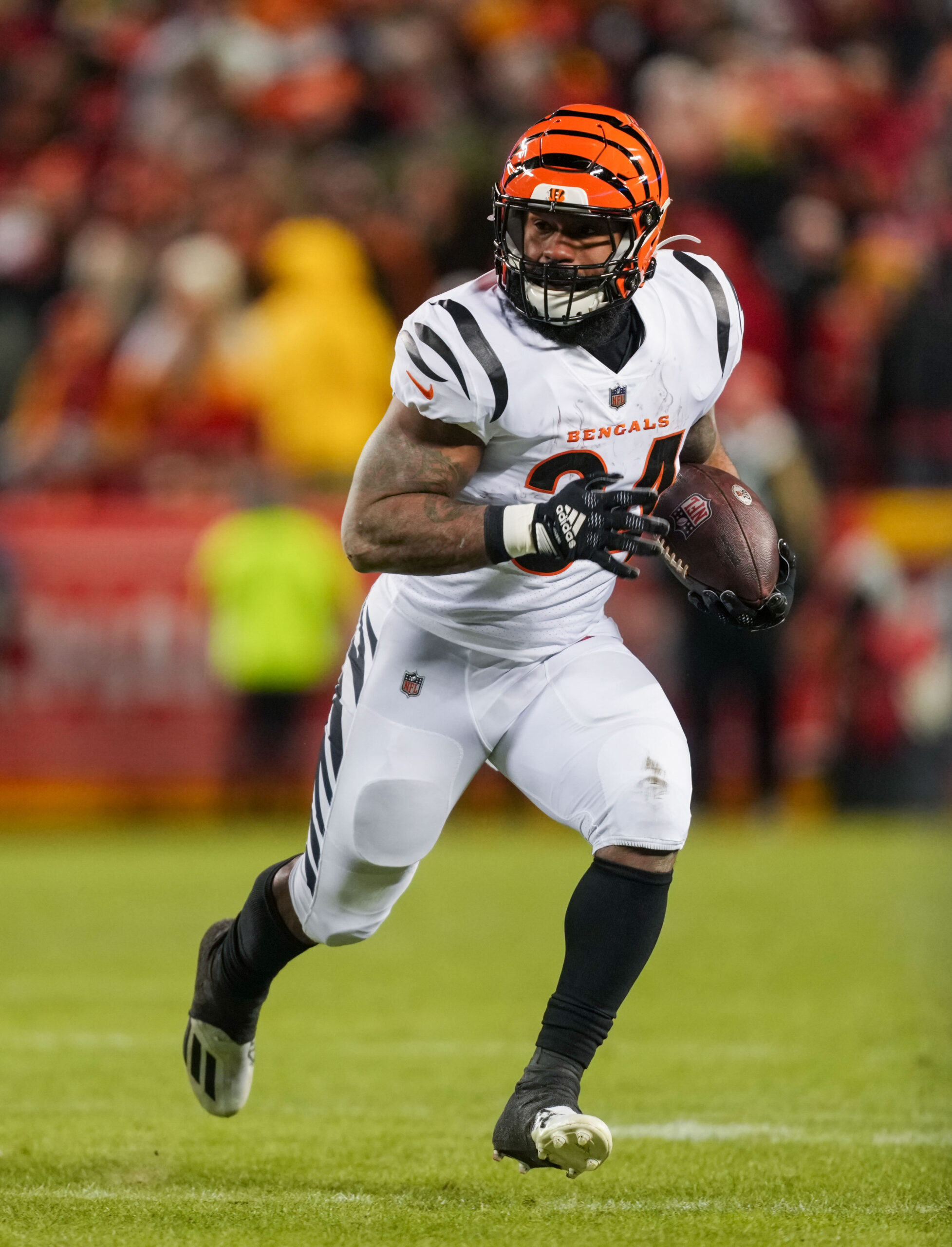
Read more
Given a monster extension after a Seahawks tag-and-trade transaction, Clark did not live up to the five-year, $104MM pact. The former second-rounder did not exceed eight sacks in a season in Kansas City, but he made a habit of playoff production. Highlighted by a five-sack 2019 postseason, Clark ended his Chiefs run third — behind Willie McGinest and Bruce Smith — in all-time playoff sacks (13.5). Clark, 30, working as a complementary presence will be a step back after he was asked to be the Chiefs’ top defensive end. Assuming Gregory is healthy, the Broncos do not figure to demand as much from the veteran edge player.
Stidham went from possible Tom Brady successor to afterthought in New England, but a 365-yard, three-touchdown pass showing — against Ryans’ No. 1-ranked 49ers defense — with the Raiders put the former fourth-round pick back on the map. Payton has spoken highly of Stidham, though his game ledger (131 career attempts) does not separate him much from 2022 backup Brett Rypien (130, with a higher completion percentage). The guarantee the Broncos authorized points to Stidham being viewed as a legitimate backup and potentially, in the event Wilson starts this season as badly as he began the 2022 slate, an emergency option in case Payton starts charting a non-Wilson course for the mid-2020s.
Re-signings:
A Montana State product who began his pro career in the CFL, Singleton initially signed a low-end Broncos deal (one year, $1.1MM) after the Eagles nontendered him as an RFA last year. Singleton made the most of his Denver opportunity, helping Ejiro Evero‘s unit stay afloat as the offense’s ineptitude raged. Moving into the starting lineup alongside Josey Jewell, Singleton posted two 20-tackle games. At 29, Singleton enjoyed a limited window to cash in. Considering where the linebacker market went after Tremaine Edmunds and Bobby Okereke inked eight-figure-per-year deals, Singleton did well to collect the $9MM guaranteed. He fared better than bigger-name ILBs like Germaine Pratt, David Long, Leighton Vander Esch and ex-Eagle teammate T.J. Edwards in that regard.
McGlinchey will be expected to be the Broncos’ right tackle for the foreseeable future, but the team lost three of its 2022 cogs — Billy Turner, Calvin Anderson, Tom Compton — and needed depth. The Broncos have not viewed Fleming — initially added during the 2021 offseason, when Ja’Wuan James suffered an offsite ACL tear — as a preferred starter. But the injuries to Bolles and Turner keyed a 15-start season from the journeyman. Quietly a top-30 tackle, in the view of PFF, Fleming profiles as Denver’s swing tackle ahead of his age-31 slate.
Only the Bills (Micah Hyde–Jordan Poyer) boast a longer-running safety tandem than the Broncos’ Jackson-Justin Simmons pairing. After Jackson signed an $11MM-AAV deal to leave Houston for Denver in 2019, he moved from cornerback to safety on a full-time basis and has started 61 games. This is Jackson’s fourth Broncos contract, but its low guarantee signals a legitimate competition between he and third-year safety Caden Sterns.
The top backup over the past two seasons, Sterns is coming off hip surgery but is believed to be a true threat to unseat Jackson, 35. Having made one of this era’s more successful corner-to-safety transitions, Jackson started 17 games last season and tallied a career-high 94 tackles.
Notable losses:
- Calvin Anderson, T
- Andrew Beck, FB/TE
- Jacob Bobenmoyer, LS
- Mike Boone, RB
- Tom Compton, T
- Ronald Darby, CB (released)
- Chase Edmonds, RB (released)
- Graham Glasgow, OL (released)
- Dre’Mont Jones, DL
- Jacob Martin, OLB (released)
- Brandon McManus, K (post-June 1 cut)
- Latavius Murray, RB
- Brett Rypien, QB
- Eric Saubert, TE
- Eric Tomlinson, TE
- Billy Turner, T
- Corliss Waitman, P (ERFA tender rescinded)
- DeShawn Williams, DL
The team is making changes at kicker and punter. Weeks after bringing Dixon back into the fold, the Broncos jettisoned their kicker of the past nine years. Performance-wise, McManus checked in below the likes of Jason Elam and Matt Prater. McManus made just 77.8% of his field goal tries last season — the second-lowest mark of his career — though he did convert eight 50-plus-yard attempts. The Broncos, who have employed just three primary kickers since 1993, used the money from the McManus cut to sign Clark. Elliott Fry, who has kicked in three career games (for three teams), is now the only kicker on Denver’s roster. He will need to fend off a to-be-determined challenger in training camp. The Broncos initially traded Dixon, a 2016 seventh-round pick, to the Giants in 2018. The 30-year-old punter spent last season with the Rams.
Jones, 26, loomed on the Broncos’ extension radar since they traded potential franchise tag candidate Bradley Chubb. While the Broncos expressed steady interest in keeping Jones, the former third-round pick was less than enthusiastic about staying. The Ohio State alum changed his tune a bit during the run-up to free agency, but with the Broncos deciding the tag was too steep in this case, he took ex-teammate Shelby Harris‘ spot with the Seahawks. Jones totaled between 5.5 and 6.5 sacks and notched either 10 or 11 QB hits in each of the past three seasons. Despite modest production, Jones did not need to settle for a midlevel deal. The Seahawks gave him a three-year, $51.53MM accord. That contract, however, contains less guaranteed ($23MM) than Zach Allen‘s.
A return to the deep waters of a guard market reminds of recent Broncos misses here. Neither Denver’s Ronald Leary move (2017) nor the Glasgow signing (2020) worked out. Glasgow signed a four-year, $44MM deal during John Elway‘s final offseason running the show, but after a midseason 2021 injury, Glasgow lost his starting job to Meinerz and was forced into a 2022 pay cut. The Broncos saved more than $26MM combined with the releases of Glasgow, Darby and Edmonds. Darby signed a three-year, $30MM contract in 2021, but injuries continued to plague the ex-Eagles Super Bowl starter. Most recently, a torn ACL sidelined Darby. The 29-year-old corner remains unsigned.
The departures of both Jones and Williams open the door for 2022 draftees Matt Henningsen and Eyioma Uwazurike on the D-line. Denver also returns veteran nose tackle Mike Purcell. But Williams, who signed with the Panthers, spent the past three seasons with the team and served as a regular starter. Quietly, the former UDFA started 34 games as a Bronco.
Draft:
- Round 2, No. 63 (from Chiefs through Lions): Marvin Mims, WR (Oklahoma) (signed)
- Round 3, No. 67 (from Colts): Drew Sanders, LB (Arkansas) (signed)
- Round 3, No. 83 (from Seahawks): Riley Moss, CB (Iowa) (signed)
- Round 6, No. 183 (from Lions): JL Skinner, S (Boise State) (signed)
- Round 7, No. 257 (from Saints): Alex Forsyth, C (Oregon) (signed)
Perhaps bored without a pick until the third round, the Broncos traded into the late second to nab Mims. Wide receiver could have been considered the team’s deepest position, pre-draft, especially after Marquez Callaway followed Payton to Denver. But the team has not seen deep threat KJ Hamler progress as it had hoped. The former second-round pick has struggled with consistency and injuries, and he is rehabbing a torn pec sustained in the offseason.
Mims’ Sooners yards-per-catch figures jump out, with the 5-foot-10 playmaker topping 20 per grab in 2021 and ’22. Last season, Mims totaled 1,083 receiving yards despite Lincoln Riley’s offseason departure for USC. Mims figures to push for immediate time as a receiver and in the return game. Hamler anticipates being ready to go for training camp, but his roster spot no longer seems secure. It is hard to see roles for both he and Hamler; the Broncos can save nearly $2MM by waiving the latter. The Broncos have since added some injury insurance to Hamler’s contract.
The latest Seahawks trade did not involve a pick from the Wilson swap. That said, the Broncos paid up to climb 25 spots for Moss. Denver sent Seattle No. 108 and a 2024 third-rounder. The team does hold an extra 2024 third from the Payton trade, but this was one of Day 2’s more interesting transactions. Moss utilized the NCAA-granted fifth year of eligibility stemming from the pandemic. The three-time All-Big Ten honoree finished with 11 career INTs and three defensive touchdowns; ESPN’s Scouts Inc. rated him as the No. 62 overall prospect. The 6-foot cover man profiles as a key backup behind Patrick Surtain II and projected CB2 Damarri Mathis.
Other:
Evero interviewed for the Broncos’ HC job (along with meetings about the other four 2023 vacancies) after a breakthrough year. Evero had spent five seasons on Sean McVay‘s staff and only advanced to DBs coach by Year 5, but he is a close friend of Hackett’s. Broncos ownership attempted to see if Payton and Evero could coexist, but seeing as the team dumped Hackett after 15 games, it made sense his right-hand man — who had declined an offer to finish out last season as interim HC — passed on staying. After helming a quality unit despite injury trouble and the Chubb trade depleting it, Evero is now the Panthers’ DC.
A more interesting plot point emerged after Evero declined and Vic Fangio — whom Paton fired after the 2021 season — determined the rumored Payton partnership occurring in Denver would be a poor fit due to the timing. Fangio passing led to his Broncos HC predecessor coming back.
An ex-Colorado Buffalo, Joseph agreed to return to the team that fired him after the 2018 season. Joseph went 11-21 as Denver’s HC, but his defenses mostly held up. And the veteran defensive coach produced sound Cardinals defensive work in 2020 and ’21 (10th and sixth in DVOA, respectively). Justin Simmons and Josey Jewell remain on defense from Joseph’s HC stay, and although the Eagles showed interest, the 50-year-old coach will try his hand in Denver again.
Lombardi, 52, will stay in the AFC West, catching on with his old boss weeks after the Chargers fired him as OC. Criticized for not maximizing Justin Herbert, Lombardi was working with an injured version of the star passer last season. This will be Lombardi’s third chance as an OC, though the ex-Lions and Bolts play-caller will step out of the spotlight a bit. As he did throughout his Saints tenure (excluding the 2012 Bountygate year), Payton will call plays. Lombardi spent 12 years on Payton’s Saints staff. After the Broncos hired an unseasoned OC in 2022 (ex-Packers tight ends coach Justin Outten), Lombardi will bring four years’ experience in this position and a strong rapport with Payton.
Perhaps a more notable move came when Webb’s playing career abruptly ended. The Bills had attempted to hire Webb as their QBs coach last year, but he opted for a Giants playing offer. After serving as a Daniel Jones mentor, the 2017 third-round pick will step up in responsibility. Replacing ex-OC Klint Kubiak, the 28-year-old Webb will be a key part of the Broncos’ Russell Wilson revival effort. This promises to be one of the more interesting forays into coaching in recent NFL history.
Rumors about Jeudy and Sutton’s availability swirled for weeks — before Payton and Paton shot them down. Jeudy, 24, closed last season strong and finished with a career-high 972 receiving yards. It is still difficult to pin down Jeudy’s trajectory, since the Broncos have cycled through quarterbacks and coaches throughout his career. The Broncos sought a first-rounder for the Alabama product, who came up in trade rumors before the 2022 deadline as well. They aimed at a second-rounder for Sutton and discussed the 6-foot-4 target with the Ravens, who pivoted to Odell Beckham Jr. Sutton’s four-year, $60MM contract runs through 2025; Jeudy now has a guaranteed 2024 salary.
The volume of rumors engulfing Denver’s top two receivers suggests the team will still entertain offers ahead of the season. One of the preeminent deadline sellers in recent years, the Broncos have made two major in-season wideout trades since 2018 — in unloading Demaryius Thomas (2018) and Emmanuel Sanders (’19). Mims’ progress might dictate Denver’s interest level in making another. As it stands, both Jeudy, 24, and Sutton, 27, are in line to anchor the team’s pass-catching contingent again.
Sutton joined Tim Patrick in signing what turned out to be team-friendly deals — thanks to the 2022 receiver market boom — during the 2021 season. A one-time 1,000-yard receiver, Sutton has played with an unexpectedly shaky Wilson, Teddy Bridgewater, Drew Lock, an aging Joe Flacco and Case Keenum in his final full season as a starter. Payton brings the Broncos’ best chance to unlock their receivers’ potential. The return of Patrick, a possession target who missed all of 2022 with an ACL tear, will help Wilson’s rebound effort as well. After years of delays, this sets up as a seminal year on the Broncos’ receiver timeline.
Top 10 cap charges for 2023:
- Russell Wilson, QB: $22MM
- Courtland Sutton, WR: $18.27MM
- Justin Simmons, S: $18.15MM
- Garett Bolles, T: $17.82MM
- Randy Gregory, OLB: $16.1MM
- D.J. Jones, DL: $12.99MM
- Tim Patrick, WR: $11.07MM
- Josey Jewell, LB: $7.13MM
- Zach Allen, DL: $6MM
- Mike McGlinchey, T: $6MM
Slotted in four primetime games over last season’s first six weeks, the Broncos saw their dysfunction morph from leaguewide curiosity into a running joke. Last year’s catastrophe drained more from the primes of Simmons, Bolles and, most importantly, Wilson. This is quietly not a young team. Bolles, Simmons and Patrick will turn 30 this year. Seven other starters are beyond their rookie contracts. Wilson (35 in November) should have some quality football left, but his woeful Denver debut — regardless of the circumstances- and injury-heightened uphill battle he waged — should probably cause even the staunchest of the ex-Seahawks star’s supporters to temper expectations.
It would cost the Broncos $35MM in dead money to designate Wilson a post-June 1 cut in 2024. Teams have eaten more dead cap to move QBs (Matt Ryan, Carson Wentz) in recent years. Payton and Wilson jelling will bury that talking point, but the slimmer QB resembling his 2022 form will make the topic difficult to evade. Wilson’s 2023 will define the Broncos’ future, as the $49MM-per-year extension producing a poor second season will thrust the Seattle-Denver trade into at least the second tier of NFL transaction infamy.
But a stronger case exists the Broncos can recover. Improved health, Payton’s track record, a beefed-up offensive line — perhaps the Broncos’ most talented front since Peyton Manning‘s record-setting 2013 — and a solid defense may well stabilize this operation and put it back on the road most expected it to travel in 2022. While the AFC’s strength likely lowers the Broncos’ 2023 ceiling, the high variance here presents the team’s recovery mission as one of the NFL’s most interesting storylines.
By Sam Robinson |
at September 10, 2022 10:46 pm
This season will feature 12 new Week 1 starting quarterbacks, though the Jets’ decision is the result of an injury rather than a roster move. High-profile wide receivers also changed teams, igniting one of the biggest market shifts a single position has seen. The Offseason In Review series is now complete. Here are the PFR staff’s looks at how the 32 NFL teams assembled their 2022 rosters.
AFC East
AFC North
AFC South
AFC West
NFC East
NFC North
NFC South
NFC West
By Sam Robinson |
at September 10, 2022 4:30 pm
The Russell Wilson era doubled as the peak of the Seahawks’ 46-year existence. The third-round pick Seattle invested in 10 years ago helped the team build a championship nucleus, and after most of the defensive cogs from the back-to-back Super Bowl teams departed, Wilson’s development as a passer kept the Seahawks in the playoff mix. This season will look quite different for the franchise, which bailed on the prospect of an 11th Wilson season and third extension.
Trades:
Hours after Aaron Rodgers‘ Packers recommitment, the Broncos pulled the trigger for Wilson. Pete Carroll‘s Combine comments indicating the Seahawks had “no intention” of trading the top quarterback in franchise history came after GM John Schneider had opened trade talks with Broncos counterpart George Paton. The Wilson-Carroll relationship had steadily deteriorated, and the Seahawks became leery of what it would cost to give their star QB a fourth contract. The noise Wilson made about the team’s offensive line and the trade-destination list that surfaced in February 2021 irked the Seahawks, and the 11th-year veteran was unlikely to do another Seahawks extension. This all led to the HC-GM combo that drafted Wilson dealing him for major draft capital with two years left on his contract.
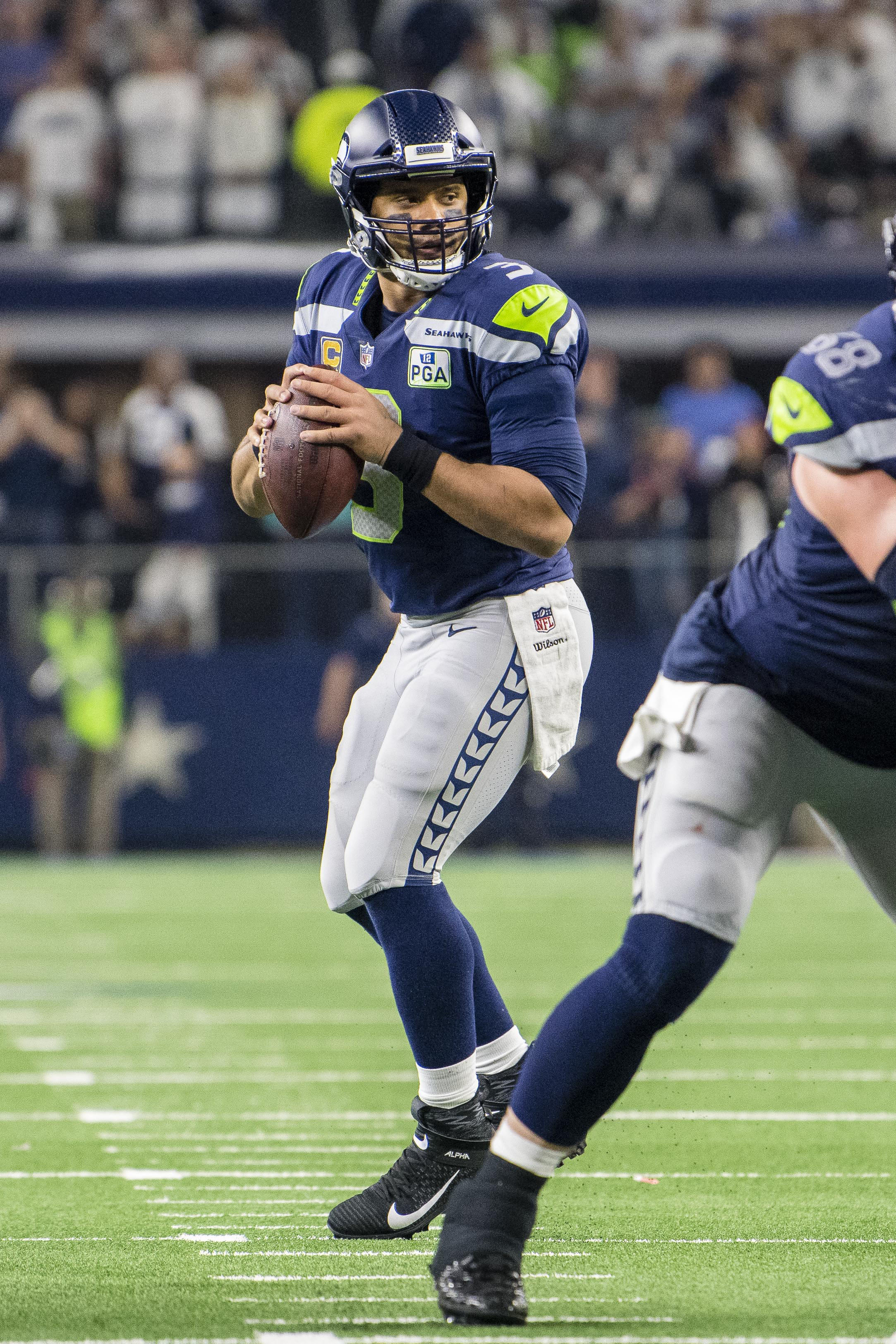
Being willing to part with three first-round picks for Wilson, the Commanders may have presented the best trade package. But Washington was not a Wilson-preferred destination. Although the Bears, Cowboys, Raiders and Saints were on Wilson’s initial 2021 destination list, the Broncos and Giants were quietly added late last year. The Giants and Saints called the Seahawks this year, but Wilson — one of the few NFLers with a no-trade clause — had zeroed in on Denver. For the first time since Matt Hasselbeck‘s 2011 exit ushered in Tarvaris Jackson as Seattle’s starter, the Seahawks have a foggy future at the game’s premier position.
Carroll’s run-heavy M.O. and the Seahawks’ penchant for skimping on offensive linemen (Duane Brown excepted) gnawed at Wilson, the centerpiece of middling rosters over the past few seasons. Seattle attempted more run plays than any team over Wilson’s tenure. Some of those were Wilson scrambles, but Brady Henderson ESPN.com notes team ranked 29th in designed pass-play rate since 2012. That number only climbed to 21st since Wilson broke through as a passer in 2015, making atypical use of a top-tier quarterback contract. Since the “Let Russ Cook” start to the 2020 season preceded a midseason swoon, Carroll largely went back to his preferred style.
Wilson’s extension talks in 2015 and 2019 generated a number of headlines, and each resolution produced a big number ($21.9MM per year in 2015, then-NFL-high $35MM per annum in ’19). Seattle could not recapture the formula it had when it capitalized on one of the great bargains in NFL history; Wilson’s four-year, $2.99MM deal that was on the team’s books as it claimed consecutive NFC championships. During Wilson’s second and third contracts, however, he became one of the NFL’s best quarterbacks.
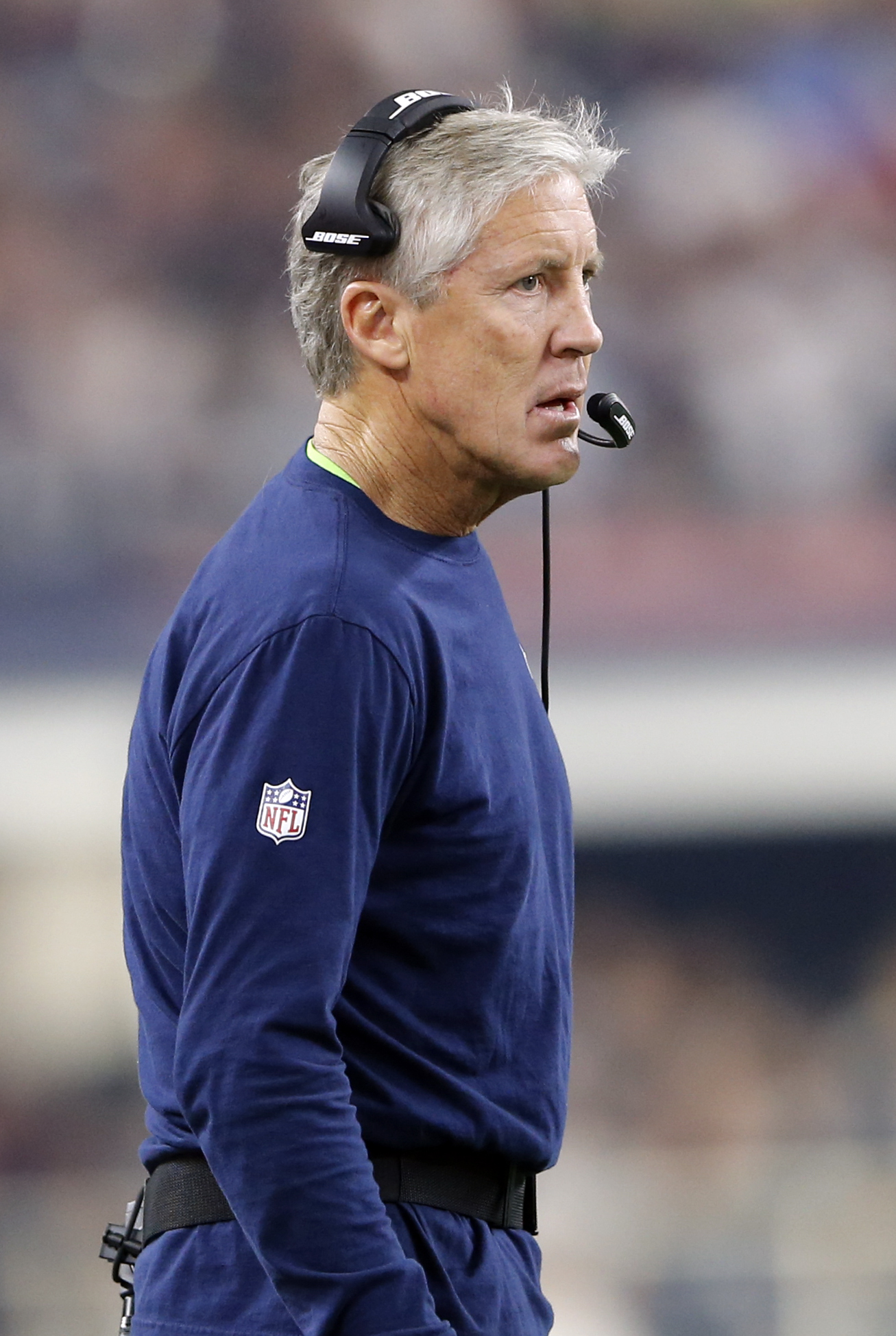
Since a 2015 season in which Wilson broke through for 34 touchdown passes (after tossing 20 in 2014), his QBR figures have ranked fourth, 15th, 10th, 11th, fifth, eighth and 10th. The final number came despite Wilson struggling in the games immediately following his finger surgery. Wilson made the Seahawks one of the NFL’s highest-floor teams, though rosters that were not on the level of the 2013 and ’14 squads continually ran into first- or second-round obstacles following Super Bowl XLIX.
Some Seahawks staffers viewed Wilson as declining, at 33, but trading him forfeits the franchise access to the NFL’s most common championship route. Carroll opting for a restart/transition year is a bit curious, considering he is the league’s oldest active HC (71 next week). The strategy will apply considerable pressure for Carroll (signed through 2025) and Schneider to strike gold again. Two first-round picks next year — when a far better QB class is expected to emerge compared to 2022 — will help Seattle’s cause, but the odds are against the Seahawks finding a player capable of Wilson’s performance level. The Seahawks also may see the Texans and Lions, each holding two first-rounders without a clear long-term QB plan as well, outflank them in the 2023 draft.
Schneider sought Lock, having liked the former Missouri prospect in 2019, but the failed Broncos starter not beating out Geno Smith represents an early warning sign of the post-Wilson road the Seahawks are about to travel. Lock and the other below-average brigade of Broncos quarterbacks hindered Fant’s progress, but the former No. 20 overall pick may find footing difficult with Smith and/or Lock (again). Harris, 31, became a steady contributor in Denver, moving into a starter role and helping Vic Fangio‘s defense as an inside rusher and frequent passing-lane deterrent. Harris’ 19 passes defensed during his starter years (2019-21) lead all defensive linemen. Harris’ three-year, $27MM Broncos-authorized extension runs through 2023.
Free agency additions:
- Uchenna Nwosu, DE. Two years, $19.1MM. $10.54MM guaranteed.
- Quinton Jefferson, DL. Two years, $9.5MM. $5.18MM guaranteed.
- Austin Blythe, C. One year, $4MM. $2.5MM guaranteed.
- Artie Burns, CB. One year, $2.04MM. $1MM guaranteed.
- Marquise Goodwin, WR. One year, $1.27MM. $153K guaranteed.
- Justin Coleman, CB. One year, $1.12MM.
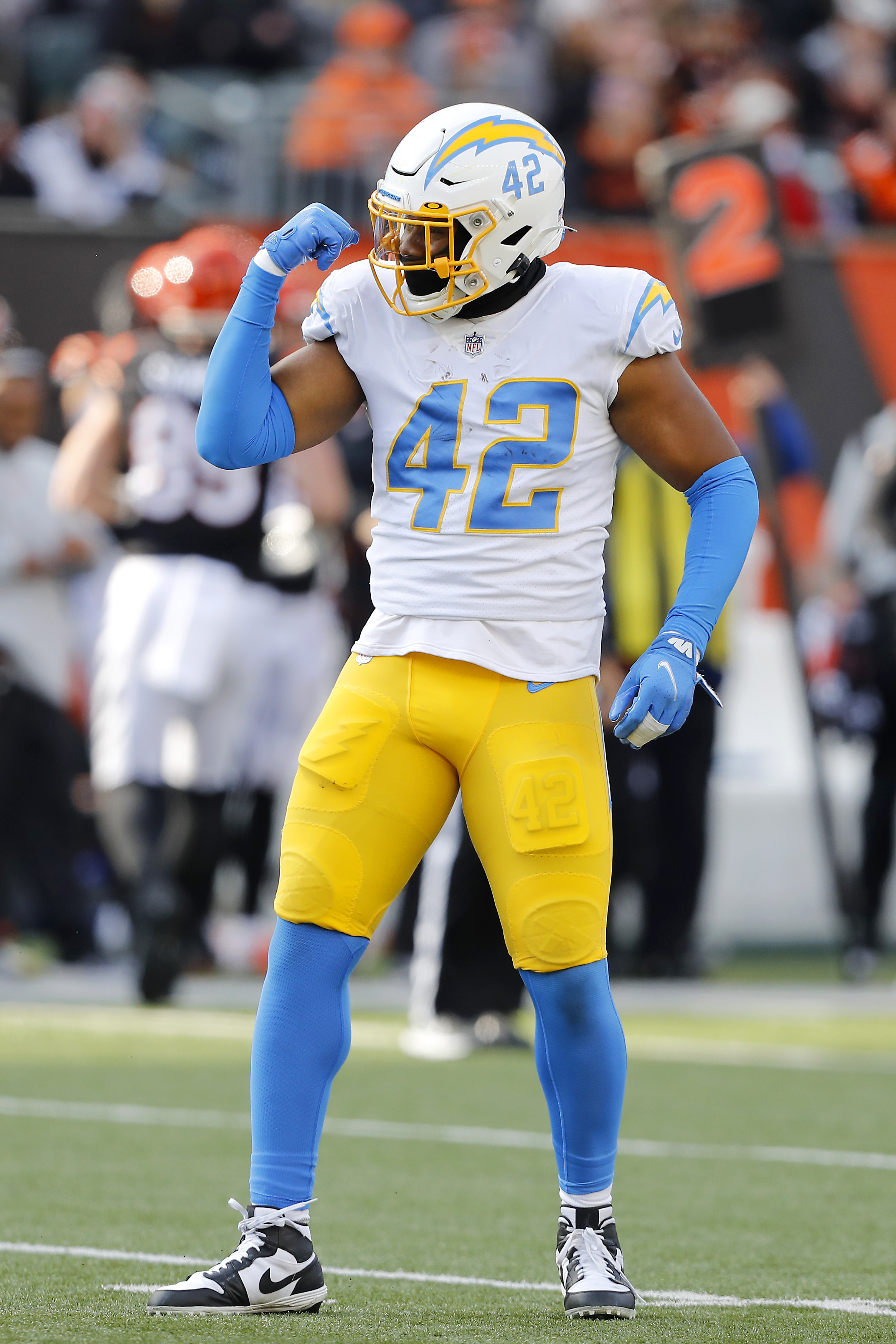
Nwosu will move from Joey Bosa‘s sidekick to a player that will be expected to produce as a No. 1 edge rusher. Swapping out Carlos Dunlap for a younger talent, the Seahawks will bank on Nwosu taking a step forward. Even with Bosa drawing O-lines’ attention, Nwosu registered just five sacks in 17 games. Nwosu’s 30 pressures did rank 31st last season and were six more than any Seahawk logged in 2021. A second-rounder out of USC, Nwosu should be coming into his prime. He will not turn 26 until December.
A hybrid player who should fit as the Seahawks transition to more 3-4 looks, Jefferson is back after two years away. Seeing time at D-end and D-tackle, Jefferson started 24 games for the Seahawks’ 2018 and ’19 iterations. He made 17 starts for the Raiders last season, totaling career-high numbers in sacks (4.5) and quarterback hits (16).
While Jefferson should be a rotational cog in Seattle, Blythe looks set to go from seldom-used Chiefs backup (12 offensive snaps behind Creed Humphrey last season) to a full-time starter again. This could be an upgrade for the Seahawks. Blythe started at center and guard for three straight seasons with the Rams, including their Super Bowl LIII-qualifying squad. Pro Football Focus graded him as a top-11 guard in 2018 and top-11 center two years later. Blythe, 30, has a clear comeback opportunity for a team that will make no secret of its desire for a smashmouth approach.
Re-signings:
- Quandre Diggs, S. Three years, $39MM. $13.49MM guaranteed.
- Will Dissly, TE. Three years, $24MM. $10.34MM guaranteed.
- Rashaad Penny, RB. One year, $5.75MM. $5.1MM guaranteed.
- Al Woods, DT. Two years, $9MM. $4.73MM guaranteed.
- Geno Smith, QB. One year, $3.5MM. $500K guaranteed.
This season brings 11 starting quarterbacks on rookie salaries, two more on fifth-year options and 19 tied to veteran deals. The veteran contingent now houses nine QBs earning $40MM-plus on average. Four more are tied to contracts worth more than $30MM per year. Tom Brady, who has a few income streams and a lavish FOX contract awaiting him, and Ryan Tannehill come in just south of $30MM AAV. Jameis Winston signed a two-year, $28MM pact, while Marcus Mariota — who has not been a full-time starter since October 2019 — signed a two-year, $18.75MM accord in March. Mitch Trubisky signed a two-year, $14MM Steelers deal. Then, there is Geno Smith, a 10th-year veteran who will be a 2022 starting quarterback on a $1.26MM base salary.
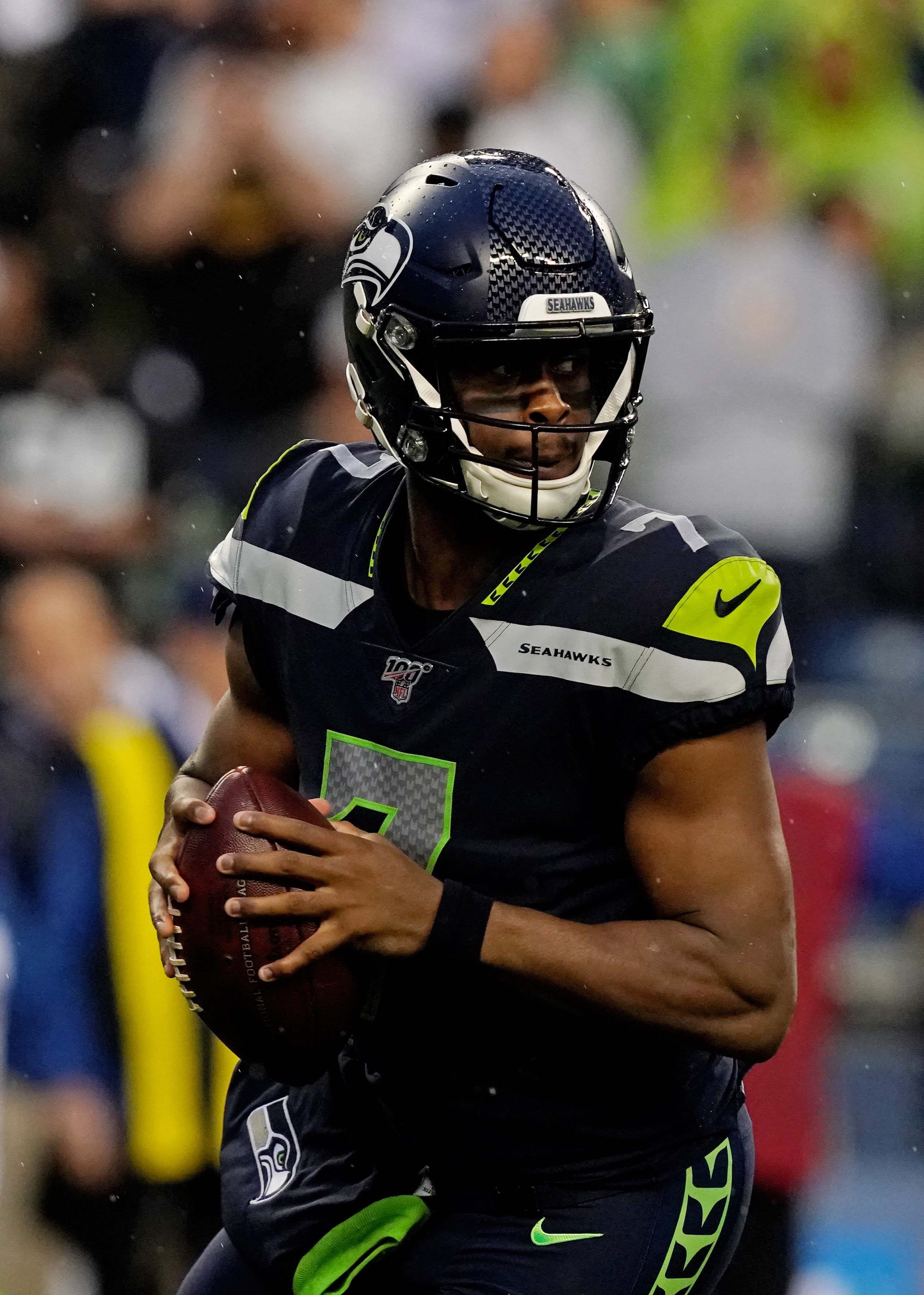
Smith, 32 next month, will make his first Week 1 start since 2014. Knocked off his Jets QB1 perch in 2015 (the IK Enemkpali incident), Smith not only never regained any footing with the Jets; he kept signing with teams who employed historically durable quarterbacks (Eli Manning, Philip Rivers, Russell Wilson). In what looks like a transition year in which the Seahawks will be connected to college quarterbacks, Smith returns. Discipline for his January DUI arrest may loom, however, though it is not a lock punishment comes this year.
Largely unimpressive with the Jets, the veteran backup fared better than expected in his midseason Wilson relief effort (68% completion rate, 5-1 TD-INT ratio, 7.4 yards per attempt). It would seem Lock will work his way into some starts this season, but Smith does profile as the better fit for a conservative offense. For now, Smith will make one of the stranger Week 1 re-emergences in modern QB annals. Although this $3.5MM number is a raise for Smith, the salaries Mariota, Winston and Trubisky are earning illustrate the rest of the league’s view of him. Smith also re-signed in mid-April, after the Browns chose Jacoby Brissett — who is also out-earning Smith — to fill in for Deshaun Watson.
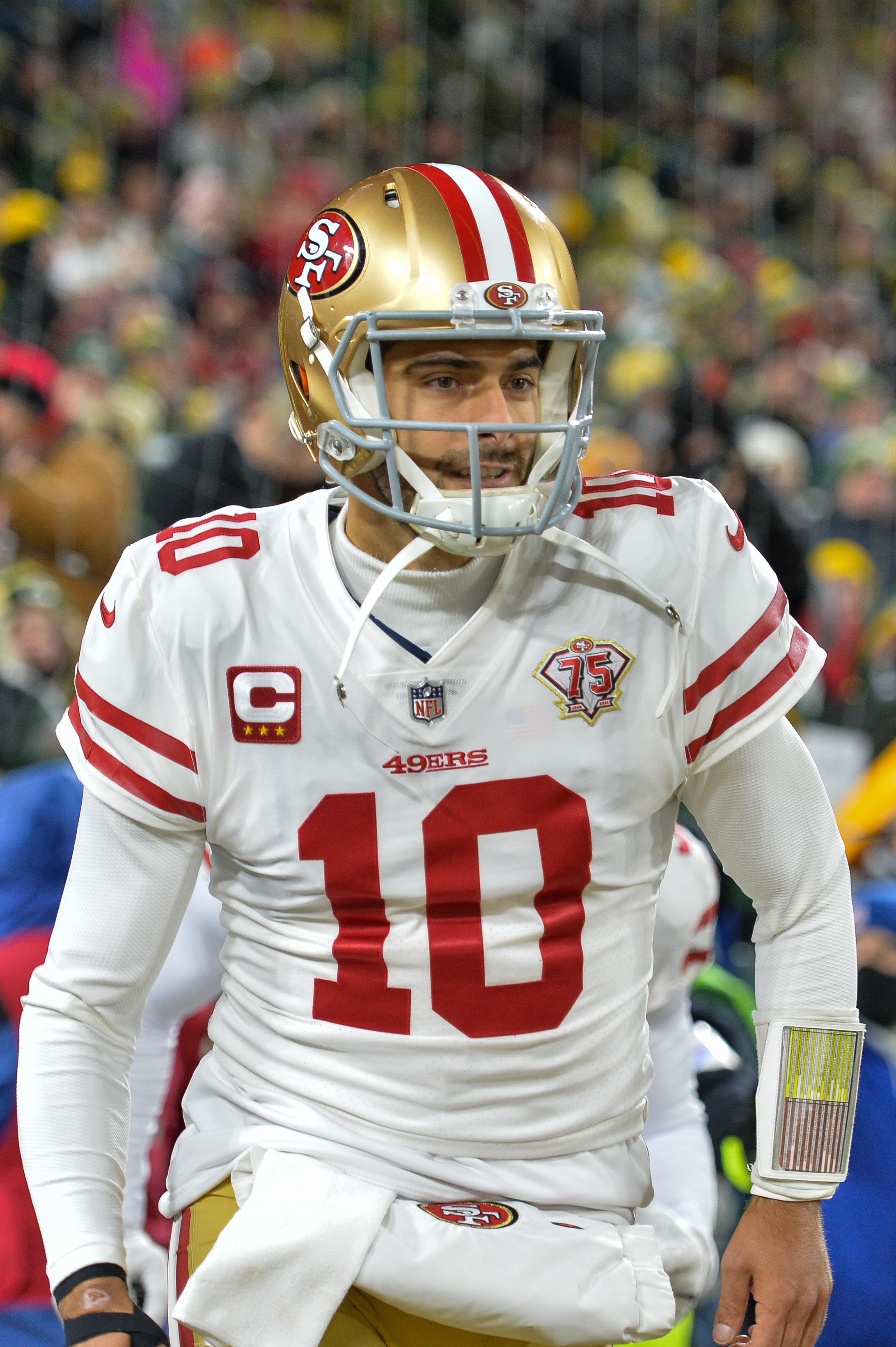
The Seahawks kept passing on the quarterbacks that fell to this year’s third round; they did not view Malik Willis as NFL-ready. Waiting for a superior 2023 class makes sense, and Carroll said post-draft the Seahawks were unlikely to make another QB trade this offseason. They stuck to their guns.
Seattle let Carolina have Baker Mayfield for a conditional 2024 fifth-rounder and showed no interest in parting with an asset for Jimmy Garoppolo. The Seahawks did homework on Garoppolo and lurked as a landing spot for the former Super Bowl starter in free agency, but given how diligent Garoppolo’s camp was in attempting to find a team that would pay more than the money he is now tied to with the 49ers ($6.5MM salary; $15.45MM max value via playing-time incentives), it looks like the Seahawks were not willing to offer too much money. Garoppolo and Mayfield have obviously proven much more than Smith; that could have impeded Seattle’s 2022 plan.
Dealt repeated injury blows, Penny made an 11th-hour push for some second-contract cash and will be Seattle’s Week 1 starter for the first time. As fantasy GMs observed, Penny exploded for four 130-yard rushing games in his final five contests and finished with an NFL-leading 6.3 yards per carry (on 119 totes) in his fourth season. The surprise 2018 first-rounder has missed 28 career games, but the Seahawks offered lower-middle-class running back dough to see how legitimate that season-closing stretch was.
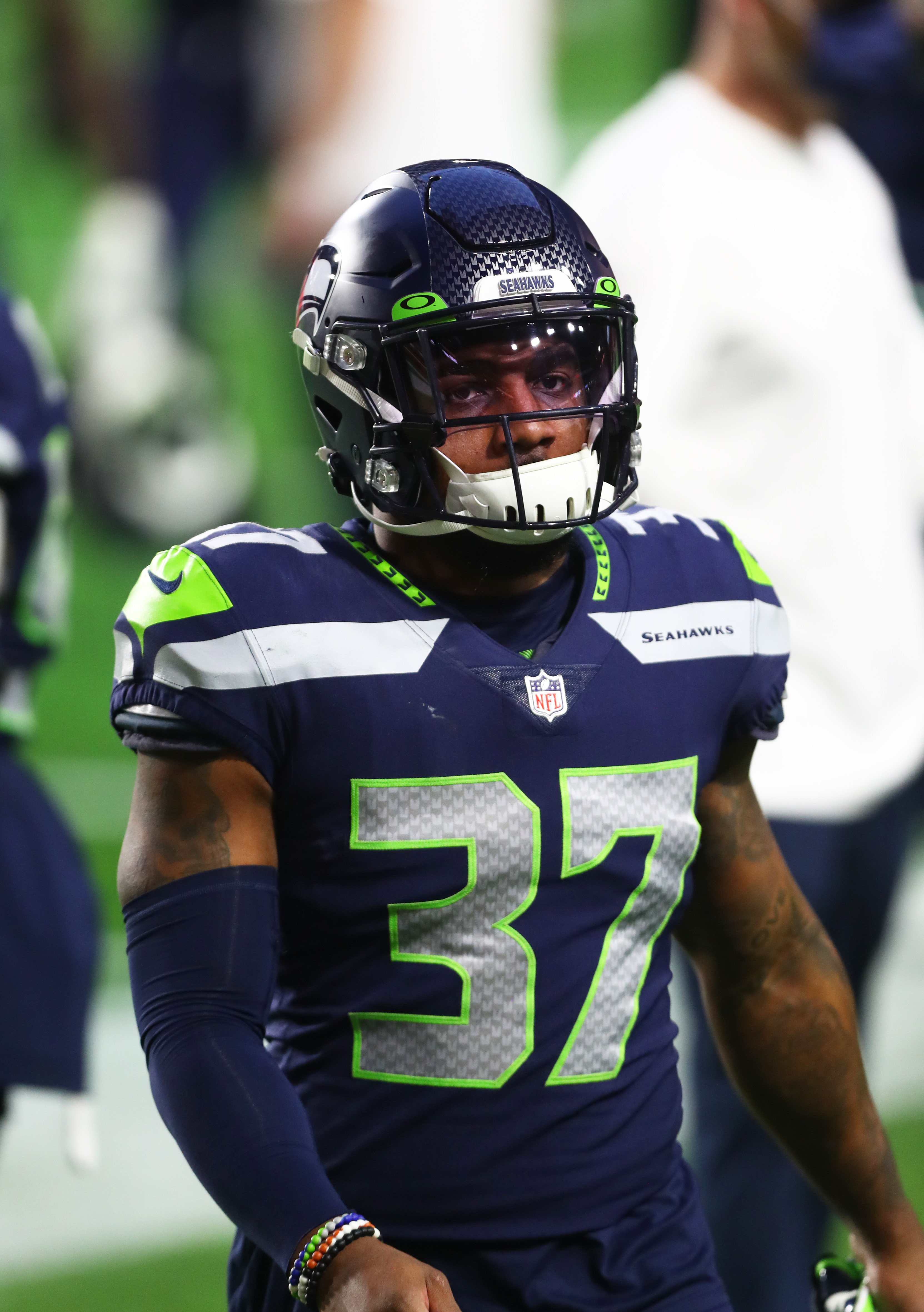
Read more
Acquiring Diggs from the Lions in a low-level pick-swap deal has been the better Seahawks safety trade of recent years. The Seahawks, who have not seen their blockbuster Jamal Adams trade and record-setting extension come close to justifying the cost, now have the league’s most expensive safety tandem. Both Adams ($17.5MM per) and Diggs ($13MM AAV) are among the NFL’s 10 highest-paid safeties. With Adams’ hybrid skillset often luring him away from the traditional safety range, more back-line patrolling is required of Diggs. Going into his age-29 season, Diggs has now secured three contracts. He will be a vital piece for a Seattle defense bringing pass-rushing and cornerback uncertainty.
The Broncos nearly kept the Wilson-Dissly pairing alive, pursuing the fifth-year veteran in free agency. Dissly appeared surprised by the market that formed for him. Suffering major injuries in 2018 and ’19, the former fourth-round pick has never topped 300 receiving yards in a season. The Seahawks valued Dissly’s run-blocking skills — more than most envisioned anyone would — and he will team with new receiving tight end Fant. Woods turned 35 shortly after re-signing. The NFL nomad (seven city changes since being a 2010 Saints draftee) has found a home in Seattle, starting 16 games in 2021. PFF graded the 12-year veteran as the No. 4 run-defending D-tackle last season.
Notable losses:
- Marquise Blair, DB (waived)
- Duane Brown, T
- Chris Carson, RB (retired)
- Alex Collins, RB
- Carlos Dunlap, DE (designated as post-June 1 cut)
- Gerald Everett, TE
- Rasheem Green, DE
- Kerry Hyder, DE (released)
- Jamarco Jones, OL
- Benson Mayowa, DE (released)
- Robert Nkemdiche, DL
- Adrian Peterson, RB
- Ethan Pocic, C
- D.J. Reed, CB
- Brandon Shell, T
- Bobby Wagner, LB (released)
Wagner is closer than Wilson to first-ballot Hall of Fame status, having been a first- or second-team All-Pro eight times. The decorated middle linebacker has more first-team All-Pro nods (six) than any active player save for new teammate Aaron Donald (seven). Wagner, 31, outlasted every Legion of Boom member (by multiple years) on Seattle’s defense and will be the centerpiece defender associated with this Seahawks era. While the LOB may be remembered more for the Super Bowl years, Wagner’s longevity bettered each member. His return from a 2014 injury ignited the Seahawks to a charge that keyed a second straight NFC championship. Last season, Wagner notched a career-best 170 tackles. He will be difficult to replace.
Like Wilson, Wagner signed three Seahawks contracts. Agentless during the third negotiation, Wagner topped C.J. Mosley‘s Jets deal — which came in well north of anything before it at the off-ball linebacker position — with a three-year, $54MM pact in 2019. Wagner did not want to leave Seattle, but the team avoided a $20.35MM cap number via the release — which came hours after the Wilson trade. Jordyn Brooks is now in place as the Seahawks’ top linebacker, but fourth-year backup Cody Barton will make a big responsibility jump this season.
For the second straight year, a team gave a Seahawks starting corner an eight-figure-AAV deal. The Jets followed the Jaguars (Shaquill Griffin) by handing Reed a three-year, $33MM pact. Reed does not have a lengthy run of starter-caliber play but caught on in that role with the Seahawks in 2020. Seattle found Reed via waivers that year and used him as an outside starter in 22 games from 2020-21.
The Seahawks paid Richard Sherman in 2014, but the Carroll-years formula remains: low- or mid-level draft investments stock this position. The team passed on paying Byron Maxwell in 2015 and let Justin Coleman walk in 2019. Griffin and Reed have now come and gone, leading to more cheap labor via Day 3 draft choices.
Carson’s neck injury continues an unfortunate run for the Seahawks, who also lost Kam Chancellor and Cliff Avril to career-ending neck issues. Seattle’s top post-Marshawn Lynch option, Carson overcame his seventh-round status to tally two 1,000-yard seasons. He was the lead back on three playoff teams. Carson did well to collect a two-year, $10.4MM payday in 2021, joining a host of 2017 running back draftees in signing notable second contracts. He collected $5.5MM guaranteed and will see up to $2MM of his 2022 base salary via the CBA’s injury-protection benefit.
Changing up its defensive scheme, Seattle swapped out nearly its entire edge-rushing crew. Dunlap became a critical part of the team’s mid-2020 defensive turnaround, arriving via trade from Cincinnati. Dunlap notched 13.5 sacks as a Seahawk. Green led the 2021 team in QB pressures with 24, while Hyder and Mayowa did not contribute much to last season’s cause. Dunlap (Chiefs), Green (Texans) and Hyder (49ers) caught on elsewhere.
Draft:
The Seahawks have not had success with a homegrown tackle since their 2010 Russell Okung selection (No. 6 overall). They relied on Duane Brown, obtained via 2017 in-season trade, after Okung’s departure led to blindside instability. Brown kept going into his mid-30s, but his training camp hold-in measure only produced a slight adjustment last year. The Seahawks met with veteran tackle Trent Brown early in free agency, but he re-signed with the Patriots. Instead, Seattle will replace both its tackles with rookies, moving on from Brandon Shell (21 Seattle starts) as well.
Cross and Lucas are ticketed to start against the Broncos, marking the first time in decades a team will have gone with two rookie bookends. This could be the start of a long era of Cross and Lucas. April was the first time the Seahawks had chosen even a Day 2 tackle since 2016 (Germain Ifedi); that undoubtedly caught Wilson’s attention from afar.
Seattle used the first Wilson-generated first-rounder on Cross, this year’s third tackle taken. Cross spent most of his time in Mike Leach’s Air Raid offense at Mississippi State, making for an NFL adjustment. That said, Cross earned first-team All-SEC acclaim as a sophomore last season and was PFF’s No. 2 SEC run blocker in 2021. As should be expected from a top-10 pick, Cross offers the kind of upside at the position the Seahawks have not possessed since Okung.
Lucas is a Seattle-area talent whom Leach recruited to play at his previous program. The Washington State product will not need converting to right tackle; he started there for four seasons at the Pac-12 school. These two could use this season to develop ahead of 2023, when the Seahawks will be expected to make their quarterback investment.
Walker is battling a hernia issue that is expected to delay his debut. The Wake Forest part-timer turned into a force at Michigan State post-transfer, totaling 1,636 rushing yards and 18 touchdowns. Penny’s one-year deal aside, Walker profiles as the Seahawks’ long-term backfield starter. Mafe notched two sacks in Seattle’s preseason opener, forcing a fumble, and is projected to be a rotational rusher behind Nwosu and Darrell Taylor. The Seahawks missed on L.J. Collier, and Nwosu has not proven much yet. Mafe (seven senior-season sacks) will need to be a regular piece this season.
Woolen looks to have beaten out the non-Sidney Jones veteran wing of the Seahawks’ corner contingent and last year’s Jim Thorpe Award winner (Bryant) to be a Week 1 starter. Woolen’s measurables beat out nearly every corner in NFL history (6-foot-4, 4.26 40-yard dash, 42-inch vertical). ESPN had the converted receiver ranked as a mid-third-round pick. Bryant moved from the outside to the slot during camp. The Seahawks were unable to steadily staff that position in the years since Coleman’s 2019 exit. Back with the team, Coleman could man the job to start the season. But Bryant, who allowed just a 44% completion rate as a fifth-year senior, should see extensive time.
Extensions and restructures:
The move away from their franchise quarterback freed up a long-term salary slot, but Schneider expressed amazement at where the wide receiver market had gone this offseason. Months after the Davante Adams and Tyreek Hill deals shook the receiver landscape, the Eagles and Commanders set the market for fourth-year receiver extensions. The Seahawks, after shutting down spring trade inquiries (most notably from the then-receiver-desperate Jets), followed that framework and kept Metcalf.
Route-tree issues and general rawness dinged Metcalf coming out, dropping him to the No. 64 overall slot. The Seahawks helped Wilson with this find, with Metcalf joining Tyler Lockett to form one of the league’s top receiver pairs. The size-speed freak reached just 967 receiving yards in 17 games last season, but he added 12 touchdowns. College teammate A.J. Brown secured more in per-year salary ($25MM) and guaranteed money ($56MM), though Metcalf’s guarantees will spike to $43MM by May 2023.
Lockett will turn 30 in September and will be remembered as one of Wilson’s wingmen. It is not yet known which quarterback Metcalf will be primarily associated with, and he may have drawn the worst QB situation of all the 2019 receiver extension recipients. But the Seahawks, at least, have receiver certainty. Their low-salary QB picture — a payroll wrinkle that could remain in place through at least 2026, and that is only if a rookie arrives next year — could accompany two big-ticket receiver contracts for a while. Lockett’s $17.25MM-per-year deal — agreed to in April 2021 — runs through 2025.
Other:
- Owner Jody Allen said Seahawks are not for sale
- Picked up $6.9MM fifth-year option on TE Noah Fant; declined $11.5MM 2023 option on DE L.J. Collier
- Promoted Clint Hurtt to defensive coordinator, replacing Ken Norton Jr.
- Promoted Andy Dickerson to offensive line coach, replacing Mike Solari
- Hired Sean Desai as associate head coach; staff target Ed Donatell became Vikings DC
- Front office executive Alonzo Highsmith joins Miami Hurricanes’ staff
- Signed 14 UDFAs
Eight years after the first set of fifth-year options could be exercised, the Seahawks finally saw fit to move a rookie contract to Year 5. Fittingly, for a team that traded out of Round 1 several times or missed on first-rounders during this timeframe, it is another team’s draftee that will see this bump. Fant’s back-to-back 600-plus yard seasons in Denver, which had some notable trouble staffing its QB spot pre-Wilson, were considered underwhelming. The Seahawks have not had a tight end reach 600 yards since Jimmy Graham in 2016.
Donatell was close to joining Seattle’s staff, but the longtime Vic Fangio right-hand man understandably accepted another DC gig in Minnesota. The Seahawks will still import Fangio concepts under Hurtt and Desai, the latter having worked under Fangio during his Chicago stay. Hurtt, 43, was with the Bears during Fangio’s first two Chicago seasons (2015-16) before coming to work for Carroll. With the Seahawks ending their 10-year Wagner partnership and facing questions at D-end and corner, Hurtt inherits a fixer-upper. The Seahawks ranked a surprising eighth in DVOA last season, but Norton’s defense checked in 21st.
Top 10 cap charges for 2022:
- Poona Ford, DT: $10.08MM
- Tyler Lockett, WR: $10.1MM
- Jamal Adams, S: $9.11MM
- Gabe Jackson, G: $9MM
- D.K. Metcalf, WR: $8.84MM
- Uchenna Nwosu, DE: $6.3MM
- Quandre Diggs, S: $5.8MM
- Rashaad Penny, RB: $5.63MM
- Jason Myers, K: $5MM
- Shelby Harris, DT: $4.71MM
The top of Seattle’s payroll reveals how much changed this year. Expectations are unusually low for one of the league’s steadiest franchises, and soon this reset will prompt thorough examinations of the college game’s top arms. Pursuits of the NFC’s seventh seed ended with 9-8 Bears and Eagles teams commandeering those slots over the past two seasons. Given the conference’s depth entering this season, it is not out of the question the Seahawks can hang around.
Of course, before those hopes can be considered realistic, this Seahawks season begins with a NASCAR-style vibe. Their biggest game may well be first on the schedule.